Temporary work zones pack the hard parts of driving into a few hundred metres: narrowed lanes, unfamiliar geometry, changing speeds, crews working beside live traffic. Static signs carry the structural load, but they cannot say what changed this morning. That gap is where a portable changeable message sign earns its cost, and where most deployments fail.
It works when three conditions hold at once: the message says what a static sign cannot, the layout fits the reading time at the posted speed, and the unit sits close enough to the decision point to change behaviour. Miss one and it becomes furniture that drivers ignore.
The sections below take those conditions in the order a project meets them.
What a portable changeable message sign is, and what it cannot do
It is a trailer-mounted or truck-mounted display whose legend is rewritten on site, and it supplements static traffic control rather than replacing it. It reports a condition that changed; it does not repeat what permanent signs already say.
The hardware is four parts: the display, a control system, a power source, and the mounting and transport equipment. Markets name the package differently. North America says portable changeable message sign, or PCMS; elsewhere it appears in tenders as variable message signs, dynamic message signs, traffic message boards or roadside message boards, and site crews shorten the lot to VMS signs. The label is a procurement difference rather than an engineering one, because these are electronic highway message boards that carry a live condition instead of a fixed plate. The current range of variable message signs runs from three-line text boards to full-colour panels.
Where a message sign earns its place
- Work zones where a closure or lane shift has changed this week’s pattern.
- Incident management, where the situation is still developing.
- Special events needing staged direction over several days.
- Advance notice of construction, before drivers meet the taper.
Where it works against you
Overuse is the main failure mode. A changeable board draws attention by being different, and that advantage dies once drivers see one on every approach and learn it says nothing useful. Federal guidance is direct: it supplements, never replaces, the signing the Manual on Uniform Traffic Control Devices requires. Generic messages such as CAUTION cheapen every later message on the corridor.
Message design: the part the equipment cannot fix
The panel offers three lines of eight characters. What those lines say is a writing decision, and it is the largest single variable in whether the sign works. The structure is three thoughts: the problem ahead, where it is, and what the driver should do.
| Line | Job it does | Working example |
|---|---|---|
| Line 1 | Names the condition ahead | LANE CLOSED |
| Line 2 | Gives the distance or location | 2 KM |
| Line 3 | Gives the action | MERGE LEFT |
Eight characters is a constraint, not a target. It kills most prepositions, forces standard abbreviations and rules out long street names. Where a message will not fit, the answer is a different message, not a longer one. Full-matrix panels in the three-line portable changeable message signs class relax the grid enough for a symbol beside text, not the reading time. Four units of information is the other ceiling.
Phases and display time
Two phases is the practical maximum and one is better. Each must make sense alone and in either order, because a driver joining mid-cycle sees only one. Guidance sets a floor of 2 seconds per phase and a combined maximum of 8 seconds, but the real test is simpler: the whole message should be readable twice within the available legibility distance. If it cannot be, cut a line rather than add a phase. Published abbreviations only, since an invented form reads as noise to a driver who has already passed the taper.
Testing a message before it goes out
A free traffic message board simulator helps a crew build a message, test it against the character grid and watch a two-phase sequence at the intended cycle time. It is a rehearsal tool, not a legibility test. No screen reproduces ambient light, viewing angle or rain on the panel, so sign-off happens in the field.
Character height, matrix and legibility distance
Character height is set by approach speed, not by budget. Above 45 mph the minimum is 18 inches; at or below 45 mph it can drop to 12 inches, provided the message is legible from at least 650 feet.
| Character height | Legibility distance | Speed served |
|---|---|---|
| 18 in (457 mm) | 720 ft (220 m) | 40 mph |
| 24 in (610 mm) | 960 ft (293 m) | 50 mph |
| 54 in (1,372 mm) | 2,160 ft (658 m) | Any speed |
The figures assume the message is read twice, which is the basis of the FHWA portable changeable message sign handbook. Treat the table as a check, not a menu: just meeting 18 inches at 55 mph leaves no margin.
The matrix behind the height
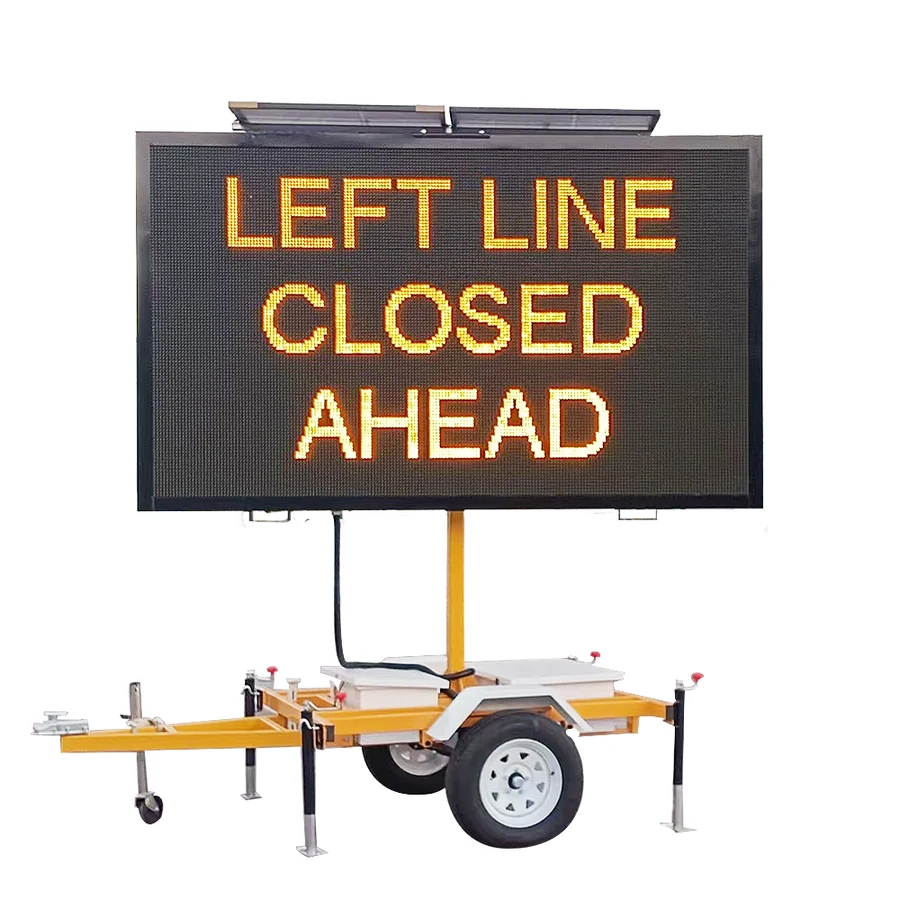
Height comes from a pixel grid, so the two are specified together. A 56 by 28 pixel matrix at five LEDs per pixel arranges into three lines of eight characters at 400 mm; regroup the same rows taller and it reaches 457 mm. The trade is height against line count, and a specification that names a height without its matrix cannot be compared. A full-size VMS board in this class carries 3,156 by 1,563 mm of active area, as on this trailer-mounted amber PCMS.
Colour, contrast and dimming
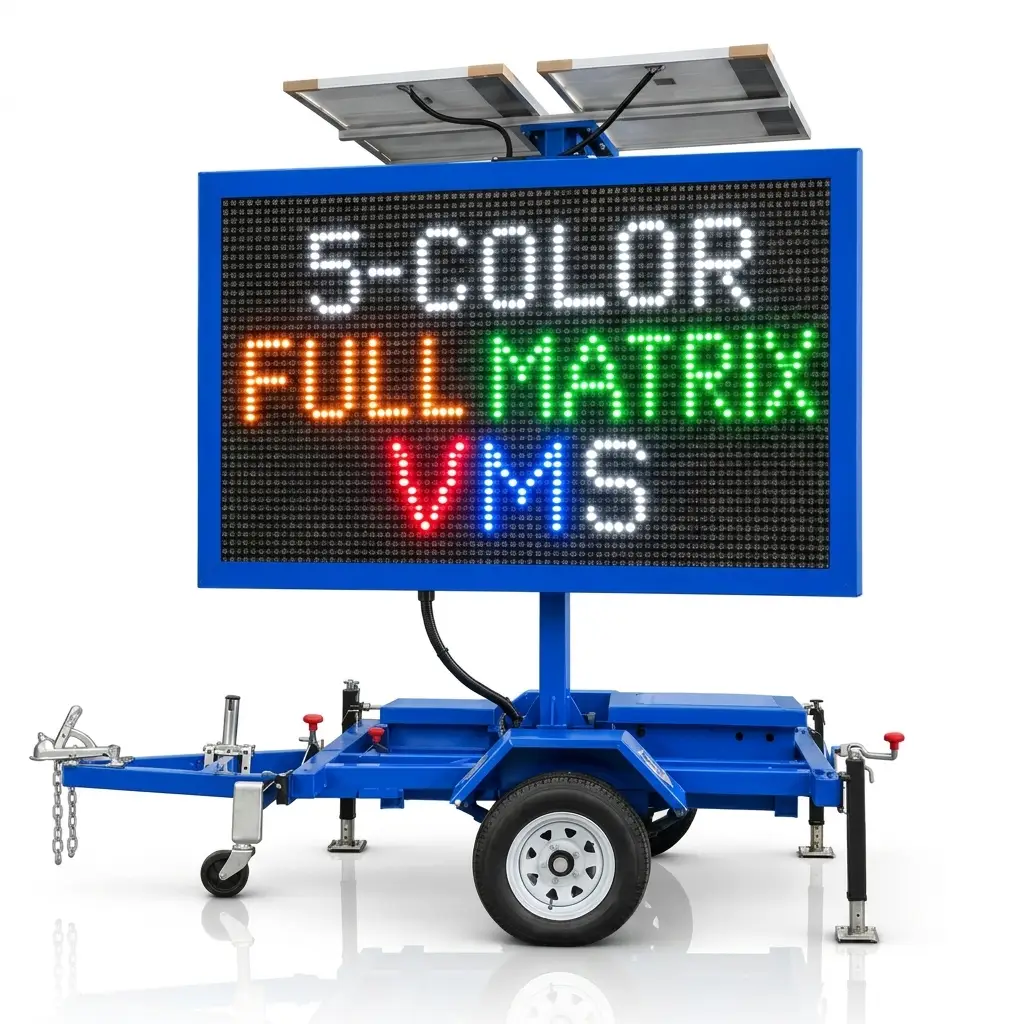
Amber sits in the 590 nm band, where scattering affects it less than shorter wavelengths, so contrast survives fog, rain and low sun. It also removes a decision: one colour, one message layer, one training path. A five-color trailer-mounted VMS buys a capability instead, separating a red closure line from a green diversion arrow, which earns its cost where a scheme must show hazard classes on one screen. Where a fleet issues one class of message, the extra electronics and second spare-part set are cost without benefit.
Placement: distance, lateral position and sight distance
Place the sign 500 to 1,000 feet upstream of the point where a driver must change lanes. Where the action is a diversion off the route, place it at least 1,000 feet upstream below 40 mph, and at least a mile upstream at 45 mph and above.
| Action required | Approach speed | Minimum distance upstream |
|---|---|---|
| Lane change or speed adjustment | Any | 500 to 1,000 ft |
| Diversion or detour | 40 mph or below | 1,000 ft |
| Diversion or detour | 45 mph or above | 1 mile |
Two units go on the same side of the roadway, at least 1,000 feet apart on freeways and 500 feet elsewhere. Units cycling phases in the same view read as one contradictory message.
Lateral position and glare
A variable message board belongs as close as practicable to the lane the message applies to, on or just outside the shoulder. Pushed far off the roadway it falls outside the driver’s cone of vision, which reaches roughly 10 degrees either side of the travel path, and stops being read before it is reached. Set it on level ground and rotate the panel about 3 degrees toward the roadway, which cuts glare from headlights and low sun. Where a barrier cannot protect the unit, delineate it with cones or drums.
Panel height, sight distance and moving the sign
The bottom of the panel sits at least 7 feet above the roadway in urban areas and 5 feet in rural areas while operating, with visibility at half a mile as the target. Curves, crests and vegetation shorten that distance, and the fix is to move the sign upstream rather than raise the brightness. Local drivers adapt within days, so rotate the position every few weeks and blank the display when the message no longer applies.
Power, mounting and remote control on unmanned sites
On a site with no mains connection the power arrangement decides how long the sign stays deployed without a visit. Solar with a battery bank is the default for multi-week work, pure battery suits short deployments, and a generator is the fallback where neither fits.
| Arrangement | Strength | Constraint |
|---|---|---|
| Solar array with battery bank | No refuelling or cabling; suits long deployment | Depends on irradiance and winter sun angle |
| Battery only | Lowest upfront cost; works in low-sun regions | Recharge or swap needed within days |
| Generator | Independent of weather | Fuel, noise, emissions, extra footprint |
What a solar array has to answer
Ask for array wattage, battery capacity and chemistry, and the controller type and current. A full-size trailer unit in this class reads 2 by 360 W of panel, 2 by 250 Ah of AGM deep-cycle battery, and an MPPT controller at 30 to 40 A. Those numbers, not a claimed runtime in days, are what a buyer can check against their own latitude, season and duty cycle.
Mounting, towing and wind
Trailer mounting suits long deployment and towing between sites behind vehicles the contractor already runs. Truck mounting suits vehicle-integrated operation, where the sign works from the vehicle it arrives on. A truck-mounted traffic control VMS trades display area for that integration, the right trade for incident response. On site, outriggers are levelled and loaded before the mast is raised, the mast is then locked in its working position, and both are rated for wind loading at that site rather than for a catalogue figure.
Remote control over 4G with GPS reporting lets a control room change a message without sending anyone to the shoulder. Security is the part that gets skipped: a panel programmable at the roadside without a passcode can be rewritten by a passer-by, and the result carries the authority of the agency that owns it.
Compliance across markets: one sign, four rulebooks
The same display has to satisfy a different document in each market, and the documents do not measure the same thing. North America works from the MUTCD, Europe and the UK from EN 12966, Australia and New Zealand from AS 4852.2 with temporary traffic management codes on top.
| Market | Governing document | What it sets |
|---|---|---|
| United States and Canada | MUTCD Part 6 | 18 in minimum character height, three lines of eight characters or full matrix, two phases, no animation or scrolling |
| European Union and UK | EN 12966 | Luminance, beam width, colour and luminance ratio classes plus a temperature class, set by road type and viewing geometry |
| Australia | AS 4852.2 with AS 1742.3 | Character sizing by approach speed, roughly 120 mm at 60 km/h and 160 to 200 mm at 80 km/h |
| New Zealand | NZTA code of practice | LED message sign characters not smaller than 300 mm inside a 50 km/h area and 400 mm elsewhere |
The UK is the awkward one: Traffic Signs Manual Chapter 8 sizes characters by x-height rather than cap height, so a cap-height figure has to be converted first.
What belongs in the specification
- Model designation, with the mounting configuration named.
- Active display area in millimetres, stated apart from the cabinet.
- Pixel matrix, LED count per pixel and LED type.
- Character height together with the matrix that produces it.
- Message format, as lines by characters per line.
- Compliance path for the destination market, with test documentation on request.
Enclosure protection and wind ratings belong there too, but both are per-configuration figures. Ask in writing rather than accepting a category claim.
Inspection, maintenance and keeping the sign credible
Credibility is the asset easiest to destroy and hardest to rebuild. One incorrect message, or a panel with dead pixels, does more damage than a month of good deployment.
The working quality threshold for temporary traffic control devices, changeable message signs included, is at least 90 percent of the pixels in every character operating, with dimming working as intended. A panel below that should be pulled from service rather than deployed and explained away. Clean the face on a schedule too, because road film cuts contrast before it cuts legibility.
A pre-deployment checklist
- Does the message tell the driver to do something specific?
- Do static signs already cover it?
- Does each phase read on its own at 2 seconds or more?
- Are the abbreviations the published ones?
- Is the unit visible from the required distance at operating speed?
- Is it clear of the buffer space and delineated?
Six yes answers is the standard. Anything less is a message the crew is about to test on live traffic.
Frequently asked questions
Can a full-matrix VMS display an arrow board pattern?
It can, and the capability helps when arrow board stock runs short, but it is a configuration change rather than a menu option. Arrow board displays flash at 25 to 40 flashes per minute, while a full-matrix panel defaults to faster frame timing, so the rate has to be reset and verified first. Some jurisdictions will not accept it in place of a dedicated arrow board.
How long will a solar message sign trailer run without sunlight?
There is no honest single number, because autonomy is the output of a calculation: array wattage, battery capacity, display size, duty cycle, latitude and the worst month of the year. Require those inputs and check the arithmetic. A full-size unit with 720 W of panel and 500 Ah of battery is sized for multi-week deployment in a temperate climate.
Can one operator manage a mixed fleet of three-line and full-matrix signs?
Yes, and mixed fleets are the normal case. Three-line boards cover text-only work at the lowest cost per deployment, while full-matrix units take jobs needing a lane-status graphic or a true arrow. One platform, one training path and one spare-part set per class keeps text work cheap without turning away the graphic work.