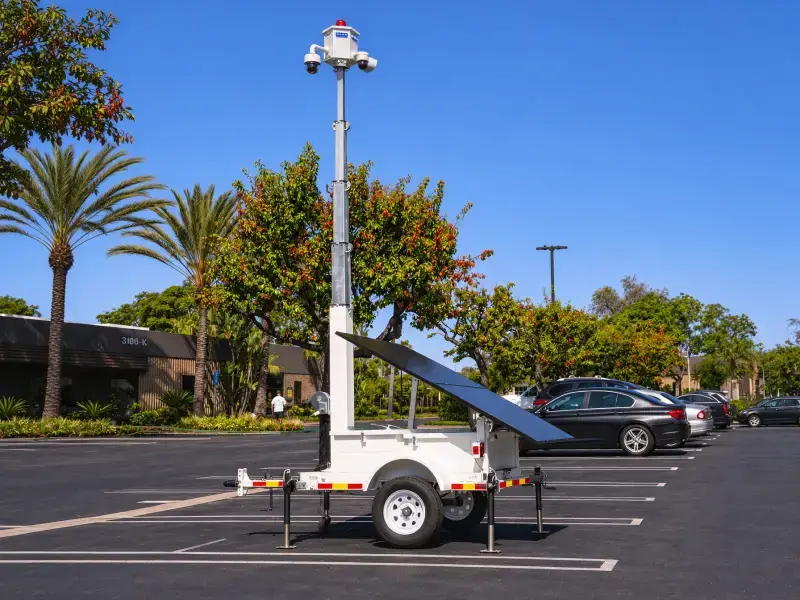
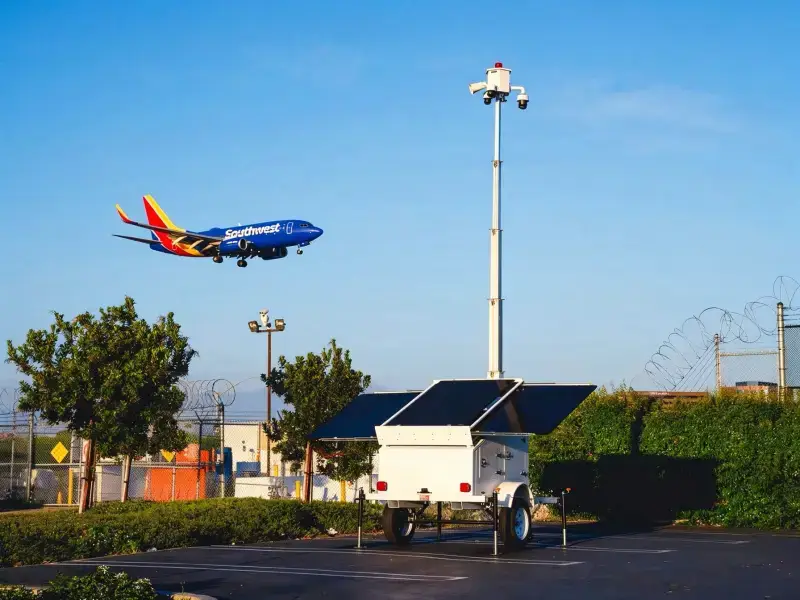
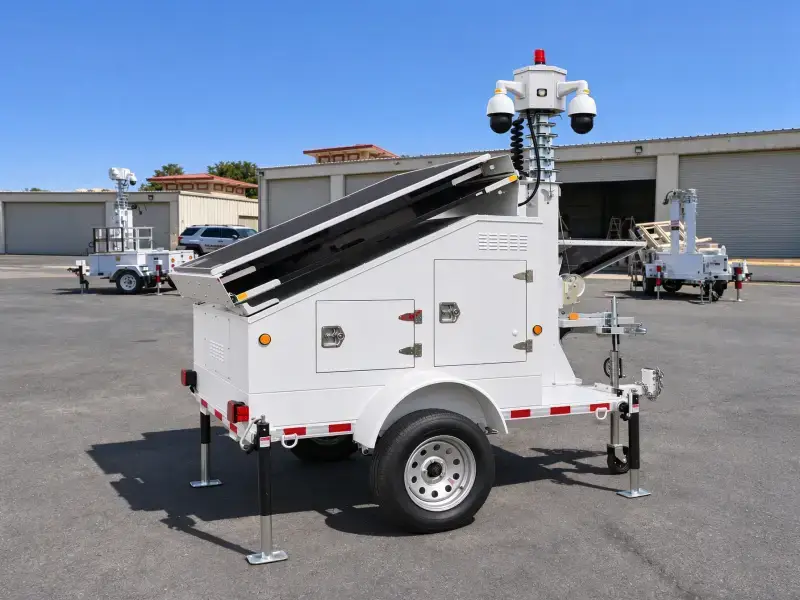
Security teams face the same problem again and again. A site needs eyes on it, but there is no grid power, no network cable, and no building to mount a camera on. Construction projects move, events last a few days, and remote utilities stretch for miles. A fixed video surveillance system cannot follow that kind of work. A solar surveillance trailer can. It puts cameras, power, and connectivity on a towable chassis that one truck can drop off and pick up later. Knowing what the unit costs, and what the price actually buys, helps buyers compare quotes on equal terms.
A solar surveillance trailer CCTV unit typically costs $50,000 to $70,000 to purchase outright, based on published US list prices checked 24 November 2026. Renting or subscribing usually runs $1,500 to $3,000 per month. The final figure moves with camera count, solar and battery capacity, mast height, and how the system reaches a monitoring center.
The sections below separate the price into its parts so you can see where the money goes.
| At a glance | Typical range |
|---|---|
| Purchase price (new, published US list, checked 24 Nov 2026) | $50,000–$70,000 |
| Rental or subscription | $1,500–$3,000 per month |
| Camera channels | 2–6 |
| Solar array | about 600–1,000 W |
| Mast height | roughly 16–20 ft deployed |
| Connectivity | 4G/5G, satellite optional |
| Recurring costs | data, storage, maintenance, transport |
How much does a mobile surveillance trailer cost?
A complete mobile surveillance trailer usually lands between $50,000 and $70,000 new, while a comparable rental agreement costs $1,500 to $3,000 a month, according to published US market pricing checked 24 November 2026.
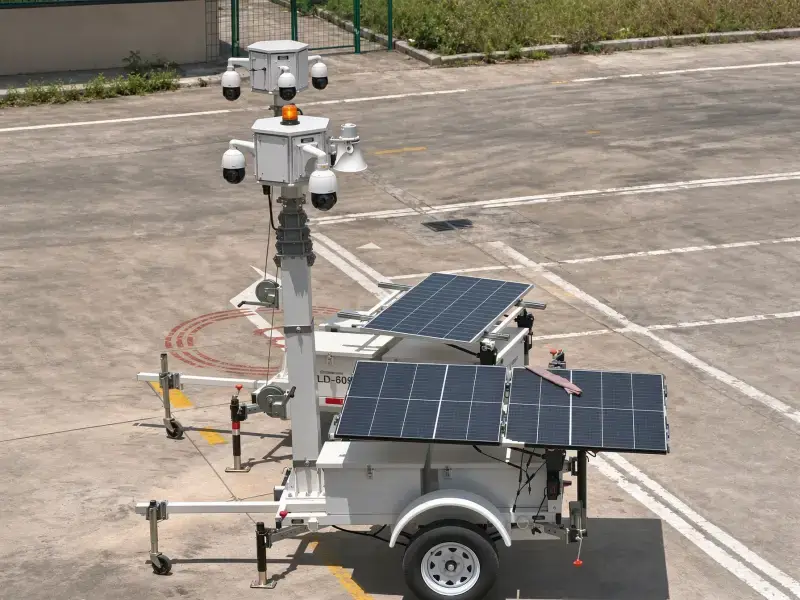
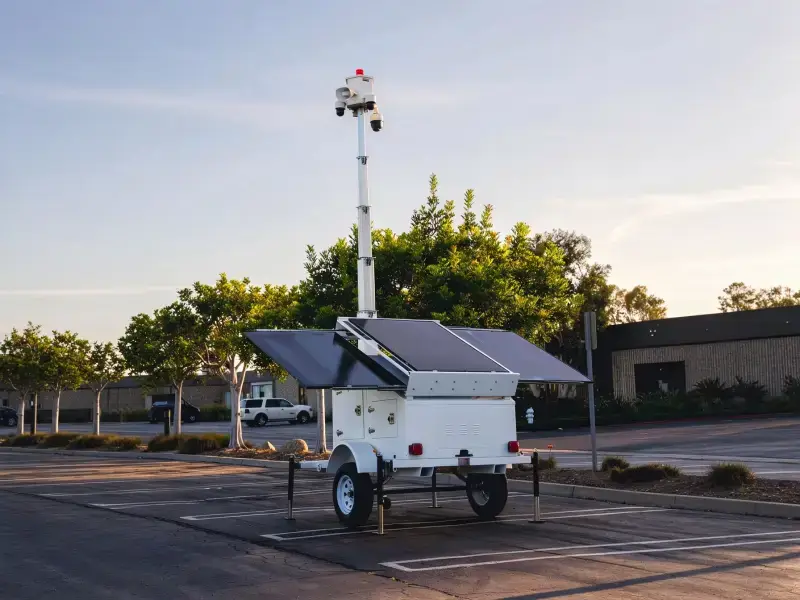
That range is wide because the term covers several different machines. A basic unit carries two cameras, a modest solar panel, and a short mast. An advanced mobile surveillance trailer adds more cameras, a larger battery bank, a taller mast, and faster connectivity. Buyers often search for a mobile surveillance trailer for sale and assume every listing is equivalent. It pays to read the specification sheet line by line, because two quotes with the same headline figure can deliver very different capabilities.
Treat the published figures as a benchmark, not a fixed rule. Price reflects what is bolted to the chassis. A solar surveillance camera trailer with two pan-tilt-zoom cameras, edge storage, and a mid-size panel sits near the lower end. A unit with six channels, a 1,000 W array, a generator input, and satellite backup sits near the top. Delivery distance also changes the number on the invoice, since freight is commonly quoted per mile from the fabrication site. Local pickup removes that line entirely.
Entry-level, mid-range, and flagship price bands
Most suppliers group their products into three tiers, and the tiers map neatly onto budget decisions.
| Tier | Typical use | Price band (US list, checked 24 Nov 2026) |
|---|---|---|
| Entry | Single-site deterrence, small events | around $50,000 |
| Mid range | Construction, municipal patrol, multi-week deployment | around $60,000 |
| Flagship | Large sites, six cameras, generator and satellite options | up to about $70,000 |
The jump between tiers buys physical capacity, not marketing language. More cameras mean more coverage angles. A bigger panel and battery bank mean longer runtime through cloudy weeks. A taller mast means a wider view over stacks of material or crowds. When comparing surveillance trailers for sale, match the tier to the length and difficulty of the deployment rather than to the largest number on the page.
What is included in the price?
A quoted price normally covers the chassis, cameras, solar panels, batteries, mast, and onboard storage, though connectivity plans and cloud services are often billed separately.
This is where quotes diverge most. One seller includes a full camera package and a control interface; another lists the trailer and sells every camera as an add-on. Ask for a written inclusion list before comparing figures. A solar CCTV trailer that arrives ready to work is a different purchase from a bare chassis that needs weeks of integration.
Camera, power, and storage hardware
Portable surveillance cameras on trailers usually ship as a matched set. A common configuration includes two pan-tilt-zoom units with optical zoom and infrared illumination for night work. Storage may be split between an on-board card and a cloud service, with a limited free period included in the purchase. Check whether the recorder is built in or sold separately, and whether the camera system works with open standards so it can plug into an existing monitoring platform.
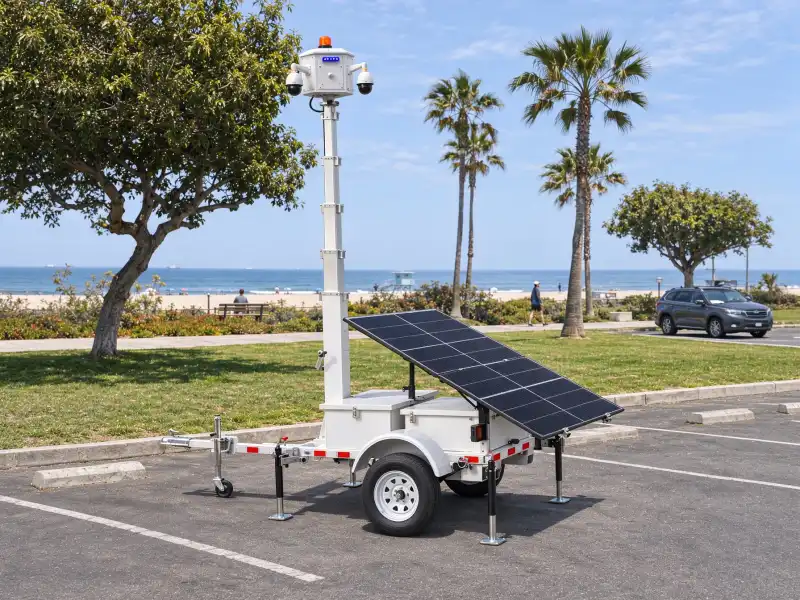
The power side deserves the same attention. Look for the solar rating in watts, the battery chemistry and capacity, and the expected runtime without sunlight. Lithium iron phosphate batteries are common in newer units because they tolerate deep cycles and temperature swings better than older lead-acid types. A larger array costs more up front but reduces the chance of a camera going dark during a long stretch of bad weather.
| Component | What to confirm in a quote |
|---|---|
| Cameras | Count, zoom, infrared range, open-standard support |
| Storage | On-board capacity, cloud term, retention period |
| Solar | Panel wattage, mounting style, tilt adjustment |
| Battery | Chemistry, capacity, expected autonomy |
| Mast | Deployed height, wind rating, raise mechanism |
Connectivity and software subscriptions
A mobile surveillance trailer camera system is only useful if footage reaches someone who can act on it. Most units use 4G or 5G routers, with satellite as an option for truly remote ground. The router hardware may be included while the data plan is not. Software follows the same pattern: a basic local interface is often bundled, while advanced analytics, remote monitoring, or long-term cloud retention carry a recurring fee. Read the quote for the phrase “no subscription” and check exactly which functions that covers.
What factors drive the cost of a solar surveillance trailer?
The main cost drivers are camera count and quality, solar and battery capacity, mast height and build quality, and the choice of connectivity.
Each factor can be sized up or down, and each change shows up on the invoice. Understanding the mechanism lets a buyer keep the capability that matters and drop the features that do not. For projects that also need lighting, solar surveillance lighting trailers combine both functions on one platform, which changes the power and mast calculations but can remove the cost of a second unit on site.
Camera count and imaging capability
Camera count is the most visible driver. Two channels cover a gate and a yard; six cover a perimeter, a compound, and a loading area at once. Resolution and optical zoom matter as much as quantity. A camera with strong zoom can identify a plate or a face from a mast where a fixed lens only records movement. Infrared range sets how far the unit sees after dark. Thermal imaging adds another layer for heat signatures, but it raises the price sharply and is only justified for specific risks.
Solar array and battery capacity
Power is the second big lever. A larger array and a deeper battery bank let the trailer run longer between service visits, which matters when a site is hours from the nearest technician. The trade-off is weight and cost. An oversized system on a short two-week job is money parked in equipment that never gets used. A modest system on a remote month-long project risks downtime. Match capacity to the deployment window and to the local weather record for that season.
Mast height and build quality
A taller mast widens the field of view and lifts cameras above obstacles, but it demands a heavier chassis, stronger bracing, and more careful wind management. Build quality shows up in the frame, the coating, the tires, and the leveling system. A trailer that must be re-leveled after every gust costs staff time. A welded steel frame with a durable finish and reliable brakes costs more to build and less to keep working. These are the parts that separate a machine from a modified cargo trailer.
Connectivity options
Cellular coverage is cheap and familiar where a signal exists. Remote sites often need bonded connections or satellite, both of which add hardware and monthly charges. The right question is not which option is best in the abstract but which one survives the specific terrain. A dead camera during an incident is the expensive outcome, so connectivity is one area where a higher quoted figure can be the economical choice over the full project.
How a mobile trailer compares with a fixed surveillance system
A fixed system has lower unit costs and no towing, but it needs power, cabling, and a permanent mount. That works for a warehouse or a terminal. It fails for a site that moves every few weeks or a location with no infrastructure. A mobile surveillance vehicle can be redeployed overnight, which spreads its cost across many projects. Buyers asking how much a surveillance system costs should price both paths over the same planning horizon, including installation labor and the cost of leaving cameras behind when the contract ends.
Buying vs renting: which costs less over time?
Buying costs more in year one and less over a multi-year horizon; renting or subscribing spreads payments but never produces an owned asset.
Neither option is wrong. Short deployments with uncertain funding often favor renting, because the cash outlay is small and the equipment goes back when the job ends. Long deployments favor ownership, because the purchase stops accumulating charges. The honest comparison is total cost over the period the site actually needs coverage.
The five-year total cost of ownership
A simple formula keeps the comparison clean:
Total cost of ownership = purchase price + delivery + data and storage + maintenance − resale value
Run the same formula on a rental by replacing the purchase price with the monthly rate multiplied by the number of months. Published figures checked 24 November 2026 put a new unit near $50,000 to $70,000 and a subscription near $1,500 to $3,000 per month. At the upper subscription rate, five years of payments exceed the purchase price by a wide margin. At the lower rate over a six-month project, renting is clearly cheaper. There is no universal break-even month, only the break-even point for a specific rate, a specific purchase price, and a specific deployment length.
Costs that rental and subscription models hide
Beyond the monthly line, subscription agreements can carry conditions that shape the real cost. Some providers keep the camera platform closed, so footage lives on their servers and stops being accessible when the contract ends. Some charge for software tiers, monitoring seats, or early termination. A purchased unit avoids those clauses and can be moved to another site or another department without renegotiation. On the other hand, the owner absorbs repairs and storage renewal after any included period expires. Both sides of that ledger belong in the decision.
What ongoing costs should you budget for?
Budget for data plans, storage renewal after the included term, routine maintenance, and transport between sites, even when the purchase price looks complete.
These costs are small relative to the purchase but easy to overlook in a bid. A data plan is paid monthly to a carrier. Cloud retention may restart at full price once a free year ends. Tires, brakes, batteries, and mast mechanisms need service, and cameras drift out of focus. Transport is the quiet variable: every move is a truck, a driver, and staff hours. A clear maintenance record and a predictable data contract turn those into line items instead of surprises.
For agencies and large contractors, procurement rules matter as much as price. Grant-funded projects often prefer a one-time equipment purchase over a recurring service commitment, and some purchasing channels require vendors to meet specific sourcing standards. Confirm eligibility early, because a lower sticker price can be unusable if it fails the funding rules. This is also where solar traffic safety solutions are often specified together, since trailers, signs, and lighting may fall under the same approval path.
Frequently asked questions
The questions below address practical concerns that come up after the budget is set, covering off-grid behavior, connectivity limits, and deployment time.
Do solar surveillance trailers work off-grid at night?
Yes. The solar array charges the battery bank during daylight, and the batteries power the cameras and router after sunset. Infrared illuminators let the cameras record in darkness without visible light. Runtime depends on panel size, battery capacity, and local weather, so a buyer should ask for an autonomy estimate based on the site’s own climate rather than a generic figure.
Can a mobile surveillance trailer run without an internet connection?
It can record locally, but live viewing and remote alerts stop when the connection drops. An on-board recorder keeps footage available for later collection, and some systems resume upload automatically when the link returns. If real-time response is part of the plan, treat connectivity as a core specification and consider a backup path such as satellite for remote ground.
How long does it take to deploy a surveillance trailer on site?
A trained crew can usually position, level, raise the mast, and bring cameras online within a short on-site window, provided the ground is firm and the cellular signal has been checked in advance. Most delays come from site preparation and permit checks rather than the equipment itself. A pre-deployment survey saves more time than any feature on the spec sheet.