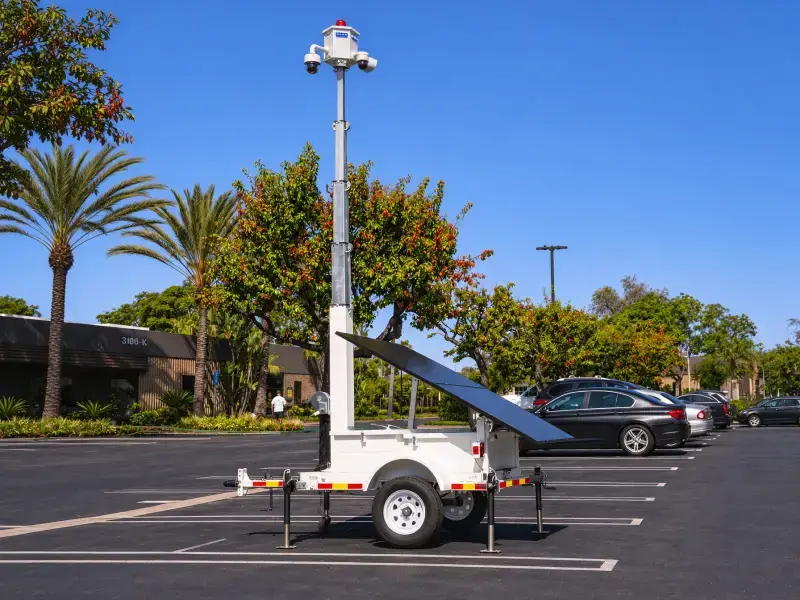
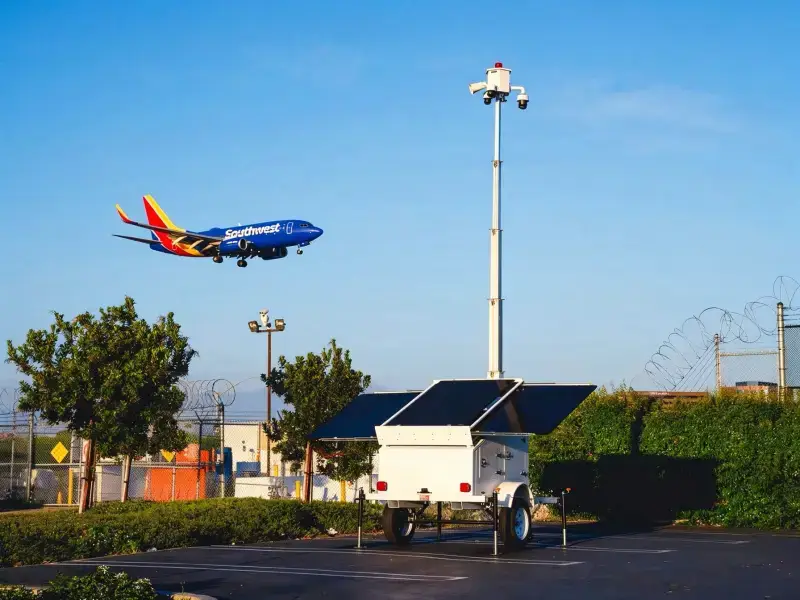
Outdoor security has a coverage problem. Cameras need power, but the places that need watching most—remote worksites, open storage yards, long road corridors, temporary events—are often the places where running a power cable is slow, costly, or impossible. In some regions site power is unreliable; in others it does not exist at all. A camera with no power cannot record, so the security plan effectively stops at the edge of the grid. The solar surveillance trailer has moved from a niche add-on to a practical way around that limit, and the equipment has become far more capable than the small panel-and-camera kits that first appeared.
Solar CCTV cameras let you watch sites the grid cannot reach. A solar surveillance trailer CCTV system pairs cameras with panels, batteries and a towable mast, so it makes its own power, moves to where the work is, and keeps recording through a grid outage. The practical gains are lower installation cost, freedom of placement, and monitoring that does not stop when the mains supply does.
Here is how the technology works, where it earns its keep, and what to check before you commit.
How does a solar surveillance trailer CCTV system work?
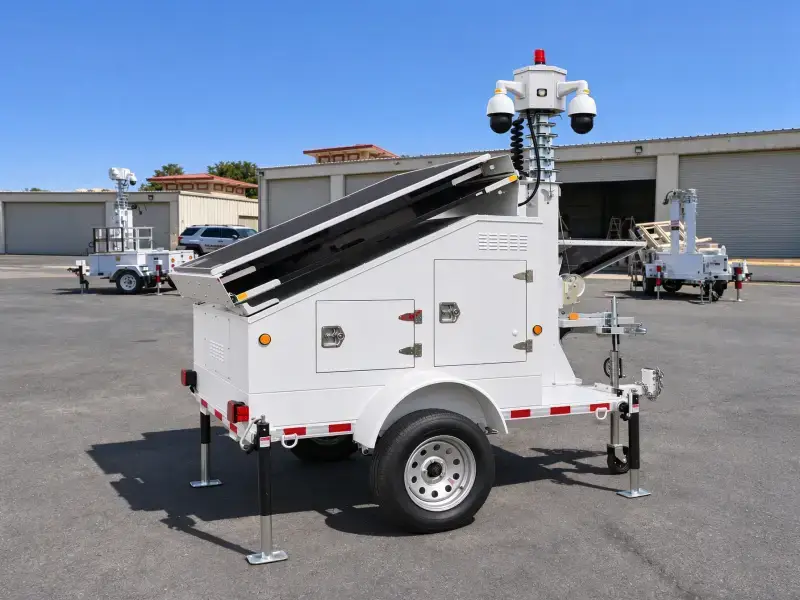
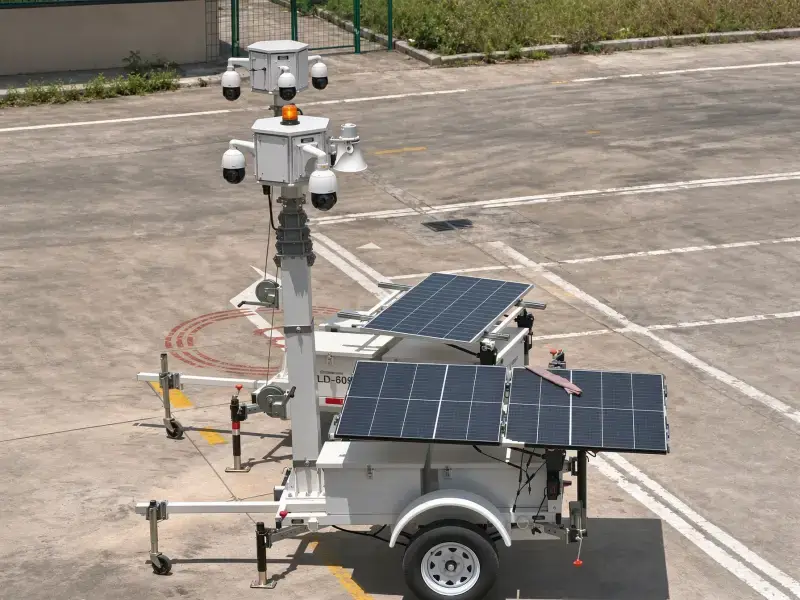
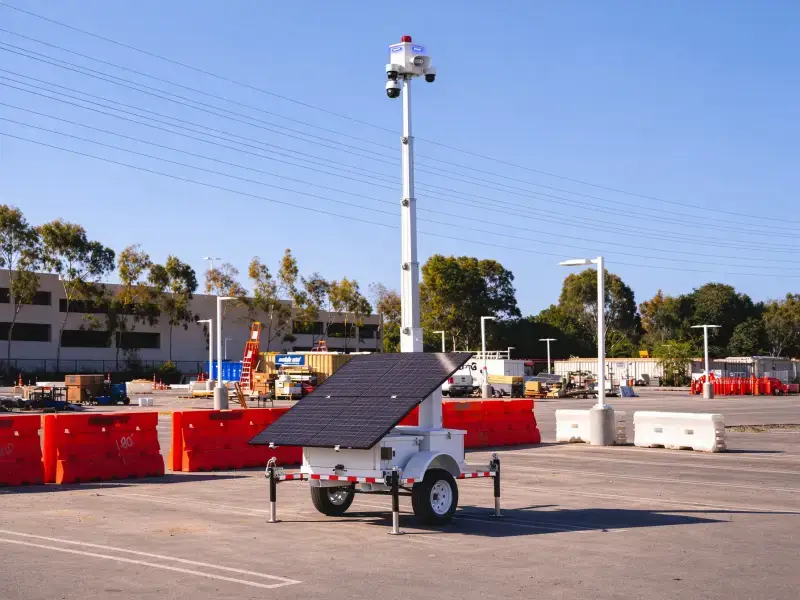
A solar CCTV trailer turns sunlight into electricity, stores it in batteries, and spends it running cameras and sending video. Panels charge the battery bank through the day. The batteries carry the load after dark. A cellular link or local recorder then delivers the footage to whoever needs it.
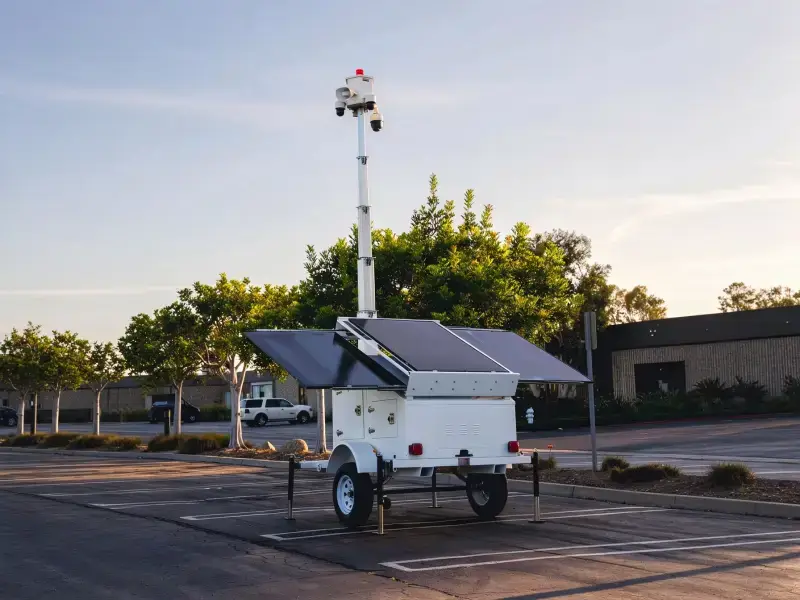
The whole assembly sits on a towable chassis, which is why it is described as a mobile surveillance trailer or a mobile surveillance vehicle rather than a fixed camera post. Nothing has to be buried or wired into a building. That single design choice drives most of the advantages below. A solar surveillance camera trailer is, in effect, a small microgrid on wheels: generation, storage and load all travel together.
Panels, batteries and charge control
Photovoltaic panels convert light into direct current. As Wikipedia’s overview of solar power explains, the underlying effect has been used for decades to generate electricity wherever sunlight falls. On a trailer, a charge controller regulates the input and protects the battery bank from overcharging. The batteries are the part buyers most often underestimate: they decide how long the cameras keep working through the night and through several cloudy days.
Sizing is a power-budget exercise. List what draws current — cameras, a recorder, a router, perhaps a light or a heater — then match panel output and battery capacity to that list and to the site’s sunlight. An advanced mobile surveillance trailer normally carries more panel area and a larger battery bank than a basic unit, because it is built for longer unattended runs. The aim is not the biggest panel on the market. It is enough generation to replace what the system consumed, even in the weak part of the year.
Cameras, mast and video transmission
The cameras sit on a telescopic mast so one unit can cover a wide area. Fixed lenses handle a known approach route; pan-tilt-zoom units let an operator look around a yard from a control room. Portable surveillance cameras on trailers are often specified with night vision and on-board analytics that separate people and vehicles from moving shadows or branches.
Video still has to leave the site. Most systems use 4G or 5G; some add a local recorder so footage survives a dropped signal. This is the piece that matters most on remote work—a camera recording to a full disk nobody can reach is only partly useful. When comparing one system with another, look at the whole chain: capture, storage, transmission and the software used to review events. Solar Trailer CCTV only pays off when all four parts work together.
Where can you deploy solar CCTV cameras?
Anywhere that lacks dependable mains power or needs short-term cover. Construction sites, remote infrastructure, events, parking areas and open yards are the common cases, and the same unit can move when the job moves.
Deployment freedom is the main reason buyers look at this category. A wired camera fixes your coverage to wherever a cable can be run. A trailer fixes it to wherever a vehicle can get to. That shift changes how a security plan is drawn up: you start with the risk, not with the nearest power socket.
Remote and off-grid sites
Mining and energy sites, pipeline sections, substations and rural compounds often sit far from a connection point. Extending a power line to a camera can cost more than the camera itself. A self-powered unit avoids that work. The same logic applies to farms and isolated storage yards, where the threat — theft of fuel, equipment or materials — tends to be highest exactly where supervision is thinnest.
Temporary projects and events
Roadworks, festivals and seasonal operations need cover that starts fast and leaves cleanly. A solar surveillance trailer can be dropped on a hardstanding area, ballasted and brought into service without trenching. When the project ends, it goes to the next one. Buyers searching for a solar surveillance trailer for sale usually value this reuse: the asset keeps working site after site instead of becoming stranded infrastructure.
Related equipment follows the same pattern. Solar surveillance lighting trailers combine illumination with cameras, which matters on night shifts where a usable image depends on light as much as on lens quality.
Are solar CCTV cameras worth the investment?
Often yes, but judge them on total cost rather than sticker price. You save on cables, trenching, grid connection and fuel; you pay more up front for panels and batteries. Which side wins depends on how long the site stays put and how hard it is to bring power in.
Costs you remove
Start with the line items that disappear. There is no trench for power and data cable, no electrician to connect into a distribution board, and no meter to run. On generator-fed sites, a self-powered unit cuts fuel deliveries and the servicing a generator needs. There is also less hardware exposed to damage: fewer cables mean fewer things to cut, trip over or steal. On a short project, those avoided tasks often matter more than the equipment price.
Upfront price versus long-term savings
A solar CCTV trailer generally costs more to buy than a basic wired camera, because you are paying for generation and storage as well as the camera. The economics turn on the site. On a remote job with no power nearby, the avoided connection work can outweigh the premium. On a lit city site with spare capacity, the case is weaker. There is no standard payback period that applies across projects, so ask a supplier to model it against your own power, labour and schedule rather than accepting a generic figure.
Do solar CCTV cameras work without WiFi?
Yes. WiFi is only one way to move video, and often the least useful one on a remote site. Most solar units use cellular networks or record locally, so they work in places with no WiFi at all.
A mobile surveillance trailer camera system normally holds a SIM and a router, sending footage over 4G or 5G to a cloud account or a monitoring centre. Where signal is weak, an external antenna or a different carrier can help. Where there is no coverage at all, the recorder keeps storing video on board for later collection. Some setups add a long-range wireless link between the mast and a nearby office.
The check before purchase is simple: test signal strength at the exact mounting point, not at the site gate. Ask whether the system keeps recording when the link drops, and how much footage the on-board storage holds. A camera that stops when the network blips is not doing its job.
How reliable are solar CCTV cameras at night and in bad weather?
A well-sized system runs through the night and through short spells of poor weather, because the batteries supply power when the panels do not. It also keeps working during a grid outage, since it never depended on the grid.
Reliability here is an engineering question, not a property of sunlight alone.
Battery storage for night and low light
Panels do nothing after sunset. The battery bank does all the work until morning, so capacity has to cover the dark hours plus a reserve for cloudy days. Cameras with night vision and analytics draw more than cameras left in daylight mode, and a mast light adds a further load. A sound specification starts from the worst-case night, then adds headroom rather than trimming to the average.
Maintenance earns its place here too. Clean panels produce more power. A quick wipe during a routine visit costs little and keeps the energy budget intact through a dusty season.
Shading, weather and service life
Shade is the usual culprit when a system underperforms. A panel sitting where a building or tree casts a shadow for half the day will not refill the batteries, however large it is. A site survey should map the sun path across the year, not just at installation time.
On lifespan, treat numbers with care. Panel, battery and camera life vary with build quality, climate and duty cycle, and no single figure covers every unit. Panels tend to outlast batteries, and batteries tend to need attention before the cameras do. Ask for the warranty terms on each part rather than accepting one blanket number for the whole trailer.
What is the environmental impact of solar CCTV?
Solar CCTV draws its power from sunlight instead of fossil fuels, and it avoids the cable runs and generator fuel that a wired or generator-fed site would otherwise need.
For a single camera the effect is small. Across a fleet of units on several sites, the avoided fuel and cable add up. There is a second, less obvious benefit: because the system is self-contained, it can sit on ground that would otherwise need digging for a power run. That matters on sensitive sites where disturbing the surface is a problem.
Keep the claim proportional. It is strongest where solar replaces a diesel generator. Where it replaces a clean grid connection, the gain is narrower, though the unit still removes the cable infrastructure and the waste that comes with replacing it.
How do you choose the right solar CCTV trailer?
Match the specification to the site: how much light it gets, how much ground you must cover, how long it must run unattended, and how video will reach you. A bigger trailer is not automatically a better one.
Buyers comparing mobile surveillance trailer for sale listings often start with camera resolution. That is the wrong starting point. Begin with the load and the sunlight, then work outward to cameras and software.
Power and battery sizing
List every device that draws power and how long it runs. Cameras, recorders, routers, lights and heaters each take a share. Compare that total with the energy the panels can generate in the weakest month at your latitude, not the sunniest. Add battery reserve for several low-light days if the site is hard to reach. This single step prevents most complaints about cameras going offline overnight.
Camera, mast and connectivity
Next, fix the coverage. Decide how many cameras you need, whether fixed or pan-tilt-zoom, and how high the mast must be to see over obstacles. Check night performance at the distance at which you actually need to identify a person or a plate. Then confirm the link: cellular coverage at the mounting point, a plan that suits the footage volume, and local storage as a fallback.
Finally, look at the support around the hardware. Solar traffic safety solutions supplied by one provider can cover the trailer, the cameras and the monitoring software, which lowers the chance of three vendors pointing at each other when something fails. Ask how quickly parts are replaced, and whether the unit can be serviced on site. Integrated lighting is worth considering if the same mast has to carry both cameras and work lights.
Frequently asked questions
Do solar CCTV cameras work in winter or in cloudy climates?
They can, provided the system was sized for the worst season rather than the average one. Shorter days and weak light mean less generation, so panel area and battery capacity need headroom. The practical test is whether the battery bank can carry the cameras through several low-light days without a visit. Where sunlight is scarce for long stretches, a unit that also accepts a mains or generator top-up is the safer choice.
Does a mobile surveillance trailer need a data plan?
If you want live or on-demand video away from the unit, yes. A cellular plan covers traffic between the trailer and your monitoring account, and the cost depends on how much you stream and how often you review it. Systems that record locally can run without a plan, but someone must collect the storage. Many buyers keep both: local recording as the record, cellular for live response.
Can solar surveillance trailers be rented instead of bought?
In many markets, yes. Rental suits short projects and trials, and it shifts maintenance responsibility to the provider. Buying suits long or repeated deployments, where the same unit moves between sites and earns its keep over several jobs. The break-even depends on how often you deploy and for how long, so compare quotes against your own schedule rather than a generic rule.