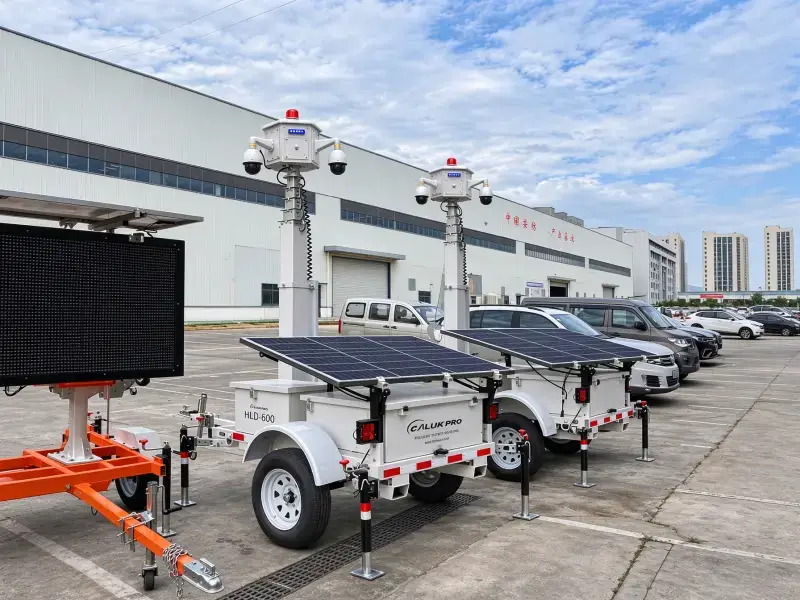
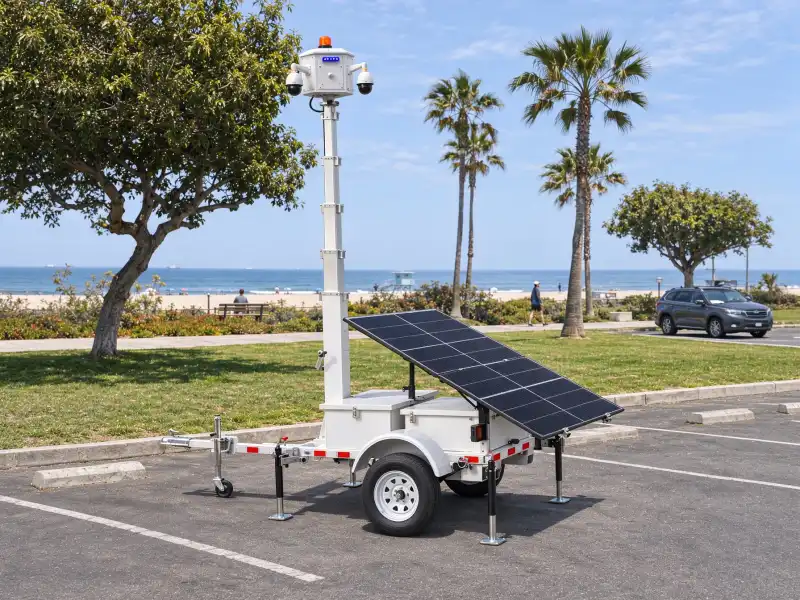
Most remote sites arrive without a power outlet or a network cable ready to use. Construction compounds, vacant lots, rural car parks and temporary event grounds all need a way to watch what happens on site, yet running mains power to every camera is often slow, disruptive or impossible. Solar-powered surveillance has stepped into that gap, and its towable form is now common at sites that need coverage today and a different location next month. For buyers comparing systems, the phrase solar surveillance trailer CCTV describes a camera platform that carries its own power and can be deployed without trenching cable.
A solar-powered CCTV camera converts daylight into electricity with a photovoltaic panel, stores that energy in a battery, and uses it to run the camera after dark. A charge controller protects the battery, while the camera records to local storage or streams footage over a cellular link. Put the same panel, battery and camera on a wheeled chassis and you have a mobile unit that can be towed to a new site and working within a short time.
The sections below explain the power chain, the questions buyers ask most often, and what to check before committing to a purchase.
| Question | Short answer |
|---|---|
| Can it work off-grid? | Yes, the panel and battery supply all power |
| Does it record without Wi-Fi? | Yes, footage is stored locally |
| Does it see at night? | Yes, with infrared illumination |
| Can it record around the clock? | Yes, if the panel and battery are sized correctly |
| Is there a towable version? | Yes, the mobile or trailer-mounted format |
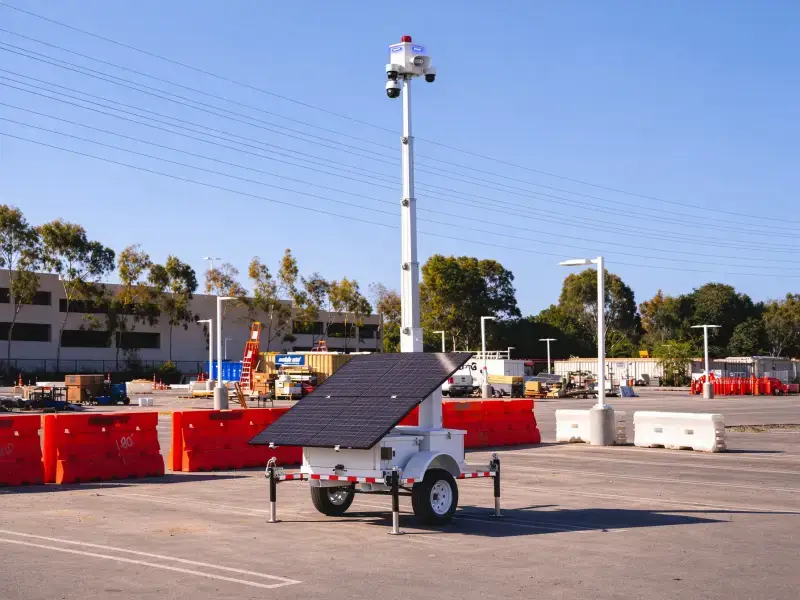
Do solar-powered security cameras actually work?
Yes. Solar cameras run on the same principle as any other closed-circuit television system, except that their power comes from a panel rather than a wall socket. The image sensor, lens and recorder behave in the familiar way; only the supply of electricity changes.
The term closed-circuit television describes a system where cameras send video to a limited set of monitors or recorders rather than broadcasting it publicly, a definition outlined in general references on closed-circuit television. A solar-powered version keeps that structure intact. What changes is that a photovoltaic panel feeds a battery, and the battery feeds the camera.
The parts that make a solar camera work
Four elements do the work. The panel turns sunlight into direct current. The battery holds that charge for use at night or under cloud cover. A charge controller regulates the flow so the battery is neither overcharged nor drained back into the panel. The camera itself captures and stores or transmits the image. If any one of these is undersized, the system will fall short of what the site needs.
Battery chemistry is another decision point. Lithium-based packs hold more energy for their weight and tolerate deeper discharge, which suits a trailer that must stay light and last through several dark nights. Sealed lead-acid units cost less up front but are heavier and prefer a shallower discharge. The choice affects both how long the unit can be left unattended and how often the battery will need replacing.
How a solar surveillance trailer differs from a fixed camera
A fixed camera stays where it is bolted. A solar surveillance camera trailer puts the mast, cameras, panel and batteries on a towable frame, sometimes with stabilizing outriggers and a telescopic mast. That changes the logistics completely. The unit can be positioned for a single project and moved when the work ends, which is why contractors and event organisers favour it. The trade-off is a larger initial footprint and the need for a safe towing and setup procedure.
How does a solar surveillance trailer turn sunlight into video?
Daylight strikes the panel, the panel generates direct current, the controller directs that current into the battery, and the battery powers the cameras and any transmitter. The process is continuous during the day and reverses after sunset when the battery carries the load.
A solar cctv trailer follows the same chain, only at a scale suited to several cameras and a taller mast. The steps run in a fixed order:
- The photovoltaic array converts sunlight into electricity during daylight hours.
- A charge controller regulates voltage and current before they reach the battery bank.
- The battery stores energy and releases it steadily to the camera system.
- Cameras capture footage and write it to a recorder or send it over a wireless link.
- A remote operator views live or recorded video through a secure connection.
This solar trailer CCTV arrangement is what makes a mobile unit self-sufficient. Because the power source travels with the cameras, there is no dependency on a site supply, and a solar surveillance trailer can be placed where a fixed installation would be impractical. Sizing remains the critical decision: the panel must rebuild enough charge each day to cover the cameras, the transmitter and any lighting, with a reserve for poor weather.
Does a solar CCTV camera work without Wi-Fi?
Yes. Recording is a local function and does not need a network. Wi-Fi or cellular only matters when someone wants to view footage remotely or back it up off site.
Three connection patterns cover most installations. A standalone unit records to a memory card or drive and someone retrieves the footage on site. A cellular unit uses a mobile data connection to send video to a monitoring centre, which suits locations with no fixed broadband. A Wi-Fi unit connects to a local network where one exists, usually on smaller or permanent sites.
The mobile surveillance trailer camera system used on temporary sites usually relies on cellular, because it does not need local infrastructure. Where signal is weak, the system can still record locally and send footage later. Buyers should check coverage before deployment and confirm whether the connection supports live viewing, alerts, or only periodic uploads, since each places a different load on the battery.
Does solar CCTV work at night?
Yes. After sunset the battery supplies the camera, and infrared illuminators let it record in darkness. Night performance depends on battery capacity and on how much power the camera draws for illumination.
Most cameras switch to night mode automatically when light falls. Colour sensors give way to monochrome infrared images, and built-in infrared light sources illuminate the scene just beyond visible range. That illumination is a real power consumer, so the battery must be sized on the assumption that night mode will run for the whole dark period.
Placement matters as much as hardware. Infrared light reflects from nearby surfaces, so a camera mounted too close to a wall or fence can wash out its own image. Clearing the field of view and keeping the lens free of obstructions often improves night footage more than a specification change.
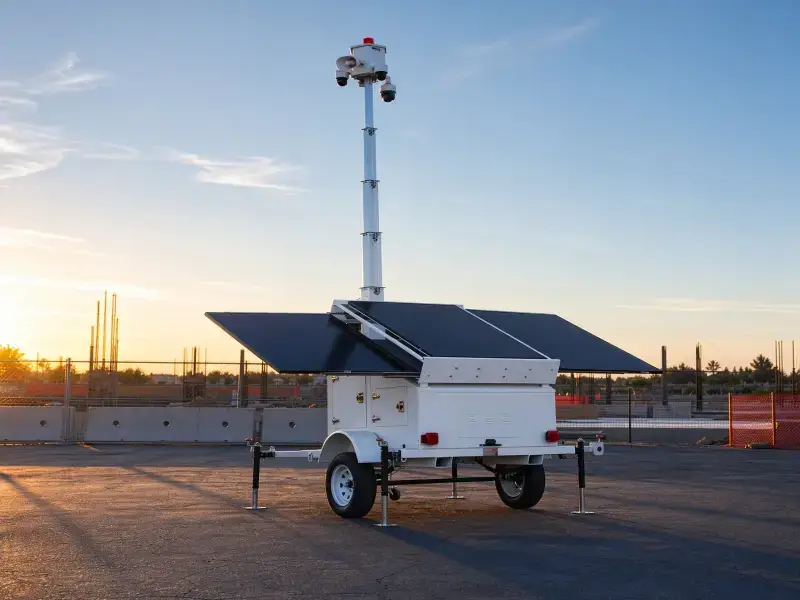
How can a solar-powered camera record at all times?
Continuous recording depends on matching supply to demand: a panel large enough to recharge the battery each day, a battery with enough reserve for several sunless days, and a camera whose power draw stays within that budget. Storage capacity then sets how long footage is retained before it is overwritten.
Three factors decide whether the system keeps running. Panel output: more wattage rebuilds the battery faster and gives more margin in winter or overcast conditions. Battery capacity: a larger bank carries the load through long nights and poor weather, but it must be matched to a charger that can refill it. Camera draw: resolution, frame rate, infrared output and transmitter activity all consume energy. Motion-triggered recording uses less than constant capture, though it can miss events outside the detection zone.
Storage is the second half of the question. Local drives fill and overwrite the oldest footage, so the retention window depends on drive size, bitrate and recording mode. Sites that need long retention typically pair local recording with off-site storage over a cellular link.
It also helps to separate retention from resolution. Raising bitrate or frame rate improves image detail but fills the drive faster, shortening the window of footage available to investigators. Define how many days of usable history the site needs, then work backwards to a recording setting and drive size that deliver it.
What to check before choosing a solar surveillance trailer for sale
Look past the camera specification and examine the power system, mast height, build quality and service support. A capable camera on an undersized panel will not protect a site through a week of cloud, and a strong panel on a weak chassis will not survive repeated moves.
Anyone comparing a mobile surveillance trailer for sale, a solar surveillance trailer for sale, or broader surveillance lighting trailers should work through a short checklist before requesting a quote. Price is only one line in the comparison; uptime and mobility are what the site actually feels.
Trailer, vehicle or fixed pole
A towable unit suits sites that change: construction phases, seasonal work and temporary events. A mobile surveillance vehicle carries the equipment on a driven chassis and is useful where a crew needs to move quickly without a separate tow vehicle. A fixed pole remains the cheaper option where the location is permanent and grid power is available. An advanced mobile surveillance trailer typically combines a telescopic mast, stabilized mounting and remote camera control in one package; confirm which of those functions are included rather than assumed.
Power budget and mast height
Ask what the panel and battery are rated for and how many cameras they support. A taller mast improves the field of view but adds weight and wind load, which affects stability. Confirm the towing and setup procedure, including whether outriggers are needed and how much space the unit occupies once deployed.
Where solar surveillance trailers fit and what limits them
Solar trailers work best at temporary or remote sites where coverage is needed quickly and no grid supply exists. Their limits come from sunlight, placement, temperature and routine upkeep, all of which can be managed at the planning stage.
Typical uses include construction sites, parking enforcement, agricultural properties, utility compounds and event security. In each case the value lies in rapid deployment and the ability to relocate. A mobile surveillance trailer can be set up, moved to another zone and brought back without new cabling, which is why hiring and fleet purchase both remain common.
The constraints are practical rather than exotic. A panel shaded by a building or tree will underperform. Dust and bird droppings reduce output, so periodic cleaning is part of ownership. Cold slows battery chemistry while sustained heat shortens service life, so outdoor-rated equipment and a sensible enclosure matter. Buyers comparing portable surveillance cameras on trailers should also check how the mast behaves in wind and whether the recorder is accessible for maintenance without dismantling the unit.
Security of the unit itself deserves attention too. A trailer left in a remote position carries valuable cameras and batteries, so locks, a stable mounting and a discreet location matter as much as the surveillance coverage it provides.
FAQ
Do solar surveillance trailers need a permit to operate?
Requirements vary by location and by how long the unit stays in one place. Some authorities treat a trailer on public land as a temporary structure, while others regulate where a camera may point or whether signage is required. Check local rules before deployment, especially for roadside or public-space use.
Can I fit my own cameras to a mobile unit?
Some systems accept standard cameras and recorders, while others use proprietary mounting and power connections. Compatibility depends on voltage, connector type and how the recorder handles the video signal. Confirm this before purchase if you already own equipment you want to reuse.
What routine upkeep does a solar CCTV trailer need?
Plan for periodic panel cleaning, battery inspection and a check of mast fittings and cables after transport. Software and firmware should be kept current, and any cellular connection should be tested regularly so a failed link is noticed before it matters.