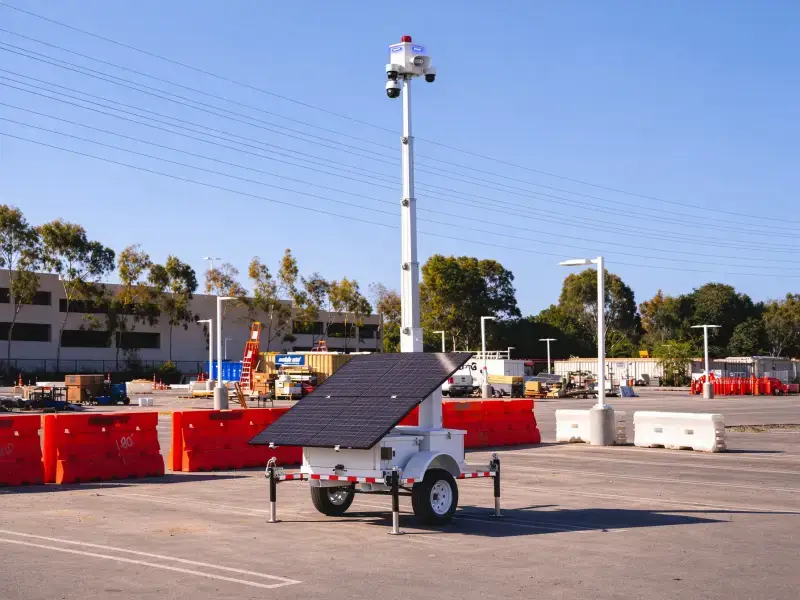
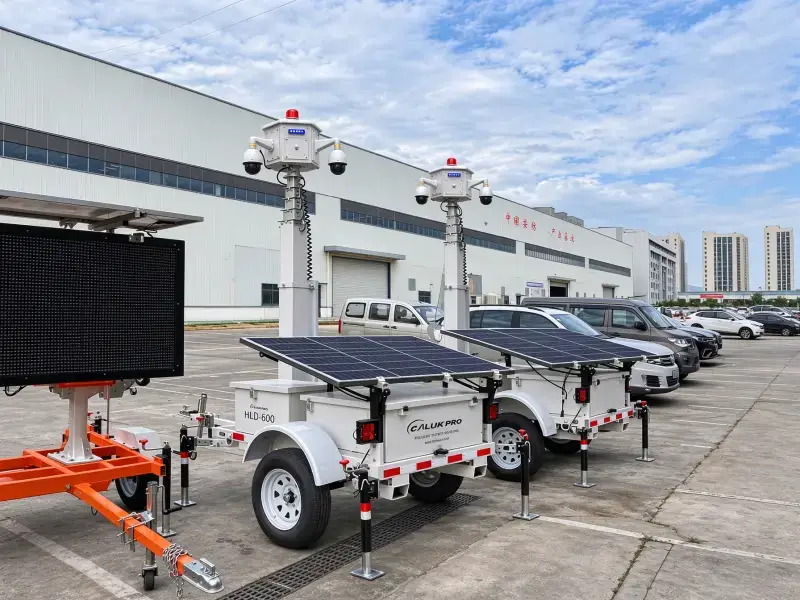
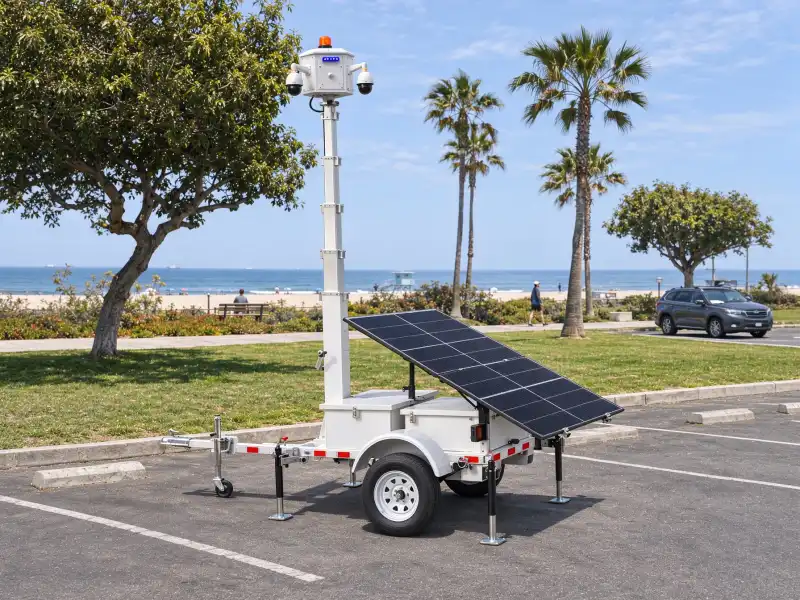
On a remote job site, the camera position is often the hardest place to power. Running cable means trenching; a generator means fuel deliveries and someone to check it. Solar surveillance trailers package the camera, panel, battery and mast into one unit that can be towed to a gate or a perimeter and left to work. That convenience has a cost, and it only pays off when the panel sees enough sun.
Solar surveillance cameras are worth it when the site has usable sunlight and grid power is impractical. They cut charging visits, but they still need battery checks, panel cleaning and safe access for service. A shaded or always-busy spot drains the battery faster than the panel can refill it, and then a wired camera is the better buy.
Whether one makes sense comes down to three things: sun at the panel, workload on the camera and how the footage gets back.
Do solar-powered security cameras actually work?
Yes, when the panel collects more energy than the camera and its radio use. The panel charges a battery during the day, and the camera draws from that battery at night and through cloudy spells. The panel does not power the camera in the dark; stored energy does.
A working unit is a system, not a camera with a panel attached to it.
What sets a solar surveillance camera trailer apart
A fixed camera stays where its cable was buried. A solar surveillance camera trailer moves. It carries its own power, its own mast and its own link back to the monitor, so it can cover a gate this week and a storage yard next month. That portability is the whole point. It also means every part has to survive being towed, parked on uneven ground and left outside in weather.
The power chain behind a solar CCTV trailer
The chain runs in one direction. A panel feeds a charge controller, the controller protects a battery bank, and the battery runs the camera and its radio. Closed-circuit television, or CCTV, means video sent to a limited set of monitors rather than broadcast to the public (source, checked 23 November 2026). On a trailer, that closed circuit usually becomes a cellular or radio link.
Each link has a weak point. Dust slows charging. An undersized battery drops voltage on a long night. A radio hunting for a weak signal can use more power than the camera itself. The weakest part decides how long the unit stays up.
When are solar surveillance trailers worth it?
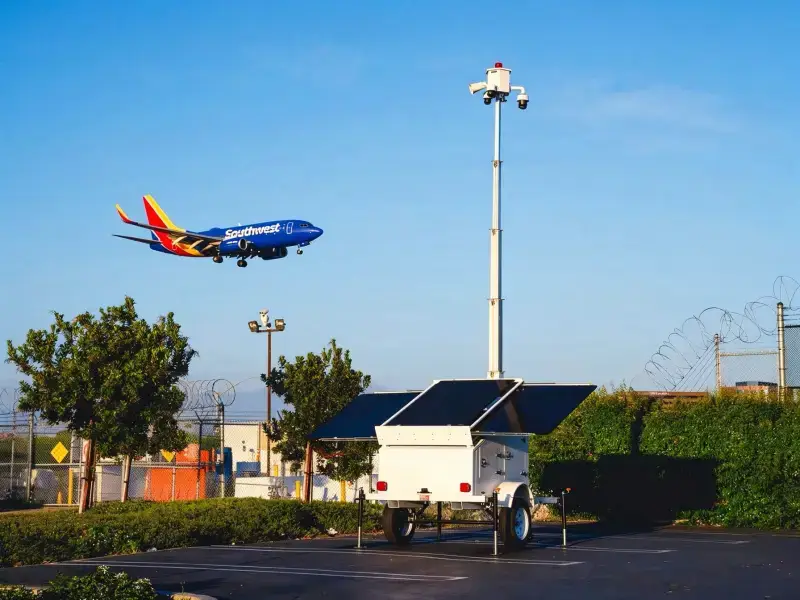
They earn their keep where grid power is far away or a cable run would disrupt the site. Think temporary works, remote gates, storage yards and events. In those cases solar removes daily charging trips and the need to run a generator just to keep one camera alive.
Sites where mobile surveillance earns its keep
A good fit has open sky for most of the day and useful events rather than constant motion. Typical examples:
- Construction perimeters and plant yards that move as the job progresses
- Mining and energy sites far from grid power
- Gates and parking areas at large facilities
- Event grounds and temporary compounds
- Public safety posts that need a camera in place for weeks
In each case the unit can be repositioned as the work changes. That is the real advantage over a wired camera.
Deterrence and response use cases
A visible mast and camera change behaviour on their own. On remote sites, theft and vandalism often matter more than the footage itself, so a camera that is clearly present can do more good than a hidden one. When an alert does come in, a live view lets a guard decide whether to send someone. The value sits in the combination: power that does not need a fuel run, a view that can be moved, and a link that reaches whoever is on call.
When is a solar CCTV trailer not worth it?
Skip solar when the panel cannot see the sky, when the camera records near-constant motion, or when nobody can reach the unit for service. Under a deep roof or behind trees, the panel will not collect enough power, and you will charge the battery by hand anyway.
| Condition | Why solar struggles | Better option |
|---|---|---|
| Shaded mounting point | Output drops below camera draw | Battery-only camera or a separate panel in sun |
| Busy street view | Constant triggers drain the battery | Tighter motion zones or wired power |
| Long winter nights | Short days limit charging | Grid power or a larger battery with backup |
| Continuous HD recording | Sustained draw exceeds panel input | Wired camera with local storage |
| Hard-to-reach position | Cleaning and checks become unsafe | Accessible mounting point |
A difficult position is not a reason to choose solar. Safe access for maintenance is still required, whichever power source you pick. If the best angle is shaded but easy to reach, a battery-only camera with an occasional swap may be simpler than a solar rig that never keeps up.
How long do solar-powered security cameras last?
There is no single lifespan figure, because the panel, battery and camera age at different rates and the site decides how fast they wear. Panels usually last longest, batteries fade first, and the camera sits in between. What matters for uptime is how the battery behaves after a season or two, not a number in a catalogue.
Battery health is the usual limit. Deep cycles, heat and cold all shorten service life. A battery that once carried the unit through two cloudy days may later manage one. Dirt, bird droppings and cracked glass cut panel output before the cells themselves wear out. The camera often outlasts both, though radios and seals fail sooner in dusty or coastal air.
Battery care and seasonal checks
- Clean the panel when you see dust; a soft cloth is usually enough.
- Log the battery level at the same time each day, and note the weather.
- Recheck the panel angle as seasons change and the sun sits lower.
- Inspect seals, cables and mast fixings after storms.
- Test backup charging before the dull season, not during it.
A week of readings in good weather cannot prove year-round performance. Repeat the check in the worst season you expect. If the battery trends down even after sunny days, the system is under-sized and no amount of cleaning will fix it.
Do you need Wi-Fi for solar security cameras?
No. Wi-Fi is only one way to move footage. Many remote sites have no usable Wi-Fi, so these units rely on cellular links, point-to-point radio or local storage that is collected on site. The power system and the data link are separate decisions.
A weak radio can spoil a well-sized solar setup. A modem that keeps searching for a signal draws power continuously, and high frame rates over a mobile network use data and battery.
- Cellular (4G or 5G). Simple where coverage is good. Check signal at mast height, not ground level, and budget for a data plan.
- Point-to-point wireless. Sends video to a nearby building with line of sight. No monthly fee, but it needs alignment and a clear path.
- Local recording. Stores footage on an onboard drive for later collection. Lowest power draw, no network, but no live view.
- Wi-Fi. Fine for a site with an existing network in range, less useful across a large yard.
Some integrated solar surveillance lighting trailers pair the camera, lights and link in one package, which cuts the number of separate power draws to manage. Pick the link first, then size the panel and battery for it. If live view is not essential, local storage is the lighter option.
What types of mobile surveillance trailers are available?
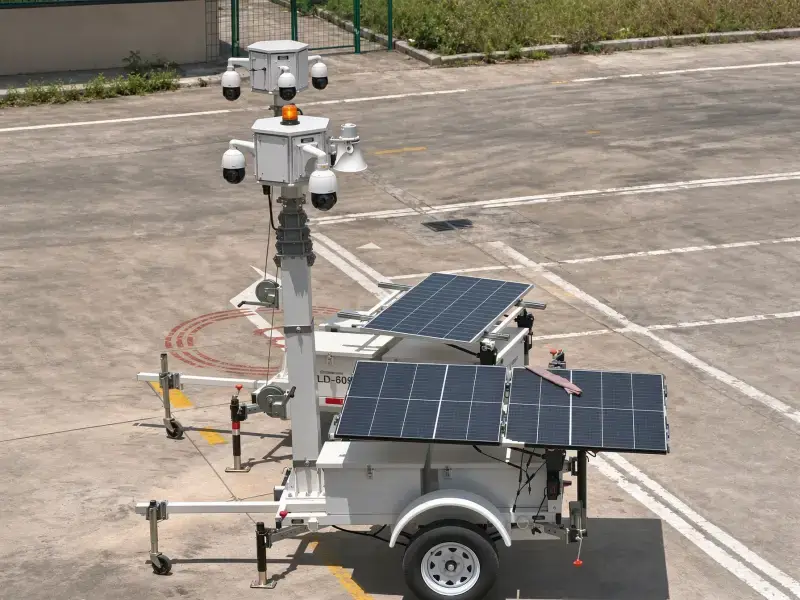
Most units fall into three groups: a basic towable camera, a higher mast with PTZ and lighting, and a vehicle-mounted system. The right group depends on how wide an area you need to see and how fast you need to move it.
Standard solar surveillance trailer
This is the entry point: one or two cameras on a mast, a panel, a battery box and a small frame. It suits gates, yards and single-perimeter jobs. A mobile surveillance trailer in this class is easy to tow and quick to set up, and it covers the cases where one good view matters more than wide coverage.
Advanced mobile surveillance trailer with PTZ and lighting
An advanced mobile surveillance trailer adds a taller mast, pan-tilt-zoom cameras and often area lights. The PTZ head lets one operator inspect a wide site without moving the unit, and lighting extends usable video after dark. A portable CCTV surveillance tower in this class can serve a large plant yard or an event compound on its own. The trade-off is weight, cost and a bigger power budget.
Mobile surveillance vehicle vs towable trailer
A mobile surveillance vehicle carries the system on a truck or van, so it drives to the site already assembled and can follow work as it shifts. A towable unit is cheaper to buy and can be left in place for weeks. For sale listings often describe both as mobile surveillance trailer camera system packages, so check what is included: camera count, mast height, battery capacity, lights and whether the radio is fitted. Compare the whole package, not just the headline.
What to check before you buy a solar surveillance trailer?
Work through the list for each proposed position, not once for the whole site. Sunlight, workload and the data link vary from one corner of a job to another, and a camera that works at the gate may fail at the compound.
| Check | What to confirm | Decision |
|---|---|---|
| Sunlight at the panel | Morning and afternoon exposure, plus seasonal shade | Enough usable sun, or choose wired power |
| Camera workload | Events per day, clip length, continuous vs motion | Match panel and battery to the draw |
| Data link | Signal at mast height, or line of sight for radio | Cellular, point-to-point or local storage |
| Service access | Safe reach for cleaning and battery checks | Accessible position, whatever the power source |
| Backup charging | Method and access for dull weeks | Ready before winter, not during |
| Package contents | Cameras, mast, battery, lights, radio | Compare like for like across for sale listings |
Run a short trial with a battery log before a full deployment. A trial shows how a position behaves now; it cannot confirm the worst week of winter.
Frequently asked questions
A few questions come up again and again when buyers compare these units.
Can a solar surveillance trailer record around the clock?
Some can, but continuous recording draws far more power than event clips and needs a larger panel and battery. Check the exact unit’s recording mode and storage support. Many systems are built for motion-triggered events, not a 24-hour timeline, and a panel that handles short clips may fall behind with continuous video.
What is the difference between a mobile surveillance trailer and a mobile surveillance vehicle?
A trailer is towed and usually left in place. A vehicle drives itself to the site and can move during a shift without being unhitched. Vehicles cost more and need a driver, but they suit work that changes location through the day. Trailers are the usual choice for a fixed post that lasts days or weeks.
Can portable surveillance cameras on a trailer work without cellular coverage?
Yes, if the unit records locally or uses a point-to-point radio to a building with a clear line of sight. Local storage means someone must collect the drive, and there is no live view. A radio link gives live video without a SIM, but only where the path is unobstructed. Check coverage at mast height before you commit.