Open worksites rarely have permanent power, wired cameras, or a guard at every gate. A construction crew needs coverage for one season, a road contractor shifts location every few weeks, and a remote utility compound may sit unattended for months. Fixed infrastructure costs more than short-term work warrants, and one guard cannot watch a wide perimeter alone. Mobile units fill that gap: they arrive on a tow hitch, generate their own power, and move as the job changes.
Surveillance trailers are used to protect temporary or remote sites, deter theft and vandalism, watch crowds and traffic, and give managers live visibility where no fixed infrastructure exists. A solar surveillance trailer CCTV setup pairs cameras on a raised mast with panels and batteries, so one unit can record activity and stay online off-grid for weeks.
This guide covers those uses, the camera and power systems behind them, published cost ranges, and how to specify a trailer that suits a real site.
What is a solar surveillance trailer with CCTV
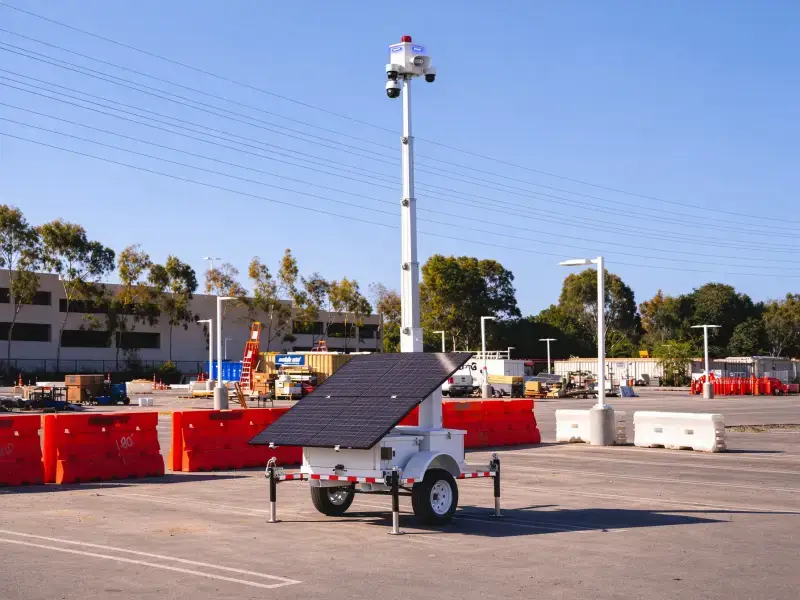
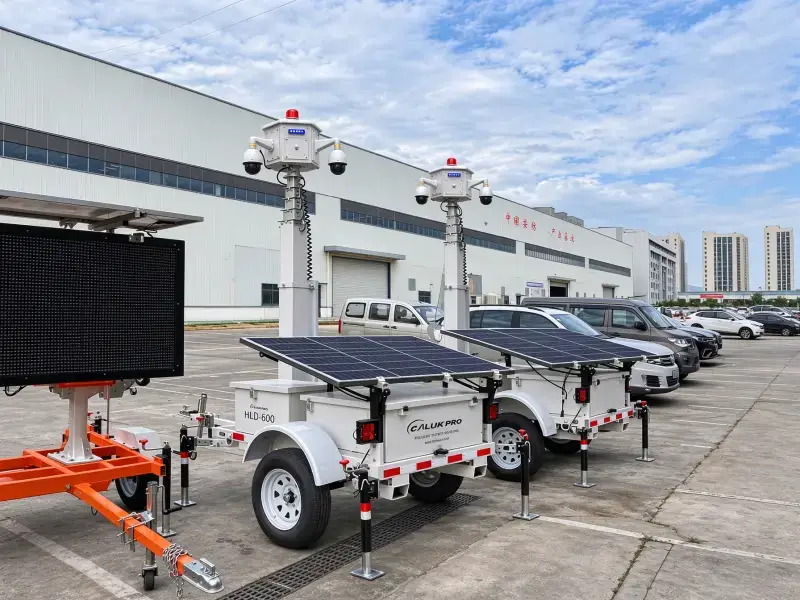
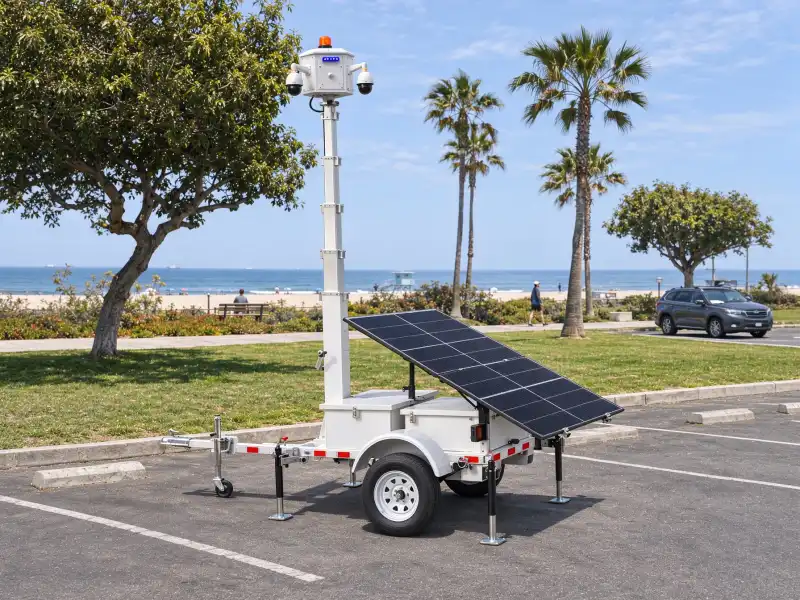
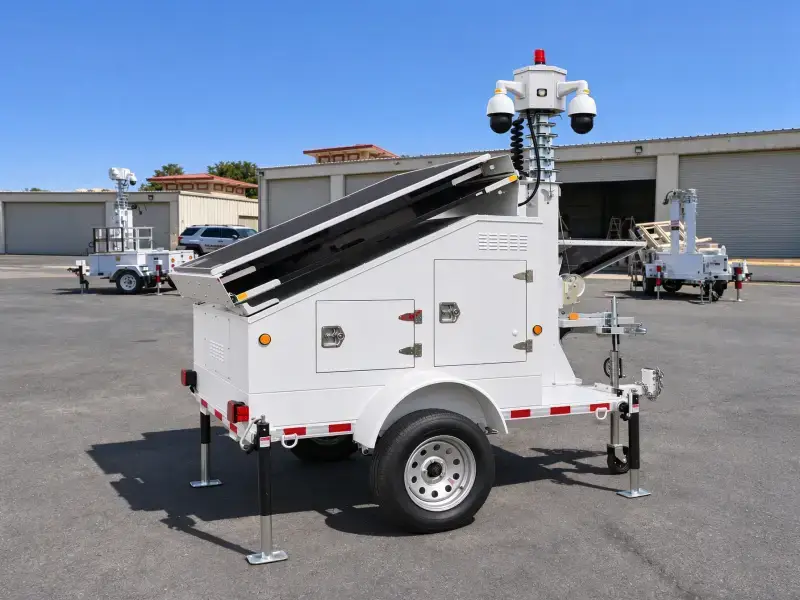
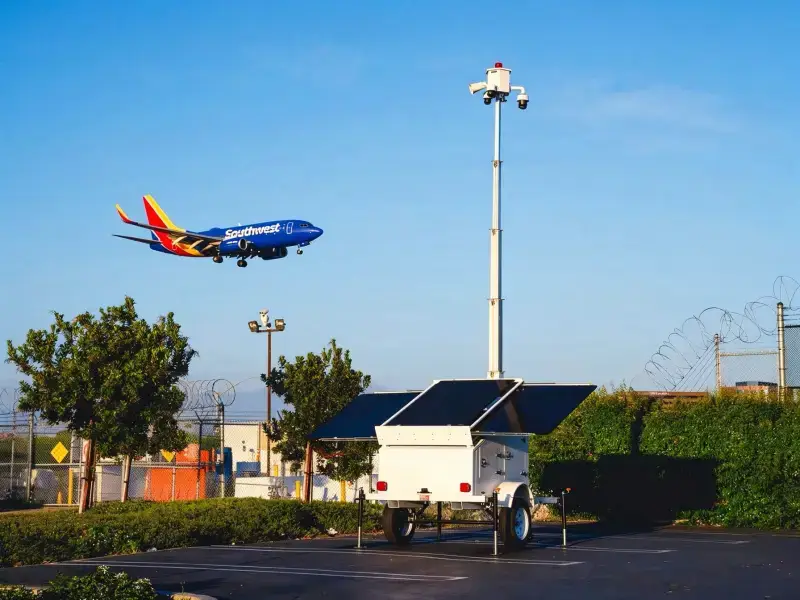
A solar surveillance trailer is a towable security unit that mounts CCTV cameras on an extendable mast and powers them with roof-mounted solar panels and a battery bank. It records, stores, and usually streams video over cellular links with no connection to mains power.
The basic idea is simple. Cameras sit high enough to see over fences and stockpiles, a battery bank keeps them running through the night, and solar panels recharge the bank during the day. A cellular router carries live video and alerts to a phone or a desktop dashboard. Some units add lights, sirens, or two-way audio so an operator can challenge an intruder without being on site. Because a solar surveillance trailer reaches a site on a tow hitch and needs no ground works, it is often chosen over a fixed camera mast for seasonal work.
In technical terms, this is a form of closed-circuit television, though modern units usually route video through the cloud rather than a closed local loop. That shift matters for buyers: footage can be reviewed remotely and alerts can reach a guard service in seconds, which is the main reason these trailers are chosen over static cameras at temporary locations.
The camera system and mast
The camera package defines what a trailer can actually see. A typical mobile surveillance trailer camera system carries two to four cameras, often a mix of fixed wide-angle units and a PTZ (pan-tilt-zoom) camera that an operator can aim from a dashboard. Fixed cameras cover a broad area continuously; the PTZ unit closes in on a plate, a face, or a specific gate when an alert comes in. Resolution in the range of 4 to 8 megapixels is common, and infrared or thermal options extend coverage into darkness and light fog.
Mast height is the other half of the equation. A telescoping mast commonly rises 20 to 30 feet, lifting the view above stacked materials, parked vehicles, and perimeter fencing. Portable surveillance cameras on trailers use that height to cover several acres from one point, though tall masts need a stable base and should be lowered before high winds. An advanced mobile surveillance trailer may add onboard analytics that separate people from vehicles, detect loitering, or flag a person entering a restricted zone, cutting the false alarms that waste an operator’s time.
Solar power and off-grid operation
Power is what makes a solar surveillance camera trailer genuinely portable. Panels mounted on the frame charge a sealed battery bank during the day, and the cameras draw from that bank at night or under cloud cover. A solar cctv trailer sized correctly will run through several sunless days before it needs attention; the number to ask for is autonomy at reduced solar input, not the peak summer figure.
The practical benefit is cost and siting freedom. There is no trench for cable, no meter connection, and no fuel delivery. For a remote site or a seasonal operation, that removes most of the setup expense. A Solar Trailer CCTV system also keeps working after the site’s mains supply is cut at handover, which is why contractors often keep one running through the snagging period. The trade-off is that panels need a clear mount and occasional cleaning, and a long run of bad weather can still call for a generator top-up.
What are the main uses of surveillance trailers
Surveillance trailers are used wherever coverage is needed temporarily or where a site has no permanent security infrastructure. The most common settings are construction sites, public events, parking areas, and remote industrial locations.
The common thread is not the industry but the condition: the location is temporary, hard to wire, or its risk changes by the hour. That pattern shows up on building sites, at weekend events, on car lots, and along isolated utility corridors. Each setting asks something slightly different of the same unit.
Construction sites and equipment yards
Building sites are the heaviest users. Equipment is valuable, easy to load onto a truck, and often left unattended overnight and through weekends. Cameras on a mast watch material stores, fuel tanks, and perimeter gates, and recorded footage supports an insurance claim when a loss occurs. Advanced units classify people and vehicles, check for protective gear in restricted zones, and flag movement after hours. Because the site changes shape as work progresses, a towable unit can be repositioned in under an hour. Contractors often pair these with solar surveillance lighting trailers so the same frame provides both security coverage and night-time illumination for a yard that has no fixed lighting.
Events, parking lots, and public spaces
Festivals, fairs, and concerts bring dense crowds that one guard cannot survey. A raised camera gives a wide view for spotting fights, pickpocketing, or a missing child, and the recording serves as evidence afterwards. The camera-led design keeps the unit discreet while remaining visible enough to deter antisocial behaviour.
Parking areas and dealerships face a quieter but persistent problem. Cameras with plate recognition track vehicles in and out, and two-way audio can address loitering without sending staff across a dark lot. Wide coverage matters more than fine detail here, which is why camera spread and mast height are specified before resolution.
Remote utilities and infrastructure
Utility compounds, substations, and pipeline works often sit far from staff. A Mobile surveillance vehicle parked on site can watch an access gate, record maintenance activity, and alert a central team if someone enters outside a work window. Because these locations rarely have grid power, solar operation is not a luxury but the only workable option. The same approach suits mining exploration sites and seasonal agricultural facilities that are occupied for only part of the year.
What should buyers look for in a mobile surveillance trailer camera system
Buyers should judge a trailer on four things: what the cameras can see, how reliably data reaches an operator, how long the batteries last, and how much monitoring is included. Resolution alone is a poor guide.
A sharp image of the wrong area is useless, and a mast raised too high can miss the gate it was meant to watch. The specification should follow a walk-through of the site at the hour when risk is greatest.
Camera resolution, PTZ, and analytics
Start with the zones that matter: entrances, storage areas, loading bays, and any place where a person could be hurt. Several cameras at moderate height usually cover a complex site better than one camera at maximum extension. A PTZ unit is worth adding where an operator needs to inspect a detail, such as a plate or a badge, after an alert. Analytics that distinguish people from vehicles or shadows reduce the false alarms that erode trust in the system. Ask to see a sample of event clips from a comparable site rather than a studio demo.
Connectivity and monitoring options
Check signal strength at the exact position the trailer will occupy, since a strong signal in the nearest town says little about a quarry floor. Dual-carrier routers help where one network is weak. Then decide who watches the alerts. A dry unit records an event; a monitored service has an operator who can challenge an intruder or call authorities. That service is the largest single line in most monthly quotes, but it is also what turns a camera from a recording device into a deterrent. Confirm the data allowance and what happens when it is exceeded.
How much does a mobile surveillance trailer cost
Published industry figures put most rentals in a broad band from roughly USD 800 to USD 2,800 per month, while outright purchase runs from about USD 12,000 to USD 55,000 depending on cameras, power, and software. Monitoring, delivery, and contract length move the final quote more than any single specification.
There is no single list price. Suppliers quote privately, and two units that look alike on a sheet can differ by thousands because of the camera package, battery capacity, or whether a person watches the alerts. The table below collects figures that rate guides and suppliers have published. Treat them as planning ranges, not offers.
| Option | Typical published range | What is usually included |
|---|---|---|
| Basic dry rental | USD 800-1,200 per month | Trailer, fixed cameras, solar and battery, local recording |
| Full-featured unit | USD 1,500-2,500 per month | Cellular link, cloud storage, alerts, PTZ camera |
| With live monitoring | USD 1,800-2,800 per month | Remote verification, incident reports, escalation |
| Outright purchase | USD 12,000-55,000 one-off | Hardware ownership; service and data paid separately |
| Deployment and retrieval | USD 200-500 per move | Delivery, setup, and pickup, varies with distance |
Industry-reported ranges, checked 23 November 2026. Actual quotes vary by configuration, region, and term.
What drives the price
Camera type is the first driver. Fixed cameras are cheapest; PTZ, thermal imaging, and plate recognition each add cost. Power is the second: a larger array and battery bank raise the hardware price but cut site visits in winter. Monitoring is the largest recurring swing. A recorded theft and an interrupted theft are different products, and the operator time behind the second is what the premium pays for. Longer commitments usually lower the monthly rate, but cancellation terms deserve as much attention as the headline number.
Renting vs buying
A mobile surveillance trailer for sale makes sense for a site that needs coverage for years and has staff to manage service and connectivity. Renting suits a project with a defined end date, because delivery, maintenance, and software are bundled into one payment. Buyers comparing surveillance trailers for sale should add data plans, replacement cycles, and repair time to the ownership case before deciding. As a rough industry guide, rentals tend to work out cheaper for deployments under about eighteen months, while ownership can pay off beyond two years of continuous use. A solar surveillance trailer for sale carries a higher upfront figure than a mains-powered unit, but removes trenching and meter costs that can rival the hardware itself.
How do you choose the right solar surveillance trailer for your site
Start with the area you must cover and the conditions on site, then match mast height, camera layout, power autonomy, and network coverage to that brief. A larger specification is not automatically a better fit.
The most common mistake is buying on camera resolution alone. The right process begins with a site walk and ends with a written specification that a supplier can quote against.
Define your coverage area and risk profile
Sketch the zones that matter and note what blocks a line of sight. Open ground is covered well by one high mast, but blind spots behind containers or buildings usually need a second camera at moderate height. Consider when the site is empty and what is most likely to be targeted then. A yard full of plant needs wide coverage and plate capture; a substation needs gate control and after-hours alerts. The risk profile determines the camera package, not the other way round.
Verify power autonomy, connectivity, and support
Request the runtime figure under reduced sunlight and compare it with the number of dark hours in the worst month. A site with long shaded periods needs a larger bank or a generator backup. Confirm network strength at the exact position, and ask what happens when data use exceeds the plan. Finally, check who services a dead unit and how quickly. A trailer miles from a depot is useless if a failed modem takes weeks to replace. Teams that deploy these units across several regions often standardise on mobile solar traffic safety solutions so that hardware, software, and support stay consistent from one site to the next.
Frequently asked questions
How much does a solar surveillance trailer with CCTV cost to buy?
Purchase prices for a complete unit commonly run from the low five figures to the mid five figures in USD. Camera count, fixed versus PTZ configuration, battery capacity, and software licences account for most of the spread. Suppliers rarely publish a fixed price, so a written specification is needed before a meaningful quote.
How long can a solar CCTV trailer run without sunlight?
Most units are rated for several days of reduced solar input, though the exact figure depends on battery size and camera load. Ask for the autonomy rating at partial sun rather than the peak figure, and check whether a generator input is available for extended bad weather.
Can footage from a surveillance trailer be used as evidence?
Recorded video with timestamps can support an insurance claim or an investigation. To be useful, the system should retain footage long enough, export it with a clear audit trail, and store it securely. Confirm retention and export formats with the supplier before purchase.