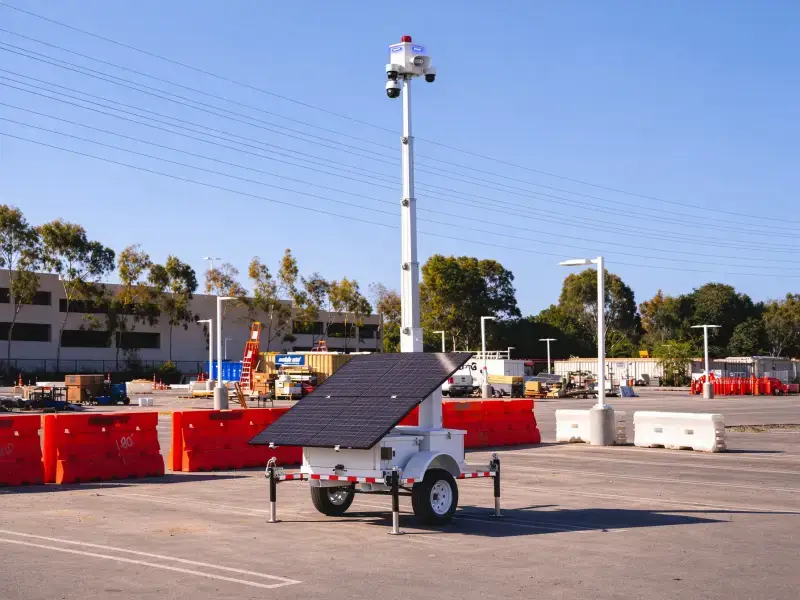
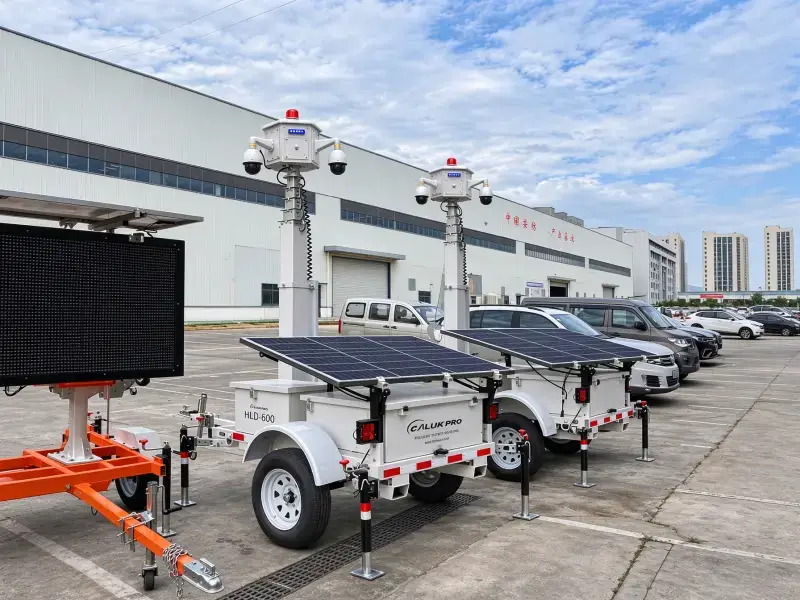
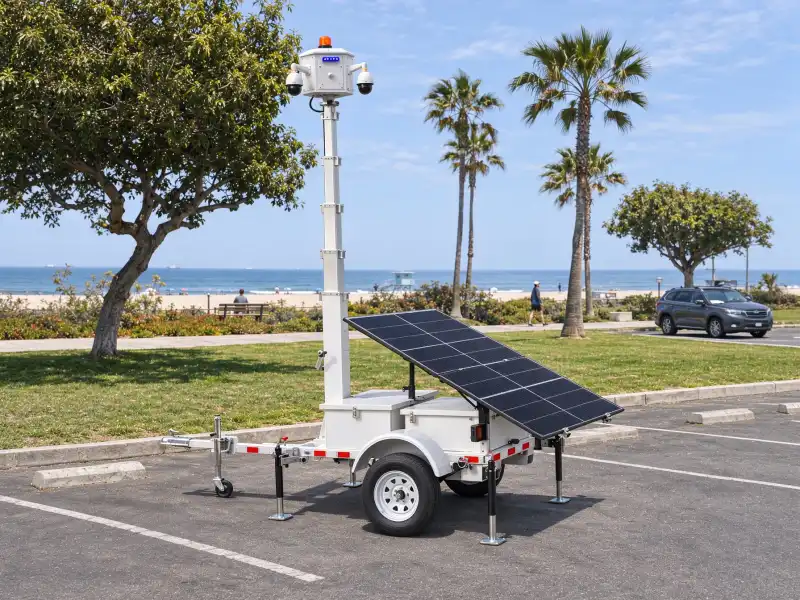
Kaztraffic opened on 18 November at the IEC exhibition centre on the Expo grounds in Astana, and for three days the halls held two kinds of traffic business side by side. One half sells asphalt plants, crushing lines and pavers. The other sells what goes on the road once it’s built: signals, barriers, lighting, and the screens that tell a driver what’s waiting ahead. Both belong in the same room because Kazakhstan is paying for both at once. The infrastructure plan running to 2029 lists 204 key projects across transport, power, water and digital networks, with annual spending above USD 30 billion, and the corridors that carry the freight pass through the country rather than around it.
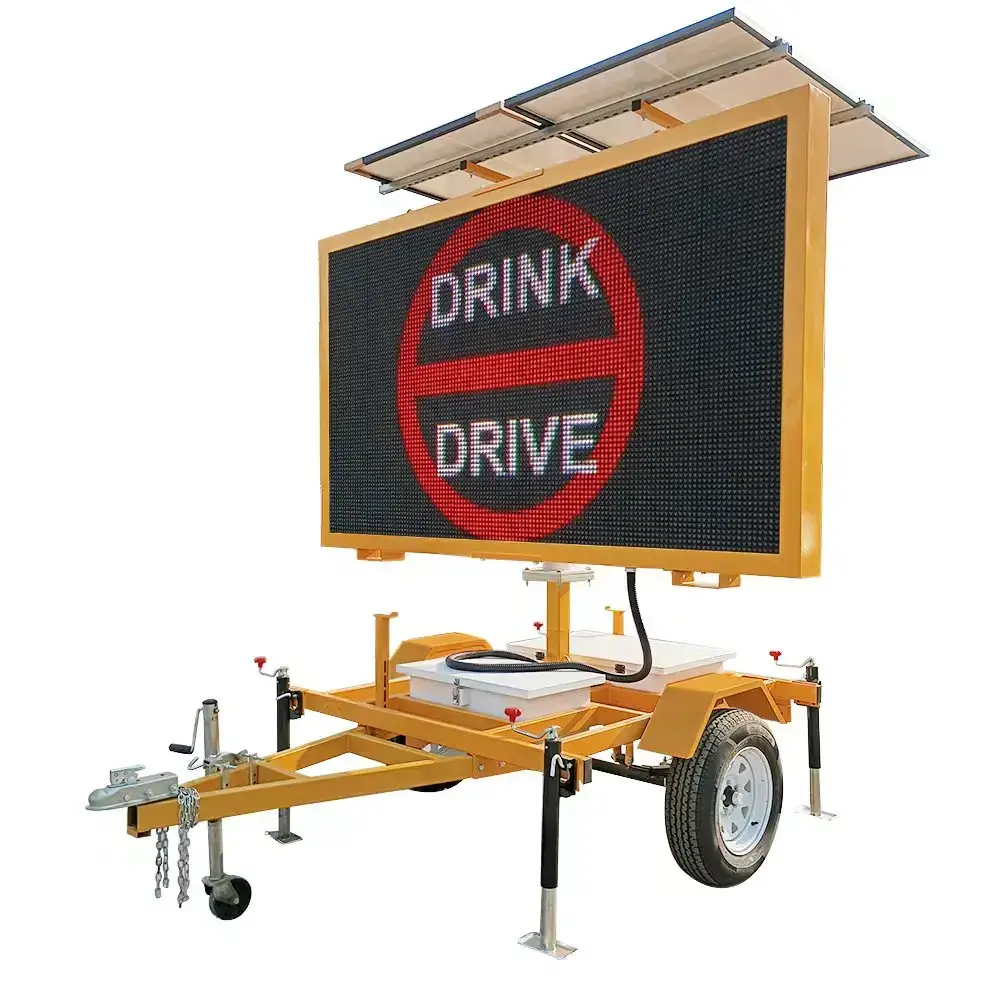
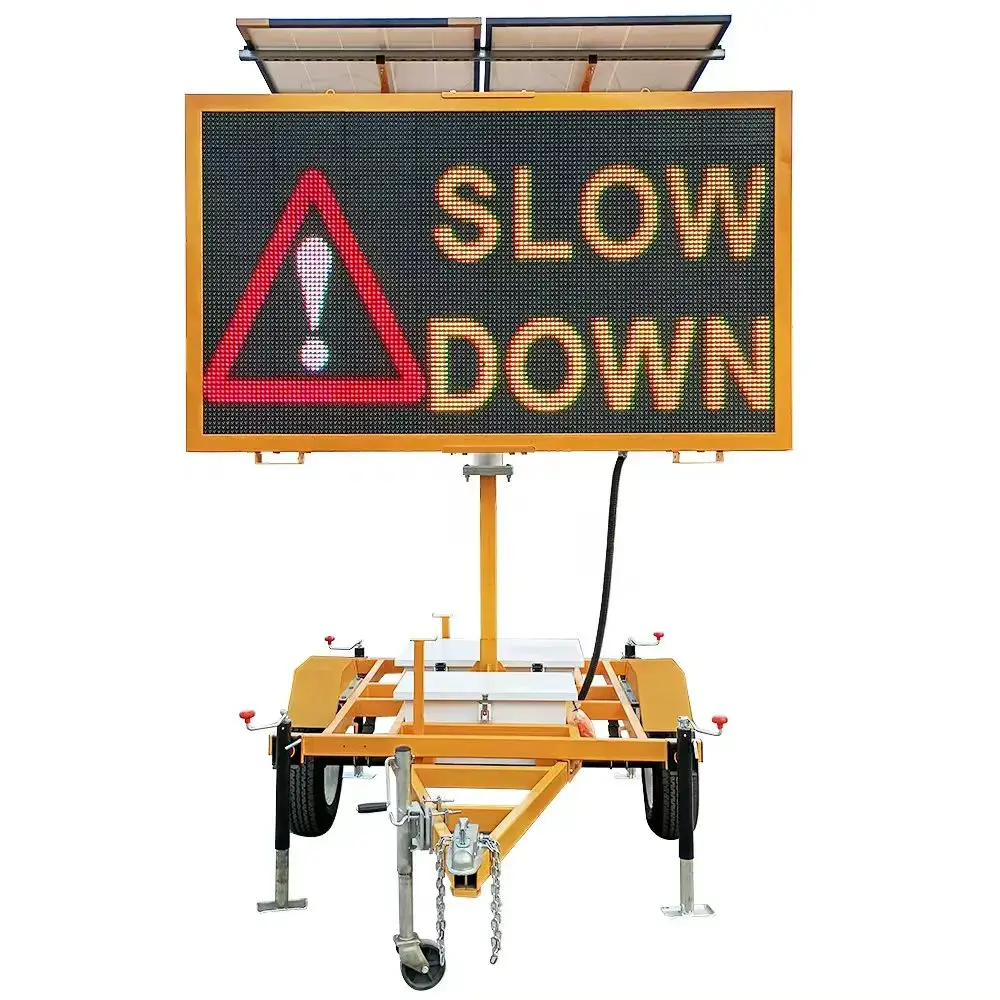
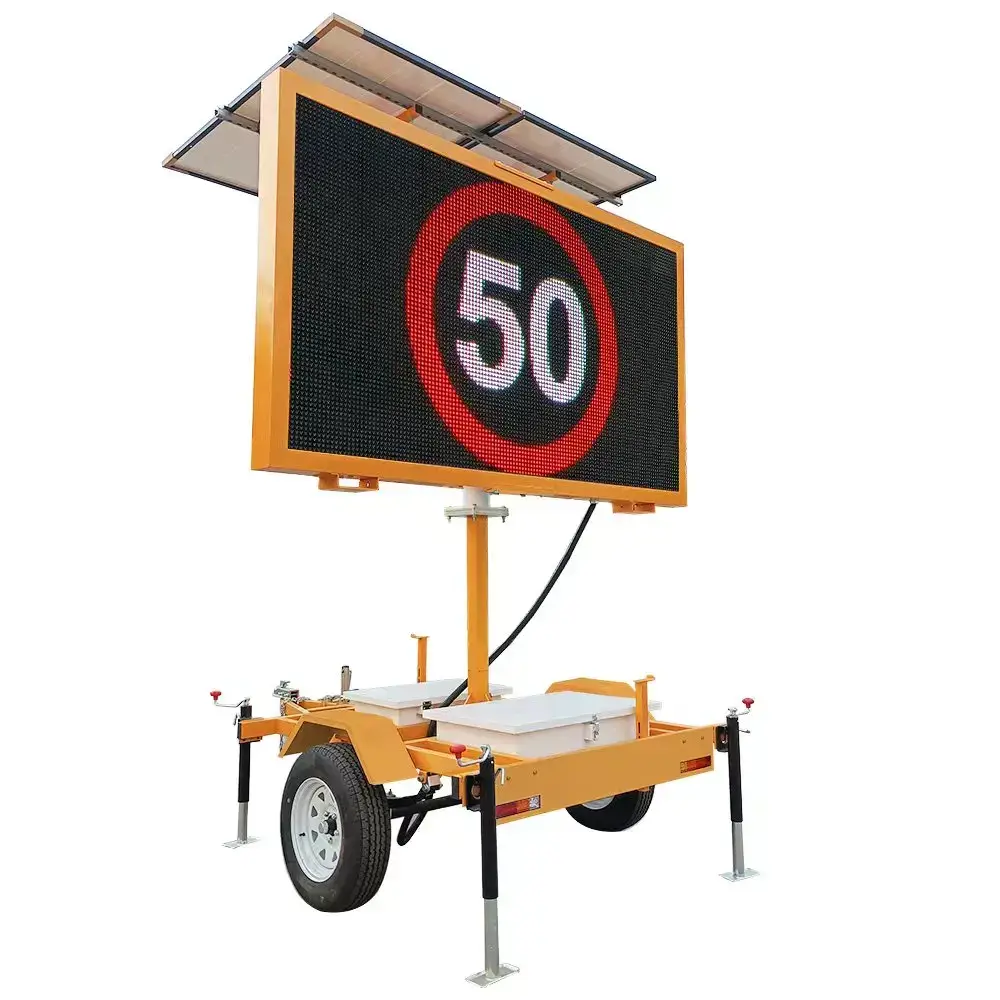
Hankun put one trailer on the floor: the HK-PTMS-FS-RGB, a full-size, full-matrix, full-colour portable changeable message sign that carries its own solar array. It’s the model in the range that answers the questions this market asks first. Work zones move every few weeks. Winter pulls battery capacity down. And a fixed gantry sign costs money in a place where the alignment may change before the sign pays for itself.
What follows tracks that one unit: why it was the model chosen for Astana, what sits on the trailer, and what buyers wanted changed before they’d sign.
Why the FS-RGB was the unit on the stand
It wasn’t chosen for being the biggest thing Hankun builds. It was chosen because it’s the only build in the range that covers the whole argument at once: full-colour output for lane and incident messages, three panel sizes to match different roads, and a solar package big enough to hold through a Kazakh winter. A visitor who wanted amber could be shown the amber builds. A visitor who wanted to know what full colour actually buys had one unit to stand in front of.
The 22nd edition follows a run of shows that drew more than 300 companies from Kazakhstan, China, Turkey, Italy, France, Canada and Uzbekistan, and the visitor mix has stayed consistent: state road directorates, maintenance contractors, regional dealers, and buying delegations from neighbouring republics. The exhibit scope runs wider than the name suggests. Alongside paving and earthworks, the show lists intelligent transport systems, roadside emergency communication, highway weather monitoring, video surveillance, axle weighing, road lighting, and the full family of road safety devices.
Trailer-mounted variable message signs sit in that last group, next to arrow boards, delineators and temporary barriers.
The four questions the FS-RGB had to answer
Almost every conversation at the trailer opened in the same order.
- How long from towing to working? A closure starting at 06:00 doesn’t wait for a crew.
- What happens with no power on site? Most temporary works have no supply, and a generator costs fuel plus somebody to watch it.
- Will it hold through January? Astana’s winter isn’t a marketing condition, it’s the operating environment.
- Can it print Kazakh, Russian and English without wrecking the layout?
The unit answers the first with a hydraulic mast, the second with three solar packages, the third with a 12 V architecture sized for 120 Ah battery blocks, and the fourth with a full-matrix panel that has no fixed character positions to break. The answers are on the specification sheet, which is why the trailer worked as a demonstration rather than a poster.
Why road safety kit shares a hall with asphalt plants
The show treats intelligent traffic management as its own category rather than an afterthought to construction equipment, and that reflects how the money moves. The same directorate that tenders a resurfacing contract also owns the work-zone signing, the speed limit through it, and the incident response afterwards. Buy the pavement and the signs through two unrelated supply chains and you get a closure with fresh asphalt and no warning.
What the HK-PTMS-FS-RGB trailer carries
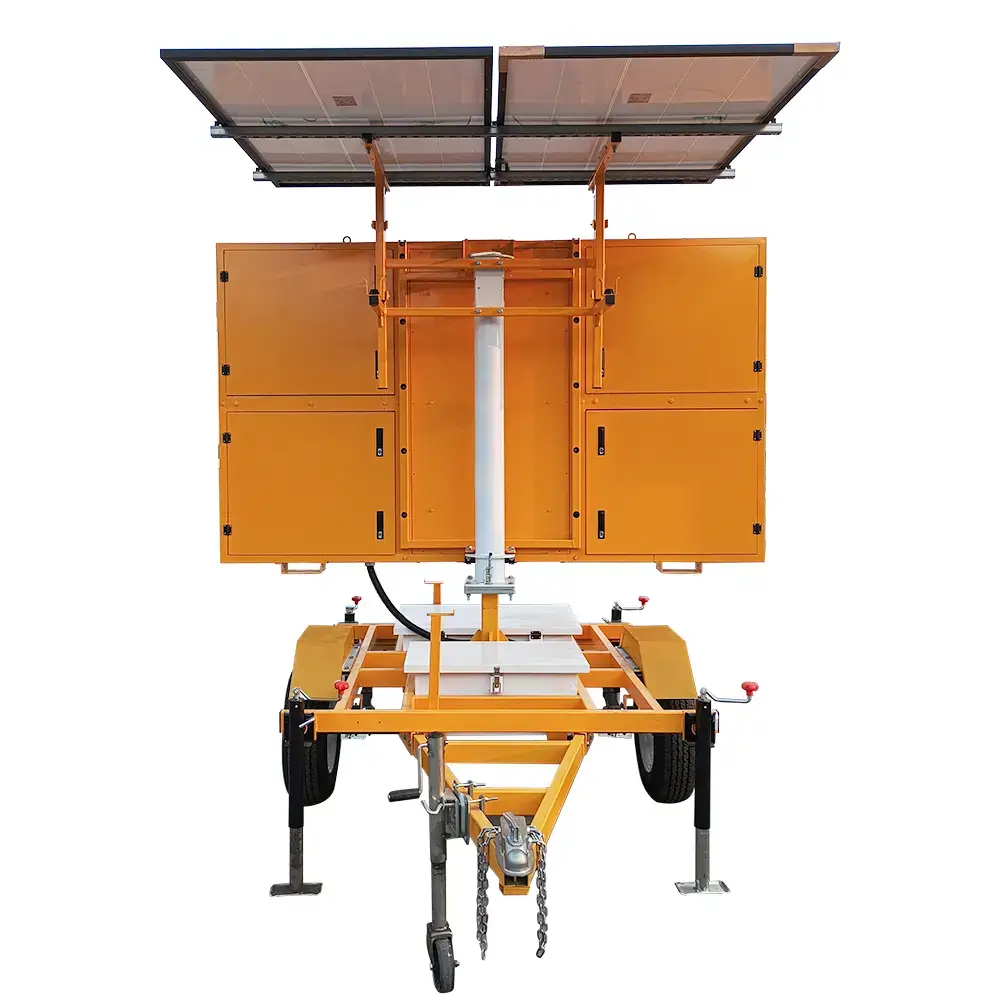
The FS-RGB is a three-line-class trailer with a full-matrix RGB panel, offered in three panel sizes and three solar packages. Hankun builds it with a hydraulic mast, a 12 V DC power architecture, cloud and app control, and GPS tracking. No single part of that is unusual. What matters is that it arrives as one trailer instead of a generator, a mast crew, a panel and a week of installation.
| Item | Specification |
|---|---|
| Panel type | Full-matrix RGB LED |
| Panel sizes | 1660 × 1020 mm, 2140 × 1340 mm, 2620 × 1660 mm |
| Content | Multilingual text, graphics, arrows, symbols |
| Power architecture | 12 V DC |
| Solar packages | 150 W with 120 Ah, 2 × 150 W with 2 × 120 Ah, 3 × 150 W with 3 × 120 Ah |
| Mounting | Hydraulic trailer-mounted mast |
| Control | Cloud portal, mobile app, on-board controller |
| Tracking | GPS with geofencing |
| Options | Rotation, soft switch, radar, custom paint |
| Factory lead time | 15-day customisation |
Specifications from Hankun’s published product data, checked 20 November 2026. IP rating and battery autonomy vary with panel size, so confirm both against the size ordered rather than the range as a whole.
Reading the 2620 mm panel from a moving vehicle
When a variable message sign (VMS) shows a speed limit, the number has to be legible at the distance where the driver still has room to act. That’s a layout problem before it’s a brightness problem. Full matrix removes the fixed character count: a three-word message gets tall characters, a two-line warning gets smaller ones, and the panel never shows blank cells where a fixed font would leave gaps. The 2620 × 1660 mm build is the one for motorway approaches, where the reading distance is long and the message is short.
Message board abbreviations do the rest of the work. A PCMS message board lives on short forms because a driver at 90 km/h gets around three seconds. The abbreviations have to match what local drivers already read, which is why the Kazakh, Russian and English argument happens at the font level rather than the translation level. Kazakhstan writes Kazakh in Cyrillic today, with a Latin alphabet committed in policy but not yet standard on road signs, so a font set carrying both covers the transition instead of forcing a rebuild halfway through.
For layout conventions the FS-RGB works to the character and message standards in the MUTCD, now in its 11th edition with Revision 1 in force since March 2026. Outside the United States that manual is a reference rather than law. The national standard where the sign stands governs, and a supplier quoting a project should name the document the layout follows.
What the three solar packages change
The packages scale with panel size, which is the right way round: a 2620 × 1660 mm panel running full colour through a night shift draws more than a 1660 × 1020 mm panel showing two lines of text. Hankun rates the platform at up to 72 hours of battery autonomy without sun, a figure that belongs to the reference configuration in the specification sheet rather than every build.
Two things quietly eat into it. Brightness is one, since a panel held at maximum output all night is a different load from one dimming itself after midnight. The optional radar is the other, because it runs whether or not anyone is reading the screen. Buyers who wanted the radar fitted were generally the ones who also wanted the third solar panel.
From towing to working
The mast raises hydraulically, so there’s no separate lifting frame and no second vehicle. The trailer tows behind a light commercial vehicle, and the removable tongue does double duty as theft deterrence at a site with nobody on it overnight. Pintle ring hitch, road lighting kit and a panel that folds flat for travel keep the unit inside normal escort rules across most of the region.
What full colour changes on this build
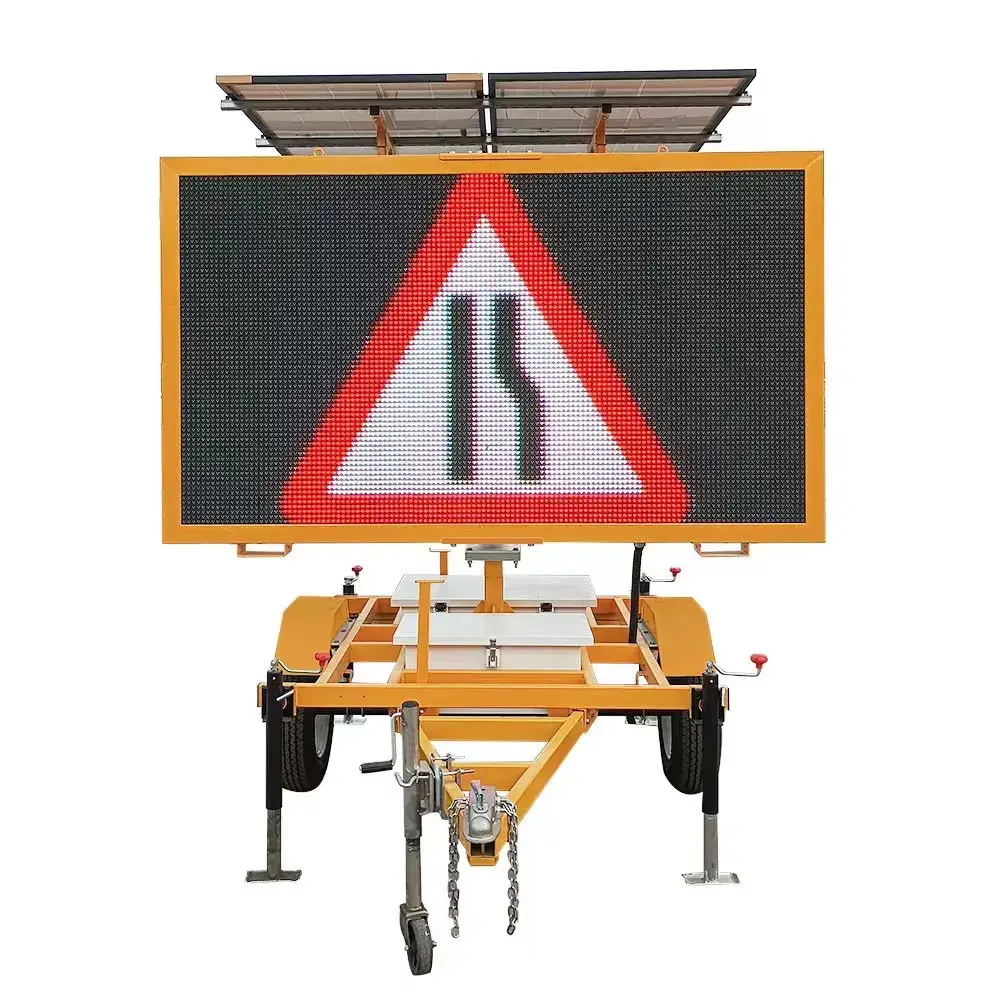
The FS-RGB exists because amber and colour do different jobs. Amber carries a sentence at long range on very little power. Colour carries meaning that a sentence can’t, like red for a full closure or a colour tied to one lane. The argument at the trailer wasn’t about which is better. It was about which one the project in front of the buyer needs.
| Amber build | Five-colour build | RGB build | |
|---|---|---|---|
| Message types | Text, arrows, simple symbols | Text plus limited colour coding | Text, graphics, icons, images |
| Long-range legibility | Highest contrast per watt | Good | Good, depends on panel and pitch |
| Panel sizes in range | 1620 × 990 mm to 2660 × 1600 mm | 1620 × 990 mm to 2660 × 1600 mm | 1660 × 1020 mm to 2620 × 1660 mm |
| Typical use | Rural work zones, long approaches, weigh stations | Highway and urban schemes with standard coding | Airport approaches, interchanges, event traffic, incident scenes |
| Power draw | Lowest | Middle | Highest |
| Purchase direction | Lowest | Middle | Highest |
Hankun builds all three on the same trailer platform, which is why the colour full-matrix portable VMS range reads as one family rather than three products.
Where amber still wins
Most highway work zones need one sentence. Slow down. Lane closed ahead. Prepare to stop. Amber cuts through dust and low sun better than a mixed-colour image, draws less power, and costs less to buy and run. A maintenance fleet buying twenty units is usually buying amber, and it’s the right call. The FS-RGB isn’t the answer to that brief.
Where colour earns the extra cost
Colour starts paying when the message has structure. A closure marked with a red band is understood faster than the same closure written out. Lane-specific instructions work better when each lane carries its own colour. Incident icons, weather symbols and direction arrows survive a glance that text doesn’t.
Airport work is the clearest case. Roads feeding Astana’s airport carry rental cars, taxis and freight that may share no language, and an icon-based colour message crosses that gap where an amber sentence can’t. The same logic applies at border crossings, event parking, and any interchange where the driver has to pick a lane before reading a paragraph.
Running the FS-RGB through a Kazakh winter
Kazakhstan’s winter is the real specification sheet, and the FS-RGB is judged on it more than on anything shown indoors. A sign that behaves in Dubai and quits at minus 25 is worthless here. Everyone at the trailer knew it. The questions were about battery chemistry, hydraulic oil, seal integrity, and how far the nearest spare sits from the site.
Cold and the 120 Ah blocks
Capacity falls as temperature drops, and the common rule of thumb puts a lead-acid bank at roughly half its rated amp-hours around minus 18°C. Charge acceptance falls with it, so the panel takes longer to recover than it would in summer. Astana also gets under eight hours of usable daylight in late December, and a panel angled for summer sun collects less of it than the array’s wattage suggests.
The practical result is that the third solar package stops being the premium option and becomes the default for anything working through winter. On the FS-RGB that means three 150 W panels charging three 120 Ah blocks, which is a heavier trailer and a cheaper February.
Dust, wind and the cleaning cycle
Steppe dust settles on the panel face and cuts contrast before it cuts output. Wind matters more, because a 2620 × 1660 mm panel is a sail on a mast, and the number that counts is the wind speed the mast holds it at rather than the trailer’s towing limit. Buyers asked for that figure directly. Several also asked what the seal looks like after a season of grit, which is a fair question for a sign that gets towed rather than installed.
Service radius and spares
Real-time diagnostics and the cloud portal cover more than they used to. Message changes, schedule updates, fault alerts and GPS history arrive remotely, and a controller can see a dead module without driving out.
What remote support can’t do is replace a module, reseat a connector or repair a hydraulic ram. The question worth asking at the stand wasn’t whether the software works. It was how fast a module reaches Almaty, Aktobe, or a site two hours outside Karaganda, and whether the panel is built from field-replaceable sections or has to travel back to a workshop.
Configuring and pricing the FS-RGB
Nobody quoted a firm number on the back of a business card, and that was the honest answer. The FS-RGB is configured, not stocked. Its price is built from panel size, solar package, towing hardware, font sets, certification and options, and those choices are made before anything is welded. What can be settled on the spot is the shape of the build and the buying model.
| Factor | Buy | Rent |
|---|---|---|
| Project length | Multi-year programmes, recurring work zones | Single closure, event, seasonal campaign |
| Control | Messages, maintenance and branding in house | Supplier handles service and swaps |
| Capital | Full cost up front, written down over years | Per-day or per-project charge |
| Availability | Yours whenever the closure happens | Depends on local stock and transport |
| Fits | Road directorates, maintenance contractors, rental fleets | Contractors bidding short jobs, event organisers |
A variable message sign for sale is rarely a stock item. It’s a build sheet, and the build sheet is where the price lives. Hankun quotes 15 days for customisation, which covers paint, options and font sets rather than structural change.
Four choices that move the number
- Panel size: 1660 × 1020, 2140 × 1340 or 2620 × 1660 mm. LED count, structure and power demand all follow.
- Solar package: one, two or three 150 W panels with matching 120 Ah blocks.
- Trailer class: hydraulic mast as standard, with towing hardware specified to the vehicle doing the pulling.
- Options: rotation, soft switch, radar and custom paint, each adding cost and, in the radar’s case, load.
If you’re pricing a variable message sign rental, the number to compare isn’t the daily rate. It’s the rate plus the tow, plus the permit, plus who pays when the battery is flat on day four. Ask for the panel size and colour configuration in writing on the delivery note, and you’ll know within an hour whether the unit that turns up is the one you priced.
Three things to settle before signing
- Which of the three panel sizes arrives, and which colour build is bolted to it?
- What is the response time on a fault, and is a replacement trailer included or billed?
- Who arranges transport, permits and on-site training, and is training priced per crew or per unit?
The 22nd edition closes on 20 November. The FS-RGB units leaving Astana for pilot sites will be judged on the same four questions the visitors asked at the trailer, and winter will answer most of them before spring.