Road signs work quietly. They tell drivers what the law requires, what lies ahead, and where to go, often in the second before a decision matters. Most are fixed panels that have read the same way for years. But roads are not always fixed. Work zones move, queues form without warning, and speed limits change with conditions. That gap is where changeable technology comes in.
The four basic types of traffic signs are regulatory, warning, guide (or information), and construction and temporary signs. Regulatory signs state the law, such as stop and speed limit orders. Warning signs flag hazards ahead, usually on a yellow diamond. Guide signs give directions, distances, services, and points of interest. Construction and temporary signs handle short-term conditions like detours and road work. Each type uses its own colors and shapes so drivers can read it at a glance.
Below is a closer look at each family, then at how dynamic boards extend the same jobs.
The four basic types of traffic signs at a glance
Start with color and shape. Red, white, and black usually mean a rule you must obey. Yellow or fluorescent yellow-green warns of something ahead. Green, blue, and brown guide you. Orange marks short-term work. Those four groupings cover nearly every static panel on a public road, and the standard that governs them in the United States is the Manual on Uniform Traffic Control Devices, or MUTCD, maintained by the Federal Highway Administration (Manual on Uniform Traffic Control Devices (MUTCD) – FHWA).
The classification is practical rather than academic. It groups signs by the job they do, which drives their color, shape, size, and placement.
| Type | Main job | Typical colors | Common shapes | Examples |
|---|---|---|---|---|
| Regulatory | State laws and orders | Red, white, black | Octagon, triangle, rectangle | Stop, yield, speed limit |
| Warning | Alert drivers to hazards. | Yellow, fluorescent yellow-green | Diamond, pennant, circle | Curve, crossing, school |
| Guide / information | Navigation and services | Green, blue, brown | Rectangle, shield | Routes, exits, services |
| Construction / temporary | Changed short-term conditions | Orange, sometimes red | Diamond, rectangle | Detours, lane closures |
Color lets a driver read a sign’s purpose before the words register. The fourth group is defined by time, not permanence: a construction panel does a warning job but appears only while conditions last. That temporary layer is the natural bridge to variable message signs.
Regulatory signs
Regulatory signs carry legal force; ignore one and you may be breaking the law. The stop sign is the red octagon, a shape reserved for that one message so it reads from the back or in poor light. Yield uses an inverted triangle. Speed limit, one-way, and do not enter panels are mostly rectangles with black or red marks on white. These signs go up only where an engineering study supports them.
Warning signs
Warning signs tell you what is coming, not what to do now. The yellow diamond covers curves, intersections, narrow bridges, animal crossings, and school zones. Fluorescent yellow-green is kept for pedestrian warnings where extra conspicuity helps. A pennant marks advance railway crossings. Messages stay short and pair with a symbol, because a driver may have only a moment to take them in.
Guide and information signs
Guide signs reduce uncertainty. Green panels handle route directions, exits, distances, and street names. Blue covers motorist services, and brown points to parks and historic sites. Route markers confirm a driver is still on the intended path. Unlike the first two families, guide signs rarely command anything; they simply make the road network legible.
Construction and temporary signs
Work zones break the normal rules, and temporary signs tell drivers how the rules have changed. Orange is the signal: detours, lane shifts, and road work messages all use it. These panels are movable by design. Crews bring them in, reposition them as the work front advances, and remove them when the job ends. That flexibility has a limit: a printed panel carries one fixed message.
What are all the different traffic signs?
Beyond the four broad families, signs divide into subcategories by the precise message they carry. Regulatory signs split into priority, direction, prohibition, speed, parking, and miscellaneous groups. Warning signs cover curves, intersections, road width, obstacles, pedestrians, railway crossings, vertical clearance, and supplementary plaques. Information signs branch into route markers, destination and street-name signs, and service signs. Temporary signs sit under the construction umbrella.
This finer breakdown is how traffic engineers and fleet managers talk about signs and why one category can hold dozens of face designs. It helps when specifying equipment, since a board that replaces several fixed panels must handle more than one kind of message.
Shape and color as instant cues
Shape carries meaning before a driver reads a word. An octagon means stop, an inverted triangle means yield, a diamond signals warning, and a rectangle signals a rule or guidance. Color narrows it further: red for stop or prohibition, yellow for caution, green for direction, blue for services, brown for recreation, and orange for temporary work. A driver who knows this code can read an unfamiliar sign at a distance.
Subcategories within each type
Among regulatory signs, priority signs settle who goes first, and speed signs set maximum or minimum limits. Warning signs group by hazard: alignment, intersections, road width, obstacles, pedestrians, and rail crossings. Guide signs separate advance direction, reassurance, street names, services, and tourist information. Temporary signs cover detours, lane control, and work-zone warnings. Every entry falls back into one of the four top-level families.
Where variable message signs fit in traffic control
A variable message sign (VMS) is an electronic board that can change its message without anyone physically replacing the face. It does not create a fifth sign family. Instead, it borrows the jobs of the four existing ones and delivers them dynamically. One board can warn of a hazard, direct traffic around a closure, and state a temporary speed limit, then switch to a different message minutes later. That single capability is why VMS units are common in work zones, events, and incident management.
Static signs work well when conditions stay the same. They are cheap to make, need no power, and last for years. They turn awkward the moment the message must change. A work zone that moves three times in a week either needs three sets of panels or a crew repeatedly swapping faces. Electronic boards can be updated from a keypad, a laptop, or a remote link, so the message follows the situation.
Fixed and portable installations
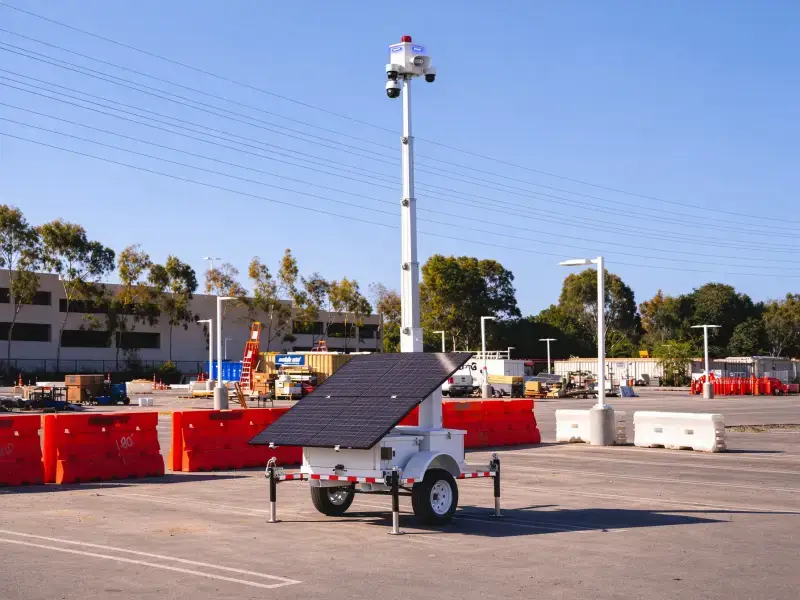
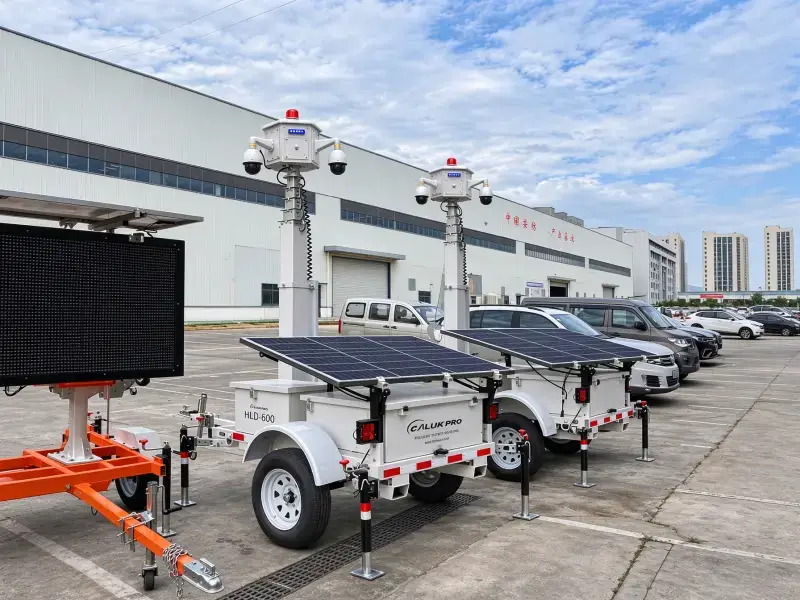
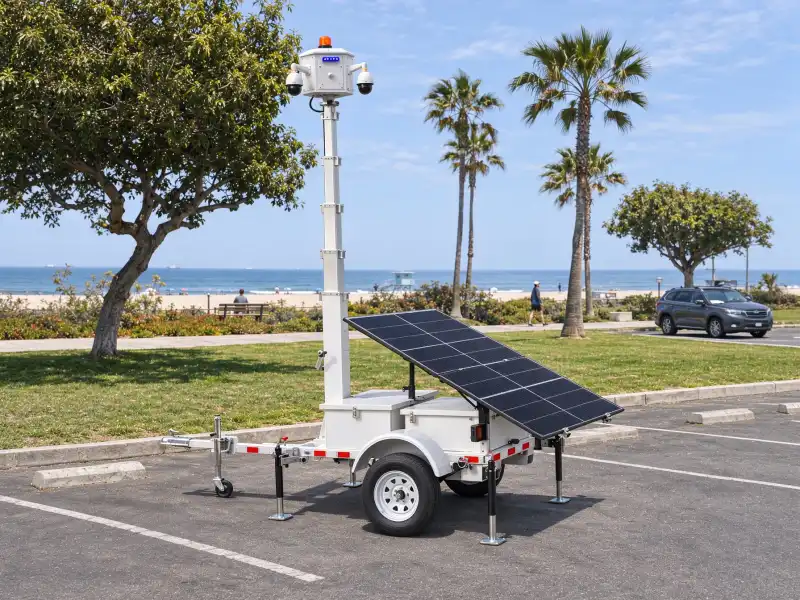
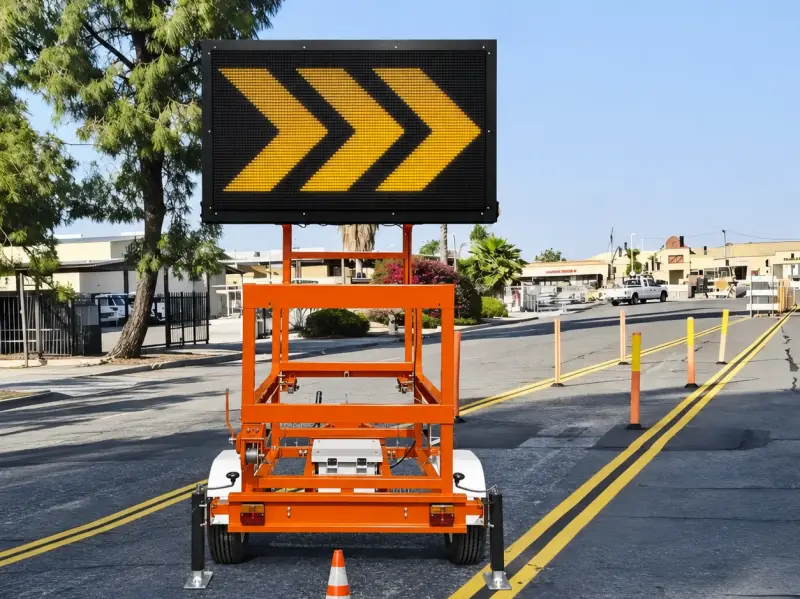
VMS hardware comes in two forms. Fixed boards sit on a permanent mast over a roadway or junction and handle recurring conditions such as variable limits. Portable units are built onto trailers or vehicles and towed where needed. The portable class dominates temporary traffic control because a contractor can move it between sites. A trailer unit typically carries its own power and control gear.
What a VMS can display
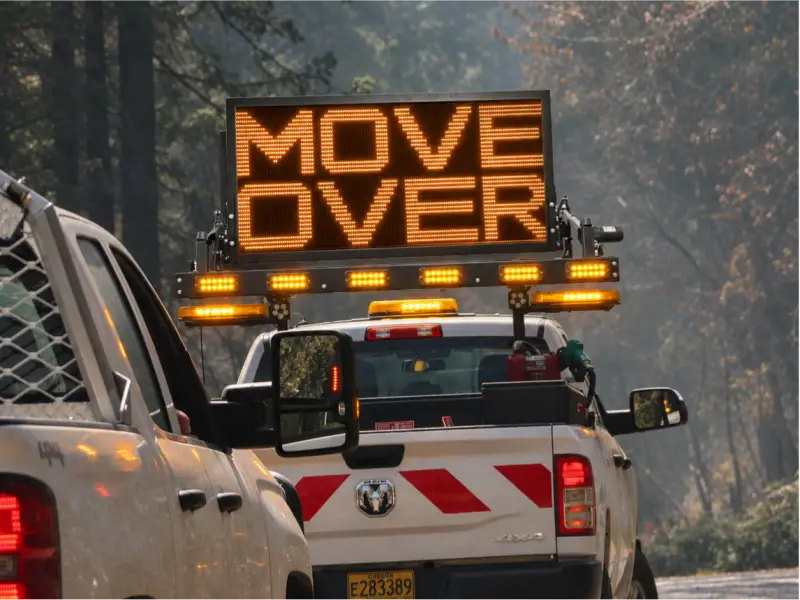
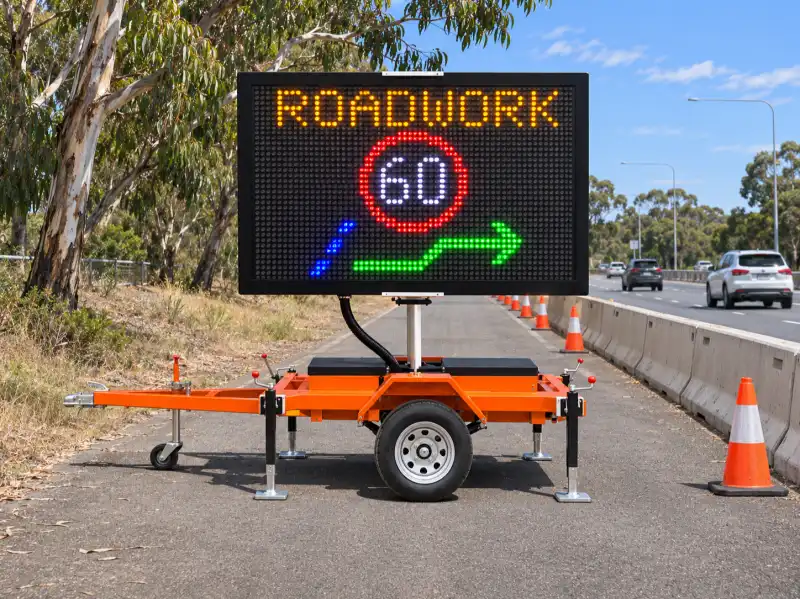
A variable message sign (VMS) shows a speed limit that can drop when visibility worsens, then return to normal when conditions clear. The same board can display a lane closure notice, a queue warning, a detour arrow, or an amber alert about an incident ahead. The text stays to a few short lines because a moving driver has seconds to read it. At airport ground operations, the same idea appears as a variable message sign airport application, where gate, runway, or apron instructions change through the day.
Changeable message sign types and how they work
Changeable message signs fall into two display families. Full-matrix boards use a grid of LEDs that can form letters, numbers, and shapes, giving almost complete layout freedom. Character-matrix boards use fixed character cells, which limits what can be drawn but keeps cost and complexity lower. Both come in single-color amber and full-color versions, and both can sit on a trailer or a vehicle.
The terms overlap, which causes confusion in specifications. A changeable message sign, a changeable message sign board, and a variable message sign board often describe the same equipment; the difference is usually regional, not technical. The display method and the mounting matter more than the name. Trailer-mounted variable message signs, for example, are defined by how they move and power themselves, not by which LED grid they use.
Full matrix vs. character matrix
| Feature | Full matrix | Character matrix |
|---|---|---|
| Display method | Individual LED pixels across a grid | Predefined character cells |
| Layout freedom | High; letters, numbers, arrows, symbols | Limited to the character set |
| Graphics and shapes | Supported | Not supported |
| Typical use | Complex messages, icons, multi-language text | Short speed or warning text |
| Relative complexity | Higher | Lower |
Full-matrix boards suit sites where messages change in kind, not just wording. If one moment needs a detour arrow and the next a sentence, a pixel grid handles both. Character-matrix boards remain common for plain text where simpler hardware is enough.
Trailer and vehicle mounting
Mounting sets how fast a board deploys and where it works. Trailer units are towed to a site, leveled on outriggers, and left to run for days or weeks. They are the standard for construction projects and long events. Vehicle-mounted boards are built into a truck or compact carrier and used where the message must move with traffic, such as a rolling work crew.
Message board abbreviations
Specifications lean on abbreviations, and reading them saves time. VMS means variable message sign. CMS means changeable message sign. A PCMS sign is a portable, changeable message sign, the temporary-control version of the same idea. DMS, used in some regions, means dynamic message sign. These message board abbreviations sometimes appear together, and PCMS message boards are a common search phrase for portable units. Knowing the terms helps when comparing quotes, since a supplier may use one label where another uses a different one for near-identical hardware.
Changeable message sign requirements under the MUTCD
In the United States, a changeable message sign MUTCD specification exists because the national manual sets rules for how traffic control devices look and behave. The guidance covers message length, display time, letter height, color, and placement relative to the road. A sign that is technically bright but breaks these rules can confuse drivers or fail acceptance on a federally funded project. Compliance is a design input, not a paperwork step at the end.
The MUTCD treats changeable signs as traffic control devices, so they follow the same core principles as static ones: serve a real need, command attention, convey a clear and simple message, earn respect, and allow enough response time. Messages stay short and divided into brief, separate phases, because a driver at highway speed has seconds to read them. Each phase must be legible at the required distance, which drives letter height and pixel pitch.
A related reference in procurement is the Portable Changeable Message Sign (PCMS) handbook guidance used by agencies and contractors. This usually means agency manuals that translate the national standard into deployment practice, such as where to place a board and how long to show each phase. Ask which standard and agency guidance a supplier designs to, and request documentation. Requirements differ between countries and states.
Variable message sign cost, rental, and purchasing
Variable message sign costs depend mainly on display size, matrix type, color, mounting, and power system. A small amber character-matrix board is the simplest build; a full-color full-matrix trailer unit with solar power and remote control is the other end. Rental and purchase options both exist, and the right choice depends on how long the board will be used and how many sites it must cover.
Price comes from hardware choices that are easy to list but hard to compare without a specification in hand. Quoted figures vary by market and configuration, so understanding the drivers helps more than a single number.
What drives VMS cost?
Display area comes first: a larger face means more LEDs, a stronger frame, and more power. Matrix type matters next, since a full-matrix panel carries more components. Color adds cost because full-color boards need more complex LED arrangements. Mounting is another layer, as a trailer with axles and a tow hitch costs more than a mast kit. When comparing variable message sign costs across suppliers, match the specifications first, then the price.
Renting versus buying
A variable message sign rental suits short projects, seasonal demand, or a first trial of the technology. It avoids storage and maintenance between jobs and shifts obsolescence risk to the supplier. Buying makes more sense when a board is in regular use across many sites. Many fleets mix the two: own a core set and rent extra capacity at peak periods. If you are considering a variable message sign for sale, ask what support and spares are included.
Power options and site constraints
A mains connection is the simplest but not always available at a roadside or remote site. A variable message sign generator, built in or towed, provides independence but adds fuel, noise, and maintenance. Solar power with battery storage is common for remote work. A solar-powered mobile changeable message sign pairs the display and storage on one chassis, which suits sites where a crew visits rarely. Many trailers combine solar with a backup generator.
Frequently asked questions
Do portable changeable message signs need permission to operate?
It depends on the road authority and the jurisdiction. On public roads, agencies usually require approval for placement, message content, and display timing, especially inside work zones. Private sites have more freedom. Check the local rules before deploying.
How quickly can a trailer-mounted board be set up?
A prepared crew can position and level a trailer unit in a short time, then power it up and load a message. The real variables are ground conditions and whether the site needs traffic control during setup. Crews should follow the supplier’s setup procedure.
Can one board show more than one language?
Full-matrix boards can store multiple messages, so switching between languages is a matter of loading the right one. The limit is display time: two languages need two phases, which lengthens the cycle. Use multilingual messages only where the audience needs them.