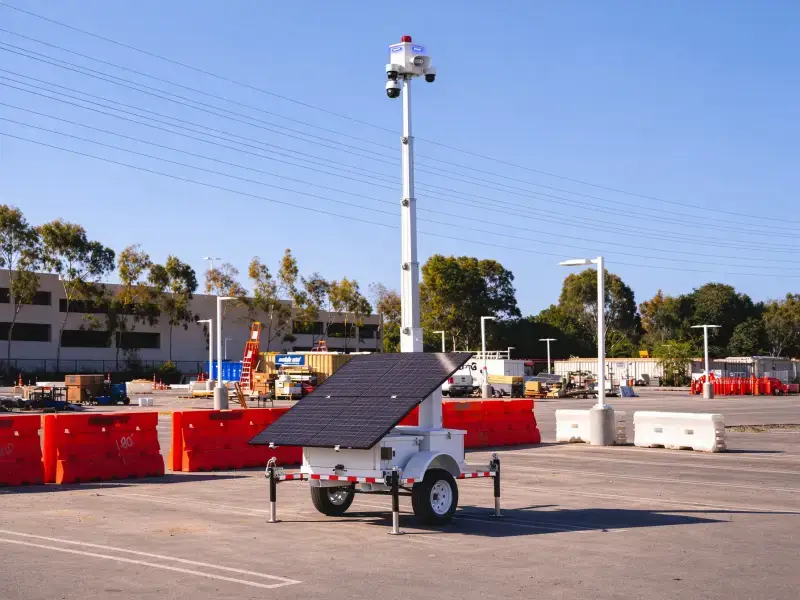
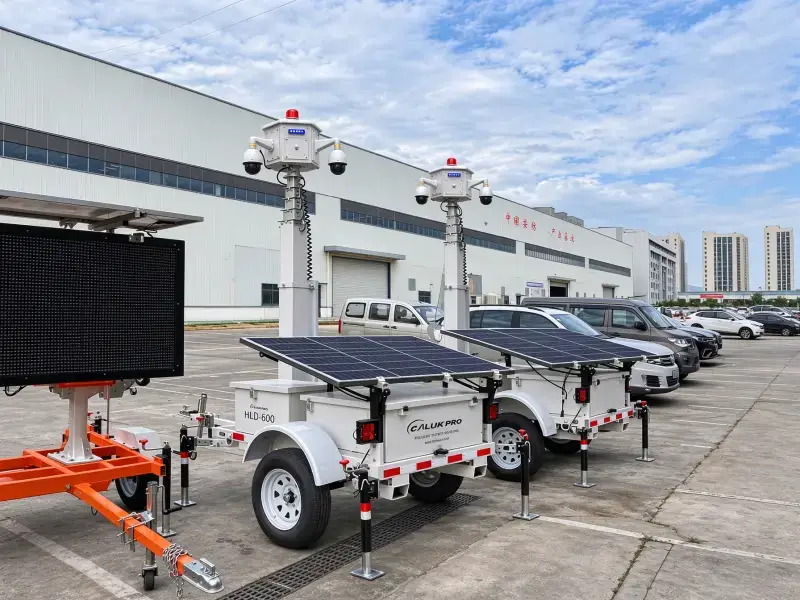
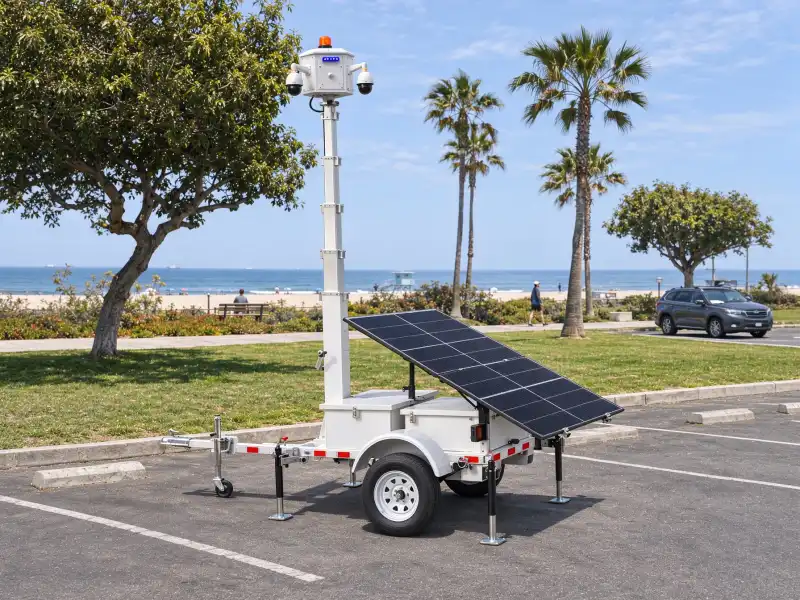
On a roadworks approach, a fixed sign cannot tell a driver what happened two minutes ago. When a lane shuts with no warning, that gap is where a portable changeable message sign does its job.
PCMS stands for portable changeable message sign. It is a trailer- or vehicle-mounted board that shows short, changeable text to warn drivers about temporary conditions: road work, lane closures, detours, crashes, or bad weather. Crews move it between sites and change the words as the situation changes.
This guide covers the term, how the boards work, what the standards require, and how to specify one.
What does PCMS stand for in traffic control?
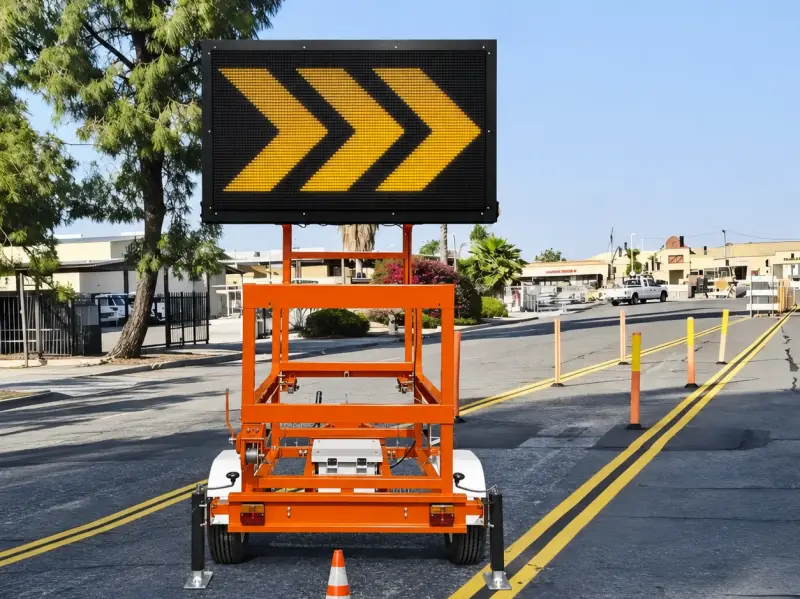
In traffic control, PCMS means portable changeable message sign: a temporary device with an electronic face that shows different messages, mounted so it can be moved and set up fast.
The Federal Highway Administration’s Portable Changeable Message Sign Handbook (FHWA-RD-03-066) describes a device that forms letters and symbols from elements on the sign face, housed on a trailer or truck bed and deployable quickly for work zones and accident areas (FHWA, checked 18 November 2026). Buyers meet several names for the same equipment. A variable message sign (VMS) is the broad term: any sign whose words change electronically, on a trailer, a truck, or a gantry. A changeable message sign is the same idea in plainer language. Add “portable” when the board tows between sites, and the phrases start to overlap.
PCMS, VMS, and changeable message sign: what is the difference
| Term | Usual meaning | Typical use |
|---|---|---|
| PCMS | Portable changeable message sign, towable or truck-mounted | Work zones, incidents, closures |
| VMS | Variable message sign, any electronic display | Motorways, tunnels, temporary sites |
| Changeable message sign | Plain-language synonym for VMS | Specifications and tenders |
| CMS | Short form of changeable message sign | MUTCD and design documents |
A variable message sign specified for a permanent motorway and a PCMS hired for a two-week resurfacing job share the same display principle. They differ in mounting, power, and how fast they move.
Message board abbreviations explained in plain terms
“Full matrix” means the whole panel can form almost any character or simple graphic; a “three-line” board builds text from fixed character cells. “LED” names the light-emitting diodes used as pixels. “MUTCD” is the Manual on Uniform Traffic Control Devices, the US document that sets how traffic signs look and behave.
How does a portable changeable message sign work?
A PCMS combines an electronic display, a controller that stores and plays messages, a power source, and a towable or truck-mounted frame. An operator picks a preset or types a new message, and the board repeats it until changed.
Most units use light-emitting diodes in a grid. The controller drives single diodes to form letters and sets brightness so the board reads in daylight without blowing out at night. MUTCD Chapter 6F lists the parts as a message sign, control systems, a power source, and mounting and transporting equipment (FHWA, checked 18 November 2026).
Three-line versus full-matrix message boards
- Three-line (character matrix): text comes from a set number of cells, often eight per line. Simple to program, easy to read at distance.
- Full-matrix: the whole panel is a pixel grid, so it can show bigger characters, several layouts, and symbols such as arrows.
- Mini or compact: smaller panels on a lighter frame, for tight sites or slow traffic.
MUTCD guidance says a PCMS should use three lines of eight characters or a full matrix. Letter height should be at least 18 inches, though low-speed roads may use smaller letters if the message stays legible from 650 feet (FHWA MUTCD Chapter 6F, checked 18 November 2026).
Power options: solar, generator, and battery
| Source | Behaviour | Where it fits |
|---|---|---|
| Solar plus battery | Charges in daylight, quiet, no fuel on site | Long jobs, remote sites, noise limits |
| Diesel or petrol generator | Steady output, needs refuelling, makes noise and fumes | Short or shaded jobs |
| Mains power | Continuous supply where a socket exists | Fixed positions near buildings |
Solar is now common because it removes refuelling and cuts roadside noise. Work-zone research notes that solar lamps have improved in intensity and viewing angle, though performance still depends on the lamps and panels a maker fits (TRB, checked 18 November 2026).
How far should a PCMS be visible?
Under MUTCD guidance, a portable changeable message sign should be visible from half a mile, day and night. Message legibility has a shorter, separate threshold.
MUTCD Chapter 6F says portable changeable message signs should be visible from 1/2 mile in both day and night conditions (FHWA, checked 18 November 2026). For permanent boards on roads posted 55 mph or higher, the related section repeats the half-mile target and adds that the message should read from at least 600 feet at night and 800 feet in daylight. The Older Driver Highway Design Handbook gives a 650-foot minimum legibility for portable variable message signs, day and night (FHWA, checked 18 November 2026).
Visibility versus legibility
- Visibility is the point where a driver first notices a sign ahead.
- Legibility is the distance at which the driver can read the words.
A board can be visible at half a mile and readable only at 650 feet. Sun angle, rain, fog, snow, and contrast all shrink the readable distance. MUTCD also notes that letter height, font, and stroke width affect legibility, and that changes helping a younger driver generally help an older one too (FHWA, checked 18 November 2026).
| Measure | MUTCD figure | What it means |
|---|---|---|
| Sign visibility | 1/2 mile, day and night | How early drivers spot it |
| Portable legibility | At least 650 ft | Where words become readable |
| 55 mph+ legibility | 600 ft night / 800 ft day | Target on faster roads |
| Minimum letter height | 18 in; 10 in on incident vehicles | Sets character size and panel layout |
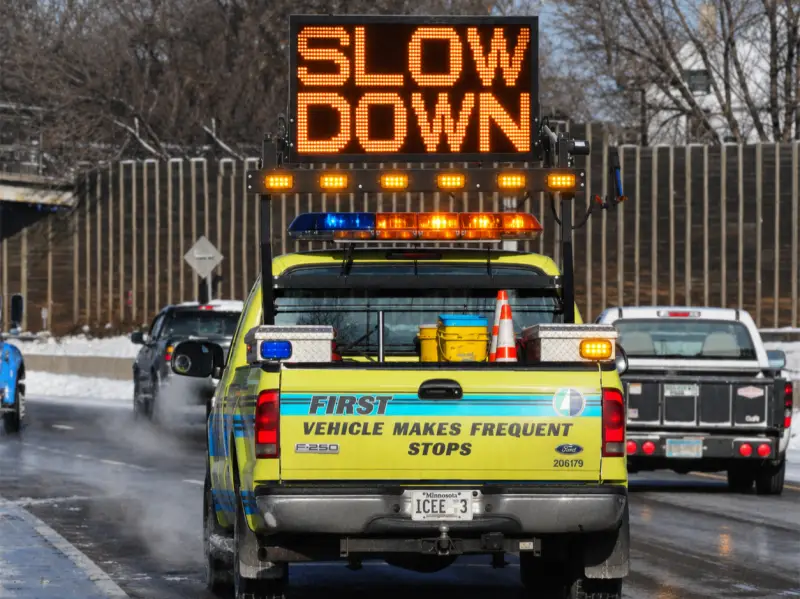
A trailer-mounted amber PCMS with full-size characters is the usual pick when a job needs these distances on a faster road. Smaller boards work on low-speed streets, where a shorter legibility distance is fine.
What types of PCMS are available?
PCMS units group by mounting: trailer-mounted, vehicle-mounted, and compact or mini boards. Each suits a different mix of road speed, space, and deployment length.
The type shapes the job: a large trailer board can sit roadside for weeks, while a compact board follows a mobile crew.
Trailer-mounted units
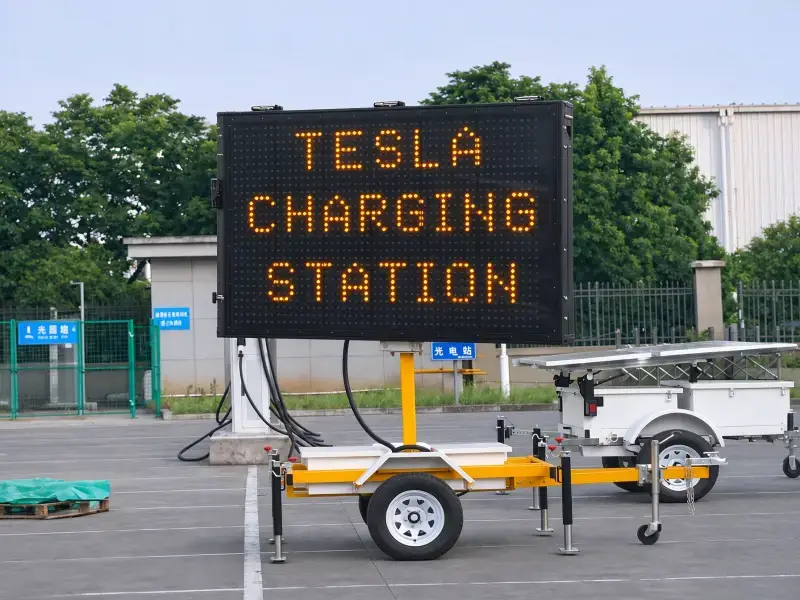
The standard PCMS. The display folds or turns for towing, outriggers steady it on site, and solar panels or a generator supply power. Used for closures, detours, and long warnings. Their size allows the letter heights MUTCD expects on faster roads.
Vehicle-mounted and compact units
These ride on a truck or utility vehicle and move with the crew. Some are full-size; others are smaller panels for slow traffic or car parks. MUTCD allows shorter letters on service patrol or incident response vehicles, provided the message stays legible from 650 feet (FHWA, checked 18 November 2026). That exception is why a smaller board can still comply for incident work.
Where are variable message signs used?
Variable message signs go wherever conditions change faster than a fixed sign can follow: work zones, closures, crash scenes, events, airports, and speed control.
MUTCD lists cases where speed is expected to drop sharply, queuing and delays are likely, conditions are poor, alignment or surface changes, advance notice of closures is needed, or crash management is under way (FHWA, checked 18 November 2026). The link is short-notice information a driver needs before reaching the point of action.
When a variable message sign shows a speed limit
Some boards display a speed limit, either one that changes with conditions or the speed of an approaching driver. MUTCD Chapter 6F points to Section 2B.13 for these signs (FHWA, checked 18 November 2026). Radar feedback trailers, which show a driver’s current speed, are related but distinct. A PCMS used this way still carries a regulatory or warning message, so colour and legibility rules still apply.
Variable message signs at airports and events
Airports use boards for ground traffic and terminal access, where temporary closures are routine. Event sites use them for entry directions and exit plans. In both cases the board is a temporary layer over permanent signs, most useful when the message changes through the day. A solar-powered mobile changeable message sign fits these settings because it runs without a fuel drop or nearby power.
What are the three different types of signs?
The three broad types of traffic sign are regulatory, warning, and guide. A PCMS is a device that can carry messages from these groups, not a fourth type of sign.
Regulatory signs tell drivers what they must or must not do, such as a speed limit or stop. Warning signs flag a condition ahead. Guide signs help with route and destination choice. MUTCD says portable changeable message signs should show only traffic operational, regulatory, warning, and guidance information, and should not carry advertising (FHWA, checked 18 November 2026).
That rule shapes the message. A board mixing a closure warning with a promotional line loses value as a traffic control device. Short factual messages naming the problem, location, and action work better.
What do MUTCD rules say about changeable message signs?
MUTCD treats a changeable message sign as a supplement to conventional signs, caps how much it can say, and restricts how it says it.
Chapter 6F and the changeable message sign sections cover points that affect both hardware and wording (FHWA, checked 18 November 2026):
- Messages should use no more than two phases, three lines each, with each phase clear on its own.
- Animation, rapid flashing, dissolving, scrolling, and travelling text are not allowed.
- With two phases, each should show at least two seconds, and both together no more than eight.
- A message should give three thoughts: the problem, the location or distance, and the action to take.
- Where two boards are readable at once, only one should show a sequential message. Freeway boards should sit at least 1,000 feet apart, others at least 500 feet.
Message design rules in practice
- Name the condition: “ROAD WORK AHEAD.”
- Give the place or distance: “2 MILES.”
- Give the action: “REDUCE SPEED.”
Three short lines cover all three thoughts. A fourth idea means a second phase, which doubles reading time. That is why a clear board often looks plain.
How do you choose and source a PCMS?
Match panel size, letter height, power, and mounting to road speed and deployment length, then decide whether renting or buying suits how many projects you run.
Start with the site. A fast road needs full-size characters and the legibility distances above. A tight urban site may favour a compact or vehicle-mounted board. Long jobs favour solar where noise and refuelling matter; short jobs may be simpler with a generator. Ask for the actual letter height and stated legibility distance, not just panel size.
Variable message sign rental versus for sale
Rental suits a contractor with scattered projects: the unit arrives maintained, with no storage between jobs. Buying suits an agency deploying boards year-round. Compare the full scope, since transport, permits, setup, programming, and power costs are often quoted separately from the headline price. Costs vary by region and contract length, so request figures from suppliers.
A variable message signs cost figure that leaves out power, towing, and operator time will not show what a job really costs. Treat the board price as one line in a wider budget.
FAQ
What does a five-sided pentagon-shaped sign mean?
In the United States, a pentagon sign marks a school zone or school crossing. The shape is reserved for school warnings, so drivers can read it by outline before the words. It is a fixed warning sign, not a changeable message sign, though a PCMS may sit nearby to warn of temporary works by a school.
Can a PCMS display more than one message at a time?
It can store several but shows them in phases, one after another. MUTCD guidance caps a message at two phases and asks that each phase make sense alone. If more information is needed, the usual answer is a second sign, not a longer sequence on one board.
How long can a solar-powered PCMS operate off-grid?
It depends on panel size, battery capacity, daylight, screen brightness, and weather. No single runtime covers every unit. Ask the supplier for rated battery capacity and expected days without sun for the model you are considering.