Road crews and traffic managers rarely choose a sign by looks alone. They choose by fit. Will the board clear a low bridge on the way to the site? Can a driver read it at the posted speed? Does it meet the standard the road authority enforces? Each question comes back to dimensions. A board that is too small fails legibility; one that is too large is hard to tow, permit, and place on a narrow shoulder. Buyers comparing variable message signs often find the published numbers inconsistent, because some suppliers quote the display face while others quote the whole trailer envelope.
Portable changeable message sign dimensions usually fall into three bands. Full-size boards have a face near 75 × 132 in (about 1,900 × 3,350 mm) and use 18-in characters for freeway work. Mid-size faces run roughly 53–64 × 91–105 in, and mini units around 36–45 × 58–80 in, with shorter characters for low-speed sites. The MUTCD does not fix one face size; it fixes letter height, line count, viewing distance, and legibility, so the panel itself may vary.
Size matters when you specify, tow, permit, and read a board, so it helps to break the numbers down one part at a time.
| Class | Typical face (W × H) | Character height | Common use |
|---|---|---|---|
| Full-size | ~75 × 132 in (1,900 × 3,350 mm) | 15–18 in | Freeways, high-speed work zones |
| Mid-size | ~53–64 × 91–105 in (1,350–1,625 × 2,300–2,670 mm) | 12–15 in | Urban arterials, events |
| Mini / compact | ~36–45 × 58–80 in (925–1,145 × 1,475–2,030 mm) | 8–12 in | Low-speed roads, campuses, parking |
These are approximate ranges drawn from published product data and public auction specifications, not a single mandated table. Confirm the exact figure against the applicable standard and the supplier drawing before you specify.
What sizes do portable changeable message signs come in?
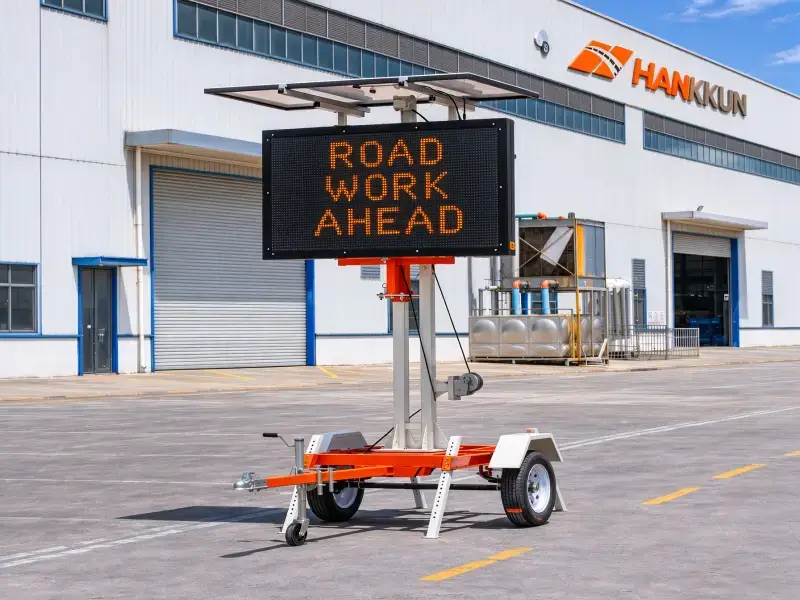
Most portable changeable message signs are sold as full-size, mid-size, or mini units. Full-size faces sit near 75 × 132 in, mid-size faces near 53–64 × 91–105 in, and mini faces near 36–45 × 58–80 in. The labels describe the display face, not the towing envelope.
The three-band model is a practical way to sort a catalog, but the boundaries are soft. One maker’s mid-size can be another maker’s full-size, and a unit built for a low-speed site may carry a large face with short characters. That is why the character height in the table above is often more useful than the face width. A road authority that specifies “18 in letters” has stated a performance requirement; a buyer who specifies “75 in face” has stated a product.
Size categories also follow regional standards. Under AS 4852, trailer-mounted units are commonly described as Size A (around 1,620 × 990 mm) or Size C (around 2,400 × 1,200 mm), with Size C the usual choice for highway work. North American buyers tend to use the full, mid, and mini language instead. Both systems point to the same idea: bigger characters for faster traffic and smaller units where space and maneuverability matter.
Full-size, mid-size, and mini classes
Full-size boards are built for drivers who have seconds, not minutes, to react. They use three lines of eight characters or a full-matrix display, and the lettering is large enough to be read from roughly half a mile. Mid-size boards trade some character height for a shorter frame and a lighter tow. They fit urban arterials, event access roads, and sites where a full-size trailer would block a lane. Mini units are the compact option: they tow behind a small vehicle, fit inside tight compounds, and work at low speed. A campus or parking facility rarely needs a mini board with freeway-grade characters.
What does MUTCD say about changeable message sign dimensions?
The MUTCD sets performance rules rather than a single face size. A portable changeable message sign should be limited to three lines of eight characters or use a full-matrix display, with characters built on at least a five-wide by seven-high pixel matrix. Letter height should be a minimum of 18 in on trailer and large-truck units and may drop to 10 in on service patrol trucks.
Section 6F of the Manual on Uniform Traffic Control Devices is the reference most buyers are asked to meet. It calls for signs visible from about half a mile in day and night conditions, colors of yellow or orange on black, and a front face covered with protective material. Messages should run no more than two phases, with each phase understood on its own, and the display should adjust brightness automatically as light changes. A control screen, retained memory, a power source, and battery back-up are also part of the requirement. The FHWA’s published MUTCD Part 6F is the authoritative text for these points.
Note the wording: the sign panel “may vary in size.” Smaller letters are allowed where a sign stays legible from 650 ft or 330 ft on an incident response vehicle. That flexibility is why two compliant boards can have very different physical dimensions. If a tender asks for a “changeable message sign MUTCD compliant,” ask which clause the supplier is claiming, and request the letter height and viewing distance in writing.
How is a variable message sign board measured?
A variable message sign board has three dimensions worth separating: the display face, the character height, and the overall unit envelope. The face is the lit panel; the envelope includes the mast, trailer, and solar frame. Only the first two affect legibility.
Suppliers often list one number and leave the others implicit. A face of 75 × 132 in describes the sign itself, while a travel height near 114 in and a travel width near 95 in describe the whole trailer. Both matter. The face decides whether a three-line message fits with 18 in characters; the envelope decides whether the unit passes under a gantry, fits a standard parking bay, and can be hauled by the fleet’s existing tow vehicles. Requesting both sets of figures early avoids the common mistake of buying a board that reads well but cannot reach the site.
The display type changes the measurement too. A character-matrix sign has a fixed grid of character positions, so the usable area is defined by rows and columns. A line-matrix sign offers more freedom within each line. A full-matrix board, built from individual pixels, gives the most layout freedom at a given face size. It is worth noting that a full-matrix display does not automatically mean larger characters: pixel pitch and matrix resolution set the practical letter size.
How do trailer and mounting dimensions affect deployment?
Mounting changes the usable size of the same display face. A trailer-mounted board sits high on a mast and needs outriggers and towing clearance; a truck or vehicle-mounted board is limited by the host vehicle’s roof, frame, and weight distribution.
Towing geometry is easy to overlook. Drawbar length, axle rating, and overall travel width affect turning radius and stability, especially on confined sites with mixed tow vehicles. A hydraulic mast reduces setup labor and gives a repeatable deployment height, while a hand-crank mast is cheaper but depends on the operator. Stabilizer jacks matter on soft ground: a board that sways in wind is a board no one can read.
Trailer-mounted vs. vehicle-mounted footprints
Trailer-mounted variable message signs are the most widely deployed format because they can be parked, leveled, and left on site while the tow vehicle goes elsewhere. Their footprint includes the sign, mast, controller cabinet, battery box, and often a solar frame—all of which must be considered together. Vehicle-mounted signs give up some face area but move with the traffic management vehicle, which suits incident response and rolling operations. When comparing the two, measure the deployed height as well as the face: a large board mounted too low behind a truck can be hidden by its own shadow and by following traffic.
How are speed-limit message displays sized?
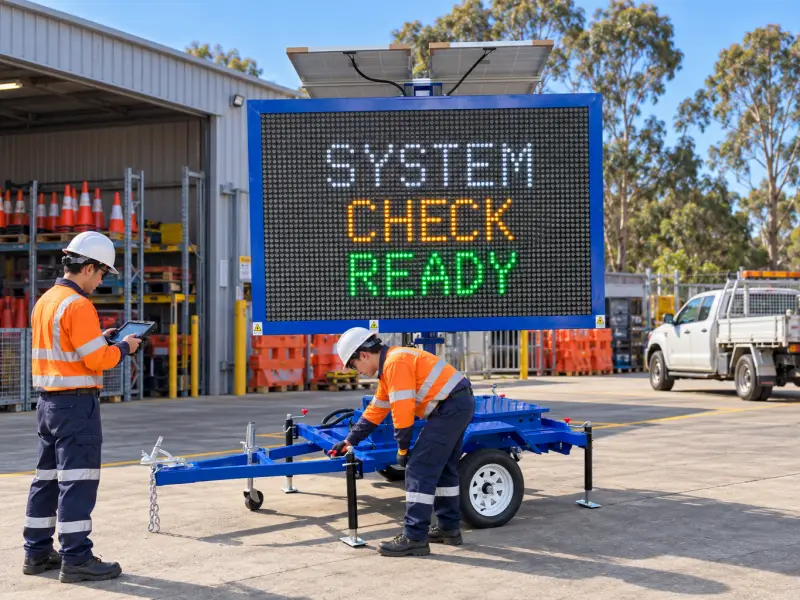
A changeable message sign that shows a speed limit uses smaller dimensions than a work-zone board. For roads at 45 mph and above, the common specification is a 36 × 48 in face with 18 in digits; neighborhood and school-zone units may use 24 × 30 in with 12 in digits.
These sizes come from FHWA guidance tied to the MUTCD speed limit provisions. A variable message sign VMS shows a speed limit either as a fixed regulatory value or as the measured speed of an approaching driver, usually with a “YOUR SPEED” legend in yellow on black or the reverse. Radar feeds the display in real time. Because the vehicle is close when the number is read, the digits can be smaller than those on an advance warning board. The tradeoff is that a compact speed sign placed too far upstream gives drivers no time to adjust; placement distance is part of the sizing decision.
Which sign size fits each application?
Use full-size boards on high-speed roads, mid-size boards on urban and event roads, and mini boards where speeds and access are constrained. The right size is the smallest board that stays legible at the required distance.
On a freeway work zone, the board must be read at traffic speed and often from half a mile, which pushes the specification toward 18 in characters and a full-size face. A city street with frequent stops can use a smaller unit. At an airport, a variable message sign airport deployment usually serves low-speed vehicle and passenger traffic: legibility matters, but the unit must also fit service roads, gate areas, and secure compounds without blocking operations. Events, mining sites, and parking facilities follow the same logic—speed sets character height, and available space sets the envelope.
Site conditions can override the default. Dust, glare, night work, and background clutter all reduce effective legibility. If a board sits against a bright sky or a lit sign, a larger face and higher character height may be needed even at low speed. Ask for a daytime and nighttime viewing-distance figure rather than relying on the class label.
How much do variable message signs cost, rent for, and sell for?
A typical portable changeable message sign costs about $12,000 to $20,000 to purchase, though published figures range from around $10,000 for a small truck-mounted unit to $16,000 or more for a large trailer-mounted full-matrix board. Size, matrix type, power options, and remote control all move the price.
That range comes from work-zone guidance compiled for state agencies, which also notes that a well-maintained unit can last around ten years. Solar panels raise the purchase price but cut fuel and servicing costs over that life. A variable message sign generator or mains charger adds cost up front; the choice depends on whether the site has reliable power. Buyers searching for variable message signs for sale should compare the same configuration, not just the same face size—a cheap mini board without remote control can cost more to operate over a season.
Rental is common for short projects. Some manufacturers rent by the month or year, and agencies in some regions lend units to local authorities. When comparing a variable message sign rental quote, confirm what is included: delivery, setup, message programming, battery maintenance, and collection. A lower weekly rate can become expensive if each message change requires a site visit.
What power options affect sign size and setup?
Solar, battery, generator, and mains power all change the physical size of a portable sign. Solar adds panel area, batteries add cabinet volume, and a generator adds a mounted compartment and exhaust clearance.
Most portable boards use a solar and battery combination because temporary sites rarely have grid power. Panel wattage must keep up with display consumption: an undersized array looks fine at noon in clear weather and dims after two overcast days. Battery chemistry and usable capacity set how long the board runs without sun. A variable message sign generator is still specified for shaded sites, long night shifts, or regions with weak solar input, but it adds fuel logistics, noise, and a larger service envelope.
The practical effect on dimensions is indirect but real. A larger face with more pixels draws more power, which calls for a bigger array and battery bank, which in turn widens the trailer and raises its travel height. If towing clearance is tight, specify the transport envelope first and work back to the display size. A solar-powered mobile changeable message sign removes the fuel stop but not the need to match the panel area to the load.
PCMS terms, abbreviations, and message board meanings
PCMS means portable changeable message sign, VMS means variable message sign, and both describe the same family of boards. Most message board abbreviations refer either to the display type or to the mounting format.
A full-matrix board builds characters from individual pixels; a character-matrix board uses fixed character cells; a line-matrix board sits between the two. MTUCD and NTCIP are two other strings buyers meet early—the first is the US traffic control manual, the second a communications standard for controllers. Reading a portable changeable message sign handbook or PCMS handbook helps decode these terms before a specification is written. The same vocabulary covers PCMS message boards in rental fleets, agency purchase lists, and tender documents; the abbreviations stay the same even when the physical size changes.
One caution: a term like “full-size” is a category, not a measurement. Write the face dimensions, character height, and viewing distance into the purchase order so every supplier is quoting the same board.
Frequently asked questions
Can a PCMS face be built wider than standard sizes?
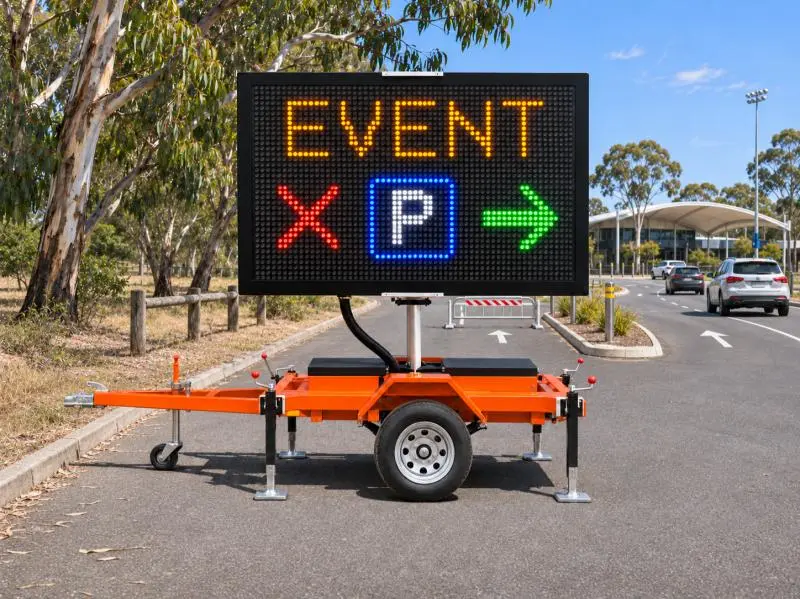
Yes. The MUTCD allows the message panel to vary in size as long as letter height, visibility, and legibility requirements are met. A wider face can help when a site needs larger characters or a full-matrix layout. Confirm that the mast, trailer, and towing permit can carry the extra width before ordering.
How many characters fit on a full-matrix changeable message sign?
Under MUTCD guidance, a message is normally limited to three lines of eight characters per line, split across no more than two phases. A full-matrix display can draw symbols and graphics as well as text, but the same readability limits still apply to the message itself.
Do dimensions change when radar or cameras are added?
The display face usually stays the same. Radar sensors, cameras, and antenna kits add hardware to the mast or cabinet, which can change the travel height and the weight distribution. Ask the supplier for the assembled envelope with all options fitted, not the base model drawing.