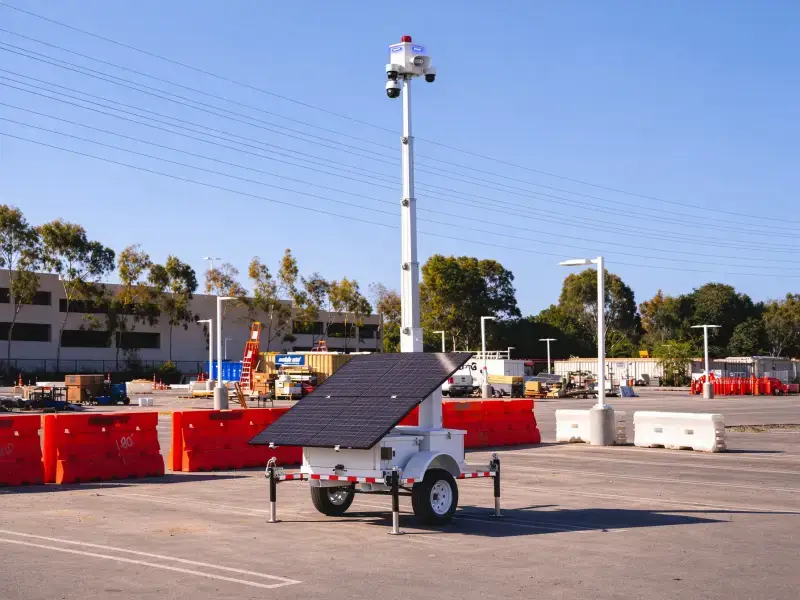
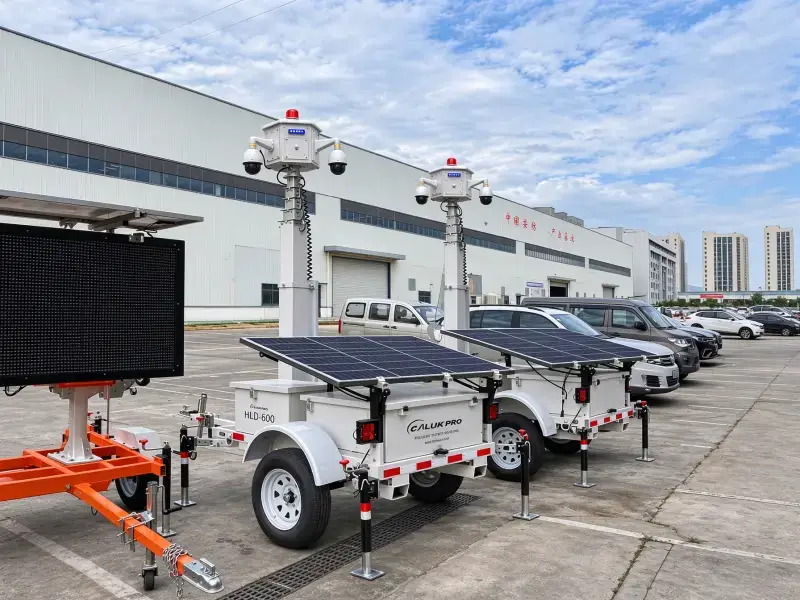
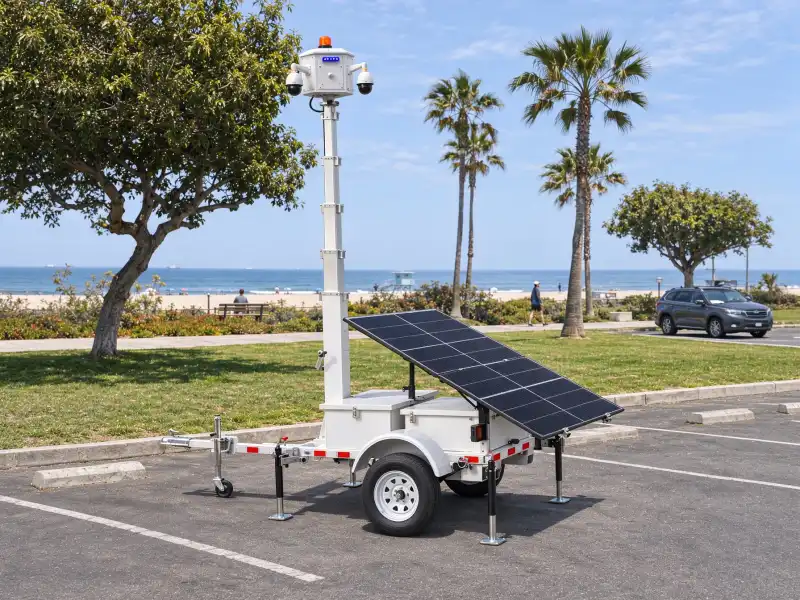
A portable changeable message sign shows up wherever traffic has to be told something it wasn’t expecting. Lane closures, a crash around the bend, a temporary speed drop, a terminal drop-off that moved overnight. Static signs can’t carry that kind of news. A rental board can be on site before the paint dries on the traffic control plan, which is why rental fleets carry most of the short-notice work in North America and Europe.
Renting a portable changeable message sign means paying for a trailer-mounted LED board, its power system, and the programming and support around it for a defined period, usually days to months. You get the display without the capital outlay, storage yard, battery replacement cycle, or resale problem. What the rate includes varies a lot between suppliers, and that variation, not the headline daily number, is where rental budgets go wrong.
This guide walks through what a rate actually buys, how MUTCD rules constrain the spec you should order, and where the break-even point with outright purchase sits.
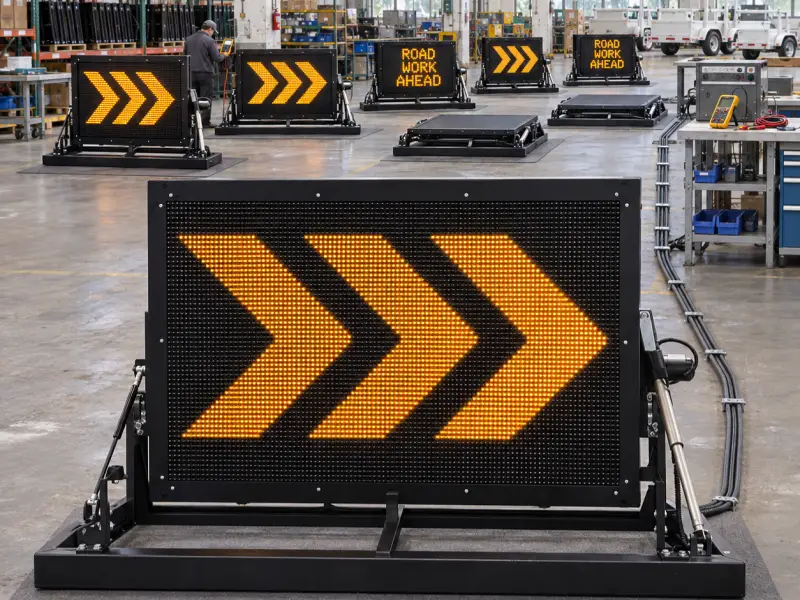
What a portable changeable message sign rental includes
A standard rental covers the trailer, the display panel, the battery bank, the solar array where fitted, a controller, and delivery to site within the supplier’s service area. Programming, remote monitoring, and technical support are increasingly bundled, though not uniformly.
The physical unit is only part of the package. Ask what happens on day two, when a message needs changing and the site supervisor has never touched a controller. Some suppliers program remotely through a cellular modem and a web dashboard. Others expect your crew to walk up and use the on-board keypad. Both are legitimate, but only one of them still works when you’re running three closures across two states with one foreman.
Service terms matter just as much. A rental that includes a mid-term battery swap is worth more than one that does not, especially on winter projects where solar yield drops and the display runs longer. Swap terms, response time for a failed panel, and whether the supplier charges for a site visit are the details that separate two quotes at the same daily rate.
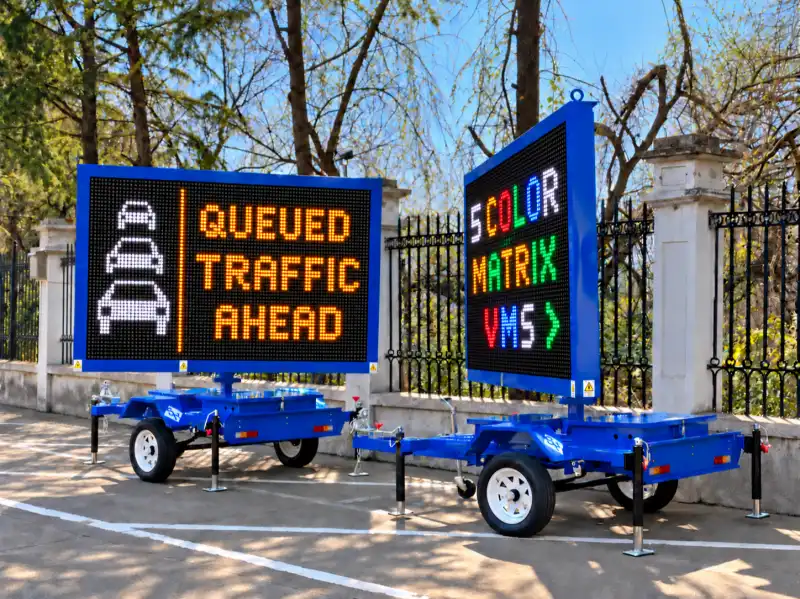
Fleet suppliers usually hold a spread of formats rather than a single model, so it pays to know the shape of the range before you specify. A look at a working variable message signs lineup shows the usual split: trailer-mounted, vehicle-mounted, three-line, full matrix, amber only, and full colour.
Changeable message sign cost: the variables that move the rate
There is no standard price for a changeable message sign rental. The rate is built from four things: how long you need it, how many units, how far the unit travels, and how much of the operation the supplier carries.
Published rate cards rarely survive contact with a real project, because the same board costs different money in different contexts. A weekend event in a metro area and a nine-month interstate rebuild are different products sold by the same fleet. Expect any quote to be assembled rather than read off a list.
Four levers do most of the work:
- Term length. Daily rates exist but punish long projects. Weekly, monthly, and seasonal pricing normally step down, so a project that runs past a month should be renegotiated on a monthly basis rather than stacked daily.
- Quantity. A single board carries delivery and setup overhead that ten boards share. Fleet buyers who can commit to a block of units usually get a better unit rate.
- Delivery distance. Transport is a real line item. A unit two hours away costs more to place and more to recover than one in the supplier’s home market.
- Support scope. Remote monitoring, cellular data, camera feeds, and radar integration all add recurring cost. So does any promise of a same-day replacement.
What usually sits outside the quoted rate
The gaps are predictable. Fuel or charging for the tow vehicle, permits, traffic control labour for placement, and damage waivers habitually sit outside the number you were quoted. So does anything that requires a second visit.
| Line item | Typically inside the rate | Typically an add-on |
|---|---|---|
| Display, trailer, battery, solar | Yes | No |
| Delivery within service area | Often | Beyond a radius |
| Remote programming and monitoring | Sometimes | Subscription |
| Camera or radar data | Rarely | Yes |
| Replacement unit after failure | Sometimes | Expedited |
| Damage and theft waiver | No | Yes |
| Permits and traffic control labour | No | No |
Read the exceptions clause before you compare two quotes. A cheaper rate with a four-day replacement window can cost more than a higher rate with a stocked local yard.
Term, quantity, and delivery distance
The cleanest way to control cost is to shorten the distance between the board and the truck that services it. Grouping units on one site, or on sites within an hour of each other, cuts both delivery and response time. Where the project plan allows, staggering the deployment so the board arrives two days before the closure rather than two weeks before also reduces billable days.
What MUTCD compliance means for a rented board
In the United States, a rented board has to meet the same standard as an owned one. MUTCD Part 6 sets the requirements for portable changeable message signs in temporary traffic control zones, and the current federal text is the 11th Edition, Revision 1, published in December 2025. States adopt editions on their own schedules, so confirm which version governs your site.
Compliance is not a sticker. It is a set of provisions across design, message construction, and placement, and a unit can satisfy some while failing others. The FHWA MUTCD Part 6 is worth reading directly before you sign a spec sheet, because procurement documents often quote a single clause and treat it as the whole requirement.
Two areas cause most of the disputes.
Message structure and phase limits
A portable changeable message sign should carry no more than two phases, and each phase has to make sense on its own, because a driver may enter the queue mid-cycle. Each phase displays for at least two seconds, and the pair should not exceed eight seconds in total. The point is that a driver at highway speed reads the message twice, not once.
The content rules are stricter than most first-time renters expect. No animation, no scrolling, no rapid flashing, no dissolving or exploding transitions. No advertising and no public service announcements. MUTCD language is explicit that these displays carry traffic operational, regulatory, warning, and guidance information only.
The practical consequence for a rental spec is simple. Ask whether the controller supports fixed, non-animated phases and whether the message library ships pre-loaded with compliant templates. Boards that default to scrolling text need that behaviour switched off before deployment, not after a complaint.
Height, character size, and legibility
Legibility is where cheap units show their limits. MUTCD expects a portable sign to be visible from half a mile in both day and night conditions, and letter height on trailer or truck-mounted units should be at least 18 inches. On service patrol trucks the floor drops to 10 inches. Smaller lettering is permitted on low-speed roads where the message stays legible from at least 650 feet.
Mounting height follows the same logic. A deployed panel has to sit clear of the roadway, with the bottom of the display around 7 feet above the surface as the usual working target, high enough to clear vehicles and low enough to stay in the driver’s cone of vision.
Brightness control is the third leg. A panel that is readable at noon and blinding at midnight is not compliant in practice. Automatic dimming, positive contrast with light characters on a dark background, and a luminance contrast in the range of 8 to 12 all belong in the specification.
Choosing between three-line and full matrix displays
Three-line boards follow the classic MUTCD layout of three lines of eight characters and suit short, structured messages. Full matrix panels address every pixel independently, so they can render variable character sizes, arrow symbols, and graphics. The choice is about message complexity, not quality.
A three-line unit forces discipline. Eight characters per line pushes you toward the messages that work best anyway: a problem, a location, an action. Expect delays. Right lane closed. Merge left. The format also makes it hard to over-write, which is the single most common messaging failure on work zones.
Full matrix opens up the rest. You can size a character to fill the panel, place a lane-shift graphic beside the text, or mix a symbol with a short legend. That flexibility earns its keep at complex merges, in event traffic, and on any site where a picture does the work of six words.
Cost and lead time sit between them. Three-line units are cheaper to rent and easier to find. Full matrix units cost more and are the first thing to disappear from a fleet during a busy season. Project teams specifying three-line portable changeable message signs usually do so because the message plan is already fixed. Teams that expect the message to evolve should book matrix panels early.

Trailer, truck, or roof mount: matching the mount to the site
Trailers suit fixed positions that last days or weeks. Vehicle-mounted boards suit mobile operations and short-duration work where setup time is the constraint. Roof-mounted units cover incident response and escort work. Mount type decides how fast you can move, not how well drivers see the message.
A trailer needs a tow vehicle, a level shoulder, and someone to set the jackstands. That is a twenty-minute job at best and a two-person job on uneven ground. In exchange you get stability in wind, a bigger panel, and a solar array large enough to run indefinitely in decent weather.
A truck-mounted board is on the road in minutes and moves with the crew. The trade is panel size and power independence. Units that draw from the vehicle need the engine running or a separate battery pack.
When a vehicle-mounted unit beats a trailer
Mobile lane closures settle the question. When the work moves a hundred metres an hour, a trailer is the wrong tool and a truck-mounted panel is the only one that keeps up. The same applies to incident response, where a responder arrives, deploys, and leaves within the hour.
Short-duration daytime work also favours the vehicle mount, because the setup and teardown cost of a trailer can exceed the duration of the job. Conversely, any position that will hold for a week or more should be a trailer, since the panel size and power reserve pay back the setup effort. A vehicle-mounted variable message signs range typically covers compact roof units through full-width truck panels, which means the mount decision and the size decision usually get made together.
Where rented boards earn their keep
Rental makes sense wherever the need is temporary, uncertain, or geographically spread. Work zones, event traffic, airport curb management, and seasonal parking all fit that description. Permanent installations do not.
The common thread is that the message changes and the location moves. A board that sits in one place for five years should be bought. A board that follows a paving crew across three counties should be rented.
Airports and passenger terminals
Airport ground traffic is its own discipline. Curbside pick-up lanes, terminal construction, parking shuttles, and rental car returns all need to redirect drivers who are already stressed and already late. A portable board placed before the terminal loop can move arrivals to a different door without rebuilding signage.
The constraint is height and sightline. Airport roads are often low-speed but cluttered with buses, barriers, and wayfinding totems. A board has to clear the sightline without competing with permanent directional signs, and the message has to be short enough to read in the two seconds a driver gets between a speed table and a merge.
Work zones, events, and parking lots
Work zones remain the core application, and the message plan should be written before the board is ordered. Event traffic is the second: a fairground, a stadium, or a festival site needs the same board on Thursday for inbound routing and on Sunday for egress, which is exactly the pattern rental pricing is built for.
Parking is the quiet third use. Overflow lots, temporary lots on demolition sites, and seasonal lots that only operate in summer all benefit from a board that says full, or says where the next space is, without hiring staff to wave cars through.
Programming the board: generators, controllers, and abbreviations
A variable message sign generator is the software or on-board tool that turns a plain sentence into a compliant display, checking character count, line breaks, phase timing, and the pixel layout before the message goes live. Good generators ship with a library of pre-approved messages, which is faster and safer than writing from scratch on site.
The phrase confuses some buyers, who hear generator and think of the power side. Both meanings appear in the market. The software meaning dominates, because the bottleneck on most projects is not electricity but someone writing a message that fits eight characters a line and still reads clearly.
Controllers come in two broad flavours. On-board units with a keypad or touchscreen are self-contained and work without a data connection. Remote systems push messages from a web dashboard over cellular, which is how a supplier programs fifty boards from an office. Remote systems also carry diagnostics, battery voltage, and location, and they usually integrate with state 511 feeds and work zone data exchanges.
Message board abbreviations are the part that ages badly. MUTCD guidance pushes toward conventional English syntax and warns against witticisms, colloquialisms, and anything drivers have to decode. Stick to abbreviations a licence holder would recognise instantly, and keep a written library so two crews on the same project don’t invent two different short forms for the same closure.
Rental versus purchase: when buying a variable message sign wins
Buying wins when annual utilisation passes roughly a third of the year and the board stays in one fleet’s control. Renting wins below that threshold, and it wins outright whenever the requirement might disappear next quarter.
The comparison is not the daily rate against the purchase price. It is total cost of ownership against total rental spend over the same period. Ownership carries the purchase price, freight, storage, insurance, battery replacement every few years, controller software updates, and the resale or disposal problem at the end. Rental carries a higher unit cost and none of that.
Run the numbers on three inputs: how many days a year the board will be deployed, whether those days are consecutive, and whether you can store and maintain it. A contractor running continuous highway work will usually find ownership cheaper inside two years. A municipality handling four events a year will not, and should not try.
Power choice changes the arithmetic. A solar-powered mobile changeable message sign removes fuel deliveries and generator noise from the operating cost, for owned and rented units alike. It also removes the excuse for a dead board on a Monday morning, provided the array and battery bank were sized for winter rather than for the commissioning photos.
A pre-rental checklist worth printing
Most rental problems trace back to four unanswered questions: what the rate excludes, what the replacement window is, who is allowed to program the board, and whether the site has a legal place to put it.
Work through these before the purchase order goes out.
| Question | Why it matters |
|---|---|
| Which MUTCD edition does the local agency enforce? | Determines message format and mounting height |
| What is the guaranteed replacement time? | A dead board stops a closure |
| Is programming remote, on-site, or both? | Decides crew training and labour hours |
| Does the site need a permit for the board? | Placement on state right of way often does |
| Is the panel rated for local wind loads? | Coastal and open-plain sites expose this fast |
| What does the damage waiver actually cover? | Theft and third-party damage are usually separate |
| Who recovers the unit, and is that billed? | Recovery fees surprise first-time renters |
Two of these deserve a second look. Permits are the most common cause of a board sitting in a yard while a closure runs without advance warning. Wind rating is the most common cause of a board on its side in the median after a storm, which is both a safety report and an invoice.
Frequently asked questions
Can a rented message board replace required static signage?
No. A portable changeable message sign supplements the traffic control plan. It does not substitute for regulatory or warning signs the plan requires, and using one that way puts the site out of compliance regardless of how clear the message is.
How long will a solar board run without direct sun?
That depends on the battery bank, the display load, and the message brightness setting, so no single figure covers the range. Ask the supplier for the published runtime at your expected duty cycle and check it against the shortest winter day in your market, not the best week of summer.
Who is responsible if the board is damaged on site?
Usually the renter, unless a damage waiver was purchased and the cause falls inside its terms. Read what the waiver excludes before deployment, because theft, third-party vehicle strikes, and storm damage are often treated as separate events with separate deductibles.