A work zone changes the road under a driver who has already picked a speed and a lane. Cones, drums and static signs describe the change, but none of them can say why traffic is backing up a quarter mile before the closure. That is the job of the board on the shoulder, and it only works when the words on it can be read at the posted speed. Weak work zone messages are rarely badly written. They are written for a reader sitting still.
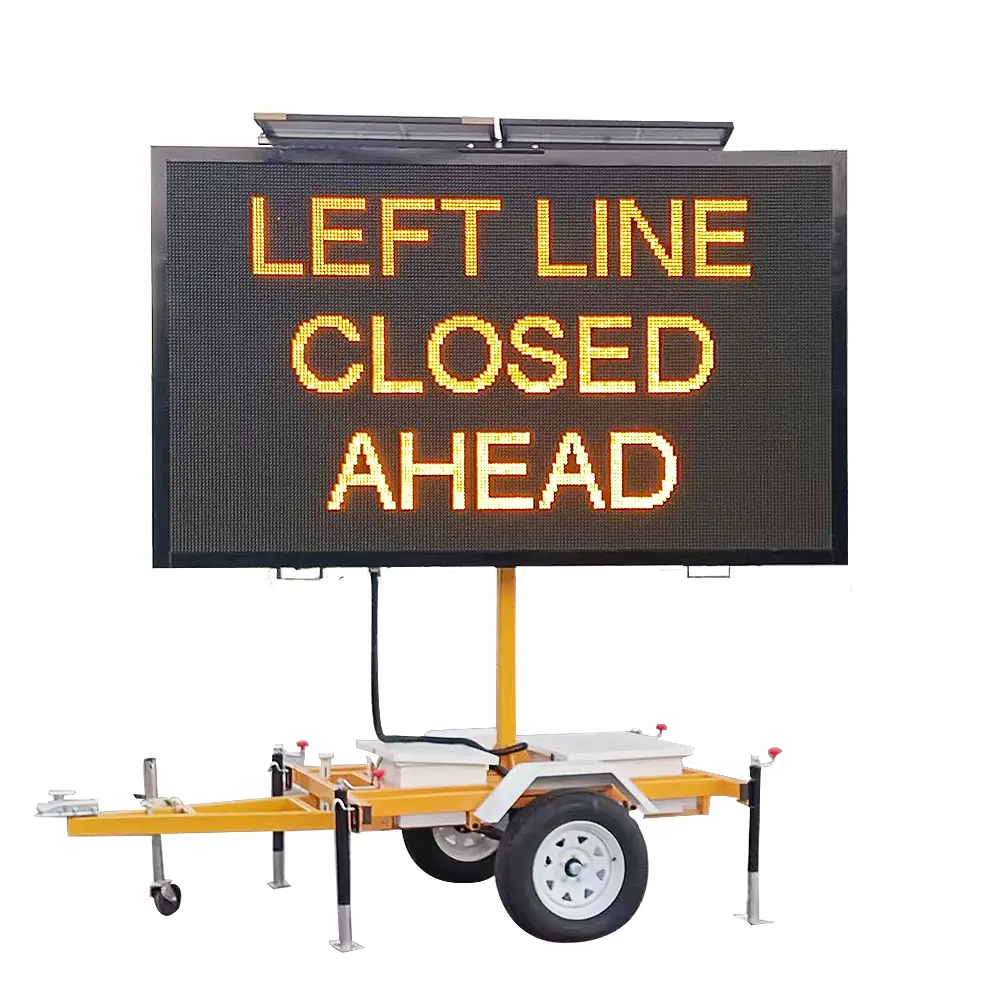
A workable message on a traffic control board carries three short thoughts on three lines of eight characters or fewer, uses no more than two phases, and runs long enough for a driver to read it twice before the taper. Everything else, from wording to abbreviation to character height, serves that budget.
The tips below follow the order a message travels in practice: what it has to say, how it fits the display, which board suits the site, and how to check it before the first cone goes down.
What a VMS message has to do before a driver reaches the taper
A message has to name the problem, say where it is, and tell the driver what to do about it. If one of those three is missing, the driver fills the gap with a guess, and guesses at 60 mph are usually wrong.
Placement explains why the brief is narrow. In a work zone the board belongs in the advance warning area, upstream of the taper, where a driver still has room to merge or exit. Federal guidance says as much: portable variable message signs exist to advise road users of unexpected conditions ahead and to give them information they can act on before the point where action is required.
Three thoughts, one per line
The structure that survives field testing is the one traffic engineers keep returning to:
- The problem: what the driver is about to meet.
- The location: where it starts, or how far ahead.
- The action: what to do about it.
On a three-line board those thoughts map onto three lines almost by default. ROAD WORK AHEAD on line one. RIGHT LANE CLOSED on line two. MERGE LEFT on line three. Nine words, one instruction, no ambiguity.
Order matters too. Drivers scan in the sequence they expect, so leading with the instruction forces a re-read.
Reading time is the real budget
At highway speed a message has roughly eight seconds before the driver is past it. That translates to about eight words at 55 mph, seven at 65 mph and six at 70 mph. The figures come from decades of human factors work, and they explain why a sentence that reads well on paper falls apart in the field.
| Approach speed | Words the message can carry | What that allows |
|---|---|---|
| 25 to 35 mph | 9 to 12 | Problem, location and action, plus one qualifier |
| 45 mph | 9 | Problem, location and action |
| 55 mph | 8 | Problem and action, stated plainly |
| 65 mph | 7 | Problem and action, location dropped if obvious |
| 70 mph and above | 6 | Action and reason, nothing else |
The table is a ceiling, not a target. A driver also watching a lane shift will not read to the ceiling.
Write the message in three lines, not three paragraphs
Most portable boards give you three lines of eight characters. Treat that as the design constraint it is, because a message that does not fit gets truncated by the display rather than shortened by the operator.
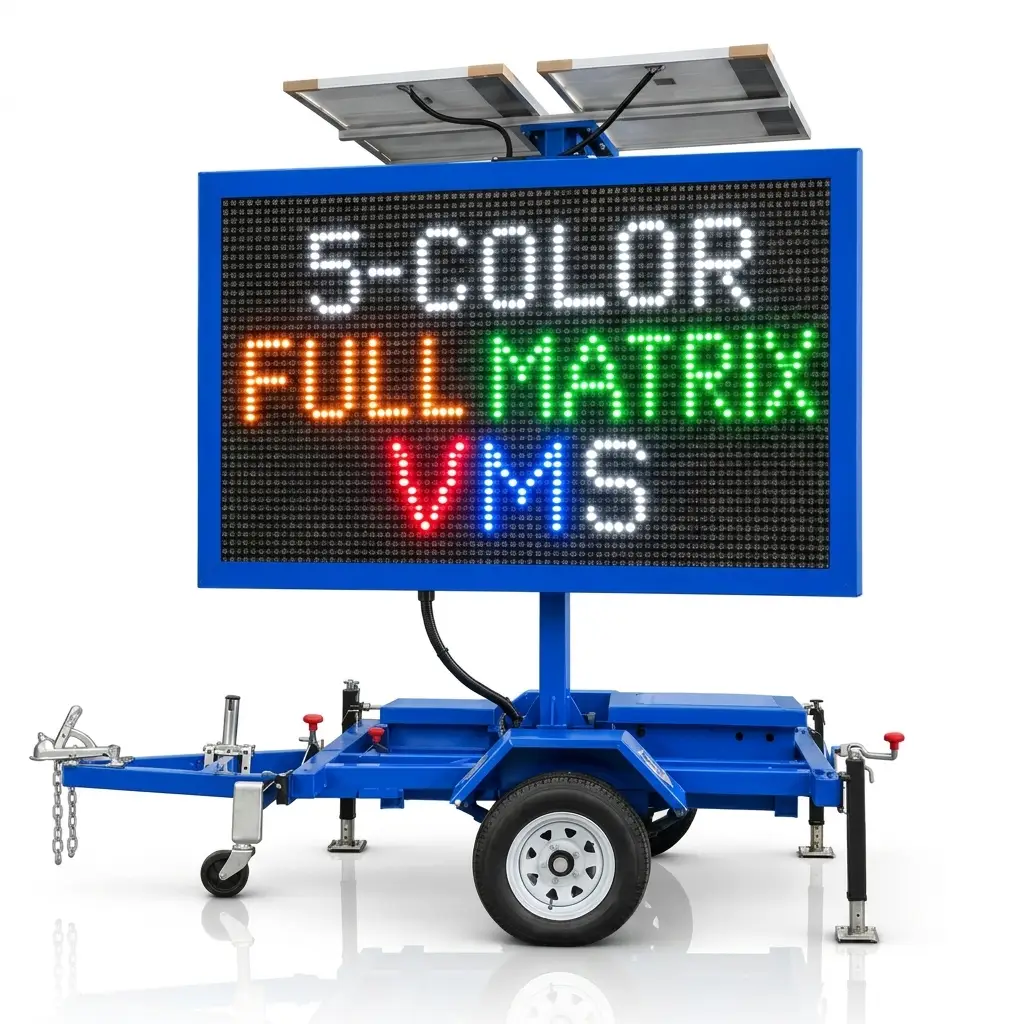
The limit applies to character-matrix boards, where each character sits in a fixed block. A full-matrix display sizes characters freely and lifts the character count, but not the reading-time budget.
Character height is the other half of legibility. Federal reference figures put an 18 inch character at roughly 720 feet of legibility, a 24 inch character at about 960 feet and a 54 inch character at more than 2,100 feet. The faster the road, the taller the letters.
| Character height | Legibility distance | Where it fits |
|---|---|---|
| 18 inches | About 720 feet | Work zones up to roughly 45 mph |
| 24 inches | About 960 feet | Arterials and moderate speed approaches |
| 54 inches | About 2,160 feet | Freeways and expressways |
Boards built as three-line portable changeable message signs sit at the practical end of that range: cheap to move, quick to set and predictable for drivers who have seen the layout before. The limitation is the one above. Eight characters per line forces the operator to choose words that earn their space.
Use standard abbreviations, and only a few
Abbreviations are the pressure valve when a thought will not fit, and also where messages go wrong. The safe set is short and well known: BLVD, CNTR, RD, EXPWY, HWY, LFT, MAINT, SERV, SHLDR, SPD. Anything invented on site is a guess imposed on a moving driver. Allow one or two per phase, and never abbreviate the action. MERGE LEFT is understood immediately. MRG LFT costs a beat of decoding the driver may not have.
Two phases at most, and each one has to stand alone
A second phase buys one extra thought, not a paragraph. Each phase must be understandable on its own, must display for at least two seconds, and the two together should not run past eight seconds.
Federal guidance on portable changeable message signs sets those numbers and adds the reason: drivers struggle to follow a message spread over more than two phases on a three-line board. Where a third phase is genuinely needed, the answer is a second board, spaced at least 1,000 feet away on freeways and 500 feet on other highways.
Order independence is what operators forget. A driver can join the queue at any point, so phase two may be the first thing they see. If it reads LANE CLOSED without naming the lane, it fails that driver.
A two-phase message worked through
Take a night closure where the right lane shuts down a mile ahead. Phase one reads RIGHT LANE CLOSED: problem stated, one idea, six characters per line. Phase two reads MERGE LEFT NOW: action stated, standalone, still one idea.
A weaker pairing would be ROAD WORK 1 MI AHEAD followed by CAUTION. The second phase carries no information, and a driver arriving mid cycle gets a warning word they cannot act on.
The MUTCD Chapter 6F treatment of portable changeable message signs is worth reading in full if you approve message sets.
Match the board to the site
A three-line trailer covers most road work, a full-matrix board earns its cost where symbols or colour matter, and a truck-mounted unit wins wherever the closure moves during the shift. Buying one type for every job is where messaging budgets go wrong.
| Board type | Best fit | The trade |
|---|---|---|
| Trailer-mounted three-line unit | Long lane closures, detours, night work | Eight characters per line, few symbols |
| Full-matrix trailer unit | Complex merges, colour coded messages | Higher cost, more setup attention |
| Truck-mounted unit | Mobile operations, short closures, incidents | Smaller panel, letters can drop to 10 inches |
| Vehicle roof unit | Rapid response, short duration work | Shortest reading distance, least capacity |
Trailer-mounted variable message signs carry most of the work because they balance display size against tow weight and setup time. Two people can position one and have a message running in a fraction of the time a fixed installation needs. Where the closure moves through the shift, a truck mounted traffic control VMS keeps the message with the operation instead of leaving it behind.
Put the board where the decision is still open
Placement is a design decision wearing logistics clothing. Reference points from state practice include about 900 feet on the approach to a construction area, enough for two message cycles, and 500 to 800 feet ahead of a developing problem. Where the pattern is unfamiliar, half a mile to two miles is the working range. Freeway approaches push that further, with warning signs spaced around 1,000 feet, then 1,500 feet, then half a mile.
Field checks matter more than the numbers:
- Clear sightline for the full legibility distance, with no crest, curve or parked plant in the way.
- Board on the shoulder or median, outside the clear zone where possible, delineated with drums if not.
- Panel tall enough that the bottom clears traffic, commonly 7 feet in urban areas and 5 feet in rural ones.
Power, height and night visibility
Solar panels and battery storage have made mains power optional, which takes the cable run and the generator out of the setup. Two requirements keep that honest. The display has to adjust brightness automatically as light changes, and the unit needs a battery backup so the message does not vanish when the primary supply fails.
Glare is the quiet failure mode. A panel facing a low morning sun reads as a black rectangle from the approach. Angling the face slightly toward the roadway, then rechecking after a season change, fixes more complaints than any rewrite of the message.
The messages drivers ignore
Drivers stop reading boards that waste their attention. Slogans, stacked numbers, invented abbreviations and messages that repeat the static signs all teach a driver to skim past the one board that mattered.
The pattern turns up in every review of message sets:
- Campaign wording. Federal rules limit these signs to traffic operational, regulatory, warning and guidance information and bar advertising. A safety slogan spends the whole reading budget on nothing.
- Warning words as content. CAUTION announces that a message follows without delivering it.
- Arithmetic. CLOSURE 2,200 FT in the same phase as DIST 1.5 MI asks the driver to convert units while changing lanes.
- Stale content. A board still reading LEFT LANE CLOSED after the closure moved right is worse than a blank panel.
What to cut first
When a message will not fit, cut in this order. Drop anything already covered by static signs. Drop distance where the location is obvious. Drop courtesy wording. Shorten the problem statement to two words if the action is clear. Never cut the action, because that is the only part the driver has to do something with.
Test the message before the first cone goes down
Read the message aloud at one word per second and time it. If it runs past eight seconds, it is too long for the road it is going on, whatever the display can physically hold.
There is a reason operators search for a free traffic message board simulator: they want to see a message before committing it to a live sign. Generic sign generators show the layout, but not whether the words survive at 65 mph. The tool that answers that question already sits in the equipment. Federal guidance requires the control system to include a screen for reviewing a message before it is displayed.
A paper grid does the same job faster. Draw three rows of eight boxes and check that each line holds one thought.
A five-minute field check
- Stand at the legibility distance for the character height and read the message once.
- Check the sun angle at the hour the closure will be busiest.
- Photograph the board from the approach lane, not the shoulder. The camera sees what the driver sees.
Keep a message library for the whole project
Projects that get messaging right pre-approve a set of messages for each closure type, keep one person accountable for changes, and review the set whenever the traffic pattern moves.
A library removes the improvisation that produces most bad messages at two in the morning. Typical entries cover a shoulder closure, a lane closure, a full closure with detour and a default message for a failed unit. Date the library and retire entries when the pattern changes, because a stale set is how a closure that moved last Tuesday shows up on a board on Friday.
Boards also work best when planned alongside the rest of the traffic control arrangement rather than bolted on afterwards, which is the logic behind treating intelligent traffic control solutions as a system rather than a shopping list of devices.
FAQ
How far ahead of a work zone should a message board be placed?
Far enough that a driver can read the message twice and still change lanes. In practice that means about half a mile of clear visibility, roughly 900 feet on the approach to a construction area, and half a mile to two miles ahead of an unfamiliar pattern.
Can a portable message board run three phases?
It can run the cycle, but drivers will not follow it. Two phases is the working limit on a three-line board. If a message genuinely needs three parts, add a second board and space the two at least 1,000 feet apart on a freeway or 500 feet on other roads.
Do portable message boards need mains power?
Most do not. Solar panels and battery storage run a modern unit through a shift, and federal guidance expects a battery backup so the display keeps working if the primary supply fails. The display still has to adjust brightness automatically through the day, and that protects legibility more than raw power does.