Highway work zones change faster than static signage can. A lane closes at dawn, reopens at midday, and shifts again for the night crew, while the posted speed follows each phase. Drivers who pass the same “ROAD WORK AHEAD” board for weeks stop reading it. A portable changeable message sign can show today’s condition instead of last month’s, but only if it sits far enough upstream, says one thing at a time, and gets changed when the site changes.
Put the portable changeable message sign in the advance warning area, upstream of the taper, with short phases that name the condition, the distance, and the driver action. The board warns that a lower speed is coming; the regulatory signs on site set the legal limit. Distances come from the current MUTCD table and the state supplement, the display needs three large-character lines with automatic dimming, and the unit needs battery backup. Crews remove or blank the message as soon as the condition ends.
The sections below cover the device, the display, the control link, the placement, the wording, and the checks that keep a roadside board accurate.
What a variable message sign does in a speed-restricted work zone
A variable message sign in a work zone is an advance warning device, not a speed limit sign. It tells drivers that a reduced speed is ahead, why, and how far off, so they can slow before the taper. MUTCD guidance says portable units supplement conventional signs and markings rather than replace them.
A temporary traffic control zone has four areas: advance warning, transition, activity, and termination. A portable changeable message sign belongs in the first, where drivers still have room to read, decide, and change speed. MUTCD Chapter 6F lists speed control and speed reductions among the recognised temporary traffic control applications (checked 11 November 2026).
VMS, CMS, DMS and PCMS: one device family
The acronyms cover one equipment family. What changes is the agency’s vocabulary and whether the unit is fixed or portable.
| Term | Where the wording is common | What it means here |
|---|---|---|
| Variable message sign, VMS | International tender documents | Broad term for fixed and portable units |
| Changeable message sign, CMS | US MUTCD and state DOT documents | Formal US term for a multi-message sign |
| Portable changeable message sign, PCMS | US work zone specifications | Trailer or truck mounted, temporary use |
| Dynamic message sign, DMS | US highway agencies and ITS specifications | Usually a permanent, networked sign |
| Traffic message board, vms board | Field and rental language | Informal names for the same roadside equipment |
Terminology follows MUTCD Chapter 2L and Chapter 6F (checked 11 November 2026). A buyer comparing variable message signs for a highway contract is usually choosing between a fixed corridor display and a towable unit. Some crews call the same hardware a variable message board or a changeable message board; the label does not change the format limits.
What a portable sign can and cannot say
Portable changeable message signs may show traffic operational, regulatory, warning, and guidance information only. A speed message fits, but its number has to match the sign physically in place at that hour (MUTCD Chapter 6F, checked 11 November 2026). They cannot replace cones, arrow boards, flaggers, or the R2-1 sign. A 1999 FHWA report noted that drivers discount warnings after seeing “SLOW” boards left standing once crews go home, and VMS messages that no longer match conditions (checked 11 November 2026).
How a changeable message board carries a speed message at highway speed
It has to be read in the few seconds a driver has at the posted speed. That pushes the design toward short lines, large characters, positive contrast, and automatic brightness control, and it sets how far away the board must be legible. Hardware and placement are one decision, not two.
MUTCD Chapter 6F asks for adjustable display rates of at least three seconds per phase, so the whole message can be read twice at the posted speed, the off-peak 85th percentile speed before work starts, or the anticipated operating speed. A message needing more than two phases calls for a second board. Text may not scroll across the sign face (checked 11 November 2026).
Three lines, eight characters, and character height
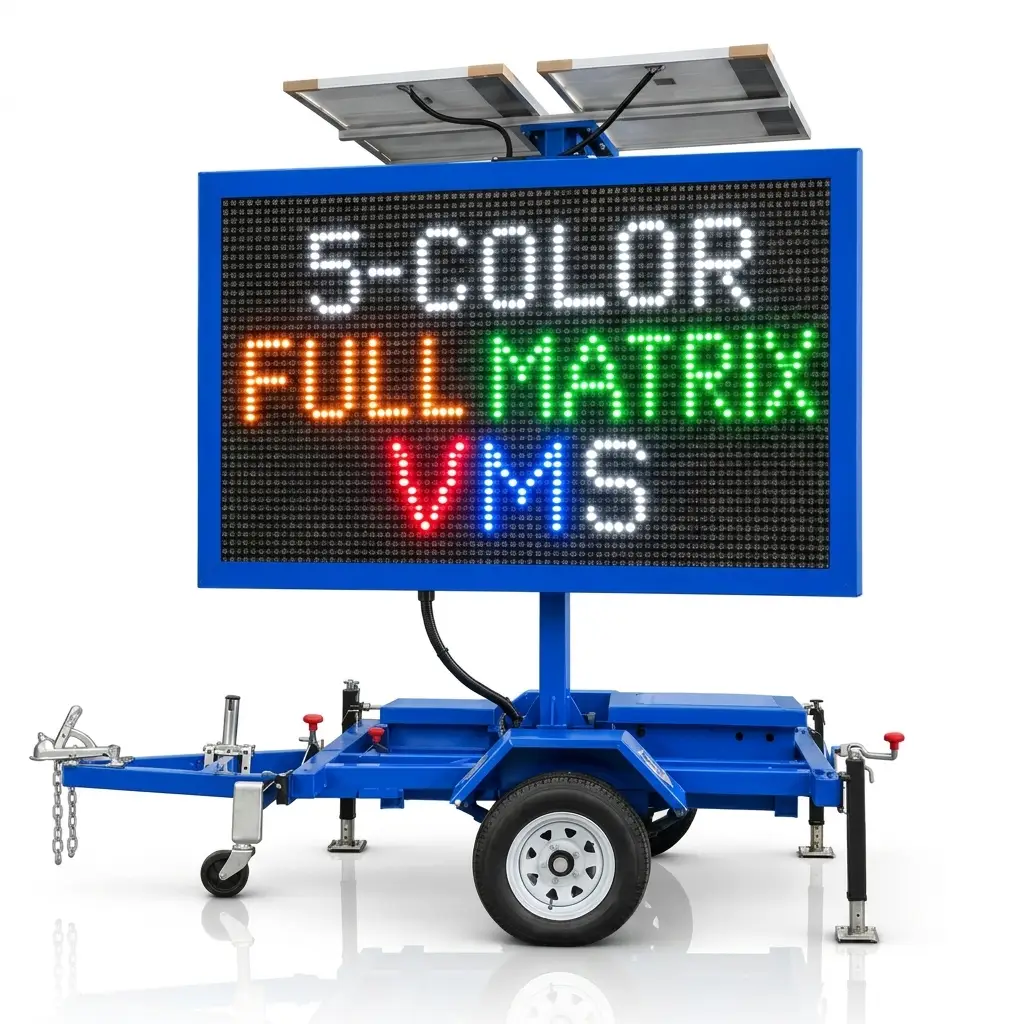
A full matrix VMs board uses one continuous pixel grid, so it can show different fonts, arrows, and symbols. A character matrix or 3-line sign gives each character its own fixed cell. The three-line format is why a three line message sign trailer is specified so often: it maps onto problem, location, action.
| Parameter | Requirement under MUTCD Chapter 6F |
|---|---|
| Message phases | One or two per message |
| Lines per phase | Up to three |
| Characters per line | Eight |
| Pixel matrix per character | At least 5 wide by 7 high |
| Character height, trailer or large truck | At least 18 in (450 mm) |
| Character height, service patrol truck | At least 10 in (250 mm) |
| Legibility, trailer mounted | 0.5 mi (800 m), day and night |
| Legend and background | Yellow or orange on black |
| Text motion | No scrolling or travelling text |
Checked 11 November 2026. Units sold as three-line portable changeable message signs follow this layout; a changeable message board with fewer lines leaves less room to separate the condition from the action.
Legibility distance and what it means for placement
Character height, reading distance, and speed move together. A published reproduction of the FHWA 2003 PCMS Handbook gives these planning estimates:
| Character height | Estimated legibility distance | Associated vehicle speed |
|---|---|---|
| 18 in | 720 ft | 40 mph |
| 24 in | 960 ft | 50 mph |
Source: FHWA 2003 PCMS Handbook, reproduced in ATSSA and VTrans work zone guidance, checked 11 November 2026. These are estimates, not approval values.
A board legible from 720 ft does a driver at 65 mph no good if it stands 300 ft before the taper. MUTCD Chapter 6F also requires automatic brightness adjustment, and ATSSA guidance suggests rotating the face about 3 degrees toward the road to cut glare (checked 11 November 2026).
How electronic highway message boards communicate and stay powered
A portable board is self contained. An onboard controller stores and previews the message, a communications link carries changes from a field operator or a traffic management center, and a solar panel with a battery bank keeps the display running off grid. MUTCD names four parts: the sign panel, the control system, the power source, and the mounting and transport equipment.
That last part is easy to miss. A message sign trailer is a towed vehicle as well as a display, so draw bar, mast, outriggers, and lights belong in the specification.
Onboard controller and message preview
MUTCD Chapter 6F requires a screen for reviewing messages before display, memory that survives a power loss, and battery backup for continuous operation if the primary source fails. Operators keep a library of pre-approved messages and call them up from a keypad, laptop, or phone on site. This preview step catches overrunning lines, obscure abbreviations, and phases that take too long to read (checked 11 November 2026).
Remote links and when they matter
Electronic highway message boards communicate over whatever link the contract and the site allow.
| Control method | Where it fits | What to confirm |
|---|---|---|
| Onboard keypad or laptop | One site, one short closure | Who holds the access code and how changes are logged |
| Cellular or radio link | Several boards, hourly changes | Site coverage and a local fallback |
| NTCIP 1203 through a central system | Contracts requiring ITS integration | Whether the contract asks for protocol support |
NTCIP 1203 defines how a central system controls and monitors dynamic message signs. Many ordinary work zone jobs do not need it. Remote access brings permissions, account costs, and a decision about who approves an emergency message, so specify it only when the operating process needs it.
Solar and battery autonomy
Solar power avoids generator fuel, noise, and refuelling trips on remote highway sites. Panel output and usable battery capacity have to cover the display at its real brightness setting through the site’s worst run of low sun. MUTCD requires backup power for continuous operation but sets no autonomy period (checked 11 November 2026). Treat the sizing as a project calculation, not a catalogue spec.
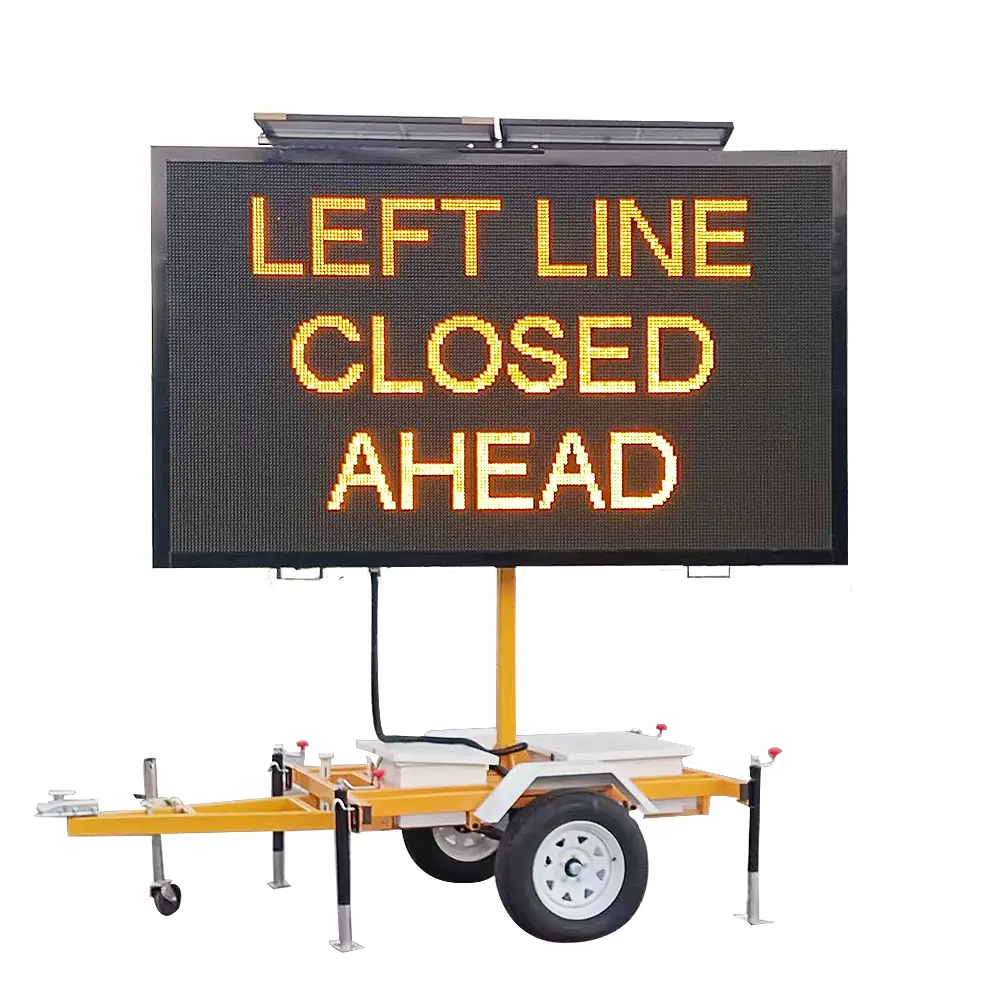
Where to place a portable changeable message sign for a speed restriction
Put it in the advance warning area, upstream of the taper, on the shoulder and clear of other signs, with a sightline long enough to read the whole message twice. Take the distance from the current MUTCD table and the state supplement, not from habit. Multiple boards go on the same side of the roadway, spaced by the same table.
The FHWA MUTCD is the national standard for US traffic control devices, published under 23 CFR Part 655 Subpart F. The 11th Edition took effect on 18 January 2024 and Revision 1 on 5 March 2026. States adopt it on their own timeline and may publish supplements, so check both (checked 11 November 2026).
Work inside the advance warning area
MUTCD Section 6B.04 of the 11th Edition carries Table 6C-1 for a three-sign advance warning sequence. As reproduced in published placement guidance:
| Road type | First sign to taper | Between first and second | Between second and third |
|---|---|---|---|
| Urban, low speed | 100 ft | 100 ft | 100 ft |
| Urban, high speed | 350 ft | 350 ft | 350 ft |
| Rural | 500 ft | 500 ft | 500 ft |
| Expressway or freeway | 1,000 ft | 1,500 ft | 2,640 ft (half mile) |
Source: MUTCD Table 6C-1, Section 6B.04, 11th Edition, as cited in published placement guidance, checked 11 November 2026. These are approximate values; state supplements and engineering judgment can modify them.
The portable changeable message sign sits with or ahead of the first warning signs, never in the buffer space and never hiding a static sign. For a route diversion, MUTCD asks for enough upstream distance to change lanes, adjust speed, or exit.
Site selection and trailer setup
- Confirm the traffic control plan, current distances, and state supplement before towing.
- Choose the shoulder or a spot behind a barrier, on the same side as the affected lane, with no curve, crest, or vegetation inside the legibility distance.
- Keep the trailer out of the buffer space and clear of existing warning signs.
- Level it, set the outriggers, and raise the panel so its bottom edge is at least 7 ft above the roadway in urban areas and 5 ft in rural areas (MUTCD Chapter 6F).
- Rotate the face about 3 degrees toward traffic to cut glare, then confirm automatic dimming.
- Delineate with retroreflective devices or conspicuity tape on the face seen by oncoming drivers, then recheck after the first night.
Steps 4 to 6 follow MUTCD Chapter 6F and ATSSA guidance (checked 11 November 2026). An unlevel trailer skews the display angle; an unanchored one in a crosswind becomes a hazard.
Sequencing the speed reduction
| Position | Device | Job |
|---|---|---|
| Farthest upstream | Portable changeable message sign | Warn of work and the coming speed change |
| Mid sequence | Regulatory speed sign, sometimes with a WORKSITE plaque | State the legal reduced speed |
| Near the taper | Arrow board | Direct the merge |
| At or after the taper | Radar speed display | Show each driver their measured speed |
A 2012 FHWA work zone webinar described one state’s layout: the changeable message sign 1,000 ft before the one-mile advance warning sign, portable regulatory signs after that sign, and radar displays 500 ft past the half-mile closure warning (checked 11 November 2026). That is one agency’s arrangement, not a universal rule. Where a variable speed limit assembly is specified, one state DOT’s 2025 toolkit treats it as a separate digital R2-1 sign, not a text message on a PCMS (checked 11 November 2026).
How to write a speed restriction message drivers will act on
Use one idea per phase. Put the problem on the top line, the location or distance on the middle line, and the driver action on the bottom line, and use the same speed value as the regulatory signs on site. A message a driver cannot finish before the taper does nothing.
At highway speed a driver gets one short look. MUTCD Chapter 6F says each phase should convey a single thought, the message should be as brief as possible, and abbreviations should be easy to understand (checked 11 November 2026).
One idea per phase
A phase has to stand alone, because a driver may join the queue partway through. If the message needs more than two phases, add a second portable changeable message sign. Messages cannot scroll, fade, dissolve, or flash for emphasis.
The strings below show structure only. They are illustrative message strings, not a recommended speed value or an approved message set.
| Phase | Problem | Location or distance | Driver action |
|---|---|---|---|
| 1 | WORK | 1 MILE | SLOW |
| 2 | LANE | CLOSED | MERGE |
Any numeric speed in a live message has to match the regulatory sign in place at that hour. No single value fits every site, so this guide does not suggest one.
Advisory wording versus regulatory speed signs
“REDUCE SPEED” on a traffic message board is a warning. It asks for a behaviour change; it does not set a legal limit. The limit comes from the R2-1 style sign and any WORKSITE plaque in the plan. A board saying 40 while the roadside sign says 55 teaches drivers to ignore both.
Variable speed limit assemblies are a different device. One state DOT’s 2025 work zone toolkit specifies a digital R2-1 legend with white characters on black, at least 5 by 7 pixels per numeral, automatic brightness adjustment, a static display with no animation, and a mounting height of at least 7 ft (checked 11 November 2026). That is a state specification, not a general MUTCD requirement.
Messages that lose driver trust
A 1999 FHWA report on real-time work zone information put it plainly: motorists discount warnings after seeing too many “SLOW” boards still standing once the crew left, and VMS messages that did not reflect current conditions (checked 11 November 2026). The fix is procedural. Write the change log into the shift handover, and name one person responsible for updating or blanking the board when a phase ends.
MUTCD Chapter 6F backs this up. A board not in use should be removed; if it cannot be, it should be shielded; if neither is possible, it should be delineated with retroreflective devices.
What to check after the sign is live
Treat the board as part of the traffic control plan, not as equipment you set and forget. Each shift should confirm that the message still matches the site, the display is legible in the current light, and the trailer is still level, anchored, and delineated. Most field failures are small ones a short walk-around would catch.
| Check | When | Action if it fails |
|---|---|---|
| Message matches current conditions | Start of each shift, after any phase change | Rewrite or blank the display |
| Dimming and daytime legibility | Daily, at dusk and in bright sun | Clean the face, check the photocell |
| Battery status and charging | Each shift | Bring in backup power |
| Outriggers, level, and mast lock | After setup and after high wind | Relevel and resecure |
| Cones, barrels, or conspicuity tape | Each shift | Replace missing delineation |
| Sightline from the approach lane | After any layout change | Move the board upstream |
Checks follow MUTCD Chapter 6F and ATSSA guidance (checked 11 November 2026).
Shift checks
Keep a simple record: who changed the message, when, and against which version of the plan. It matters most on sites with remote access, where several people can edit a changeable message sign from different places. Lock the controller cabinet, restrict the accounts, and set the approval path before the first night shift. Transport is hard on mast locks, connectors, and leveling jacks, so a board back from another site needs the same checks as a new one.
When to remove, shield, or blank the board
The MUTCD order is remove first, shield second, delineate third. A board back at the yard cannot be hit, vandalised, or left showing a stale restriction to the morning commute. Where one trailer covers several sites, a trailer-mounted amber PCMS can be towed in each morning; every arrival counts as a fresh setup, not a continuation of yesterday’s.
Frequently asked questions
The questions left over are about tooling, reuse, and service intervals. None changes the placement or wording rules above, but each affects how a crew plans a deployment and what it asks a supplier to put in writing.
Do I need a simulator or separate software to program a roadside message board?
Usually no. The onboard controller already has the preview screen MUTCD Chapter 6F asks for, and most suppliers include a desktop or web editor for laying out lines, checking character counts, and saving pre-approved messages. People searching for a free traffic message board simulator are generally after that preview function, not a separate training package. Check that the editor enforces the real board’s limits: lines per phase, characters per line, phase duration, and approved abbreviations. A laptop preview that ignores the 8-character line will fail in the field.
Can one message sign trailer cover day and night shifts at more than one site?
Yes, if the crew treats every move as a new setup. Towing a portable changeable message sign means redoing the leveling, outriggers, mounting height, sightline check, 3-degree rotation, and delineation, and rewriting the speed message to match the signs there. Check tow vehicle capability, hitch type, trailer weight, storage between shifts, and who holds the keys. Remote status such as battery level, location, and the current message can save driving, but it does not replace the on-site setup check.
How long can a solar portable sign stay out before it needs servicing?
There is no standard number of days. It depends on display power draw at the brightness setting in use, usable battery capacity, local solar data for the season, message change frequency, and whether the panel stays clear of dust and shade. MUTCD requires backup power for continuous operation but sets no autonomy period. Ask the supplier for a figure calculated from your solar data, brightness setting, and planned unattended period, with margin for a bad week of weather. Then log battery status each shift so the estimate gets checked against reality.