Roadside signage assumes the road behaves the same way every day. It does not. A lane closes at nine in the morning, a ramp backs up at half past four, a car park fills by noon, and a painted aluminium panel cannot say any of that. Agencies and contractors have spent decades looking for a sign that can be rewritten from a desk instead of by a work crew.
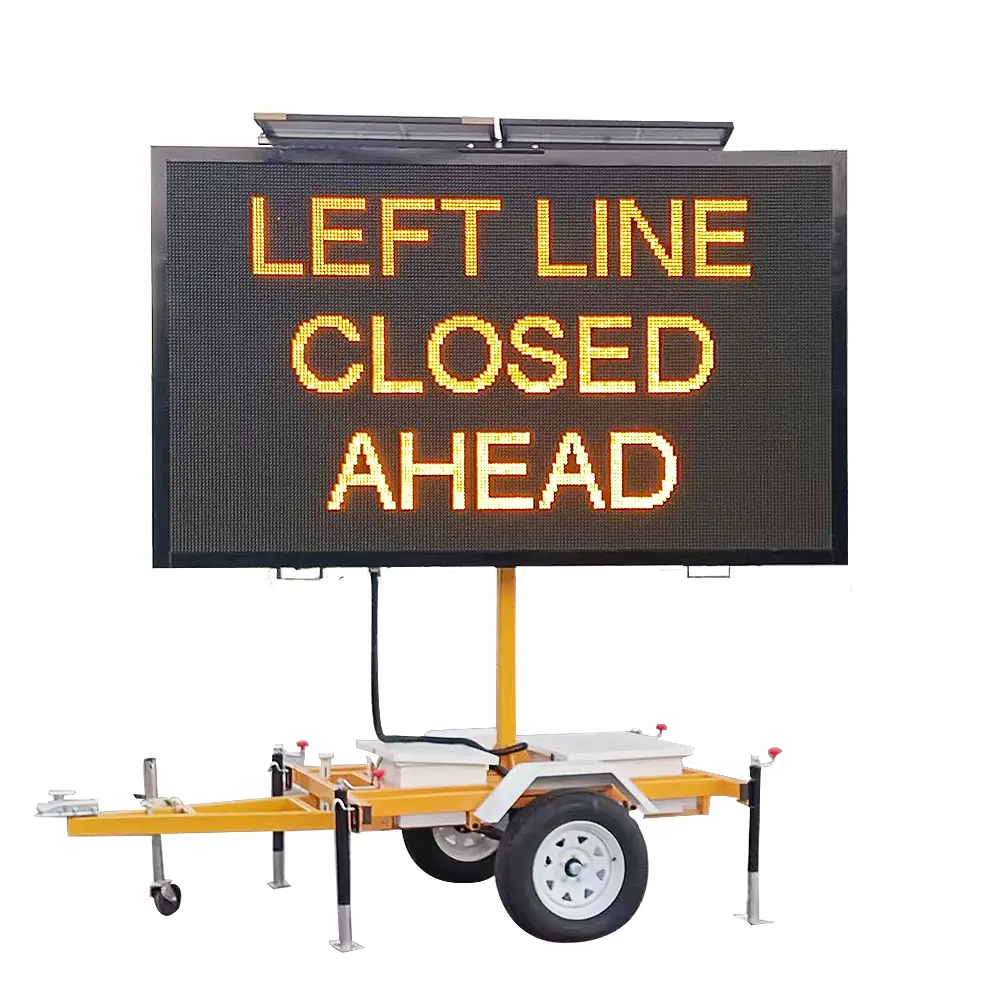
A variable message sign (VMS) is an electronic roadside display that shows changeable text, and sometimes simple symbols, so an operator can post a new message without visiting the site. The same equipment is sold as a dynamic message sign, a changeable message sign, or, when it is built onto a trailer, a portable changeable message sign (PCMS).
Three things decide whether a given unit suits a job: the display underneath, the rules that govern the wording, and the mount that decides where the sign can stand.
How a VMS shows a message
A VMS builds every letter from individual light-emitting diode pixels. The pixel count across the face limits how tall a character can be drawn, and character height sets the distance at which a driver can read it.
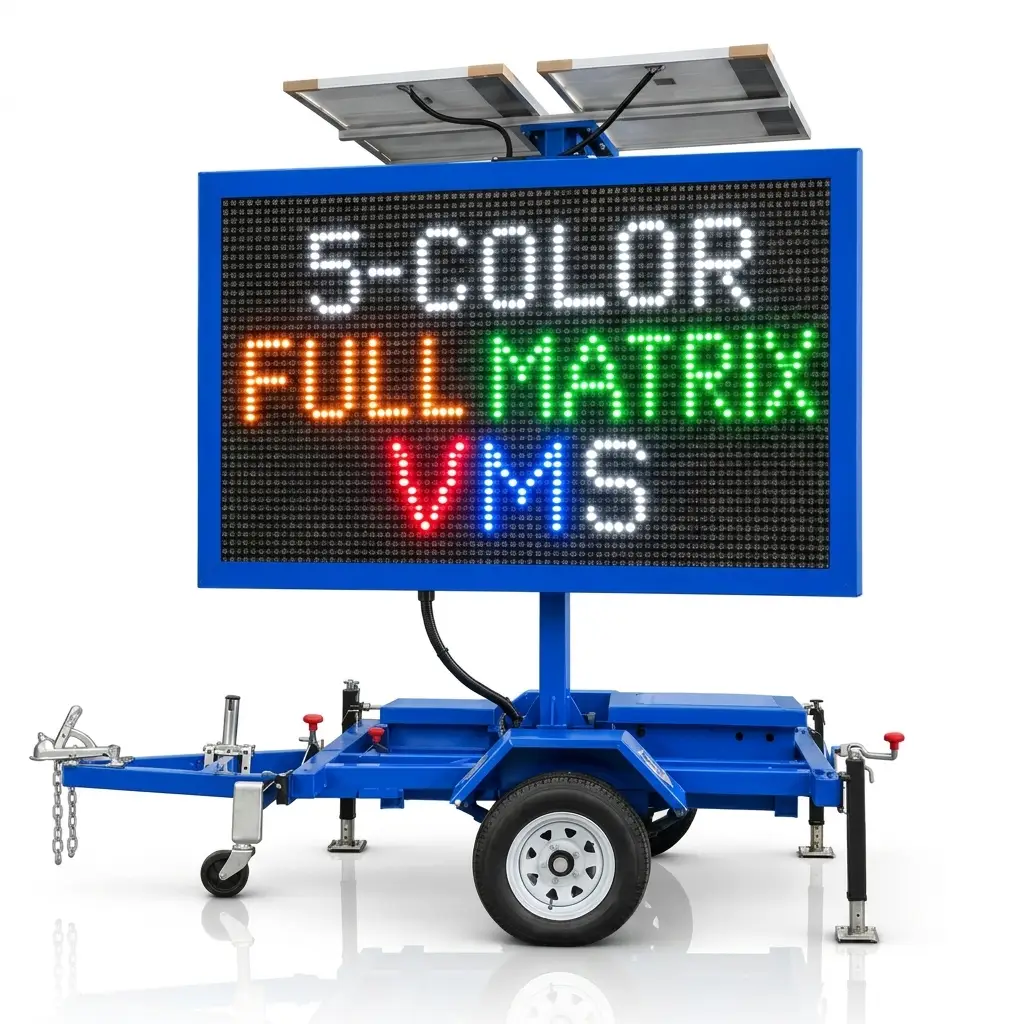
A printed panel has one letter size and one message. A pixel display has neither. Across the Variable Message Signs category, faces run from a compact three-line board on a light trailer to a five metre panel on a gantry, and the display technology underneath is what separates them. On a full matrix face an operator can run three lines of ordinary text in the morning, switch to a single line of oversized characters at noon, and show a lane arrow after that, all on the same hardware. Resolution decides how fine that control gets. A character needs at least five pixels across and seven down, and lowercase text with descenders needs a taller cell, which is why a seven by nine grid is the practical minimum once mixed case is allowed.
Reading distance follows from character height. FHWA guidance works on roughly 40 ft of legibility per inch of letter height, which puts the common sizes at these distances:
| Character height | Legibility distance | Matching road speed |
|---|---|---|
| 18 in | 720 ft | up to 40 mph |
| 24 in | 960 ft | up to 50 mph |
| 54 in | 2,160 ft | any speed |
The table explains why an 18 in three-line board is a work zone tool and a 54 in panel belongs on a freeway gantry. It also explains why buyers who compare two units on price alone end up with the wrong one.
Matrix types: modular, continuous line and full matrix
Three display constructions cover most of the market, and they differ in flexibility rather than in quality.
| Type | How it is built | What it can show | Typical use |
|---|---|---|---|
| Modular | Fixed blocks of characters | Three lines, eight characters, monospaced | Short repetitive messages |
| Continuous line | One matrix strip per line | Proportional fonts, variable spacing | Readable sentence-style text |
| Full matrix | Edge-to-edge pixels | Any character size, arrows, simple symbols | Work zones, freeway messaging |
A full matrix costs more per square metre of face, and it earns that back on any site where the message changes shape during the job.
The parts that make a sign work
Every VMS is four assemblies: a display face, a controller that stores and runs messages, a power system, and a structure that carries the face. A weak link in any one of them takes the whole unit off the road.
The controller and the message generator
The phrase variable message sign generator usually refers to the software layer, the tool an operator uses to compose a message and push it to the sign. On commercial units it is a controller board inside the cabinet paired with a web or desktop application. A capable setup does four things beyond simply displaying text. It stores pre-approved message templates, so a night-shift operator is not inventing wording at two in the morning. It schedules messages by time of day. It reports faults back to a depot. And it accepts remote updates over a modem or cellular link, which is the difference between changing a message in ninety seconds and sending a crew to a roadside.
Automatic brightness control belongs here as well. A display bright enough for direct sun is dangerously bright at night, and units that dim by ambient light rather than by clock keep contrast usable in both conditions. Where the sign feeds a queue warning or a speed advisory, radar input enters through the same controller.
This is the part buyers under-specify most often. A cheap cabinet with a limited controller cannot be upgraded later without replacing the electronics, so the specification list matters more than the panel.
Power: solar, battery and the sizing question
Most portable units run on a solar array, a battery bank and a charge controller. The arithmetic looks simple and is not. Panel wattage has to cover the display draw plus standby losses, and the battery has to carry the sign through the worst run of overcast days in that market, not the average day. A single-colour amber display draws a fraction of what a full colour panel needs for the same face area, which is why solar sizing and display type get decided together.
Two habits cause most field failures. Sizing on annual sunshine hours rather than the local winter low, and forgetting that battery capacity falls with age and cold. A unit that runs fine in its first summer can drop out in its third January.
Where variable message signs are used
A VMS belongs anywhere the information changes and the driver has to act before a fixed decision point. If the message never changes, a static sign does the job for less.
Work zones and lane closures
Temporary traffic control is the largest single market. The standard is clear that a portable sign supplements the required static signage and does not replace it. What it adds is timing: advance notice of a lane shift that starts tomorrow, a queue warning two miles upstream, a detour instruction at the last point where a driver can still choose. Long-run construction benefits most, because the message changes with each phase of the job.
Airports, ports and parking
Approach roads into an airport are a special case. Traffic is heavy, drivers are unfamiliar with the layout, and the thing they need to know, which car park has space, changes hour by hour. A variable message sign at an airport entrance can push arrivals toward a lot with capacity, publish current pricing, and warn of curbside congestion before the terminal loop. One airport authority rebuilt its roadway signage around a network of fourteen ground-mounted LED displays for exactly this purpose, tied into parking occupancy rather than operated by hand.
Ports use the same logic for freight lanes, gate queues and temporary roadworks inside the estate.
Speed limits and variable speed limits
When a variable message sign shows a speed limit, it is acting as a regulatory device, not a suggestion. That brings two requirements. The legend has to follow the colour and format rules for regulatory signs in that jurisdiction, and the displayed value has to be consistent with the posted limit or with an approved variable limit scheme. Advisory speeds, the kind used at curves and work zone approaches, sit in a different category and are usually paired with radar detection so the number on the face responds to actual approach speed.
Before any deployment, four decisions need to be made in order: the position relative to the decision point, the set of messages the site will use, the power budget, and the communications path for updates. Sites that skip the second step end up with a sign showing the same message for a month.
What a message can say under MUTCD
Message content is regulated, and the limits are tighter than most first-time buyers expect. A VMS is a traffic control device, not a noticeboard.
The US Manual on Uniform Traffic Control Devices sets the working constraints for portable units in Chapter 6F, and the same principles carry into most export markets through local equivalents.
| Constraint | Requirement |
|---|---|
| Display layout | Three lines of eight characters, or a full matrix face |
| Letter height | 18 in minimum, 10 in allowed on incident response vehicles |
| Visibility | Legible from half a mile, day and night |
| Message length | Two phases maximum, three lines per phase |
| Phase timing | At least two seconds per phase, eight seconds total |
| Motion | No scrolling, flashing, dissolving, animation or travelling text |
| Content | Traffic operational, regulatory, warning and guidance only, no advertising |
The motion ban catches people out. Scrolling text looks modern in a showroom and reads badly at speed, because a driver who arrives mid-scroll has missed the start of the message. The replacement is a two-phase message where each phase stands alone, so a driver who sees only the second half still understands it.
Wording follows a three-part pattern: what the problem is, where it is, and what the driver should do. Three thoughts, one per line, is the shape that survives a glance at 60 mph. It is also why the familiar changeable message sign board is laid out as three lines of eight characters rather than as a wide paragraph.
Trailer, truck or fixed: choosing a mount
Pick the mount by how long the sign stays put and how often it moves, not by purchase price. The cheapest unit in the wrong mount costs more in labour than the difference.
| Mount | Setup | Moves between sites | Power | Best for |
|---|---|---|---|---|
| Trailer | Towed, levelled, mast raised | Routine, one person plus a vehicle | Solar and battery | Multi-week work zones, events |
| Vehicle-mounted | Bolted to truck bed or roof | Continuous, travels with the crew | Vehicle or dedicated battery | Moving operations, incident response |
| Fixed gantry | Installed on structure | Never | Mains | Permanent corridors, tunnel approaches |
Trailer-mounted units
Trailers carry most of the volume in this category because they balance deployment speed against capacity. The details that matter in the field are unglamorous. A mast that raises the face to a usable height, stabilising legs that hold in wind, a chassis narrow enough for a standard lane without escort, and a lighting and braking kit that satisfies road rules for towed equipment. Buyers who skip the last point sometimes find the unit cannot legally travel on the road it was bought for.
What variable message signs cost
Price spreads by more than a factor of five across units that all call themselves a trailer-mounted VMS. The difference is specification, not brand.
Public procurement records give the honest picture. In a US Department of Transportation study of smart work zone systems, two state agencies reported purchase prices for the same equipment category: one at $5,000 to $8,000 per unit, the other at $26,350 for a single sign bought in 2012. Both figures are real. The expensive unit carried an on-board controller, automatic brightness control, a modem for remote messaging, radar and solar assistance. The cheap one did not.
Rental shows the same spread. Reported rates in the same study ran to $950 per month at one agency, $300 per day at another and $233 per month at a third. A state contract amendment listed a portable changeable message sign at $95 per day, $320 per week and $950 per month. Rates move with local supply, contract length and whether delivery is included.
What drives the number:
| Specification | Effect on price |
|---|---|
| Single-colour amber versus full colour | Large, in both panel and solar capacity |
| Matrix size and pixel pitch | Proportional to face area |
| Controller grade and remote communications | Moderate to large |
| Radar, cameras or environmental sensors | Additive per feature |
| Trailer chassis, mast and stabilising gear | Moderate |
| Certification to a national or state standard | Moderate, and non-negotiable in some markets |
When you request a quote for a variable message sign for sale, the answer is only meaningful if you supply the intended road speed, the message set, the number of lines, the power source available, and the market the unit will operate in. A price without those five answers is a guess. For units built to sit on a towable chassis, the Trailer-Mounted Variable Message Signs range shows how the configurations split.
Rent, buy or both
Count the days the unit will actually be on site in a year. That number, not the sticker price, decides the question.
The comparison is annual hire cost against purchase plus the costs that never appear on the invoice: maintenance, battery replacement, chassis servicing in some markets, insurance, and yard space for the weeks it sits idle. Work it through with your own figures.
- Days deployed per year, multiplied by your local day rate, gives the rental baseline.
- Purchase price, divided by expected service life, gives annual capital cost.
- Add annual maintenance, insurance and storage to the capital figure.
If the third line lands below the first, ownership wins on cost. If it does not, the case has to rest on availability, because a rented unit during a shortage is not a unit you can promise to a client.
Many operators end up with both, holding one or two units for routine work and hiring during peak season. Where a project runs under about four weeks, hire is usually the cheaper path even before storage is counted.
FAQ
Do you need a permit to place a variable message sign?
On a public road, almost always yes, and the permit is usually tied to the site rather than the equipment. On private land, the rules shift to the landowner and to local signage law.
Work zone deployments normally sit inside an approved traffic control plan, and the plan is what the authority reviews. Permanent installations go through a separate design and approval process. Because requirements differ by jurisdiction, confirm local practice before committing to a position, especially where the sign will display regulatory messages such as a speed limit.
How long does it take to set up a trailer-mounted sign?
Two people can usually tow in, level, raise the mast and have a message running in fifteen to thirty minutes. One person can do it, in more time and with more risk.
Setup time is dominated by the mast and the levelling, not by the electronics. Two habits cut it further: pre-loading the message set before the unit leaves the yard, and checking battery state at the same time as the tyres. On sites where the sign moves weekly, that fifteen minutes compounds fast.
What maintenance does a VMS need between projects?
Clean the face, test the battery under load, check the seals and inspect the chassis. Most of the work is inspection, and most failures trace back to a skipped one.
LED modules themselves are durable. The parts that fail are the ones exposed to weather and cycling: batteries that lose capacity, charge controllers, cabinet seals, and trailer components. A short checklist run at every demobilisation catches most of it while the unit is still in the yard, where a fault is cheap to fix.