A printed sign states one fact for years. Road conditions don’t work that way. A lane closes at 07:40, a crash clears by noon, and a bridge deck ices over on a night nobody scheduled. Agencies that relied on static plates had two options: send a crew with a ladder, or leave drivers guessing. Changeable message signs removed that choice.
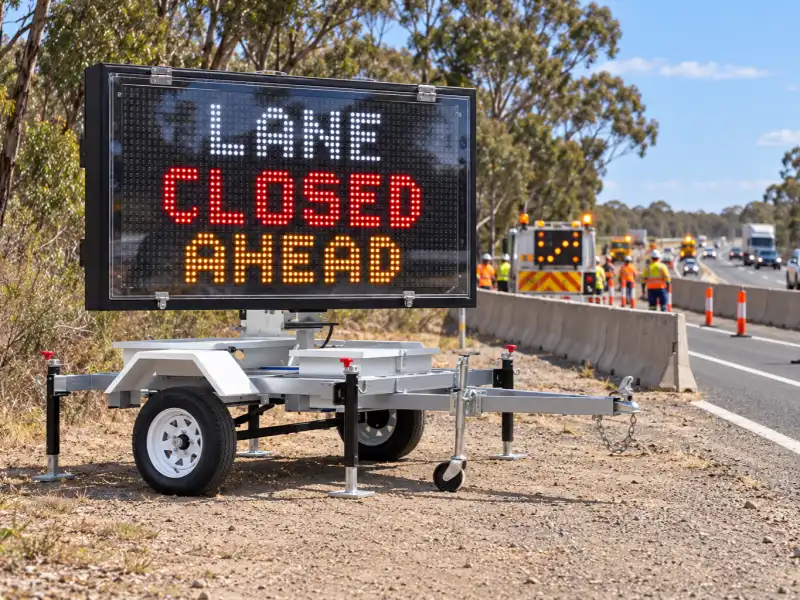
A changeable message sign (CMS) is a traffic control device that can display more than one message, and a variable message sign (VMS) is the same device named after its electronic face. The sign is a grid of light-emitting diodes driven by a controller, so the legend can be rewritten from a keypad, a laptop, or a traffic management centre without anyone touching the hardware. A portable changeable message sign puts that assembly on a trailer or a truck bed so it can follow the work.
The rest of this guide covers how the hardware works, what the MUTCD requires of it, and what separates a compliant board from an expensive mistake.
How a variable message sign works
Three parts do the work. A matrix of LEDs produces the legend, a controller stores and sequences the messages, and a communications link lets someone change them from a distance. Power comes from the grid, a battery bank, or a solar array mounted on the trailer.
Every character on the face is built from pixels. The FHWA portable handbook sets a floor of five pixels wide by seven high per character, which is the minimum at which a letter still reads as a letter rather than a smudge at highway distance. Brightness is handled by a photocell: the controller raises output in direct sun and drops it at night, partly for legibility and partly because a board running at full power after dark glares and shortens battery life.
Controllers keep two things in memory that operators care about. The first is the message library, so a crew doesn’t retype a closure notice at 2 a.m. The second is state. MUTCD requires the control system to hold memory when power is lost, and requires a battery backup so the sign keeps displaying through a primary power failure. A board that blanks in a brownout is a hazard, not a warning.
Matrix types and what each can display
The display construction decides what a sign can say. Three types dominate the market.
| Matrix type | Construction | Typical character height | What it can render |
|---|---|---|---|
| Character matrix | Fixed blocks, commonly 3 lines by 8 characters | 18 to 24 inches | Letters and digits only, monospaced |
| Continuous line matrix | One addressable strip per text line | 18 to 30 inches | Proportionally spaced text, tighter fit, no graphics |
| Full matrix | Entire face addressable pixel by pixel | 18 to 54 inches | Text, arrows, standard symbols, multi-colour legends |
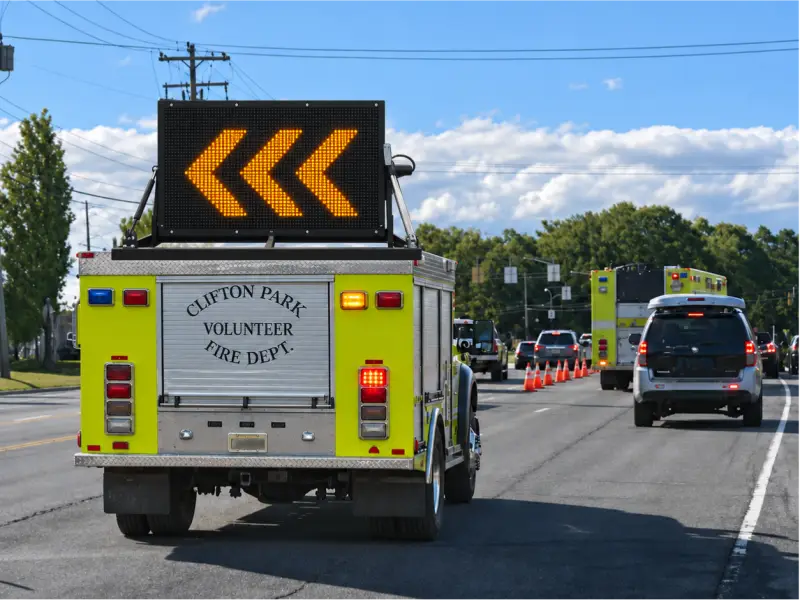
The difference shows up in practice. A three-line character board fits a closure notice and nothing else. An amber full-matrix portable VMS can set a merge arrow beside the text, vary character height line by line, and reproduce a standard warning symbol closely enough that drivers recognise it without reading. Multi-colour full-matrix units go further and match the colour conventions of conventional signs, which the MUTCD explicitly encourages for new CMS because recognition beats reading.
From the traffic control centre to the roadside
The oldest control method is a keypad on the unit and a person standing in front of it. The newest is a browser session at a traffic management centre, pushing a message to forty boards at once over cellular. Between those sits the protocol most agencies now specify: NTCIP 1203, which lets a central system talk to VMS hardware from different manufacturers through one interface.
Remote control changes the failure modes. A sign on a cellular link needs an authority model, so a maintenance technician can run diagnostics without being able to post a lane closure. It needs an audit log, because a message that appeared at 06:15 and caused a queue will be asked about. And it needs a fallback, because the link will drop during exactly the storm you bought the sign for. Solar-powered units add a second constraint: every hour of display is drawn from a battery that has to recharge, so the controller settings that govern brightness and blank periods are an energy decision as much as a legibility one.
What MUTCD requires of a changeable message sign
Chapter 2L of the MUTCD governs design, message format, and display for both permanent and portable CMS, and Section 6L.05 adds rules that apply only to portable units. A board that skips either chapter isn’t a traffic control device an agency can lawfully deploy on a public road in the United States.
The 11th Edition took effect in January 2024, and states had two years from that date to adopt it as their legal standard. That timing matters for procurement: a specification written against the 2009 edition can pass a factory inspection and still fail at installation.
Legibility and visibility
On roads posted at 55 mph or higher, a portable CMS should be visible from half a mile under day and night conditions, with the message legible at 600 feet at night and 800 feet in daylight. Those are functional targets, not hardware ratings. A board can meet every character-height requirement and still miss them if it sits where a curve, a crest, or a queue of trucks blocks the sight line.
Contrast runs one way. Positive contrast, meaning light characters on a dark background, is required. Negative contrast boards lose a quarter or more of their legibility distance and the extra light they emit hasn’t been shown to help detection.
Character height follows speed. Eighteen inches is the working minimum on higher-speed roads, and 12 inches is accepted below 45 mph. On service patrol trucks and incident response vehicles, lettering as short as 10 inches may be used, and shorter sizes are allowed on low-speed roads if the message is legible from 650 feet.
Message length and units of information
MUTCD counts messages in units of information rather than words. A unit is a single answer to a single question a driver can act on, and it shouldn’t run past four words.
| Question | Answer | Units |
|---|---|---|
| What happened? | MAJOR CRASH | 1 |
| Where? | AT EXIT 12 | 1 |
| Who is it for? | TO NEW YORK | 1 |
| What should I do? | USE ROUTE 46 | 1 |
Four rules follow from that count. A message gets no more than two phases, and a phase gets no more than three lines. Each phase has to stand on its own, because a driver may catch phase two first and still needs a complete instruction. And no phase carries more than three units, with four units total at speeds of 35 mph or above and five below that.
Timing is where most non-compliant messages fail. A phase displays for at least two seconds, calculated at one second per word or two seconds per unit, whichever is less. The gap between phases stays under 0.3 seconds, and the whole two-phase cycle caps at eight seconds. At freeway speed, eight seconds is roughly the entire window in which an 18-inch character is legible, so a message that needs longer than that needs a second sign, not a faster scroll.
What a CMS may not display
Advertising is prohibited, on the face and on the housing. So are manufacturer names, brand names, and model numbers, whether in the message or on the exterior. Scrolling, dissolving, exploding, flashing, and animation are out, with one exception for units simulating an arrow board. Content is limited to traffic operational, regulatory, warning, and guidance information, plus a narrow set of public messages such as AMBER alerts and safety campaigns that run alongside other media.
The three sign types a VMS has to serve
Traffic signs fall into three functional groups: regulatory, warning, and guide. A VMS isn’t a fourth category. It’s a delivery method for any of the three, and the design rules follow whichever group the current message belongs to.
That classification isn’t academic. It decides colour, it decides the sign’s legal weight, and it decides what a driver is entitled to assume when the board lights up.
Regulatory messages and speed limits
Regulatory signs state a requirement or a prohibition, and they carry legal force. A stop sign and a speed limit plate are the standard examples; anything a driver can be cited for ignoring belongs here. When a changeable message sign displays a speed limit, it’s functioning as a regulatory device, and it’s held to the same design standard as the painted plate it replaces. Variable speed limit applications, which raise or lower the posted maximum with weather and traffic flow, are covered separately in Section 2B.13 and are the clearest case of a VMS doing regulatory work rather than advisory work.
Warning messages in work zones
Warning signs tell a driver what’s coming. In temporary traffic control that means lane closures, shifts, flagger stations, and pavement changes, and the portable CMS is usually the first device a driver meets in the advance warning area. The message structure MUTCD prefers is three thoughts on three lines: the condition, its location, and the action. CRASH AHEAD, LEFT LANE CLOSED, MERGE RIGHT. Each line is a unit, the phase reads in under three seconds, and a driver has time to change lanes rather than brake.
Guide messages and travel time
Guide signs give direction, distance, and destination. On a CMS that usually means a detour instruction or a travel time to a junction. Travel times demand more care than they look: the message should tie the time to a stated distance or a named destination, should show only one destination when distance is also displayed, and should round distance to the whole mile. A bare TRAVEL TIME 18 MIN tells a driver nothing they can use.
Inside the portable changeable message sign format
A portable changeable message sign is a CMS built onto a trailer or truck bed so it can be repositioned between sites. The common configuration is three lines of eight characters, a packaging limit that became a design convention.
That limit is why PCMS messaging looks the way it does. Eight characters is about all that fits at 18-inch lettering on a trailer-width face, so operators abbreviate, and the abbreviation rules exist because invented shorthand fails at 60 mph.
Three lines, eight characters, and the PCMS handbook
The FHWA portable changeable message sign handbook remains the clearest explanation of the format. It sets out the matrix types, the message design process, the accepted abbreviation tables, and a legibility table that ties character height to reading distance.
| Character height | Legibility distance |
|---|---|
| 18 inches | 720 feet |
| 24 inches | 960 feet |
| 54 inches | 2,160 feet |
Mounting height is specified too. On a trailer or truck, the bottom of the sign sits at least 7 feet above the roadway in urban areas and 5 feet in rural ones when operating. Below that, headlights and following vehicles start cutting into the sight line at the distance where the message matters.
Message board abbreviations
Section 1D.08 governs abbreviations, and the rule has two halves. The abbreviation has to come from the accepted list, and where comprehension depends on it, it should appear beside a prompt word that supplies the missing context. LN on its own is ambiguous. LN CLOSED isn’t, because the second word fixes the meaning. Invented shortcuts, phonetic spellings, and abbreviations outside the list are the most common reason a message gets rejected at review.
Message generators and what they check
A variable message sign generator is software that previews a message against a specific board before it goes live. Good ones check more than character count. They flag lines that exceed the board’s width, phases that don’t read standalone, total cycle time over eight seconds, and unit counts above the limit for the posted speed. Some agencies publish approved message libraries and require operators to work from them, which is worth knowing before buying a tool: a generator that doesn’t load your jurisdiction’s list will approve messages your reviewer rejects.
What variable message signs cost
There is no list price. A VMS is configured to a road, and the number moves with the display type, the colour count, the power system, the mounting, and the control software.
That’s why two quotes for what both suppliers call a three-line VMS can sit far apart and both be honest. The difference is in what’s behind the face.
What drives the quote
| Component | What changes the number |
|---|---|
| Display face | Matrix type, pixel pitch, character height, monochrome versus multi-colour |
| Controller and software | Message library size, remote access, authority levels, NTCIP compliance |
| Power system | Battery capacity, solar array size, autonomy target for overcast days |
| Mounting | Skid, single-axle trailer, tandem trailer, truck bed, mast height |
| Communications | Cellular modem, radio, hardwired, or manual only |
| Documentation | Factory test reports, compliance statements, spare parts list |
| Delivery and commissioning | Freight distance, site training, programming of the first message set |
Ask for the quote itemised along those lines. A single lump sum hides whether the money went into the display or into a trailer that will need brake service in three years.
Rental or purchase
Rental suits work that ends. A resurfacing season, a stadium opening, a bridge inspection campaign: the sign arrives programmed, the supplier carries maintenance and replacement, and the cost lands in operating budget instead of capital. The trade-offs are availability during peak season and the fact that you don’t control the specification. Rental units are usually the common configuration, so a project needing a specific full-matrix layout may not get one.
Purchase suits agencies and contractors who deploy boards continuously. A owned fleet means the trailer-mounted variable message signs can be specified for local conditions, kept on the same control platform as the permanent network, and depreciated over a known service life. The cost that buyers underestimate is the support side: spare modules, annual battery replacement, and someone on staff who can program a message at short notice.
Variable message signs at airports
Airports use variable message signs to sort vehicle traffic before it reaches a decision point: which car park, which terminal, which kerb.
The landside road network around a terminal is a short, fast-decision environment. A driver approaching a split has seconds to choose a lane, and the wrong choice means a loop back through a one-way system. That’s why airport VMS deployments cluster at approach roads, car park entries, and curbside zones rather than inside the terminal, where fixed wayfinding does the job.
The messages differ from highway signage in three ways. They’re tied to live data, so parking availability, tariff changes, and lane status come from the parking management system rather than from a person with a keypad. They’re shorter, because approach speeds are lower and the decision window is shorter still. And they carry operational rules that have nothing to do with traffic flow: which kerb is open to which vehicle class, where rideshare pickup sits, when a lane closes for a security sweep.
Low-speed airport roads also relax the hardware requirement. Twelve-inch characters are acceptable below 45 mph, which allows more lines on a narrower face, and a compact truck-mounted full-matrix VMS can sit on a service vehicle and reposition as the traffic plan changes through the day. Multi-colour capability earns its cost here, because a red FULL and a green SPACES register faster than either word read as text.
Specifying a VMS board for a project
Start with the road, not the sign. Posted speed and available sight distance set the character height, and character height sets everything downstream: face size, trailer width, power draw, and price.
Work through it in this order.
- Confirm the posted speed and measure the real sight distance at the intended position, including the effect of curves, crests, and queued vehicles.
- Set character height from that speed, then derive lines and characters per line from the face size the height allows.
- Decide whether the message library needs graphics. If arrows or standard symbols are required, the answer is a full matrix, not a character matrix.
- Size the power system against the worst week of the year, not the average, and ask for a tested autonomy figure rather than a battery amp-hour rating.
- Confirm the mounting suits the site. Trailer units need room to level and anchor; truck-mounted units need a vehicle that’s actually available when the closure starts.
- Verify the compliance path in writing, including which MUTCD edition the state has adopted and whether the control software supports the state’s message library.
Get those six answers before comparing prices. The cheapest compliant board for a 25 mph airport access road and the cheapest compliant board for a 65 mph interstate are not the same product, and treating them as one category is how projects end up with a sign that can’t legally display the message it was bought for.
FAQ
Can a portable changeable message sign be used on a low-speed road?
Yes, and the requirements scale down with the speed. Below 45 mph, 12-inch characters are acceptable, and shorter lettering is permitted on low-speed facilities provided the message stays legible from at least 650 feet. What doesn’t relax is the message structure: two phases, three lines per phase, and the same eight-second cycle limit apply whether the road is posted at 25 mph or 70.
How long will a solar VMS run without sunlight?
There’s no standard answer, and any supplier who quotes one without knowing your display settings is guessing. Runtime depends on battery capacity, the load the display draws at your brightness settings, how many hours a day the sign is active, and the controller’s sleep behaviour. Ask for a tested autonomy figure in hours at a stated message and brightness, then compare that against the longest overcast stretch your region records.
Are graphic symbols allowed on a changeable message sign?
On a full-matrix unit, yes, provided the symbol duplicates the standard design and appears in the correct colour combination. Signs with pixel spacing wider than 20 millimetres should display word legends only, because a coarse grid turns an arrow into a shape drivers have to interpret. Advertising, logos, and any graphic that isn’t a recognised traffic control symbol remain prohibited regardless of what the hardware can render.