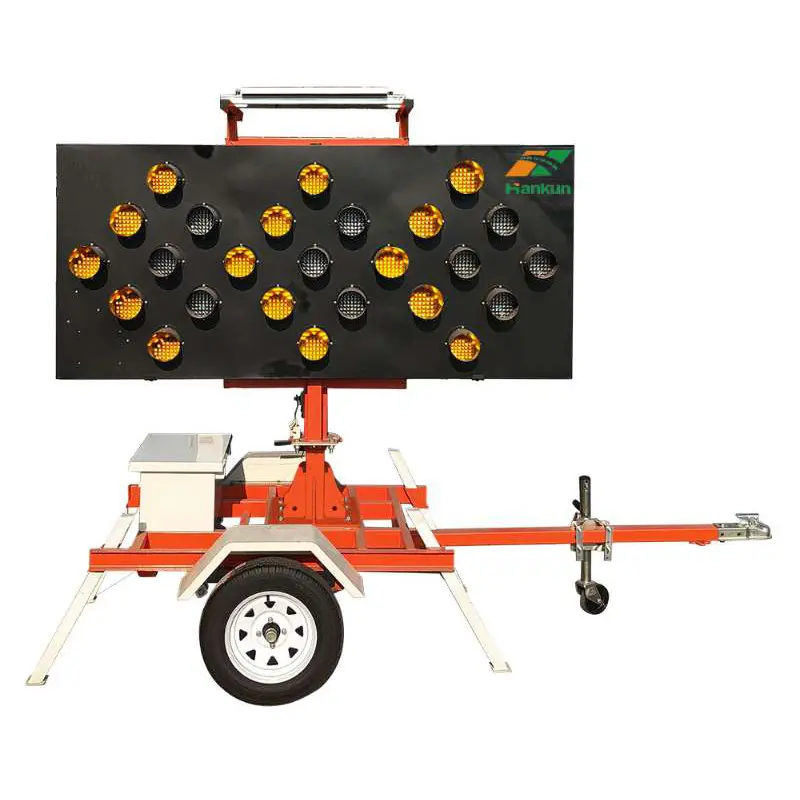
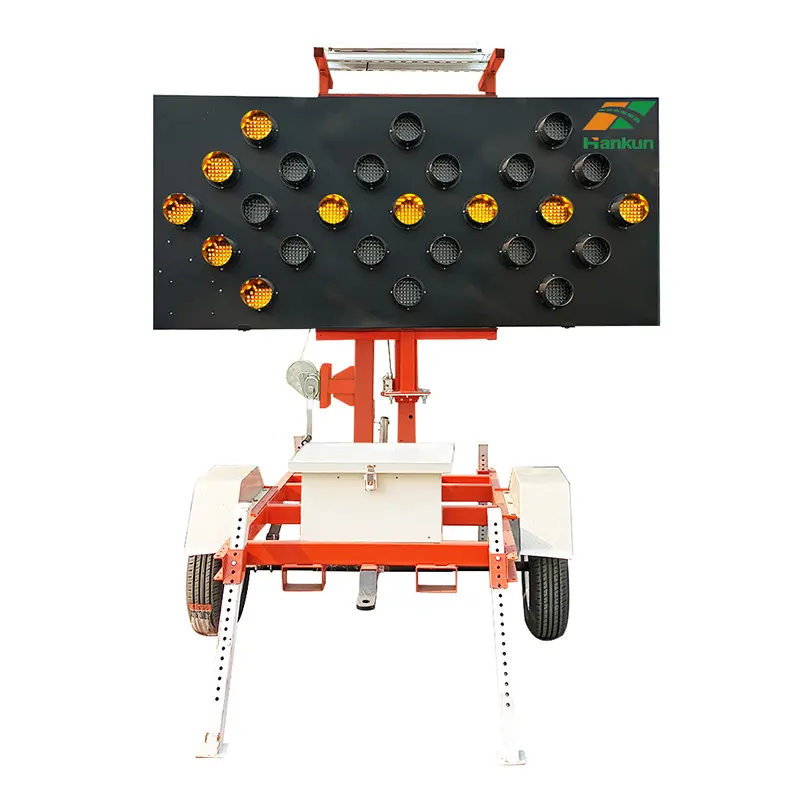
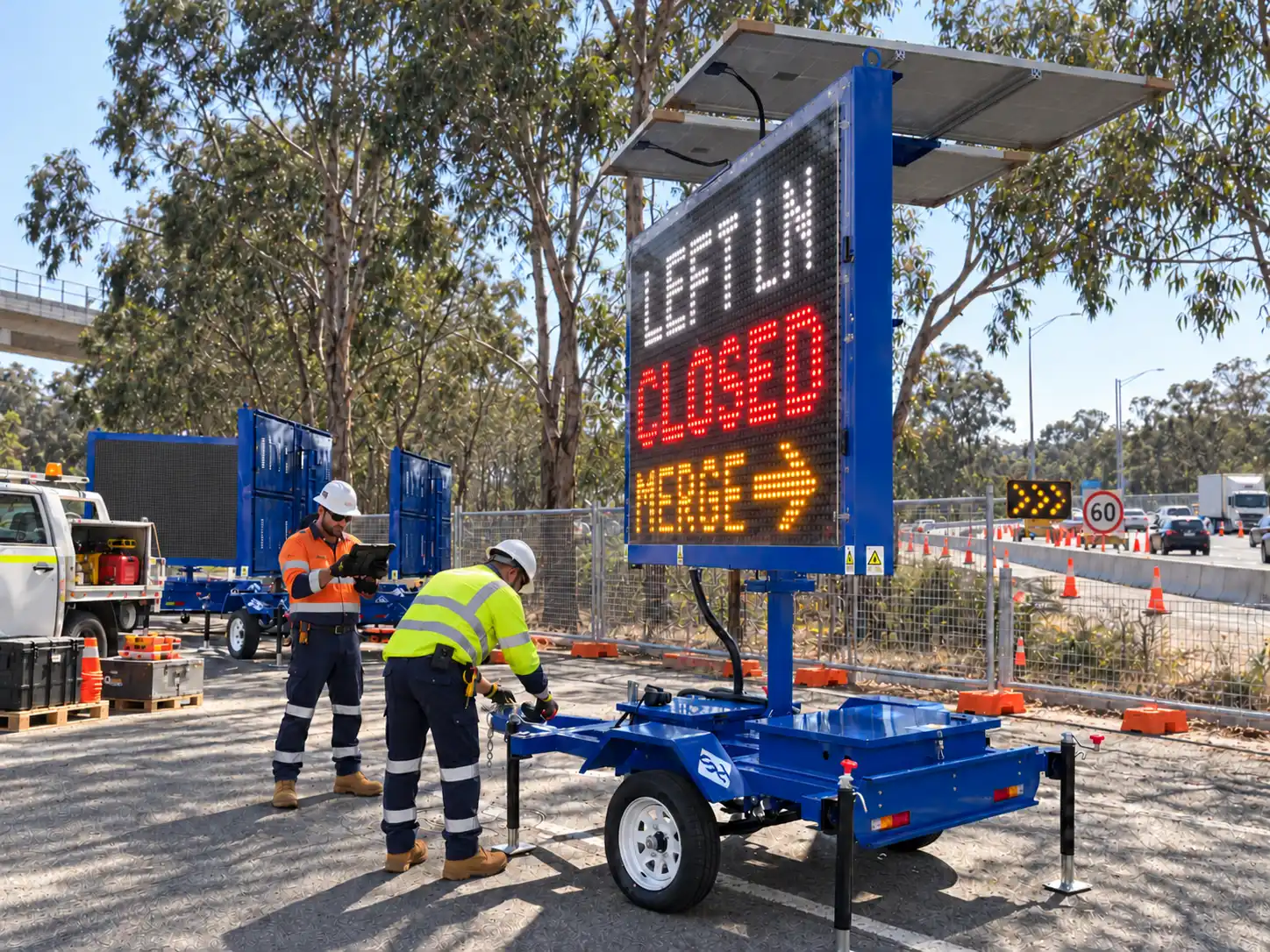
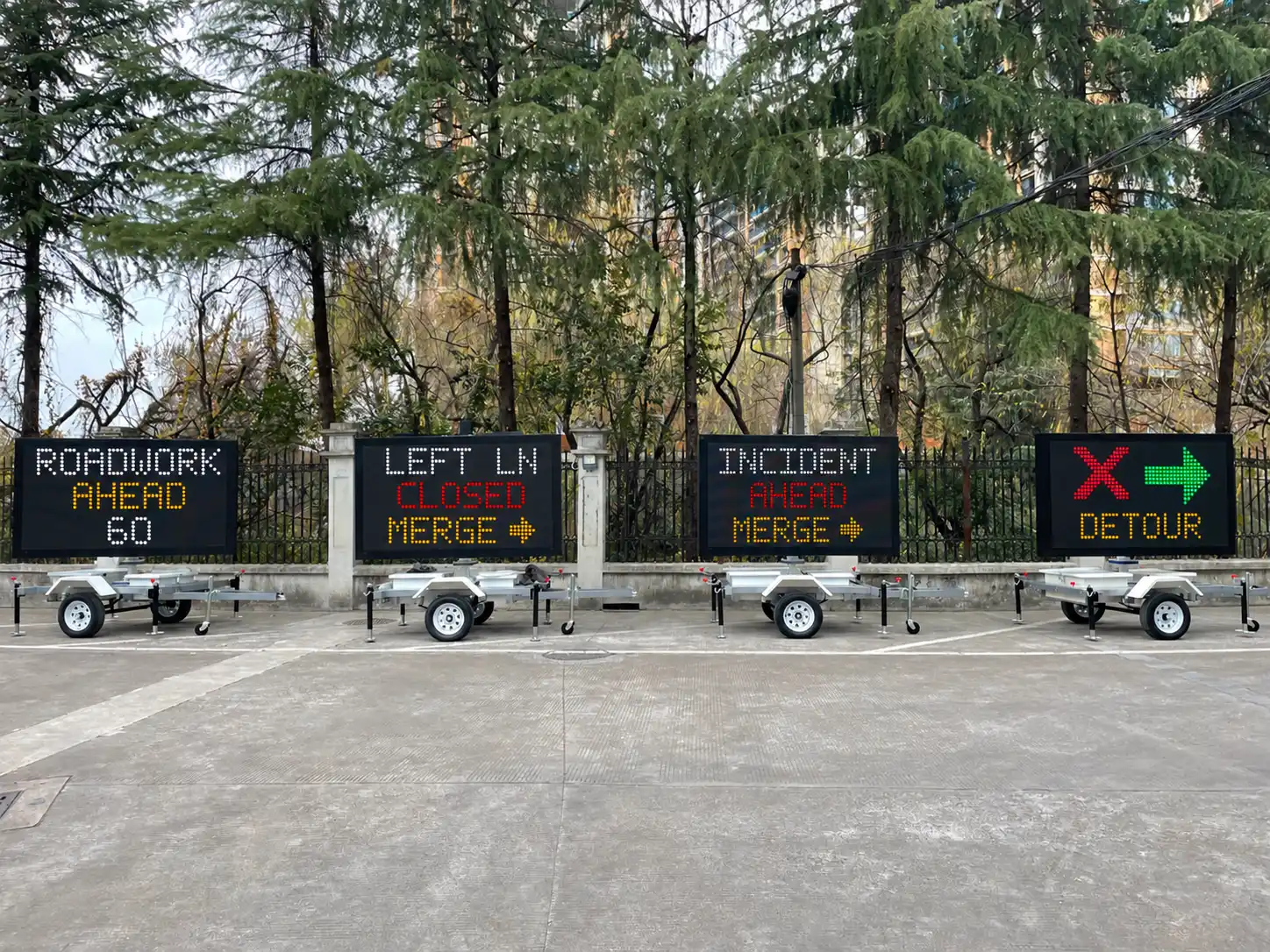
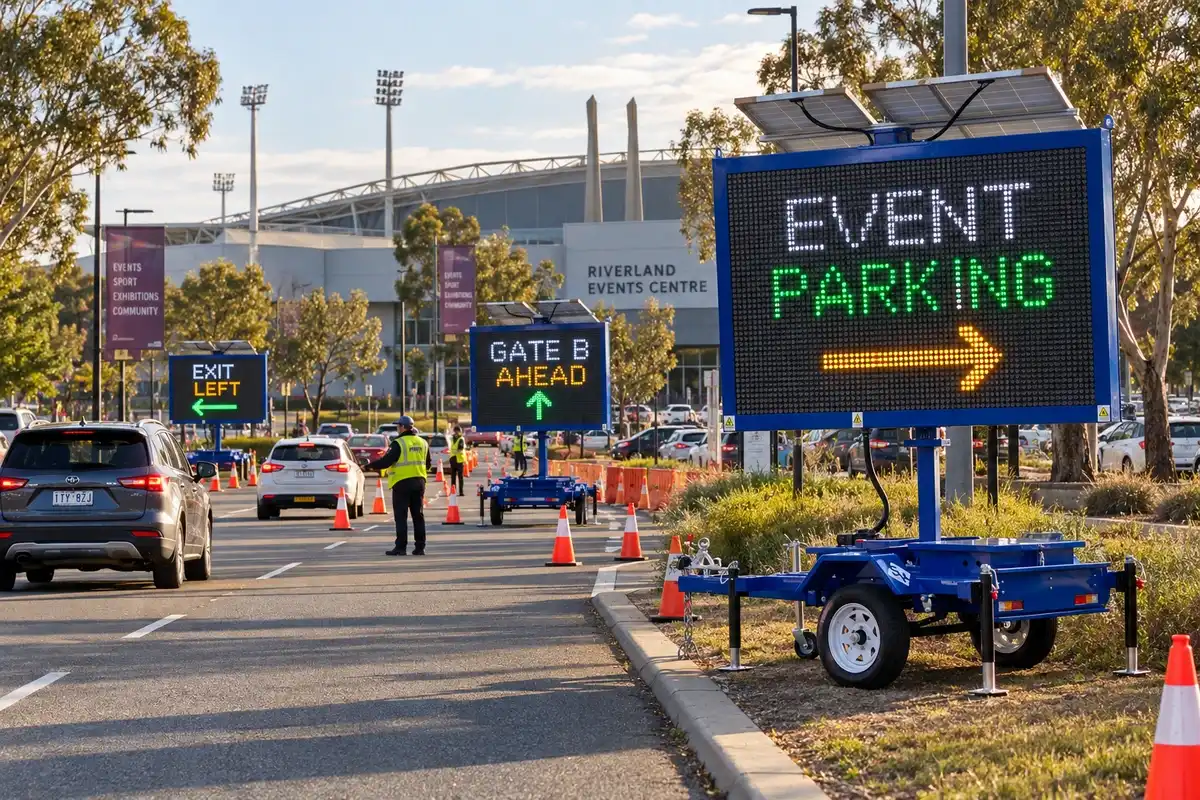
The HANKUN Full-Size Five-Colour Trailer-Mounted Variable Message Sign (VMS) is an advanced portable variable message sign engineered for highway traffic control and roadside safety. Featuring a 56 × 28 matrix displaying 3 lines of 8 characters (400 mm / 15.75 in), this solar-powered electronic variable message sign system (PCMS) complies with MUTCD standards. Built with a heavy-duty foldable VMS sign trailer, it ensures fast deployment and 24/7 visibility.
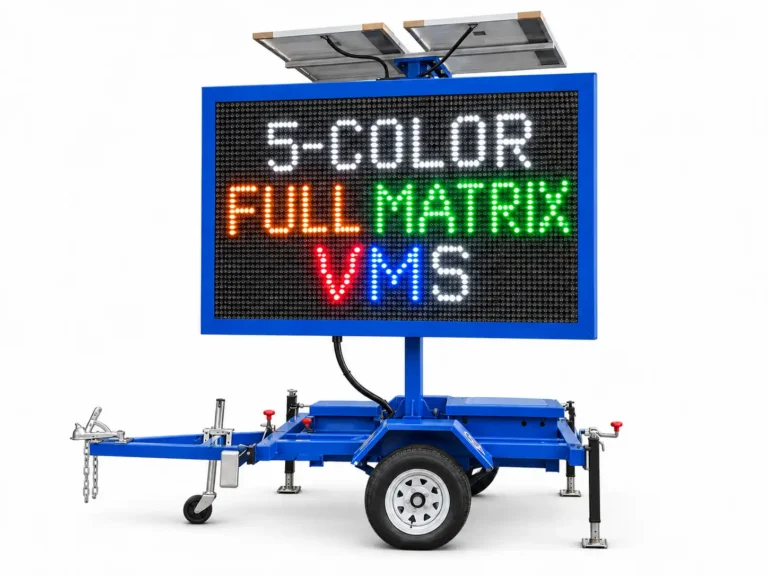
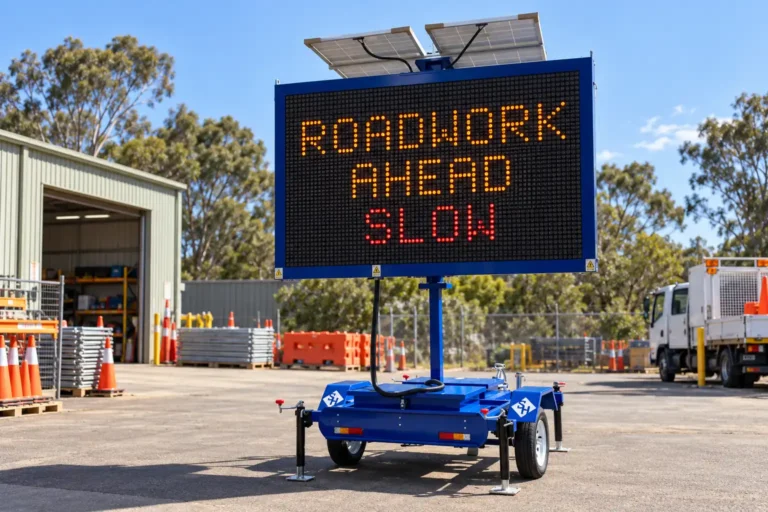
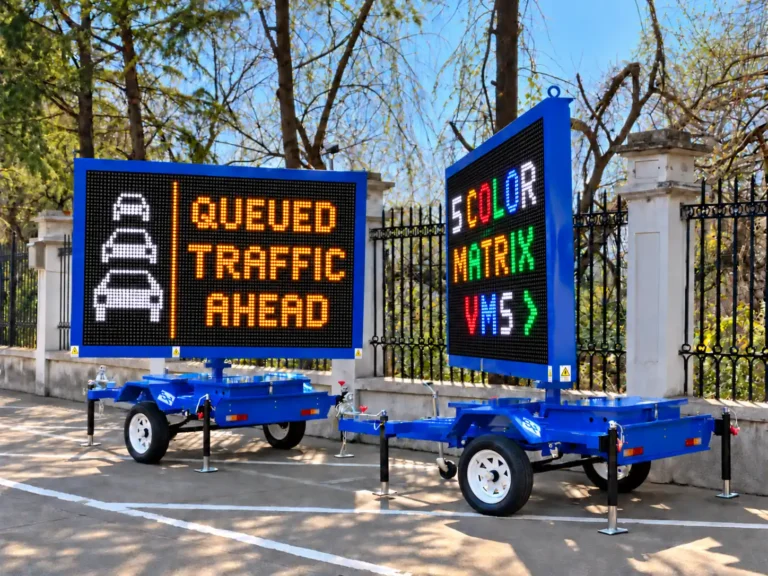
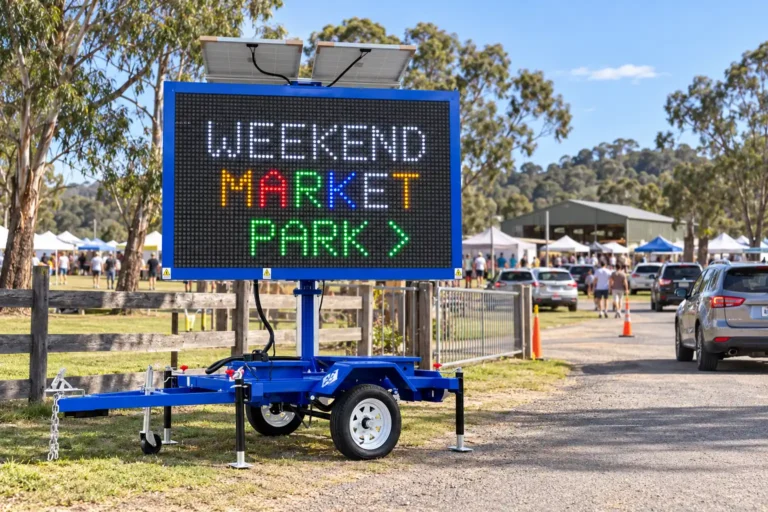
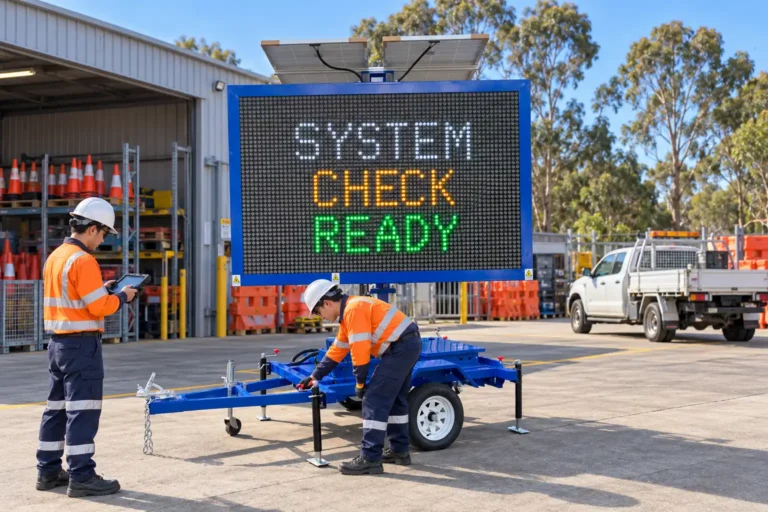
Full-Size Five-Colour Trailer-Mounted VMS
Model HK-PTMS-FS-0807-47-5C Full-Size Five-Colour Trailer-Mounted
| Active Display Area | Max Character Height | Pixel Structure | Display Colour | Cabinet Dimensions |
|---|---|---|---|---|
| 3156 × 1563 mm / 124.25 × 61.54 in | 400.0 mm (15.75 in) with the 5 × 7 character matrix; up to 457 mm (18.0 in) with the 8-pixel-row character matrix | 56 × 28 pixels | discrete per-colour LEDs — up to 17 individual LEDs per pixel (4 red, 4 amber, 3 green, 3 blue, 3 white); no colour blending | Five-colour — 17 LEDs per pixel (4 red, 4 amber, 3 green, 3 blue, 3 white), no colour blending. The same platform is also available in amber. | 3356 × 1763 mm (100 mm border basis; depth 200–250 mm) |
The HANKUN HK-PTMS-FS-0807-47-5C is a full-size trailer-mounted variable message sign (VMS) with a 56 × 28 five-colour pixel matrix, three lines of up to eight characters per line, and a character height of 400.0 mm (15.75 in) with the 5 × 7 character matrix — extending to 457 mm (18.0 in) with the 8-pixel-row character matrix — on a 3156 × 1563 mm (124.25 × 61.54 in) active display area.
Share:
VMS
The standard industry term used by DOTs, contractors and rental fleets across the United States and Canada for this class of roadside equipment; the portable version is called a PCMS.
Trailer VMS
Trailer VMS
— Core Characteristics
01
02
400.0 mm (15.75 in) with the 5 × 7 character matrix; up to 457 mm (18.0 in) with the 8-pixel-row character matrix. Character height depends on the character matrix selected, so the two are always published together.
03
04
3156 × 1563 mm (124.25 × 61.54 in) — the illuminated area, stated separately from the cabinet.
05
3 lines × 8 characters per line (variable format) — stated together with the number of characters per line.
06
07
Cabinet 3356 × 1763 mm on a 100 mm border basis, depth 200–250 mm. Trailer-mounted with a road-tow configuration.
08
Display brightness and grey level are adjusted to ambient light conditions; a manual brightness setting is also available. The display therefore draws less power in low light, which extends the working time available from the solar array and battery bank.
09
10
4G; GPS position reporting. Message management from phone, tablet or PC. Open API and SDK protocol provided, for integration into an existing fleet management platform.
11
12
Every published dimension — including the 56 × 28 matrix and the 3156 × 1563 mm (124.25 × 61.54 in) active display area — is taken from the released engineering drawings and is internally re-checkable, so the figures can be quoted in a project specification.
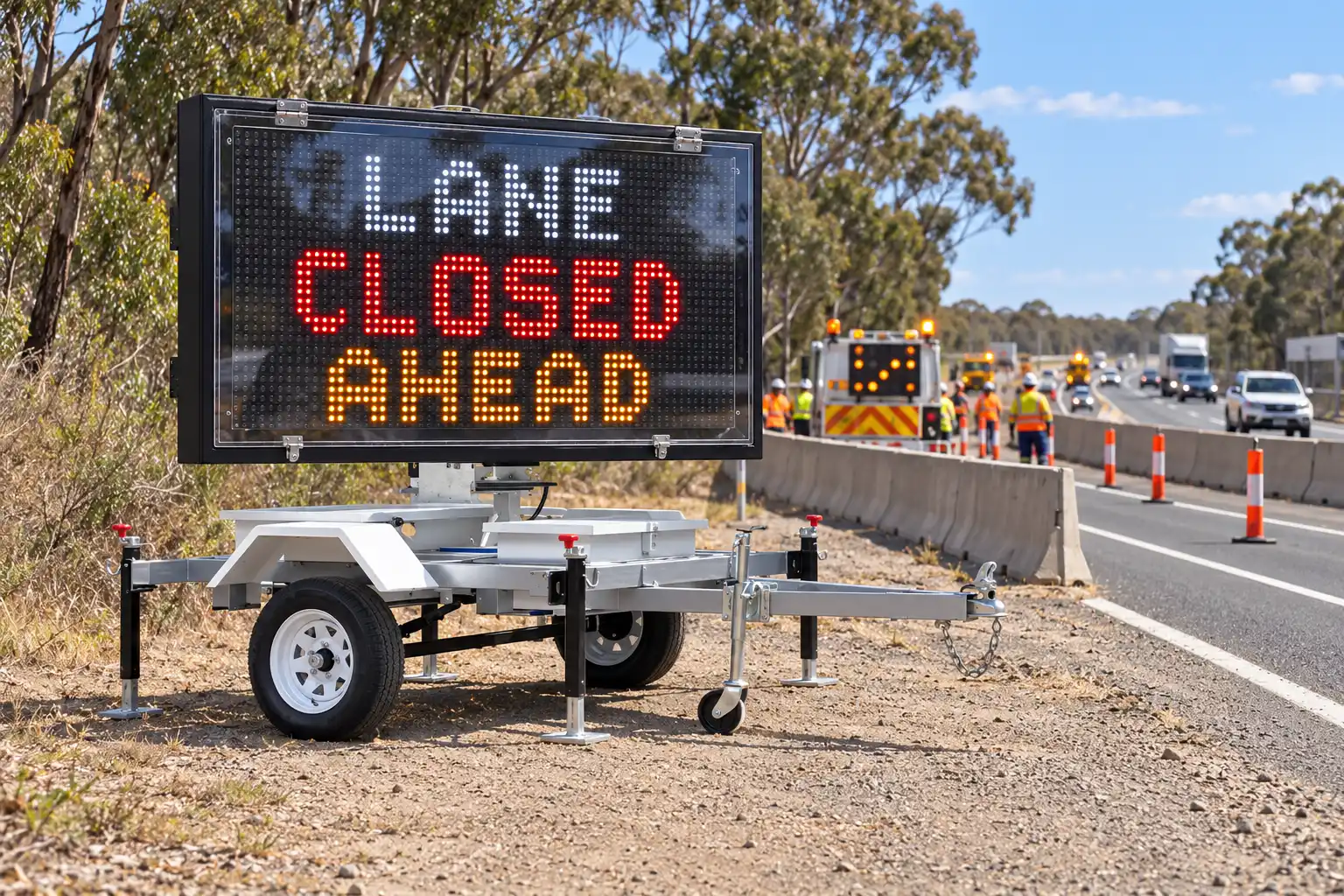
Continuous multi-week deployment on mainline approaches. This model carries 3 lines of 8 characters on a 56 × 28 matrix — 3156 × 1563 mm (124.25 × 61.54 in) of active display area at a 400 mm (15.75 in) character height — and the five-colour output, which lets one priority message carry its own colour above the advisory text, keeps that message readable at mainline approach speed.
§ MUTCD Part 6 (Chapter 6F)
§ MUTCD Table 2E-4
US practice sets letter height from the posted approach speed. MUTCD Part 6 (Chapter 6F) gives 18 in (457 mm) as the minimum letter height for a portable changeable message sign and permits shorter letters on low-speed facilities; Table 2E-4 adds that 450 mm (18 in) should be used where speeds are greater than 90 km/h (55 mph), in persistently poor weather, or where the driving task is complex. Messages are limited to two phases, and animation, flashing and scrolling are not used.
This model reaches 457 mm characters, which is the 18 in class the US guidance names for approaches above 55 mph (90 km/h), carried as 3 lines of 8 characters in the priority-colour layer carried on the same board.
§ AS 1742.3:2019
§ State roadworks guidance
AS 1742.3:2019 and the state roadworks guidance size characters to the approach speed, at roughly 120 mm for 60 km/h approaches and 160–200 mm for 80 km/h approaches, with the larger alphabet series applied to high-speed and multi-lane works. The sign face is confirmed with the road authority for each project.
§ NZTA CoP for Temporary Traffic Management
§ Published NZ figures for LED message signs
The NZTA Code of Practice for Temporary Traffic Management sets a temporary speed limit at least 20 km/h below the normal limit, gated across the carriageway, with repeat signs at 400 m intervals. The published NZ figures for LED message signs set characters at not smaller than 300 mm inside a 50 km/h area and not smaller than 400 mm elsewhere.
§ Traffic Signs Manual Ch. 8, Table A1.2
§ TSRGD 2016
The UK sizes characters by x-height rather than cap height. Traffic Signs Manual Chapter 8 (Table A1.2) runs from 62.5 mm at 30 mph to 200 mm on dual carriageways at the national speed limit, and TSRGD 2016 sets the legal x-height limits at 35 mm to 400 mm, so a cap-height figure has to be converted before it can be placed in that table.
§ EN 12966:2014+A1:2018
EN 12966:2014+A1:2018 classifies a variable message sign on luminance, beam width, colour and luminance ratio, with a temperature class. The class required follows the road type, the viewing geometry and the climate at the site, and it is stated per configuration rather than as a single figure.
The 56 × 28 matrix and 400 mm (15.75 in) characters are the two figures an agency can put against the posted approach speed, and the compliance path for the market is stated on this page rather than left for the tender.
One matrix · two layouts
56 × 28 matrix → 3 lines × 8 → 400 mm ⇄ regrouped rows → 457 mm
Character height and line count are the same decision, and this platform answers it with its matrix rather than with a menu: a 56 × 28 grid laid out for 3 lines of 8 characters, giving 400 mm (15.75 in). The same rows can also be grouped into a taller character, which is how this model reaches 457 mm. The trade is height against the number of lines
Pixel → stroke → character
17 LEDs / pixel → 3 mm through-hole → clean strokes → 400 mm character
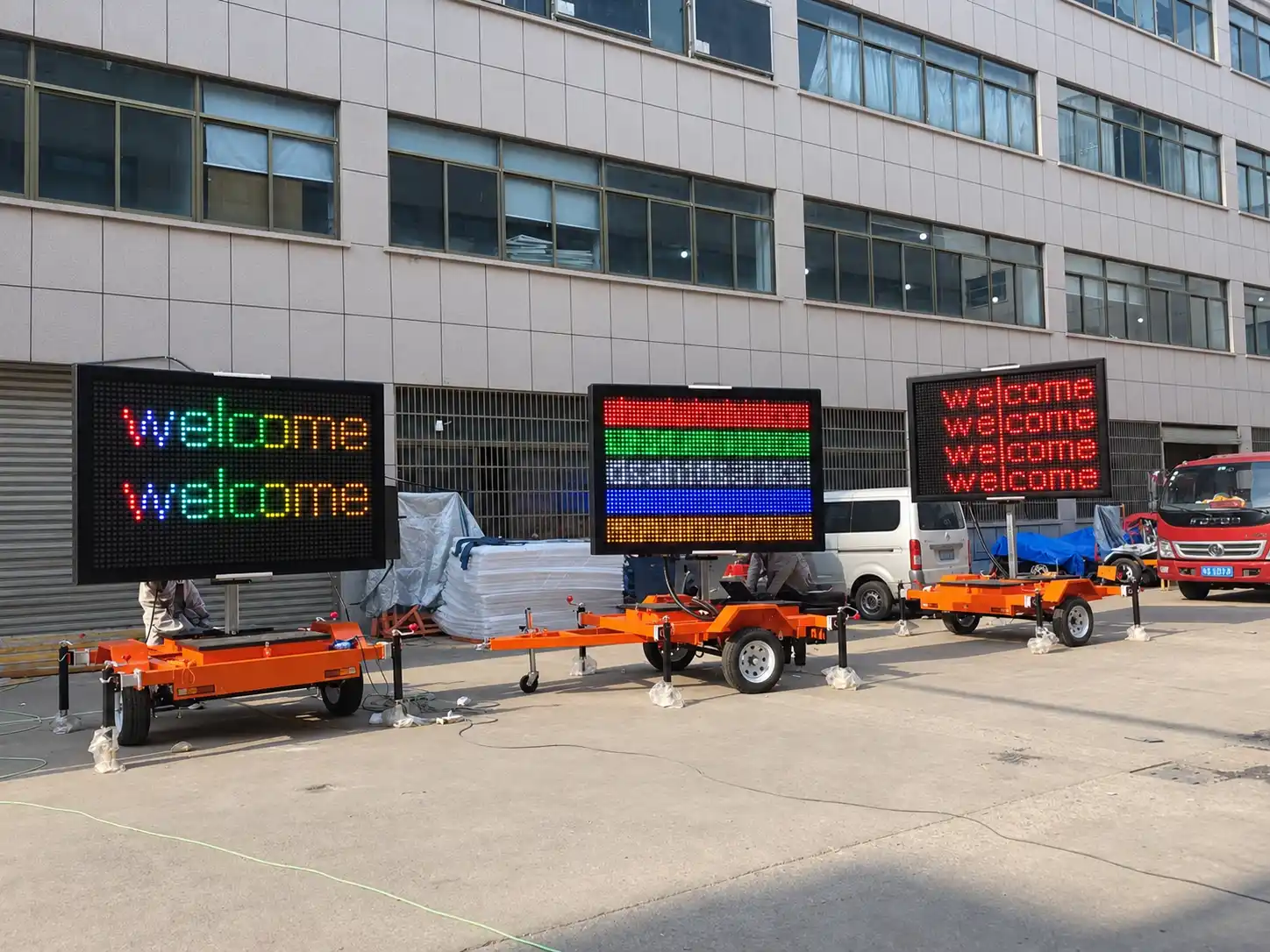
The pixel structure is published as: discrete per-colour LEDs — up to 17 individual LEDs per pixel (4 red, 4 amber, 3 green, 3 blue, 3 white); no colour blending. That is what lets a priority line take its own colour while the advisory text stays amber, on the same 3156 × 1563 mm of active display area, which is why five-colour is published as its own configuration rather than being folded into one blended panel.
Power on board · site off the brief
Solar + battery→no generator / cabling→
towable 3356 × 1763 mm
The platform carries its own power, which takes the site out of the design brief: no generator, no cabling and no mains connection has to be arranged before the sign can work. What is left to design is a 3356 × 1763 mm cabinet that tows between long-duration sites behind vehicles the customer already runs
North AmericaAustralia / New ZealandUK / EuropeOther
Long-duration highway work zoneShort-term / incident responseSpecial eventsFixed facility (port, airport, utility)
Arrows (left / right)Arrows plus other symbols (work-zone triangle, speed roundel, etc.)
Amber is sufficientWe need five-colour
Answered the four? Send them with your enquiry.
We reply with the configuration that matches your market, duty and message set — five-colour on this platform, or the amber model if Q4 says a single colour is enough.
Colour branch
Identical display geometry, only the colour configuration changes.
Choose amber if colour hierarchy is not needed; it does not reduce any display figure.
Size branch
Taller matrix: up to 513 mm (20.2 in) characters, or four lines.
Choose the extended model when the road speed or the message structure requires it.
Mounting branch
The same display class in the other mounting configuration.
Trailer-mounted suits long-duration deployment and towing; truck-mounted suits vehicle-integrated operation.
→Confirmed per project
If the viewing distance or the message volume is beyond what a 3156 × 1563 mm active display area can serve, this is the top of the five-colour trailer-mounted range — tell us the road and the viewing position and we will confirm whether a larger configuration outside the published five-colour group can be quoted.
If the sign can be placed closer to the traffic, the HK-PTMS-MS-0809-37-5C covers the same message format at a smaller footprint, with a 56 × 27 matrix and a 2619.1 × 1321 mm active display area.
→Confirmed per project
The other mounting platform is confirmed per project, because no directly equivalent model is published in this size class.
Between two sizes? Send the viewing distance and the message set.
We confirm the model against your site geometry before you commit.
The HK-PTMS-FS-0807-47-5C is one of 19 catalogued models — 15 of them published and available for specification — and it is the 14th by active display area among the published models. Within the full-size five-colour trailer group it is the 4th of 4. It carries a 56 × 28 pixel matrix — 56 pixels across and 28 down — over 3156 × 1563 mm (124.25 × 61.54 in) of active display area, with a character height of 400 mm (15.75 in) extending to 457 mm (18.0 in) with the 8-pixel-row character matrix.
Those five figures are the whole basis on which this model is chosen: the rest of the range differs in matrix, colour and display area, not in what a full-matrix display can do.
catalogued models
in the HANKUN PCMS range
published & available
for specification
by active display area
among published models
within the full-size
five-colour trailer group
Published range · by active display area14 / 15
This model sits in the upper band of the published range — larger units above it step up to the 56 × 32 matrix.
Full-size five-colour trailer group4 / 4
The top of its own group — no larger five-colour trailer-mounted configuration is published.
Need a different position in the range? Tell us the viewing distance.
We place your requirement on the same scale and name the model — this one, a step up, or a step down.
| Item | Value |
|---|---|
| Model | HK-PTMS-FS-0807-47-5C |
| Mounting | Trailer-mounted (road tow) |
| Display colour | Five-colour |
| Active display area | 3156 × 1563 mm (124.25 × 61.54 in) |
| Cabinet dimensions | 3356 × 1763 mm (100 mm border basis; depth 200–250 mm) |
| Display matrix | 56 × 28 pixels | discrete per-colour LEDs — up to 17 individual LEDs per pixel (4 red, 4 amber, 3 green, 3 blue, 3 white); no colour blending |
| LEDs per pixel | 17 per pixel — 4 red + 4 amber + 3 green + 3 blue + 3 white = 17 LEDs per pixel (3 mm through-hole LED) |
| Message format | 3 lines × 8 characters per line (variable format) |
| Character height — standard matrix | 400.0 mm (15.75 in) with the 5 × 7 character matrix |
| Character height — extended matrix | up to 457 mm (18.0 in) with the 8-pixel-row character matrix |
| Compliance path | MUTCD configuration options · North AmericaEN 12966 compatible configuration · Europe & UKAS 4852.2 configuration options · Australia & New Zealand |
— System & Operation
| Item | Value |
|---|---|
| Power | |
| Solar array | 2 × 360 W (720 W total) |
| Battery | 2 × 250 Ah AGM deep-cycle battery |
| Charge controller | MPPT charge controller, 30–40 A charge current |
| Panel mounting | Fixed as standard; tilt-and-rotate mounting (optional) |
| Trailer chassis | |
| Coating | Powder-coated and oven-baked |
| Axle assembly | 2,000 lb (907 kg) capacity; 5-on-4.5 in. bolt-circle idler hub |
| Suspension | Double-eye leaf spring group, 1.5 t (3,300 lb) gross capacity |
| Wheel track | 1,800–2,200 mm (model dependent) |
| Tires | ST205/75 D15 |
| Lifting | Electro-hydraulic; manual winch (optional) |
| Automatic dimming | |
| Ambient light control | Automatic dimming — display brightness and grey level are adjusted to ambient light conditions; a manual brightness setting is also available. |
| Remote operation and integration | |
| Connectivity | 4G; GPS position reporting |
| Operating terminal | Message management from phone, tablet or PC |
| Fleet integration | Open API and SDK protocol provided, for integration into an existing fleet management platform. |
— Compliance & Regional Configuration
MUTCD configuration options; NEMA TS-4 testing available on request.
✓MUTCD
✓NEMA TS-4
EN 12966 compatible configuration (class confirmed per project); CE marking and Declaration of Conformity available.
✓EN 12966
✓CE + DoC
AS 4852.2 configuration options; trailer build to applicable ADR requirements.
✓AS 4852.2
✓ADR
— Procurement Case
01
02
03
04
— Before You Specify
Colour Choice & Driver Response
Amber is one colour and one message layer; five-colour adds a second layer that carries its own colour. On this platform the pixel is 4 red + 4 amber + 3 green + 3 blue + 3 white = 17 LEDs, with no colour blending, so a priority line can take red or green while the advisory text stays amber on the same panel. Amber suits a site that issues one class of message. Five-colour earns its cost where the message carries a hierarchy — a colour-coded symbol beside an instruction, or a warning that has to separate from the text around it. The decision is a colour choice, not a different display: matrix, character height and message format do not change.
Recognition is faster when a symbol carries its own colour: a red triangle or a green arrow is picked up before the text beside it is, because colour is the first thing the eye sorts. That is the practical argument for a five-colour panel on a complex approach — the driver identifies the hazard by shape and colour, then reads the line that applies to them. It is also why colour is the wrong thing to add on a simple two-phase message: nothing in the message needs separating, so the extra layer carries no information and only adds a decision.
Specification, Compliance & Cost
Compare in the order that decides the specification. Active display area and the pixel matrix come first, because together they set the character height and how much message fits. On the full-size five-colour trailer that is a 56 × 28 matrix, 3 lines of 8 characters, and 400 mm (15.75 in) characters with the 5 × 7 character matrix. Then the power system — array and battery capacity against the insolation of the destination market — then the trailer chassis (axle rating, hub bolt circle, spring group, tires), then the compliance path. Price follows those four. A factory-direct quote that names the configuration item by item can be compared against another quote; a headline price cannot.
Check three things against the document that governs your market. Line capacity and character height — the sign has to carry the message the site needs, at the letter height its approach speed calls for. Legibility — luminance, contrast and beam width, stated as a class rather than as a claim. And the compliance path itself: MUTCD configuration options for North America, AS 4852.2 configuration options for Australia and New Zealand, EN 12966 compatible configuration with CE marking and a Declaration of Conformity for Europe and the UK. Compliance is supplied as configuration options with testing documentation available on request, and we do not describe a sign as certified unless a certificate number applies to that configuration — so ask for the document by number before quoting it into a project.
Rental earns its cost on short or uncertain work; purchase earns its cost once the unit is deployed for most of the year. As a rule of thumb the crossover lands somewhere around 6–12 months of cumulative deployment, and it moves with three things: how many sites the unit covers in a year, how far it has to be towed between them, and whether the rental rate already includes delivery and servicing. Ownership also carries costs the rental rate hides — storage, inspection, battery replacement and spares — so the comparison has to be total cost across the holding period, not monthly rate against invoice price.
Deployment & Integration
Upstream of the queue, far enough back that a driver at the posted speed can read the message, decide and change lanes. In practice that means the message is sized to the distance it is read from — which is why active display area and character height are always specified together — and it means the unit is placed against the advance warning arrangement rather than wherever the trailer happens to fit. One phase, one instruction: a driver already managing a work zone reads a short instruction faster than a programme.
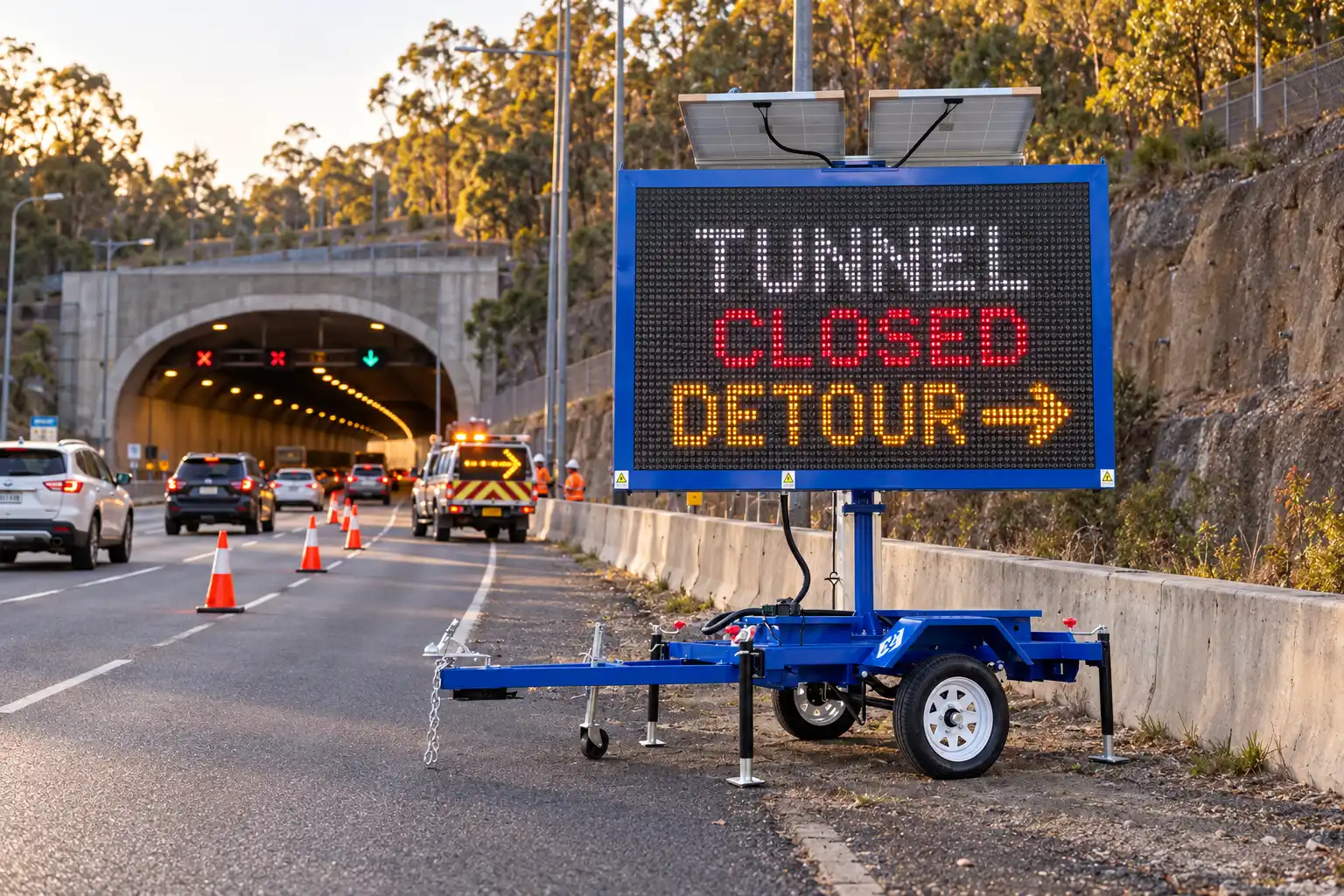
Pairing the board with Doppler radar makes it speed-responsive: the controller reads the approach and switches to a warning display when the threshold set for the zone is exceeded, which is how the same panel operates as a dynamic variable speed limit sign. It is used at work-zone approaches and before tunnel entries, where the speed drop has to happen before the hazard rather than at it. Radar is a configuration item — the sensor, the trigger logic and the message set are agreed at ordering, because the threshold belongs to the site, not to the panel.
The transport problem is height: a display raised for reading is too tall to tow at highway speed. The folding mast brings the panel down to a transport position without dismantling it, and the same mast is raised on site by electro-hydraulic lift (manual winch optional). That is what makes single-operator deployment realistic — tow, level the outriggers, raise and lock the mast, set the message. Stability in service is the other half: outriggers loaded, mast locked, and the assembly sized for the wind loading at the site, which is confirmed per project rather than published as a single figure.
Off-Grid Power & Upkeep
Off-grid means the display, the controller and the communications all run from the trailer’s own supply: a 2 × 360 W array (720 W total), a 2 × 250 Ah AGM deep-cycle bank, an MPPT controller at 30–40 A, and automatic dimming that cuts draw in low light. Over 4G, with GPS position reporting, the message, the schedule, the dimming profile and battery diagnostics are all handled from a phone, tablet or PC, so the unit is not attended to change its message. Working time between charges is set by duty cycle and site insolation and is quoted per project rather than published as a fixed number of days; array and bank capacity are matched to the destination market.
Four checks carry most of the reliability. Battery voltage and state of charge — the bank is where a failing system shows first. Panel and array cleaning — dust and snow cost output before they cost anything else. Enclosure seals — ask for the protection rating in writing, since it is confirmed per configuration and the seal is what delivers it. And mast and outrigger inspection after any tow. In freezing conditions charge acceptance falls and the bank has to be sized for it; in sustained heat the same bank ages faster, so the inspection interval shortens. Remote diagnostics let most of this be checked before anyone drives to site.
A question not listed here? Send it with your project location — the answer comes back with the configuration sheet.
Fill in your information to reserve a free exclusive video consultation. Our team will contact you within 24 hours to arrange a dedicated online meeting.