A driver closing on a work zone at highway speed has a few seconds to decide whether to hold the lane or merge. By the time that decision arrives, it’s already been made for them by a sign whose text changed minutes earlier from a control room many kilometers back. Roadside message boards are one of the few traffic tools that address every driver at once, in the same words, at the same moment. The trouble is that the vocabulary around them is a mess, and most guidance online explains the hardware before it explains what the sign is for.
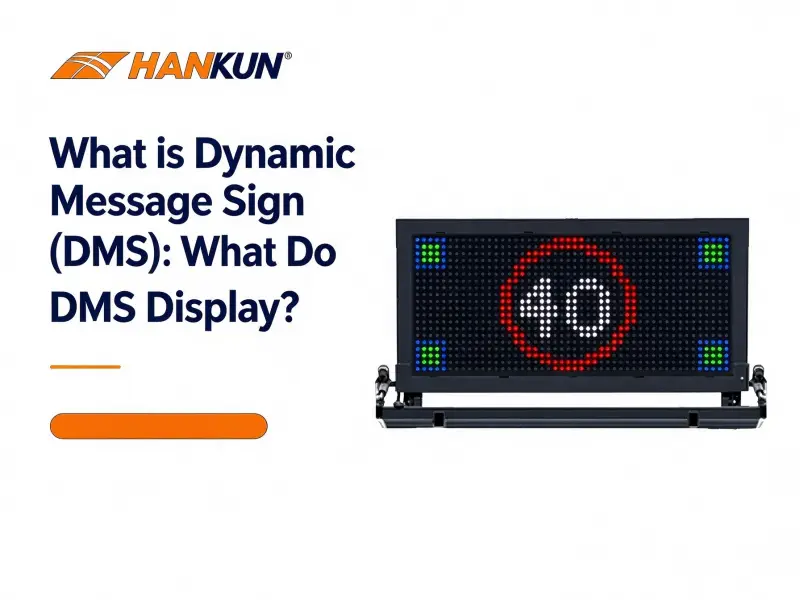
A dynamic message sign is an electronic roadside display whose text or symbols can be changed remotely, usually from a traffic operations center, to show real-time conditions ahead: crashes, closures, detours, travel times, weather, and speed limits. The same device is sold as a variable message sign, a changeable message sign, or a portable changeable message sign depending on the market and on whether it hangs from a fixed gantry or sits on a trailer.
What separates a DMS from a lit billboard isn’t the display panel but the rules behind the message, so the definition is the right place to start.
What is a dynamic message sign?
It is a traffic control device, not an advertising medium. Inside the housing sit a display module, a controller holding a library of stored messages, a power system, and a communication link, and every message it shows has to serve a driving decision.
The panel is usually built from LED modules arranged in rows and columns. The controller stores approved legends, enforces line and character limits, and logs what was displayed and when. Power comes from the grid on permanent installations, or from batteries charged by solar panels on portable units. The link back to the operations center runs over fiber, cellular, or a leased line.
In intelligent transportation system terms, a DMS belongs to advanced traveler information. Permanent units fall under Chapter 2L of the Manual on Uniform Traffic Control Devices. Portable units used in temporary traffic control fall under Part 6, Chapter 6L. That split explains most of the confusion in the market.
DMS, VMS, CMS, PCMS: four names for one device
| Term | Where you’ll see it | What it usually means |
|---|---|---|
| Dynamic message sign (DMS) | US agencies, research literature, procurement documents | Umbrella term covering fixed and portable units |
| Variable message sign (VMS) | Europe, the Middle East, Asia, Australia, and many suppliers | Same device, with the emphasis on variable content |
| Variable message sign (VMS) board | Trade and rental listings | Informal term for a single trailer-mounted unit |
| Changeable message sign (CMS) | The federal standard, Chapter 2L | A sign whose legend can be altered, typically fixed in place |
| Portable changeable message sign (PCMS) | The federal standard, Part 6 | A trailer- or truck-mounted unit used in work zones |
A buyer in one market asking for vms signs and a buyer in another asking for a message sign are describing the same product. The datasheet matters more than the label. What does change between them is the mounting, the power budget, and how strictly the message format is constrained.
Permanent versus portable units
| Feature | Permanent DMS | Portable DMS |
|---|---|---|
| Mounting | Overhead gantry, cantilever, or roadside post | Trailer with a raising mast, or a truck bed |
| Power | Grid connection, sometimes with backup | Battery bank, solar array, or a generator |
| Typical display | Three-line text or full matrix, large character height | Three-line text, or full matrix on premium units |
| Positioning | Fixed for years, chosen during design | Towed into place, repositioned as the job moves |
| Typical buyer | State or municipal road agency | Contractors, rental fleets, event organizers, industrial sites |
A permanent installation gets designed around sight distance and structural load. A portable unit gets designed around transport: it has to fold, tow, and set up without a crane, and it has to run for weeks without a grid connection.
What do DMS display?
Only traffic operational, regulatory, warning, and guidance information. In practice that means the handful of things a driver can still act on: what’s ahead, where it is, and what to do about it.
| Message category | Typical legend | What triggers it |
|---|---|---|
| Incident | CRASH AHEAD / RIGHT LANE / MERGE LEFT | Operator confirms it on camera |
| Closure and detour | ROAD CLOSED / 2 MILES / USE EXIT 14 | Planned works or police closure |
| Travel time | TO DOWNTOWN / 18 MIN | Loop detector or probe data |
| Work zone | ROAD WORK / NEXT 5 MILES / 45 MPH | Active temporary traffic control |
| Weather | FOG AHEAD / REDUCE SPEED | Visibility sensor or patrol report |
| Special event | EVENT PARKING / EXIT 22 | Event traffic plan |
| Speed advisory | YOUR SPEED / 58 | Radar paired with the display |
Some of these are a matter of local policy rather than fixed rule. One state’s operations manual permits incident management, emergency diversion, congestion, roadwork, travel times, adverse weather, and safety messages, then explicitly bars advertising, time of day, temperature, and general rules-of-the-road reminders. Another state’s handbook prohibits public service announcements and test messages on portable units altogether. If you’re buying for a specific jurisdiction, get that list in writing before you specify the controller.
The three-line, eight-character rule
Most portable changeable message signs are built around three lines of eight characters. That layout isn’t arbitrary. The federal standard caps a message at two phases, each phase at three lines of text, and requires each phase to make sense on its own. Message phases should run at least two seconds each, with the whole sequence finishing inside eight seconds.
The message itself should carry three thoughts, ideally one per line: the problem ahead, its location or distance, and the recommended action. Read a well-built legend and you can see the pattern immediately, which is why “ROAD CLOSED / 2 MILES / USE EXIT 14” works and “ATTENTION MOTORISTS / PLEASE BE ADVISED / ROAD WORK” doesn’t.
Legibility drives the hardware. Character height has a guidance minimum of 18 inches, dropping to 10 inches on service patrol trucks and low-speed streets where the sign still reads from 650 feet. Characters are built on a five-by-seven pixel grid with a height-to-width ratio around 1.4 to 1. Portable units should be legible from half a mile in daylight and at night, which is why automatic brightness adjustment is a requirement rather than a feature. Where two units are visible at once, only one should run a sequential message.
The physical install has rules too. The bottom of the sign sits at least 7 feet above the roadway in urban areas and 5 feet in rural ones, and units need a battery backup so they keep running when the primary supply fails. More than two phases means more than one sign, spaced at least 1,000 feet apart on freeways and 500 feet on other highways. A fuller look at the trailer-mounted variants specifically built to these limits is covered under three-line portable changeable message signs.
What a DMS may not show
Advertising, animation, scrolling text, and in many jurisdictions public service announcements are all excluded, and the exclusion is written into the standard rather than left to operator taste.
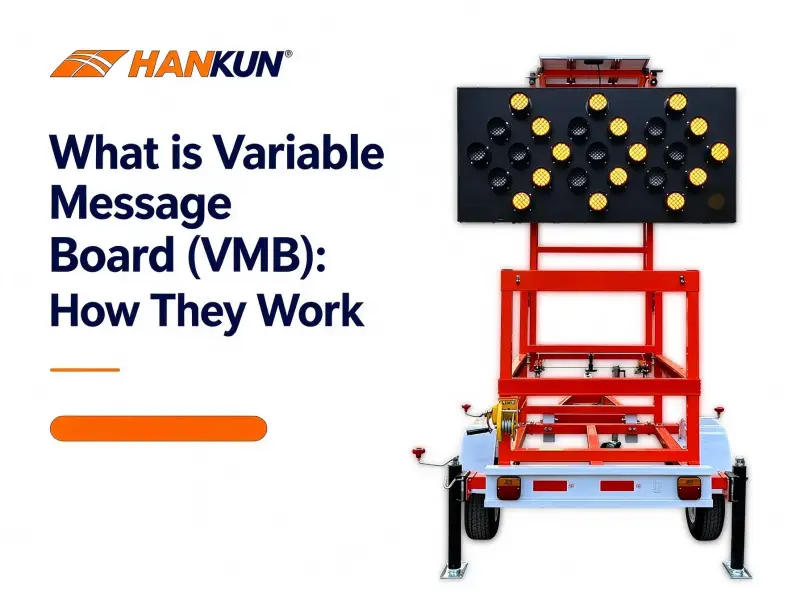
The prohibited display techniques list is specific: no animation, rapid flashing, dissolving, exploding, scrolling, or text traveling across the face of the sign. The one exception is a unit simulating an arrow board, where the chevron sequence is the message. Text and arrow graphics must never share a phase.
The standard is equally clear that a changeable sign supplements conventional signs and pavement markings rather than replacing them. When a portable unit isn’t showing a temporary traffic control message, it should be moved out of the clear zone or turned away from traffic, and the trailer face should carry retroreflective conspicuity material so it can be seen as a physical object at night.
From text-only to full matrix
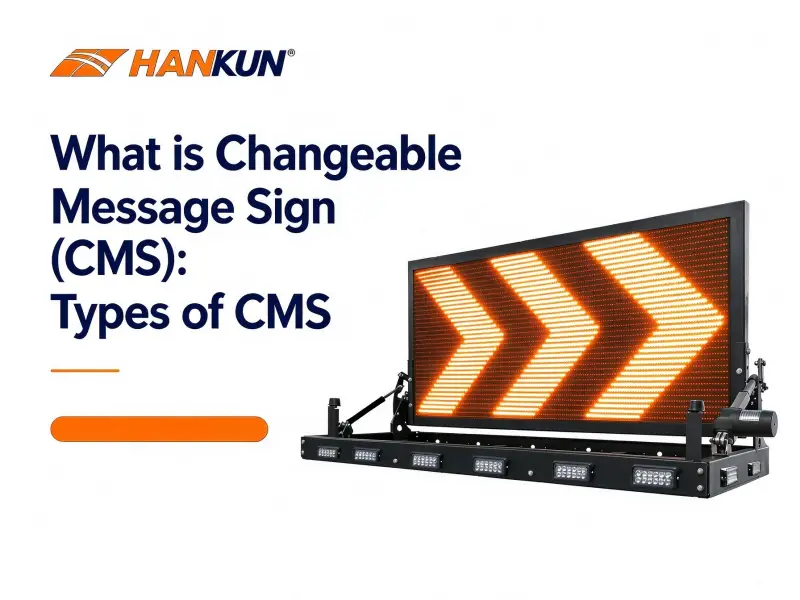
A three line sign shows text and numbers in a fixed grid; a full matrix sign treats the whole face as a pixel grid, so it can draw arrows, chevrons, lane-status symbols, and route shields.
The difference matters when the message has to convey geometry rather than words. A lane closure diagram, a merge arrow, or a shield for a numbered route can’t be typed into a 24-character text panel. A full matrix unit can reproduce a standard symbol exactly, and the standard only allows the symbol if it matches the official version in both shape and colour.
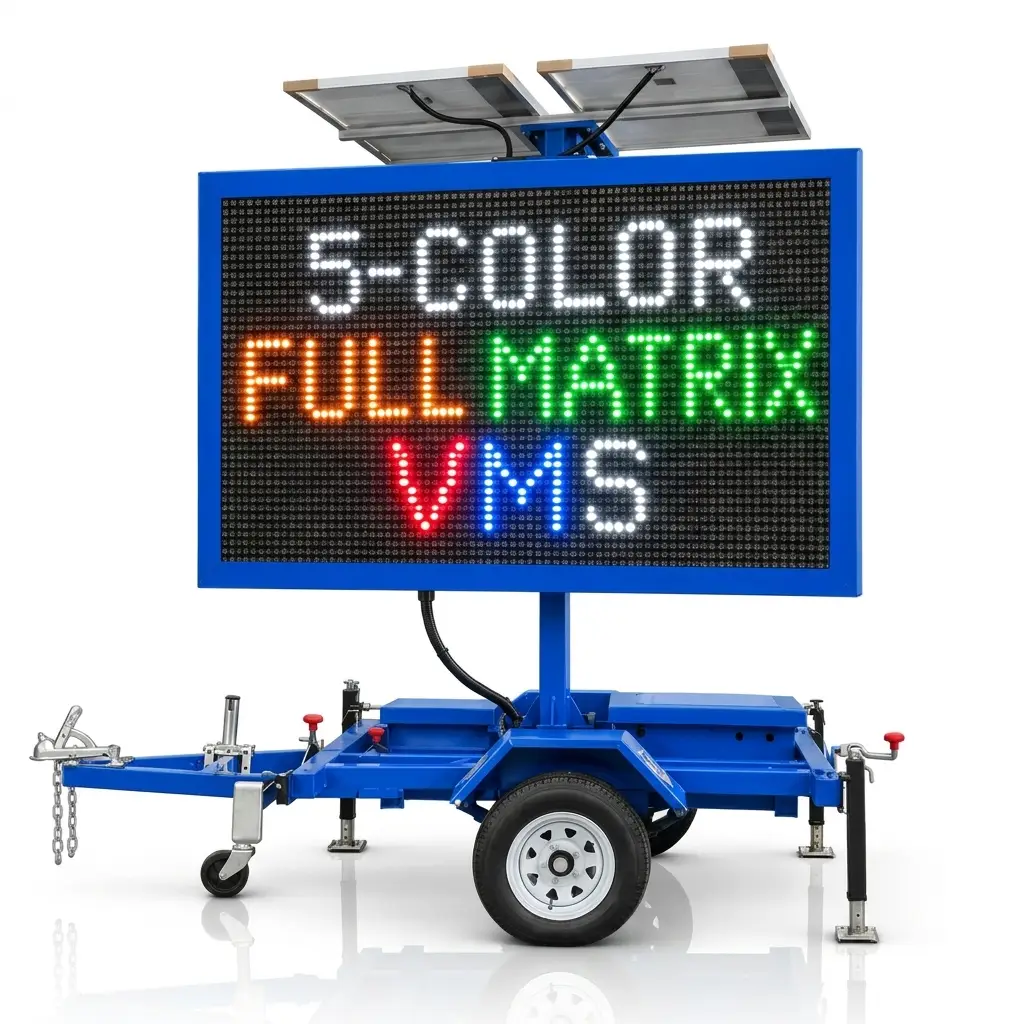
Amber remains the default legend colour, specified around 590 nanometers, and it wins on cost and long-range contrast. Full-colour and five-colour panels cost more and earn their price at events, in urban settings, and anywhere a red or green element carries meaning the driver already understands.
How a message travels from the control room to the road
An operator at a traffic management center selects a stored template, checks it against live camera and sensor data, previews it on a screen, and publishes it. The sign receives the message over fiber or cellular and displays it at an automatic brightness level.
The sequence is short but every step has a failure mode.
- Detection: loop detectors, radar, cameras, or patrol reports flag a change in conditions.
- Verification: an operator confirms the event rather than trusting a single sensor.
- Selection: an approved template is pulled from the library, which already fits the line and character limits.
- Preview: the legend is reviewed on the controller’s display before it goes live.
- Publication: the message is pushed to the unit, with confirmation that it was received.
- Review: the operator checks the sign on camera or through a field report.
- Clearance: the message comes down as soon as the condition clears, and the unit reverts to a default or goes dark.
Interoperability sits underneath all of it. A common protocol profile lets a center control signs from different manufacturers without a separate terminal for each. The controller must also retain its memory when power drops, so a unit that reboots comes back with the right message rather than a blank face.
Preview tools and message simulators
Previewing is a requirement, not a convenience: the control system has to include a screen where the message is reviewed before display, and a free traffic message board simulator does the same job offline for training and layout testing.
A simulator is useful for the narrow task it does well. Type a proposed legend and it shows the line breaks, counts characters against the eight-per-line limit, estimates how long the phases will take to read, and lets you see whether the three lines actually form three thoughts. Crews use them to draft messages before a shift, trainers use them to teach new operators, and sales teams use them to show a client what a three line sign will look like loaded with their own text.
What a simulator can’t do is tell you whether the message survives real conditions. Contrast in low sun, rain on the panel face, viewing angle from a neighboring lane, and the time a distracted driver actually spends looking at the sign all sit outside the model. A legend that passes a simulator can still fail a field trial, and a field trial is the only test that counts.
What does “dms traffic” mean?
In a road context, DMS traffic means the stream of traffic information published through dynamic message signs, and by extension the part of a traveler information program that feeds those signs.
There’s a second reading worth separating out. Some people use the phrase for the whole pipeline: detection, the decision to post, the display itself, and the behavior change that follows. That’s closer to how agencies talk about it, because a sign is only the visible end of a system that starts with sensors and ends with a driver choosing an exit.
The phrase has nothing to do with direct messaging in a marketing or social media sense, which is where most search results for the term go wrong. If you’re reading about dynamic message signs and someone mentions DMS traffic, they mean the incident and travel-time feed, not a private message inbox.
Credibility is the constraint that holds the whole pipeline together. One state’s operations guidance puts it bluntly: no matter how well a message is designed, drivers will stop believing the system if messages aren’t updated to match what they actually encounter. A survey cited in a state research report found that 98.4 percent of respondents recognized the signs and 93 percent trusted the information on them. The message type rated most useful was advance notice of an incident paired with an alternative route, which is exactly the three-thought structure the standard asks for.
Which DMS formats are used in the field
Four formats cover most deployments: three-line trailers, full-matrix trailers, truck-mounted boards, and compact vehicle-mounted units for service patrols and lower-speed streets.
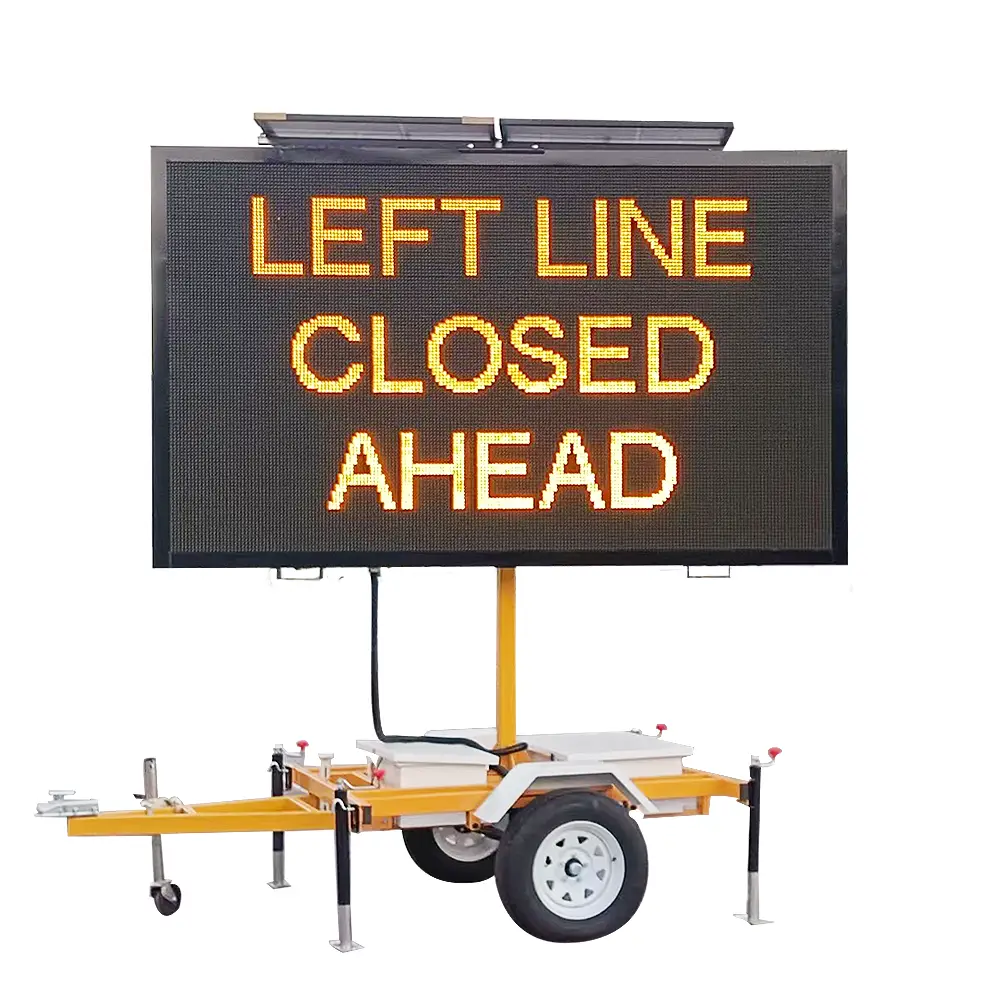
The trailer-mounted variable message signs in this group are the workhorses: they tow behind a pickup, raise on a mast without a crane, and run for weeks on solar and battery. Everything else is a variation built around message complexity and dwell time.
| Format | Display | How it moves | Best fit |
|---|---|---|---|
| Three-line trailer | Three lines of eight characters, amber | Towed, mast raises on site | Work zones, lane closures, utility jobs |
| Full-matrix trailer | Full pixel grid, amber or full colour | Towed, heavier chassis | Freeway lane closures, events, complex merges |
| Truck-mounted board | Three-line or matrix on the truck bed | Drives to the site, deploys from the vehicle | Incident response, short-duration work |
| Compact vehicle-mounted | Smaller panel, lower character height | Roof or rear mount | Service patrols, parking control, urban streets |
The two variables that decide which one you need are message complexity and dwell time. A utility crew closing one lane for three days needs three lines and a stable trailer. A freeway incident that shifts lane geometry every twenty minutes needs a matrix panel and a truck that can leave in a hurry.
Solar sizing is where portable specifications quietly diverge. Panels and battery capacity have to cover the worst stretch of weather in the deployment season, not the average day, and a unit that browns out in its third overcast week has failed at the one job it had.
Where DMS do the most work
Work zones, incident scenes, special events, and severe weather are the four situations where a changeable message outperforms a static sign, because the information changes faster than a crew can drive out and post it.
The benefits aren’t speculative. A state operations manual lists four that agencies consistently measure: lower approach speeds near congested areas and fewer crashes as a result, more diversion to alternate routes during incidents, earlier lane changes away from closed lanes and safer merging, and smoother traffic during special events.
Two more settings deserve mention because they’re rarely covered. Industrial sites, including mines, quarries, and energy projects, use the same hardware on haul roads and access routes where there is no public signage to supplement. Event and venue operators use trailer units for parking direction and pedestrian routing, which is the same three-thought logic applied to a different kind of queue.
What to check before specifying a DMS
Start with the message, not the trailer. Line count, character height, and legibility distance decide whether the sign does its job, and every other choice supports those three.
| Check | Why it matters | Benchmark to ask for |
|---|---|---|
| Line count and matrix type | Determines whether you can show symbols or only text | Three lines of eight characters, or a full pixel grid |
| Character height | Sets reading distance at speed | 18 inches as a minimum, with the low-speed exception documented |
| Legibility distance | Ties character height to the road’s operating speed | Half a mile in daylight and at night for portable units |
| Colour configuration | Amber is cheaper; colour carries meaning | Amber around 590 nanometers, or full colour where justified |
| Power and autonomy | Decides uptime through bad weather | Panel and battery sized for the worst week, not the average |
| Communication | Determines whether remote updates are possible | Cellular with a fallback, plus memory retention on power loss |
| Controller and language support | Affects who can operate it and how fast | Stored templates, preview screen, multiple character sets if needed |
| Mounting height | Affects sight lines and crash risk | Sign bottom at 7 feet urban, 5 feet rural |
| Compliance documentation | Decides acceptance by the road authority | Standard references, test reports, and conspicuity marking |
Ask for the message library as well as the hardware. A unit that arrives without pre-approved templates tends to get run with improvised text, and improvised text is how signs end up with six lines, mixed fonts, and messages nobody can read at speed.
Common questions about dynamic message signs
Can a DMS show more than three lines?
Not on a standard three-line unit, and not by splitting a message into four or five short phases. The rule caps a message at two phases of three lines each. If the content genuinely needs more, the answer is a second sign placed far enough back to be read separately, or a full matrix unit that can convey the same idea with a symbol instead of a sentence.
Do portable DMS have to meet a national standard?
In the United States, yes, if the sign sits in a temporary traffic control zone on a public road. Chapter 6L of the federal manual sets the message format, timing, brightness control, power backup, and mounting height requirements, and state manuals typically adopt them with local additions. Elsewhere the equivalent national or regional standard applies, and the message limits are often similar because they come from the same reading-distance research.
How are solar DMS powered through cloudy weeks?
A solar array charges a battery bank sized to carry the sign through a run of low-yield days, and the controller sheds load before the battery reaches a critical level. Practical autonomy depends on panel wattage, battery capacity, display size, and duty cycle, which is why the honest answer to “how long will it run” is a calculation based on your site’s worst-month solar data rather than a number from a brochure.