Road work, a crash or a sudden closure can change the driving task in the time it takes to travel a few hundred metres. Printed signs cannot report that, because their faces are fixed months before the work starts. Agencies needed a sign whose text could be rewritten the same morning, from a control room or from a laptop at the roadside. That requirement produced the changeable message sign, now standard equipment on freeways, arterials and construction sites.
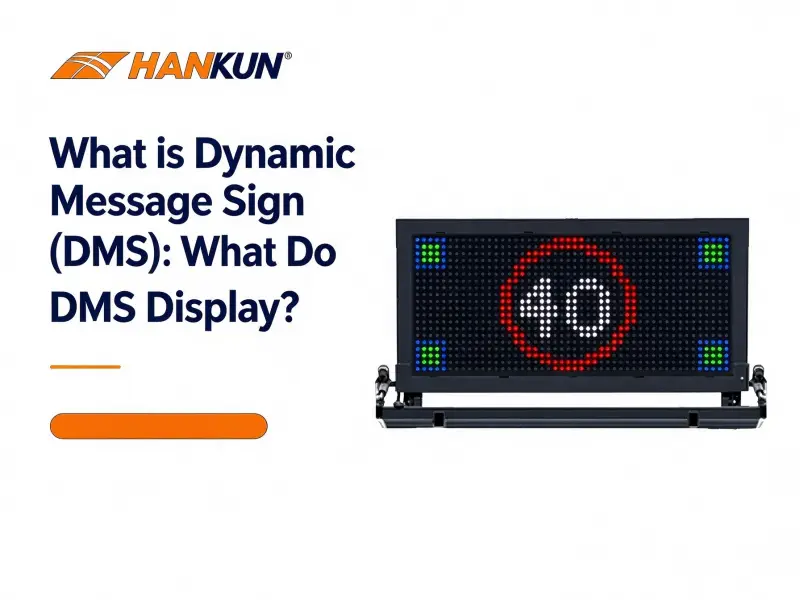
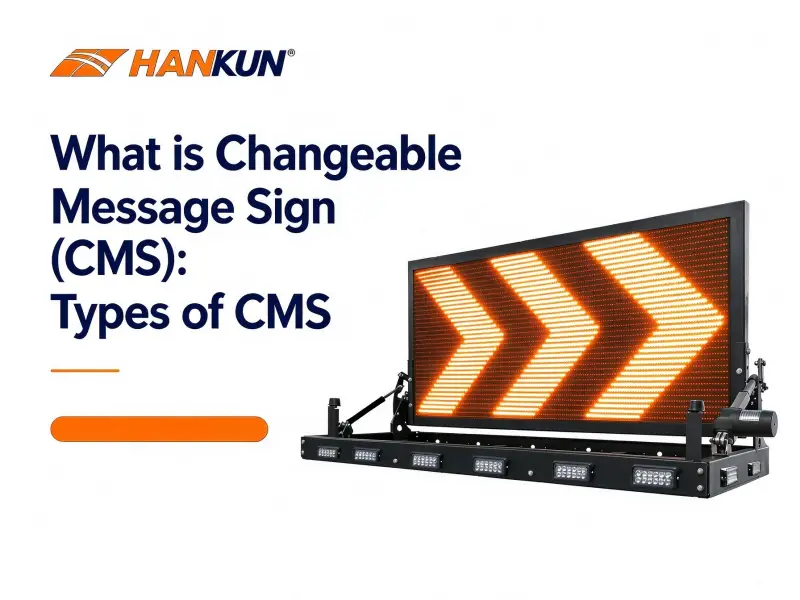
A changeable message sign (CMS) is a programmable traffic control device that shows road users one of several alternative messages. Mechanical models select from a fixed set of printed messages; electronic models build any combination of characters on a pixel matrix. US standards use CMS, engineering documents often use dynamic message sign (DMS), and international tenders use variable message sign (VMS). The three names describe the same hardware.
The useful distinctions begin with those names, then move to how a sign produces a message and where it is mounted.
CMS, VMS and DMS: three names, one device
The three terms describe one device. CMS is written into US traffic control standards, DMS appears mostly in intelligent transportation system documentation, and VMS is the general term in international standards, tenders and catalogues.
That matters in procurement. A tender asking for a CMS may mean a full-matrix electronic display, or any device whose message can be changed, mechanical types included. Two suppliers can answer the same document with very different products and both be correct. Read the definition clause before the specification table.
Why the terminology differs by market
- United States. The Manual on Uniform Traffic Control Devices treats a CMS as a traffic control device and covers permanent and portable units. State approved product lists follow that wording.
- Europe and export markets. Product standards and catalogues say variable message sign, so the same trailer is a VMS in one market and a PCMS in another.
- Engineering and ITS documentation. Dynamic message sign appears where the emphasis is on the live data link to a traffic management centre.
- Site language. Crews say message board or board trailer, which matches none of the formal terms.
Devices that are not changeable message signs
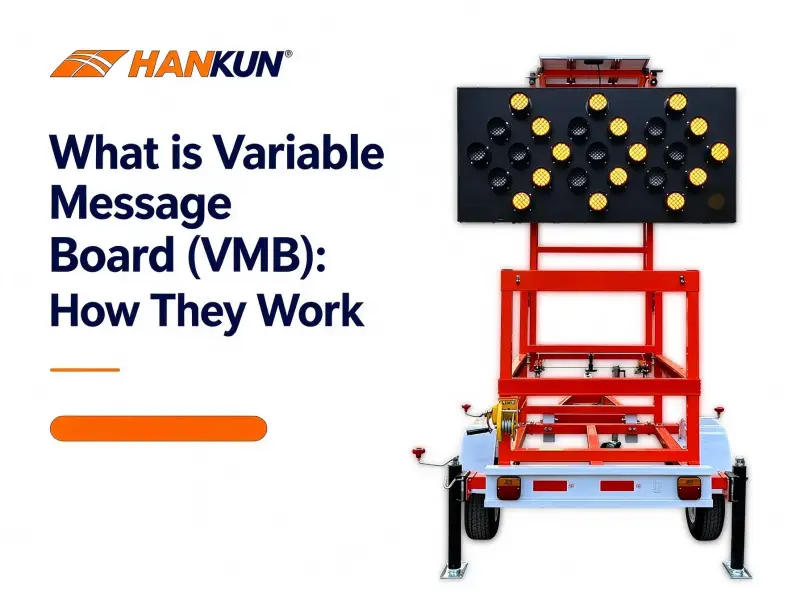
An arrow board carries a chevron pattern and no words, so it is a separate device class. Highway advisory radio speaks through the vehicle radio instead of a display. A commercial LED advertising trailer uses similar panels and the same trailer format, but traffic signs of this family are restricted to road operation and guidance. Static printed signs are the baseline a CMS supplements.
The two ways to sort changeable message signs
Signs are classified two ways: by message capability, meaning a fixed set of messages or any combination of characters, and by mounting, meaning permanent structure, trailer or vehicle. Most catalogues mix the two, which is why product ranges look inconsistent at first reading.
Signs with a fixed set of messages
The message set is decided at build time, and a mechanism selects one of them.
| Type | How it produces a message | Capacity | Where it still appears |
|---|---|---|---|
| Fold-out | A hinged face opens to reveal a second printed panel | Two | Bridge icing warnings, weigh station states |
| Rotating drum | One to four multi-faced drums turn on an axis, each face carrying one line | Two to six lines | Tolls, parking access, older urban schemes |
| Neon or blank-out | Neon tubing forms characters, separate or stacked | A small fixed set | Legacy sites, special-purpose signs |
Signs that can display any message
Electronic units build characters from pixels, and the pixel layout sets how much freedom the sign has.
Character matrix. Each character sits in its own block, usually a five by seven grid. It is the cheapest layout, strong with capitals and weak with lowercase. Many permanent units run three lines of eighteen characters.
Line matrix. Each line is a continuous pixel strip, so characters can be proportionally spaced. Text reads faster at distance, at the cost of a few characters per line.
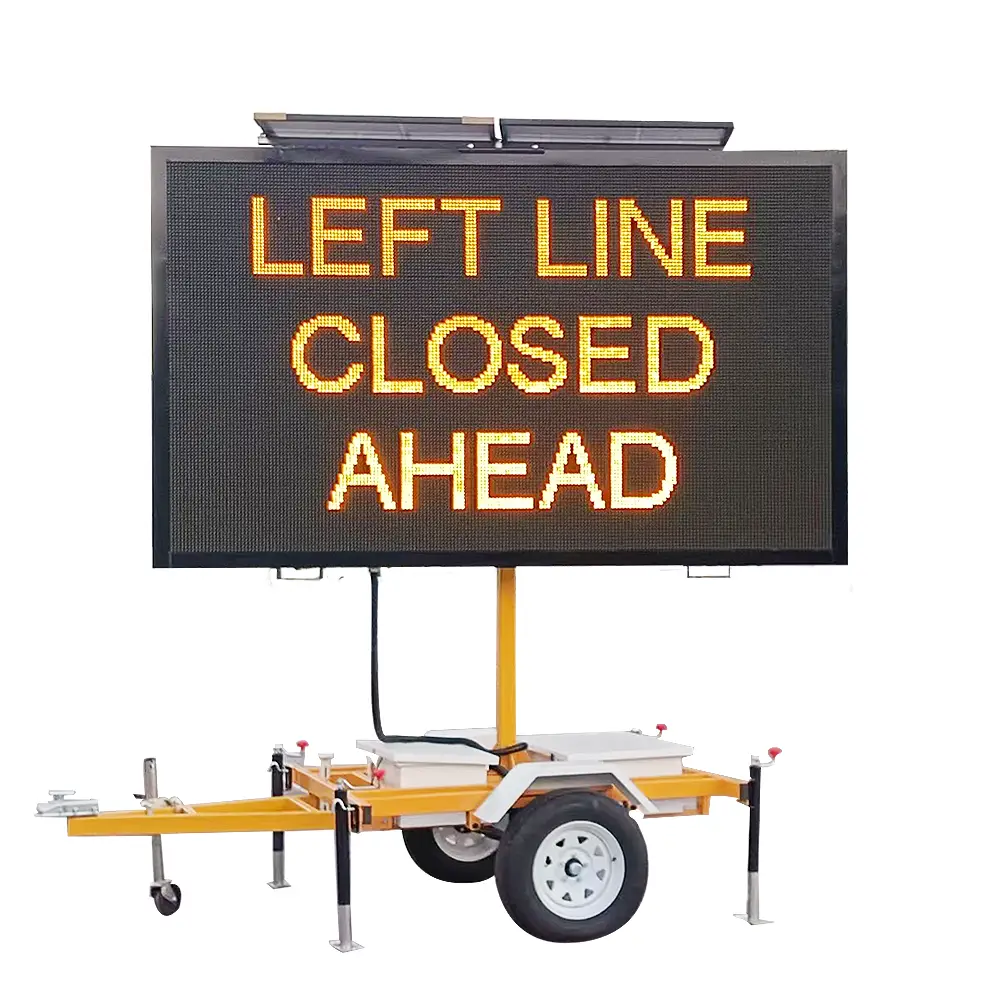
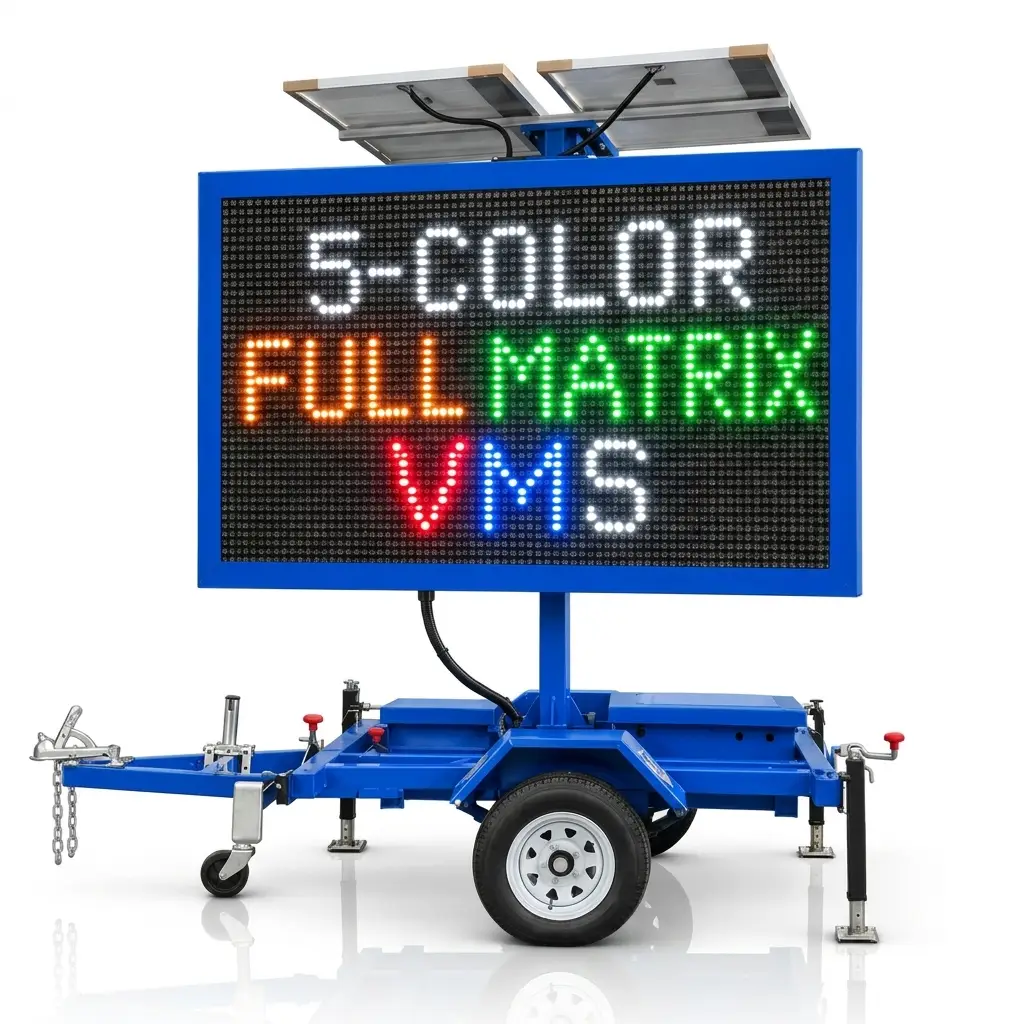
Full matrix. The whole face is one field of pixels. Character height varies by line, arrows and symbols become possible, and one sign serves several message types. Most portable traffic units are full matrix, and the range of Variable Message Signs covers solar trailer units and compact boards.
Display technologies inside the matrix
How a pixel is lit decides power draw and behaviour in low sun.
| Technology | Principle | Strength | Weakness |
|---|---|---|---|
| Reflective disk | Magnetised discs, black on one face, reflective on the other | Very low power | Needs lighting at night, jams with dust |
| Fibre optic | A light source feeds bundles, shutters form characters | Few failures, even output | Narrow viewing cone |
| LED | Diode clusters form each pixel | Reliable, full colour, wide dimming | Heat management, narrow cone on some designs |
| Hybrid | Discs combined with a light source | Legible in sun and at night | Carries both sets of drawbacks |
LED has taken nearly all new construction. The other technologies survive in legacy fleets and small special-purpose signs.
How a changeable message sign works
A controller turns text into a pixel pattern, driver boards switch the matching LED clusters, and power and communications keep the unit running unattended. The panel is one part of a system.
From pixel to character
Standards set a floor of five pixels wide by seven high per character, which is why a matrix looks like a grid of dots up close. Portable character height runs from about 457 mm to 1,372 mm, or 18 to 54 inches. The rule of thumb is one inch of height for forty feet of legibility, so an 18 inch character is recognisable at roughly 720 feet and a 54 inch character at roughly 2,160 feet.
Those figures describe recognition, not reading. The driver also has to assemble the words, decide and change lane, so the usable distance is shorter and the gap widens with message length.
Control, communications and sensors
Local control runs from a keypad at the trailer. Remote control runs over a cellular modem to central software, sometimes through traffic management interoperability protocols, so one operator can manage a fleet. Radar or loop data can trigger a speed message, and some units log speeds while displaying them. Without a local fallback, a unit that loses coverage keeps showing a message that is no longer true.
How much text fits on a changeable message sign
About eight words, or one short instruction, per phase. Portable units are usually three lines of eight characters, so reading time at the approach speed, not pixel count, sets the limit.
Lines, characters and fonts
The three line grid is the portable standard because it fits a short instruction without asking the driver to parse a paragraph, and the range of three-line portable changeable message signs reflects that. Eight characters per line is common, nine appears on some models, and display area grows with character height rather than line count.
Proportional fonts fit more into the same width and look more like printed words, but they break the predictable grid drivers scan. Capitals are easier to identify at distance, though long strings of them slow reading. Fill the space with what fits comfortably, not with every character position available.
Phases and reading time
A phase is one complete screen of text. Two is the usual ceiling, and each has to stand alone, because a driver joining mid sequence sees only the second. Never split a word across phases, keep abbreviations standard, and treat any phase that needs a second reading as too long.
Standards also limit content. The Manual on Uniform Traffic Control Devices restricts these signs to traffic operation and guidance and rules out advertising, which is why a safety slogan passes and a sponsor message does not. At highway speed the reading window is roughly eight seconds, and that, rather than the panel layout, sets the word limit.
Where changeable message signs are used
The common thread is a condition that changes faster than printed signing: a closure that moves, a crash that clears, weather that lifts, a crowd that arrives on schedule.
| Application | Typical message | Mounting that fits |
|---|---|---|
| Work zones | Lane closed ahead, shift left, detour | Trailer or truck-mounted |
| Incidents | Crash ahead, lanes blocked, expect delay | Vehicle-mounted or trailer |
| Weather | Fog, ice, flooding, high wind | Permanent or trailer |
| Special events | Parking, venue access, event traffic | Trailer, often relocated |
| Structures | Bridge or tunnel closure, toll lane status | Permanent |
| Diversion | Alternative route, follow signs | Gantry or trailer |
Fixed, trailer-mounted or vehicle-mounted
Mounting decides more of the purchase than the acronym does. A fixed sign is installed once and wired in, a trailer carries its own power between sites, and a vehicle-mounted unit travels with the crew.
| Factor | Fixed | Trailer | Vehicle-mounted |
|---|---|---|---|
| Power | Mains | Solar and battery | Vehicle or small battery |
| Display size | Largest | Medium to large | Small to medium |
| Relocation | Rare | Between sites, by tow | With the vehicle |
| Best fit | Network coverage | Long work zones, events | Incident response |
When a trailer makes sense
A trailer buys height, panel area and autonomy together. The mast lifts the panel above the traffic stream, the solar array and battery carry a long shift, and the unit moves as the work front advances. Trailer-Mounted Variable Message Signs also solve the power problem on sites with no supply, which is most of them. In return they need a tow vehicle, a level stance, wind ballast and brakes on the larger frames.
When a vehicle-mounted unit makes sense
Crews cannot wait for a trailer, so the sign rides on the vehicle and deploys at the roadside. The trade is size and height: a truck bed carries fewer lines and less panel area. Vehicle-Mounted Variable Message Signs suit short closures, lane shifts during clearance and escort work, where the sign is needed for hours rather than weeks. Above a certain panel size the mount stops being practical.
What to check before you specify
Fix the road and the viewing geometry first, then the optical class, the power margin and the trailer requirements. Projects that start from screen size and work backwards end with a sign that is either unreadable at approach speed or oversized for the site.
Optical performance and standards
In the US the reference is the traffic control manual and the state approved product list. In Europe, EN 12966 grades luminance, colour, luminance ratio and beam width, and each grade follows the site. A highway gantry on a head-on approach suits a narrow beam, an urban intersection a wider one, and an east or west facing panel needs a high ratio class because low sun lifts the unlit background and flattens contrast. A supplier quoting one class has not confirmed the others.
Power and autonomy
Solar sizing is a winter calculation. The array must cover the display load across consecutive poor sun days, with headroom for battery ageing and panel heating. Night dimming extends autonomy, and a budget that assumes full brightness around the clock will fall short. A Solar-Powered Mobile Changeable Message Sign runs indefinitely in most climates, but only when sized from the site’s worst month.
Trailer, mounting and site requirements
Mast height sets the sight line over intervening vehicles. Ballast and anchors decide whether the unit stays upright in a gust, while brakes, lighting and coupling decide whether it can travel on public roads. Transport dimensions and ground surface matter for access. These details cause more site problems than display specifications.
Controller, software and message library
Ask what happens when the network drops, who can change a message, and whether the library covers the phrases the agency uses. A good sign with a clumsy controller gets operated badly, and badly operated signs teach drivers to stop reading them.
Limits worth knowing
A CMS supplements standard signing, it does not replace it. Used too often it stops being read, and a message that is too long, too late or badly placed can create the hazard it was meant to prevent.
Condition is judged per character module, so one failing module downgrades a panel that still looks fine from a distance. Low sun exposes weak contrast long before a brightness figure looks wrong, and dust, condensation and lens wear reduce output gradually, which makes scheduled inspection more useful than repair. Content rules are not optional either: traffic operation and guidance only.
FAQ
Is a portable changeable message sign the same as a CMS?
Yes. It is a CMS built for temporary deployment, usually on a trailer or a truck, and it follows the same message rules with a smaller panel and its own power supply.
Can a changeable message sign run entirely on solar power?
Most trailer units do. The array charges a battery bank sized for the display load and for the number of consecutive cloudy days the site expects. Heavy tree cover or long winter nights may call for a larger array, a generator backup or a mains connection.
Can a changeable message sign display symbols or graphics?
Full matrix models can, within the limits of the pixel grid. Symbols work for arrows, lane shifts and merge instructions, and they cross language barriers. Complex artwork does not, because the driver has seconds and no capacity to interpret a picture.