A driver meets a variable message board long before they meet the reason it was put there. The board sits a kilometer upstream of a lane closure, a crash, or a queue that has not formed yet, and it does the one job a painted sign cannot: it changes. For contractors, traffic management firms, and road agencies buying this equipment, that flexibility is also where the difficulty starts. A board that shows the wrong message, at the wrong height, or in the wrong format is worse than no board at all, because it teaches drivers to stop reading.
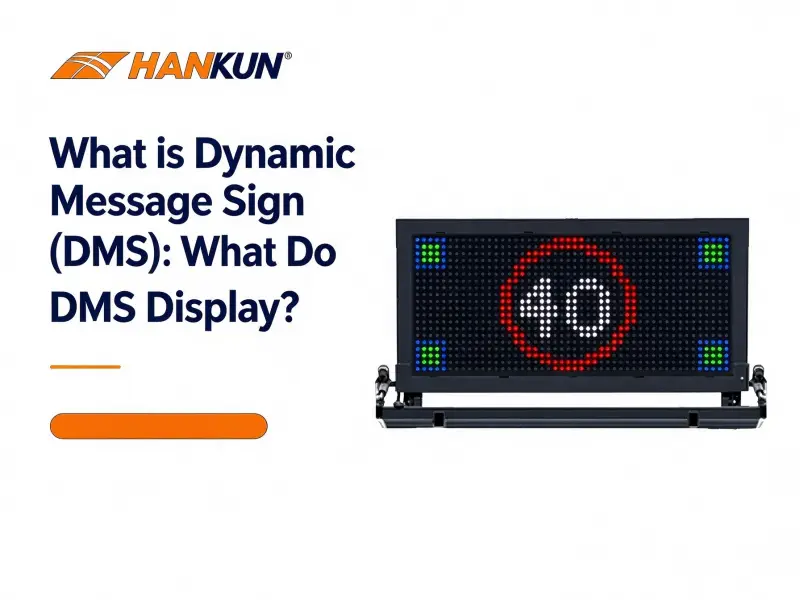
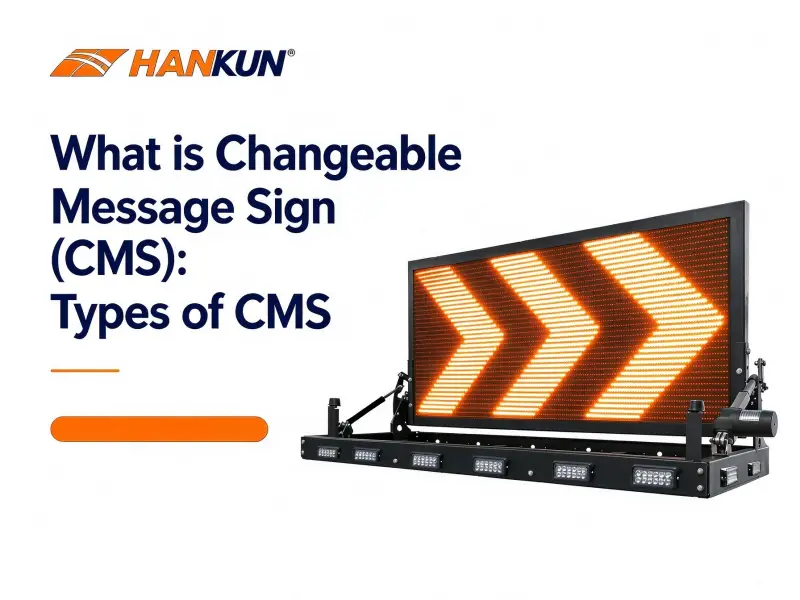
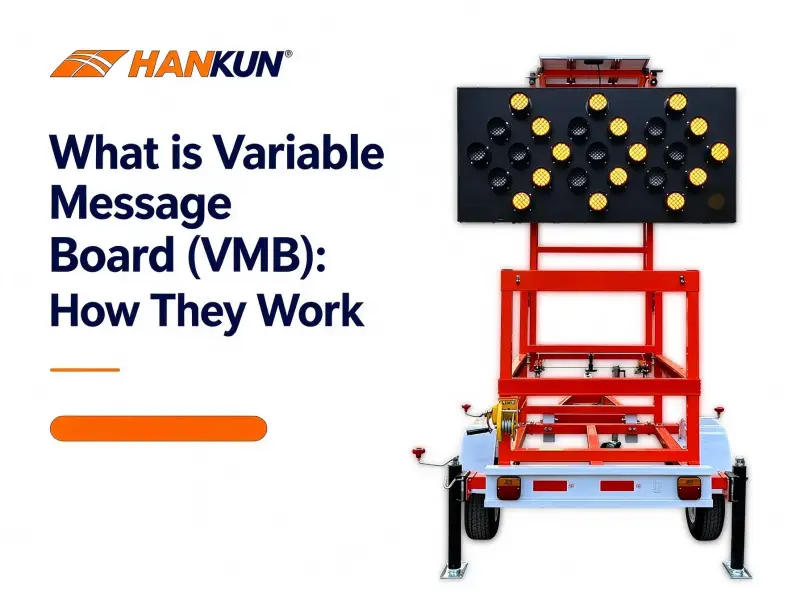
A variable message board is an electronic roadside display whose text can be rewritten from a control terminal, a laptop, or a traffic management center, so one piece of hardware can carry many different messages over its working life. The industry calls the same object a variable message sign (VMS), a changeable message sign (CMS), a dynamic message sign (DMS), or a portable changeable message sign (PCMS) when it is trailer mounted and temporary. The board itself is the display and its cabinet. What makes it useful is everything behind the panel: the controller, the power system, and the rules that decide which words are allowed on it.
The sections below take that stack apart, from the terminology buyers trip over to the price bands you will meet in a quotation.
What “VMS board” means in plain terms
The phrase “VMS board” is trade shorthand, not a defined term in any standard. Buyers use it because “VMS” is shorter than “variable message sign”, and suppliers use it because search engines reward it. The object being described is the same either way.
The naming splits along regulatory lines rather than technical ones:
| Term | Where it dominates | What it implies |
|---|---|---|
| VMS (variable message sign) | Europe, Australia, international tenders | A permanent or temporary electronic display, specified against EN 12966 |
| CMS (changeable message sign) | US standards and state DOT documents | Any sign whose legend can be changed, including mechanical flip-disk types |
| PCMS (portable changeable message sign) | US work zone practice | A CMS on a trailer or truck, deployed for weeks rather than years |
| DMS (dynamic message sign) | US highway operations | Usually a fixed gantry sign tied into a traffic management centre |
| VMB (variable message board) | Supplier catalogues, procurement chatter | No formal status, but widely understood as a portable unit |
| Matrix sign | UK | Refers to the pixel grid rather than the function |
The practical consequence is that a specification written around the word “VMS” and one written around “PCMS” can describe the same trailer, but they will point to different test standards and different message format rules. When a tender document mixes the terms, ask which standard governs acceptance before you quote.
How variable message signs work, step by step
The operating cycle has four stages, and each one can fail on its own. A message is created somewhere, checked against format limits by a controller, pushed to an LED matrix, and held on screen by a power system sized for the site. Solar panels and a battery bank carry portable units through the night; fixed installations usually draw mains power with battery backup. Communication runs over cellular, Wi-Fi, or a wired link to a traffic management center.
Where the message comes from
Three sources feed a board. An operator types it on the unit’s keypad or on a laptop connected over a local link. A traffic management center pushes it out to a fleet over cellular. Or a sensor triggers it: a radar or loop detector spots a queue forming and calls a pre-written message, which is how queue warning systems on smart work zones behave.
Most portable boards in daily use run on the first source. Automatic triggering sounds better in a brochure than it works in a muddy verge, because a sensor that misfires will broadcast a false warning to several thousand drivers before anyone notices.
Control and validation
The controller is where a message either survives or gets rejected. Most units hold a library of pre-approved messages and enforce character and line limits as text is entered, so an operator cannot center a 14-character word on a three-line, eight-character-per-line panel and wonder why it wraps.
Priority handling matters on networked fleets. An incident alert should override a routine notice, and a unit that has lost contact with the centre should keep showing its last valid message rather than going blank.
The display itself
Two panel architectures cover nearly all portable equipment.
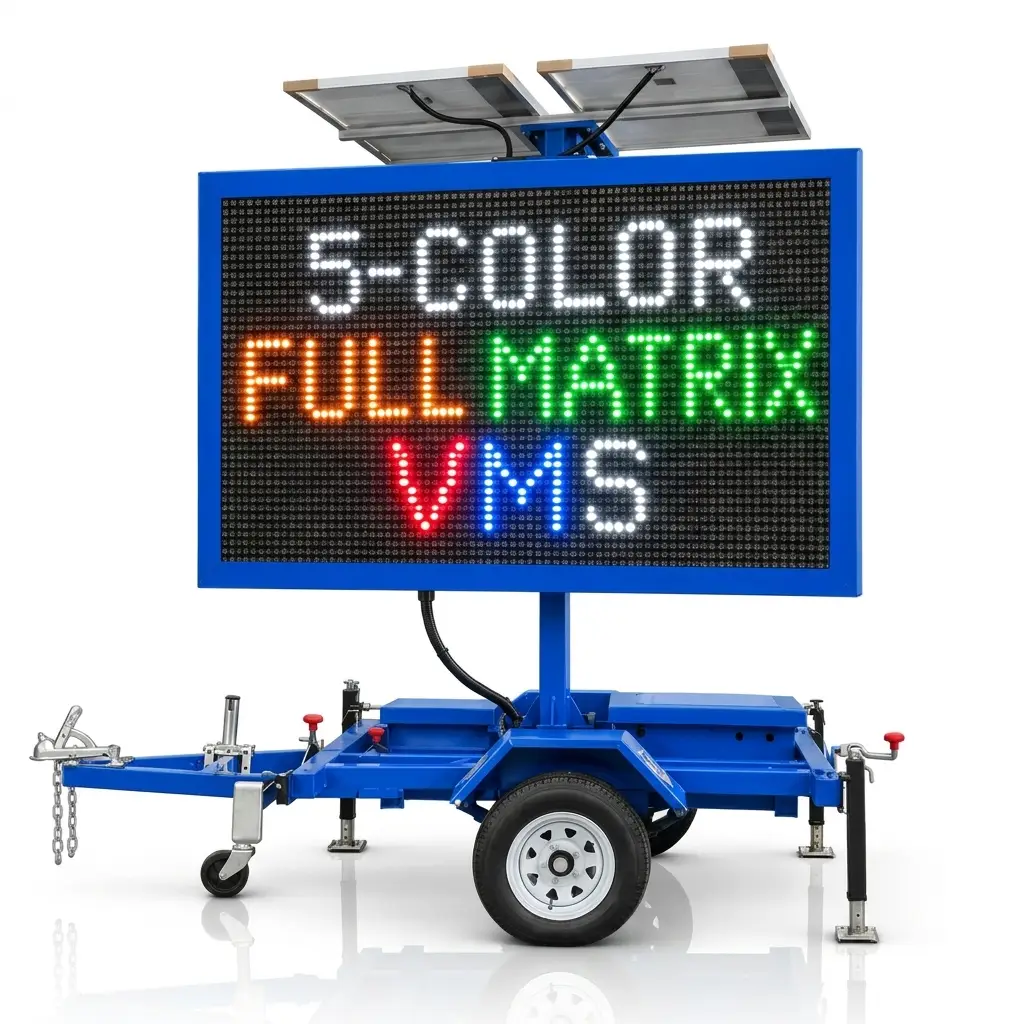
A line-matrix board has fixed rows of characters, typically three. Each row is a separate module, and the panel is cheap to build and simple to read. A full-matrix board is a continuous grid of LEDs with no fixed character rows, so it can show text in different fonts, arrows, and simple pictograms. The cost difference is real, and so is the difference in what you can legally display: a full-matrix unit can simulate an arrow board, a three-line unit cannot.
Pixel pitch, the distance between LED centers, sets viewing distance more than any other number on the datasheet. A 25 mm pitch on a panel around 2.6 m wide is common on export trailer units and reads cleanly at highway approach speeds. Tighter pitch buys sharper text and costs more per square meter.
Power and uptime
A portable board’s power system is a small off-grid installation: panels on the trailer roof or an adjustable frame, a charge controller, and a battery bank, usually lead-acid or lithium. The panel output has to cover the display’s daily consumption plus the controller’s idle draw, and the battery has to carry the site through consecutive overcast days, not just one night.
This is where most undersized units fail. A board specified for average sunshine will drop its brightness first, then shut down, and a dim board on a rainy Tuesday is a liability.
What is inside a roadside message board
A portable variable message board has five functional blocks: the display panel and cabinet, the control unit, the communication module, the power system, and the trailer or mounting hardware. Fixed installations replace the trailer with a gantry or cantilever structure and usually replace solar with mains supply.
| Block | Typical content | What fails when it is underspecified |
|---|---|---|
| Display | LED modules, driver boards, sunshades, optical lenses, front polycarbonate | Washout in low sun, dead pixel rows, unreadable at 200 m |
| Control | Onboard computer, keypad, message library, clock, password levels | Operators lock out of their own board, or anyone can change the message |
| Communication | Cellular modem, GPS, sometimes Wi-Fi | No remote updates, no fleet visibility, no fault alerts |
| Power | Solar panels, charge controller, battery bank, mains charger | Overnight shutdown, reduced brightness, short battery life |
| Mounting | Chassis, axle, tow hitch, mast or lift, stabilisers | Slow setup, movement in wind, unsafe towing at speed |
Optical lenses deserve a note of their own. A bare LED throws light in every direction, so a lensless panel has to run hot to look bright from the road. A lens collimates the output into the corridor drivers actually occupy, which lowers drive current, lowers heat, and extends diode life. It is also how a panel reaches the higher brightness classes in European specifications without a bigger power budget.
Types of changeable message signs used on roads
Fixed, trailer-mounted, and vehicle-mounted boards use the same display technology and differ in where they live and how fast they can move. Fixed gantry signs serve long-term highway operations and tie into permanent power and communications. Trailer units serve work zones and events and get relocated every few weeks. Vehicle-mounted boards ride on patrol trucks and incident response vehicles and are the only category allowed shorter character heights in US practice.
Fixed gantry signs
These are the boards above the carriageway on sign bridges and cantilevers. They are permanent infrastructure, sized for the road’s design speed, and controlled from a traffic management centre. The procurement cycle runs to years and the specification is usually written by the road authority rather than the contractor.
Trailer-mounted portable signs
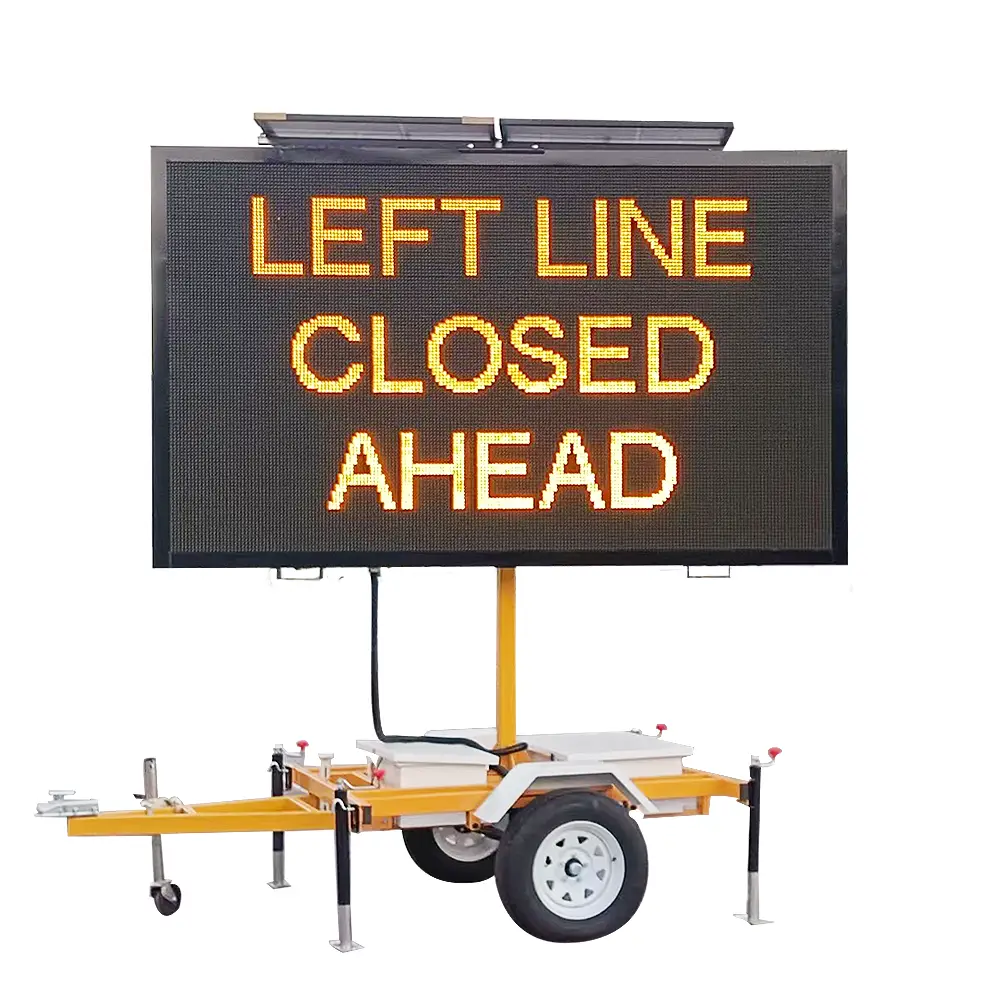
This is the category most buyers actually purchase. Within it, the split that matters is three-line versus full-matrix, and the choice follows the road, not the budget. A three-line amber board is enough for a lane closure on a rural two-lane road, where the message is short and the approach speed is moderate. A full-matrix unit earns its price on high-speed approaches, where a pictogram or a wide arrow carries meaning faster than eight characters of text.
Physical configuration varies as much as the electronics. Some units use a hand winch to raise a rotating mast; others use electric lift and electric rotation, which matters when one person has to set up in the rain. For buyers comparing formats, the range of three-line portable changeable message signs shows how much of the price sits in the display and how much in the trailer.
Vehicle and truck-mounted boards
These mount on the rear of a work truck or patrol vehicle and travel with the crew. They are the fastest option to deploy and the most limited in panel size. In US practice the reduced character height allowed for service patrol mounting exists precisely because the panel is small and the viewing distance is short.
What the rules say about the message
Message content is regulated, not just hardware. US practice under the MUTCD limits a portable changeable message sign to three lines of eight characters per line, or a full-matrix display, with no more than two phases and a recommended minimum 18 inch character height on trailer and truck-mounted units. Animation, scrolling, flashing, and dissolving effects are prohibited. The Federal Highway Administration’s MUTCD also requires visibility from half a mile in both day and night conditions, automatic brightness adjustment, and rules out advertising messages entirely.
The format limits force a discipline that most first-time buyers underestimate. Three lines, eight characters, two phases is roughly the information content of a text message, and it has to be read at 100 km/h.
The working pattern that survives contact with real sites is three thoughts, one per line:
- The problem ahead, such as a closure or queue
- Where it is, or how far away
- What the driver should do
Anything that does not fit those three is decoration. State guidance in several US jurisdictions goes further and bans generic safety reminders on portable boards, on the reasoning that a board showing a slogan trains drivers to ignore the board that later warns of a closure.
In Europe the hardware side is governed by EN 12966, which grades a sign on four independent axes rather than one brightness figure:
| Class axis | Range | What it controls |
|---|---|---|
| Luminance | L1 to L3, plus tunnel variants | How bright the lit pixels are at a given ambient light level |
| Beam width | B1 to B7 | The angular cone over which that brightness holds |
| Colour | C1, C2 | Whether amber stays amber and white stays white |
| Luminance ratio | R1 to R3 | Contrast between lit and unlit pixels under glare |
A datasheet quoting only the luminance class has answered a quarter of the question. A board rated L3 can still wash out at sunset if its luminance ratio class is low and it faces west.
How much does a VMS board cost
Public listings put a trailer-mounted solar board in the range of roughly 6,500 to 15,000 US dollars for export supply, with North American dealer retail on a compact full-matrix trailer unit around 17,500 dollars. Price tracks five variables: display area, pixel pitch, whether the panel is line-matrix or full-matrix, the solar and battery configuration, and the certification package. A three-line amber unit and a full-colour full-matrix unit on the same chassis can differ by a factor of two.
Those figures are listing prices checked on 3 November 2026, not negotiated contract values, and freight, duty, and local commissioning sit on top.
| Configuration | Typical band | Where the money goes |
|---|---|---|
| Compact line-matrix, vehicle mounted | Lower band | Small panel, minimal power system, no trailer |
| Three-line amber trailer, solar | Mid band | Display modules, battery bank, trailer and mast |
| Full-matrix amber trailer, solar | Mid to upper band | Continuous LED grid, larger power system, rotating mast |
| Full-colour full-matrix trailer | Upper band | Colour LEDs, higher drive electronics, tighter pitch |
| Fixed gantry installation | Project priced | Structure, civil works, mains supply, integration |
Two cost traps recur. The first is comparing a panel-only quotation against a complete trailer: the price gap usually reflects the chassis, battery bank, and solar array, not a better display. The second is under-buying the power system to hit a target price. Replacing a battery bank after eighteen months of nightly deep discharge costs more than the upgrade would have, and it happens in the season when the boards are needed. A solar-powered mobile changeable message sign is the configuration where this trade-off is easiest to get wrong, because the panel wattage is visible on the quote and the battery capacity often is not.
Running costs are modest but not zero: battery replacement every few years, modem data plans on connected fleets, LED module replacement, and towing and servicing between deployments.
Planning a message before the sign leaves the yard
Free web-based message board simulators let you type a message and see how it breaks across three lines of eight characters before anyone touches the real unit. They are useful for one thing only: catching layout failures such as an eight-character limit that splits a word awkwardly. They cannot tell you whether the message reads at 300 m in low sun, and the pixel layout on screen never matches the pixel layout on the panel.
Treat the simulator as a drafting tool. The real check happens on site, at the actual approach speed, in the actual light:
- Stand at the distance a driver first sees the board and read the message aloud once
- Time each phase; if a phase needs longer than about four seconds, the message is too long
- Check for foliage, a crest, or a sign structure that clips the board from the nearside lane
- Confirm the board sits at the required height above the carriageway, which in US practice is a minimum of 7 feet in urban areas and 5 feet in rural ones
What to check when specifying a VMB
Five items decide whether a board does its job: viewing distance against approach speed, days of power autonomy without sun, the certification the destination market actually requires, towing and setup practicality, and how the fleet is managed remotely. Getting the first four right and the fifth wrong produces a board that works perfectly and still gets forgotten in a yard.
- Viewing distance. Match panel size and pixel pitch to the speed limit on the approach, not to the price list.
- Power autonomy. Ask for the number of consecutive overcast days the battery bank covers at full brightness, not the panel wattage alone.
- Certification. EN 12966 for European roads, MUTCD compliance for US work zones. A CE mark is not a substitute for either.
- Handling. One person should be able to level, raise, and rotate the unit. Electric lift is worth the money on a two-person crew.
- Fleet management. Remote message changes, GPS position, and fault alerts turn a scattered fleet into something you can actually operate.
On the hardware side, trailer-mounted variable message signs differ most in mast design and power sizing, which are also the two areas where a low quotation hides its savings.
FAQ
Can a solar VMS board run through a cloudy week?
It depends entirely on battery capacity relative to daily consumption. A board sized for one overcast night will run at reduced brightness by day three and shut down by day four. Ask the supplier for the autonomy figure in days at full brightness, and derate it for winter sun angles if the deployment runs through the colder months.
Do I need approval before placing a portable message board?
In most jurisdictions, yes. Portable boards on or near a public road usually fall under the approved traffic control plan, and messages may need sign-off from the road authority or project engineer. Some agencies require pre-approval of every message variant, including changes made on site during an incident. Check before deployment, not after.
How is a VMS board different from an arrow board?
An arrow board does one thing: it shows a directional arrow, usually with sequential flashing, to guide traffic past a closure. A variable message board shows text and, on full-matrix units, symbols. Some full-matrix VMS units can be switched into arrow board mode and must then meet the arrow board’s visibility requirements, but a three-line character board cannot, which is why the two are often deployed together rather than instead of each other.