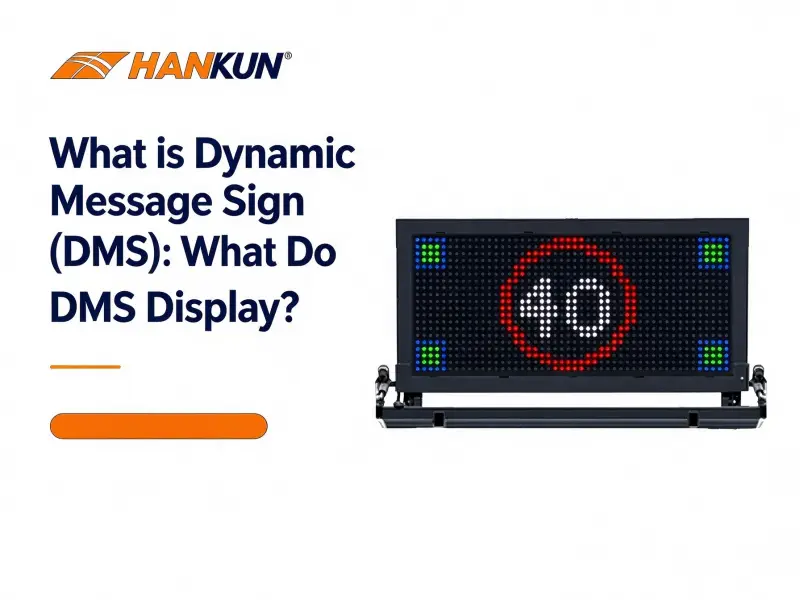
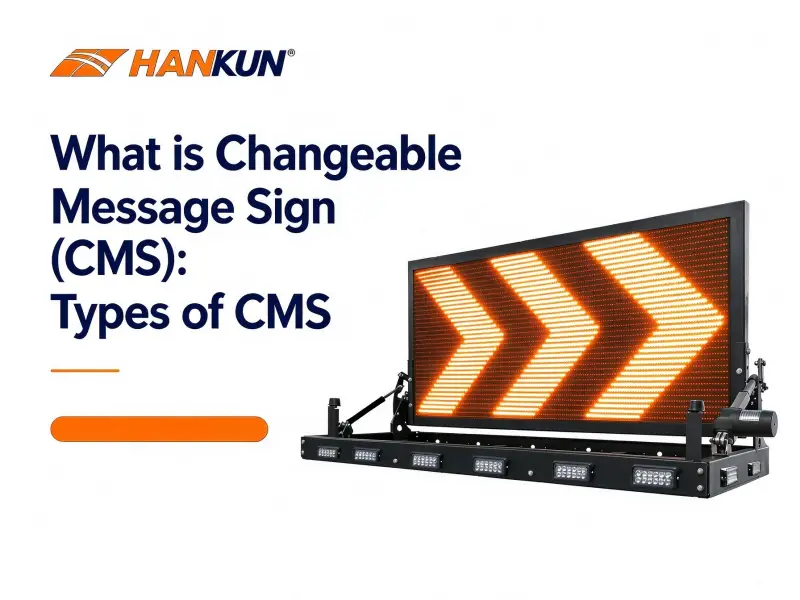
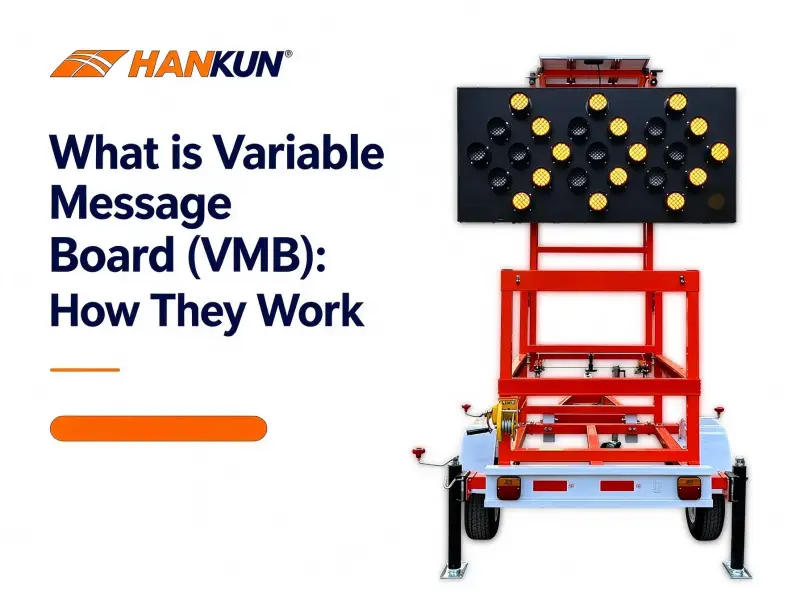
A closed lane needs a message a driver can read at speed and act on. The equipment that carries it gets bought under at least five names. A tender asks for VMS, the drawing says CMS, the freight papers say message board trailer, and the quote comes back priced per DMS. Someone then has to confirm all four mean the same box.
VMS stands for variable message sign, an electronic traffic sign whose display can be changed to show different text, symbols or arrows as conditions change. What varies is the message on the face, not the position of the sign.
This article unpacks the acronym, maps it against the other four names in circulation, and answers what the equipment contains and what it costs to own.
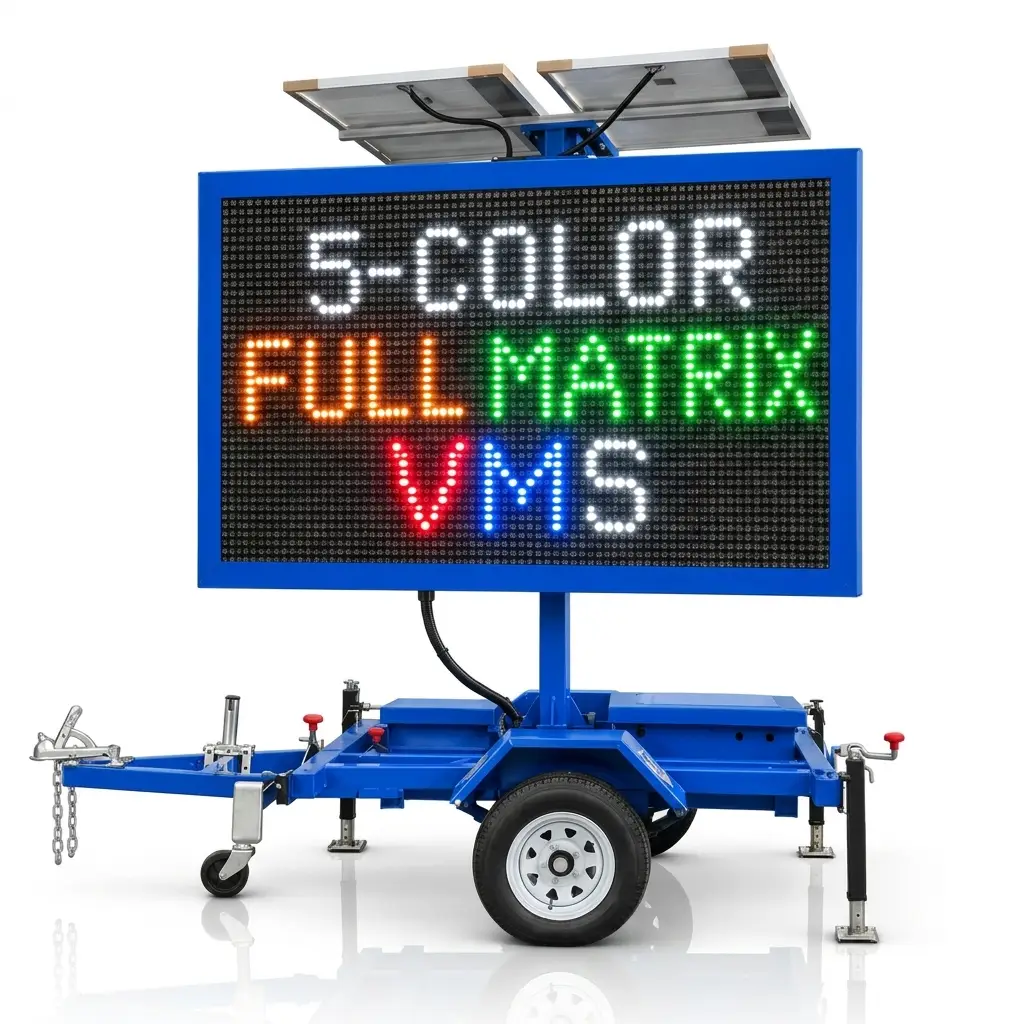
What does VMS mean in signage?
In signage, VMS means a sign whose content is generated electronically rather than printed once. A matrix of light-emitting diodes, driven by a controller, shows whatever the operator sends it.
“Variable” is often misread. It does not describe a sign that swings or gets towed somewhere else. It describes the message layer. A printed road-closed board carries one statement until someone covers it. A VMS holds a sequence: warning, closure detail, diversion, each shown long enough to read at the posted speed. Outside traffic work the phrase also covers indoor screens and retail displays, but in a procurement document it means the roadside unit. The Variable Message Signs range on this site shows how the two mounting families divide.
What the three letters describe
Each word maps to a part of the product, which is the easiest way to hold the definition.
- Variable covers the content layer. Text, arrows, lane diagrams and warning symbols, changed by remote command, schedule or sensor.
- Message covers the format. Most portable units carry three lines of eight characters, and rules limit how many phases one message can run.
- Sign covers the hardware. Panel, controller, power supply, mounting, plus the trailer chassis on anything portable.
Where the acronym shows up in a project
Four documents, usually four spellings. The specification sets the term and the standard. The drawing labels the unit and its mounting. The quotation prices it per unit or per day. The acceptance sheet records what arrived. When those four disagree, the mismatch surfaces at delivery rather than at bid stage.
VMS, CMS, DMS, PCMS and VMB: why one sign has five names
All five name the same class of equipment. Which one is correct depends on the market and the document, not on the product.
The split is historical. Different standards bodies named the device as it developed, and each name stuck where that body had reach. A supplier shipping into four markets prints four datasheets.
| Term | Where it dominates | Who uses it |
|---|---|---|
| Variable message sign (VMS) | Europe, Australia, Asia, private tenders | Contractors, suppliers, consultants |
| Changeable message sign (CMS) | US federal and state highway practice | Highway authority specifiers |
| Dynamic message sign (DMS) | US intelligent transport systems | Network operators, gantry installs |
| Portable changeable message sign (PCMS) | North America, work zones | Contractors, rental fleets |
| Variable message board (VMB), matrix sign | United Kingdom, trade and rental | Hire firms, traffic management |
The standards split behind the names
The United States federal traffic manual defines a changeable message sign as a sign able to show more than one message, changed by hand, remote control or automatically. Inside that category, the electronic type is a dynamic message sign in the national intelligent transport systems architecture and a variable message sign in electrical manufacturers’ standards. The American terms are not rivals. They are one category and two sub-labels. Europe’s product standard for variable message signs uses that term in its title, and Australia and New Zealand follow it in commercial documents.
Pick the term the governing standard uses and stay with it. Mixing VMS and CMS in one specification invites a bidder to price a permanent gantry structure against wording that reads like a trailer.
What is inside a variable message sign board?
A variable message sign is five subsystems in one unit: display, controller, power system, mounting structure and communications link. Almost every price and performance gap between models comes from how those five are specified.
The panel is the visible part and the least interesting technically. The controller holds the message library and decides what shows when. The power system sets where the unit can work. The mount sets how fast it deploys. The link decides whether anyone has to drive out to change a message.
Character, row and full matrix
Three screen architectures are in use, and the federal handbook for portable changeable message signs describes all three. A character matrix gives every character its own block: rigid layout, low cost. A continuous line matrix runs each line as one array, which allows proportional spacing. A full matrix addresses every pixel, so character height can change and arrows can be drawn at any length. Full matrix now dominates new portable units, partly because symbol and arrow patterns from different national standards can render on the same panel.
Character height sets the readable distance
Character height decides whether the sign works, and it usually sits three pages into a datasheet. The relationship is close to linear: an inch of character height buys about forty feet of legibility.
| Character height | Legibility distance | Typical use |
|---|---|---|
| 457 mm (18 in) | 220 m (720 ft) | Minimum for portable signs on US highways |
| 610 mm (24 in) | 293 m (960 ft) | Higher-speed approaches, multi-lane |
| 1372 mm (54 in) | 658 m (2,160 ft) | Permanent overhead installations |
A full-size trailer unit reaches 457 mm characters on an eight-row matrix and 400 mm on a five-by-seven matrix, from the same 3,156 by 1,563 mm display area. The panel did not change. The grid did. Quote character height with the matrix it was measured on.
Colour configurations
Single-colour amber is the workhorse: bright, cheap to drive, unambiguous. Three-colour and five-colour panels exist where a red restriction has to sit beside a green direction. The difference lives in the pixel. A single-colour pixel may carry five amber LEDs. The five-colour version carries up to seventeen: four red, four amber, three green, three blue and three white. More LEDs means more current, which means a larger array and battery bank. Colour is a power decision before it is a design decision.
Where a variable message sign board gets used
Anywhere a message has to change faster than a crew can reach the site.
- Lane closures, shoulder work and long-running construction.
- Crash scenes, where the message may change three times in an hour.
- Festivals and fixtures, where routes open and close on a schedule.
- Urban corridors, parking guidance and school zones.
- Fixed industrial points such as ports, mines and terminal gates.
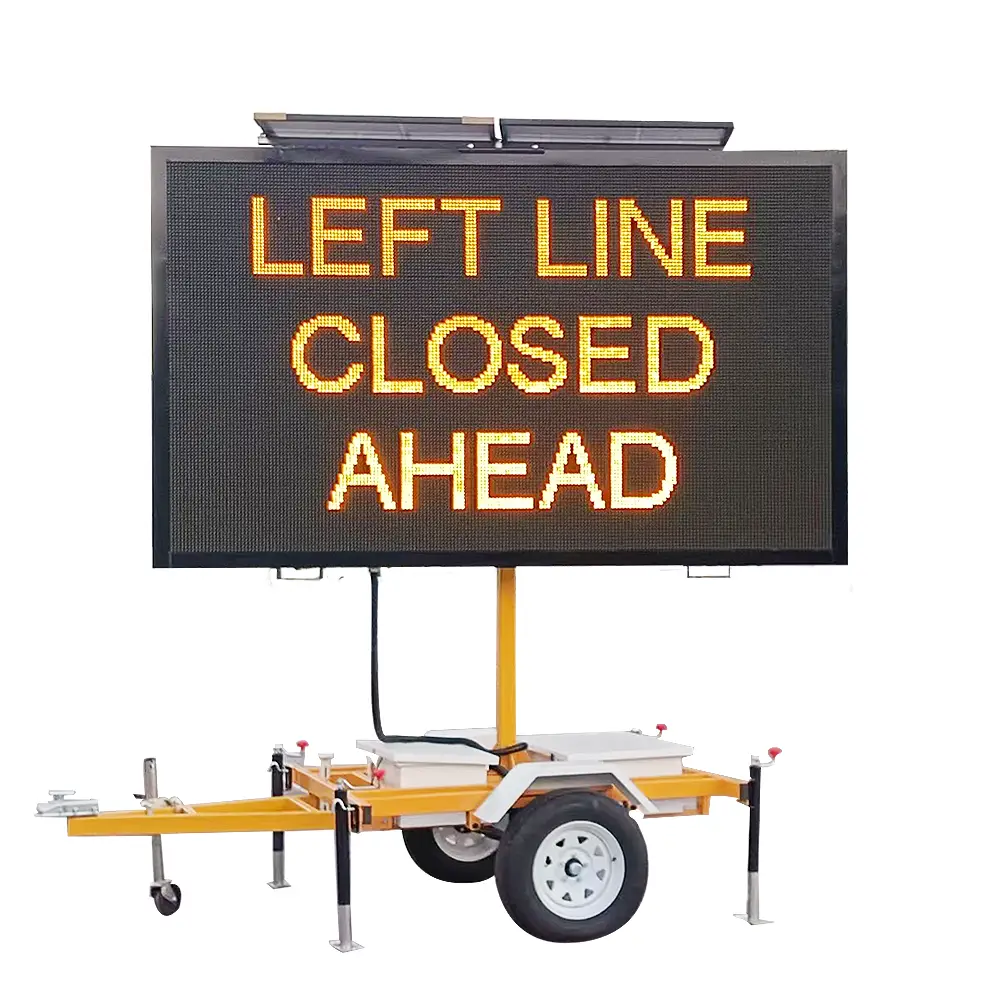
Form follows the site. A relocatable closure wants a trailer, and trailer-mounted variable message signs cover that half of the list. A paving crew that advances a kilometre a day wants a panel that travels with the vehicle. A trailer bought for a job that never moves spends money on chassis and brakes.
How much does a variable message sign cost?
A trailer-mounted variable message sign typically lands between about $10,000 and $30,000 in North American dealer listings. The spread comes from display area, pixel resolution and power configuration, not from the name on the cabinet.
That range is a starting point, not a quote. A compact three-line amber unit and a full-size five-colour unit share a category name and differ by a factor of three.
| Cost item | Effect on price | What changes it |
|---|---|---|
| Display area and pixel pitch | Largest single factor | Panel size; pitch sets resolution and LED count |
| Colour configuration | Moderate to large | Amber versus three or five colour; LEDs per pixel |
| Power system | Moderate | Array wattage, battery chemistry and capacity |
| Chassis, mast, lifting | Moderate | Tow rating, hydraulic or manual lift, stabilisers |
| Control and telematics | Small to moderate | 4G, GPS, platform licence, API access |
| Compliance documentation | Small, non-negotiable | Type testing, declarations, market configuration |
What moves the price most
Two specifications carry most of the variance. Active display area comes first, because panel cost tracks LED count, and LED count tracks the square of the dimensions. Pixel pitch comes second. A tighter pitch puts more LEDs behind the same glass, which sharpens text and raises both cost and power draw. Small panels with fine pitch and large panels with coarse pitch land at similar prices, which is why headline size comparisons mislead.
The costs that arrive after delivery
Purchase price is the easy number to budget and the wrong one to plan around. Battery replacement is the recurring line item nobody puts in the first spreadsheet; trade estimates put it at roughly $2,500 to $4,000 per unit every four to six years. Add tow vehicle wear, trailer registration, spare pixel modules and any monitoring subscription.
Does a variable message sign need a generator?
Usually not. A solar array with a battery bank covers routine work zone and event deployments, and a fuel generator is now the exception chosen for specific conditions rather than the default.
Solar array plus battery bank
The standard arrangement is a photovoltaic array, a charge controller and a lithium iron phosphate battery bank sized for a target number of sunless days. Daylight runs the panel and tops up the battery. The battery carries the night load, and automatic dimming cuts draw after dark. Autonomy is the number to specify. Asking for a solar sign gets you a panel. Asking for a stated runtime at a stated brightness with no solar input for a stated number of days gets you a system.
When a generator still makes sense
Three situations justify one: persistent overcast through a high-latitude winter, heavy full-colour duty where panel current outruns what a trailer roof can collect, and mains access with easy fuel logistics. The case against is operational. Federal work zone guidance notes that generator supply generally will not last as long as solar or battery, and that the generator needs space beside the sign, which limits where the unit can sit. Add noise limits at event sites and somebody who has to visit the unit.
How to size the power system
Sizing is arithmetic, and the supplier should run it with you rather than for you.
- Daily demand equals average draw multiplied by lit hours, using the dimming profile rather than rated maximum.
- Battery capacity equals daily demand multiplied by autonomy days, divided by usable depth of discharge.
- Array size equals daily demand divided by equivalent sun hours at the site, with an allowance for tilt, soiling and temperature.
Bring five inputs: average and peak draw at rated brightness, the daily message schedule, the autonomy target, the lowest expected ambient temperature, and any limit on panel tilt.
What to check before you specify a VMS
Six checks cover most of the risk.
- Name the market and the governing standard in the first paragraph.
- State character height and its character matrix together.
- Decide matrix type by whether symbols and arrows are needed, not by price.
- Convert the power spec into sunless-day autonomy at a stated brightness.
- Confirm the control protocol and whether an open interface exists for fleet integration.
- Ask what a replacement pixel module costs and how long it takes to arrive.
Match the mounting to the deployment pattern before comparing prices. A Truck Mounted Traffic Control VMS suits a crew that advances along a corridor all day, while a trailer suits a site that holds position for weeks. They are not competing quotes, even with identical panels.
FAQ
Is a VMS the same as a digital billboard?
No. Both use LED panels, but they follow different rules. A VMS is a traffic control device: brightness is capped and adjusted automatically, content is restricted to traffic information, and animation is generally prohibited. A digital billboard is an advertising medium, permitted through planning rules rather than traffic standards.
Can a VMS run on mains power only?
It can, and some permanent installations do. Portable units are a different case. A trailer that depends on mains power cannot be placed where the work is, which defeats the purpose of a trailer. Most portable models accept a mains connection for charging while keeping the battery bank as the operating supply.
How is a VMS different from a variable speed limit sign?
A variable speed limit sign is a single-purpose device. It shows one number, and its legal status comes from the speed limit regime it belongs to. A VMS is a general-purpose display that can carry text, symbols and arrows, including a speed value inside a longer message. The electronics overlap. The approval route and the message rules do not.