Enforcement budgets mostly pay for people and vehicles. A patrol car covers one stretch of road at a time, and when it leaves, the stretch goes back to whatever behaviour it had before. Static signs have the opposite problem: they stay for years and say the same thing whether the road is clear, flooded or closed two kilometres ahead. Drivers learn to read past them.
A variable message sign belongs at the centre of an enforcement strategy because it reaches every driver who passes, not only the ones an officer stops. It carries the warning; the patrol car carries the penalty. When the warning arrives before the hazard, fewer drivers need penalising at all.
This article covers where the device sits among other traffic signs, the enforcement jobs it does better than a parked car, what the units cost, and what to specify before you ask for quotes.
What a variable message sign can do that a static sign cannot
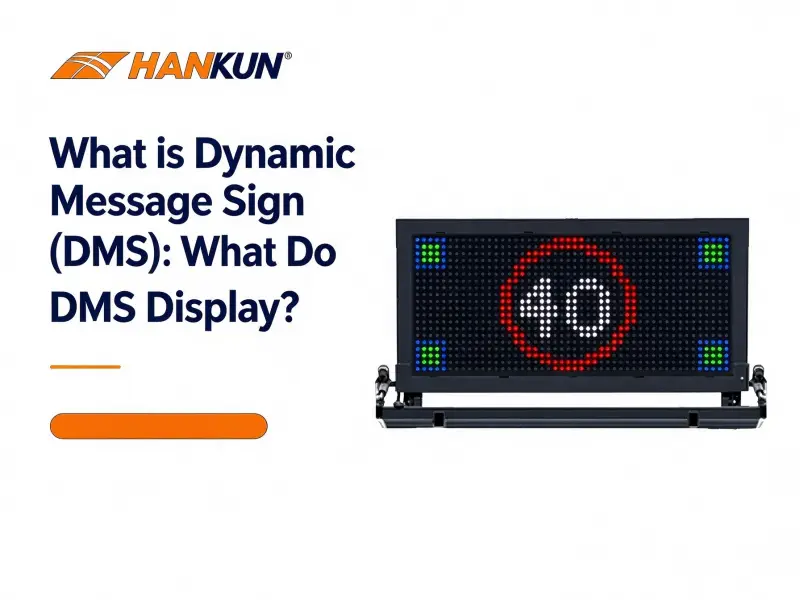
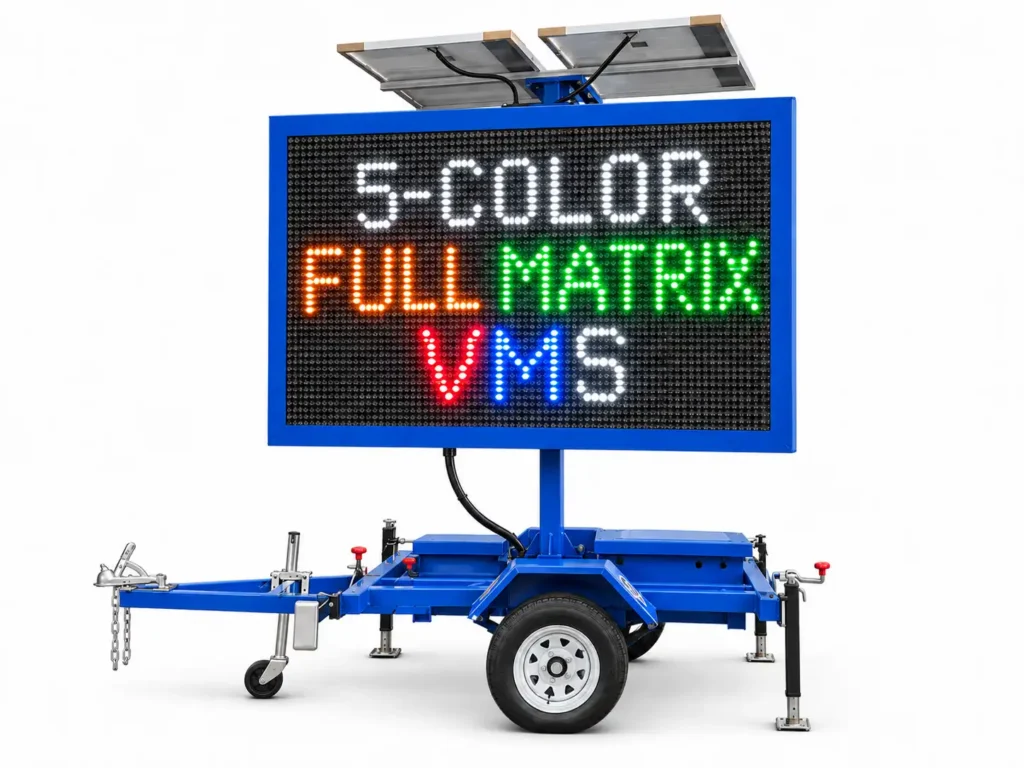
A variable message sign is an LED display that shows different text, symbols or graphics at different times. A static sign states one permanent condition. A variable sign states the condition that exists now.
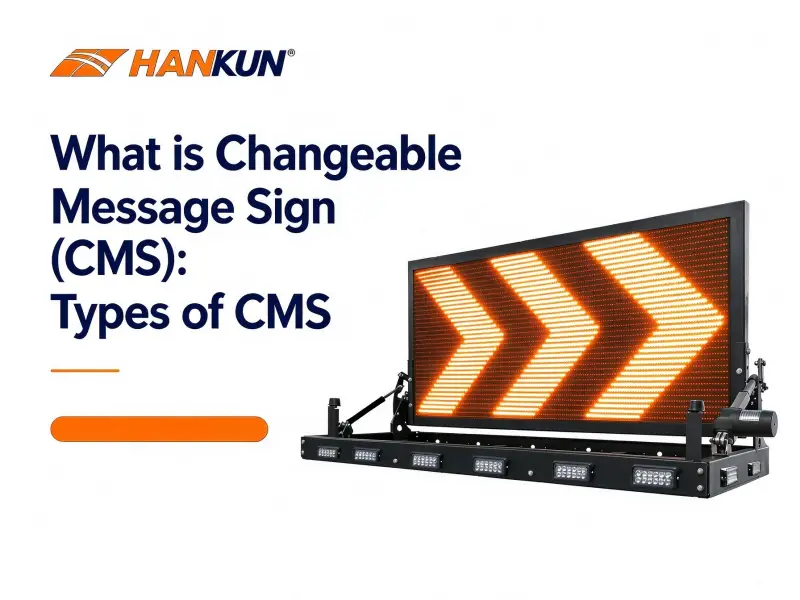
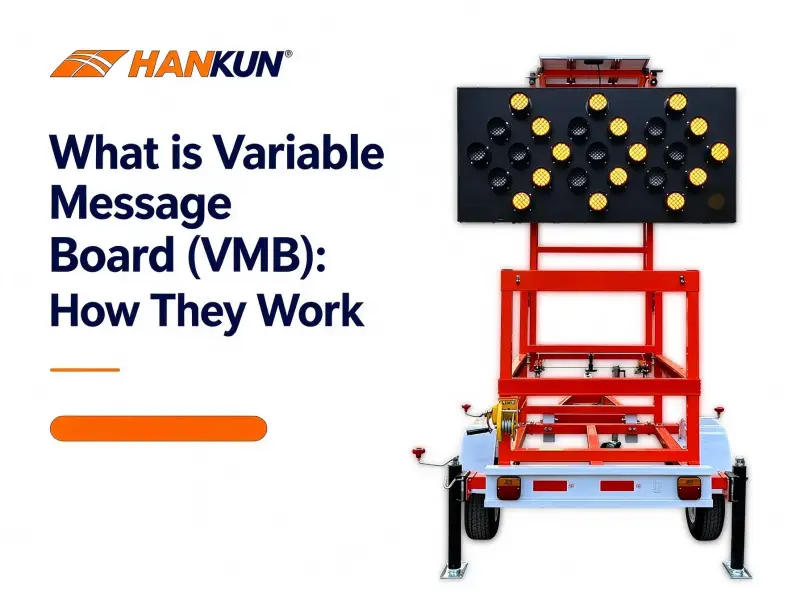
The same device goes by several names. Changeable, dynamic and electronic message sign all describe the same hardware. Portable changeable message sign usually means the trailer or truck-bed version. Fixed installations sit on gantries and poles over a carriageway; mobile units ride on a trailer chassis or bolt to a vehicle. Variable Message Signs covers both families, and the split matters, because a fixed unit is bought once for a location while a mobile unit is bought once for a programme.
What separates either family from a painted panel is the ability to be corrected. A sign reading ROAD WORK AHEAD eight months after the crew left teaches drivers that roadside text is noise.
Display content is not open. Most traffic authorities restrict these signs to operational, regulatory, warning and guidance information, and advertising is barred. That tells you what the display has to render well: short uppercase text, lane arrows and chevrons.
Why enforcement loses ground without real-time messaging
Enforcement works on three fronts: engineering the road so the safe choice is the easy one, telling drivers what is coming, and penalising the few who ignore both. A sign that cannot change only serves the first front.
The middle front is where programmes leak. A hazard appears on Tuesday morning. The officer who attends it leaves on Tuesday afternoon. The hazard, the queue and the diversion stay for a week. Static signing cannot follow that sequence, so drivers either hit the queue without notice or stop trusting the signs that warned them last time.
Repetition is the other leak. Federal guidance on portable changeable message signs notes that local drivers adjust to a new condition quickly, and recommends moving the unit every few weeks so it keeps drawing attention. A fixed warning loses that contest by design. A blank display loses it faster, because drivers read a dark screen as a sign switched off to save budget.
Where VMS sits in the traffic sign hierarchy
A variable message sign is not a fifth category of traffic sign. It is a display technology that carries the categories other signs carry, which is why it can act as a warning sign in the morning and a guide sign in the afternoon.
The four categories drivers learn to recognise hold across most road systems, even where colours differ.
| Type | Purpose | Typical treatment | Legal force |
|---|---|---|---|
| Regulatory | States a rule the driver must obey | White or red legend, octagon or circle | Enforceable |
| Warning | Gives advance notice of a hazard or a change in conditions | Yellow or fluorescent yellow-green diamond | Advisory |
| Guide | Directs traffic to routes, destinations and distances | Green background, white legend | Advisory |
| Informational | Points to services and facilities | Blue or brown background | Advisory |
The 1968 Vienna Convention on Road Signs and Signals splits the same field into danger warning, regulatory and informative signs, the last covering advance, direction and confirmatory signs. Names differ by country. The jobs do not: one group tells you what the law requires, one warns you, one helps you navigate.
The three kinds of regulatory signs
Regulatory signs carry the only content a driver can be prosecuted for ignoring, so the sub-division matters when you buy equipment that will display it.
- Priority signs settle who goes first: stop, give way, priority road.
- Prohibitory and restrictive signs forbid something: no entry, no overtaking, a maximum speed, a weight or height limit.
- Mandatory signs require a specific action: keep right, turn left only, minimum speed.
US practice groups the same content by series, but the logic holds. A temporary speed limit on a variable sign is still a regulatory instruction, and its force comes from the order behind it. That decides who signs off on your messages: if the sign will show a reduced limit during works, the road authority has to authorise the limit in advance. The equipment cannot create it.
Four enforcement jobs a VMS handles better than a patrol car
A patrol car catches one driver at a time and is visible only where it is parked. A sign warns every driver approaching it, during the seconds when the warning can still change what they do.
Slowing traffic before the hazard
Speed enforcement usually starts where the hazard already is, which is late. A unit placed 300 to 500 metres upstream, paired with radar, shows each driver their own approach speed and switches to a slower message when the threshold is crossed. The driver corrects before the taper. Nobody is needed for that first correction, so the officer who does attend deals only with drivers who ignored the display.
Holding a work zone together
Work zones change daily. Lane shifts, a closed shoulder, a taper that moves 200 metres overnight: these are conditions a static layout cannot describe. Two phases of text cover the problem, the distance and the required action, and the same unit is reprogrammed when the layout moves. Guidance puts the bottom of the panel at least 2 metres above the roadway and asks for visibility from 0.8 kilometres.
Clearing the road after a crash
Incident response is a timing problem. The first vehicle on scene is often a service patrol truck, and a truck-mounted display turns it into moving advance warning while the crew works. Detour text goes up while drivers are still choosing a route, not after the queue has formed. Truck Mounted Traffic Control VMS boards are built for that role, with a mast that lifts the panel above the cab.
Broadcasting an AMBER Alert
Abduction bulletins reach roadside signs within minutes of activation, and the reach is the point: a driver three counties away may be the one who sees the vehicle. Paired with automatic number plate recognition, the sign becomes part of the search.
Mounting formats and what a VMS actually costs
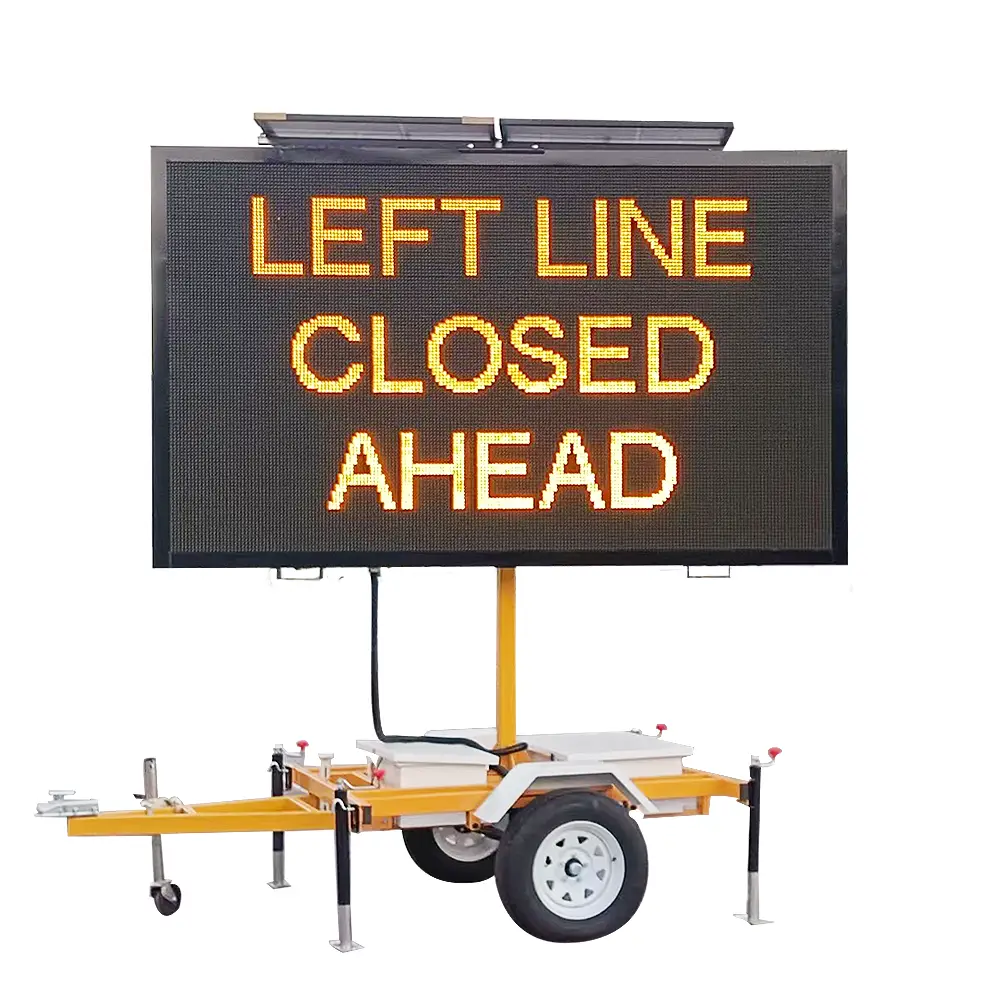
Mounting format decides how fast the sign reaches a site, and display size plus power package decide the price. On a New York State contract price file, trailer-mounted full-matrix units listed between about 14,500 and 17,200 dollars, and a smaller vehicle-mounted unit listed at 9,125 dollars.
| Format | Time to deploy | Best fit | Main constraint |
|---|---|---|---|
| Trailer-mounted | Towed to site, mast raised on arrival | Work zones, events, long closures | Needs a towing vehicle and space off the shoulder |
| Vehicle or truck-mounted | Already on the vehicle | Incident response, patrol fleets | Smaller display than a trailer unit |
| Fixed gantry or pole | Installed once, permanent | Motorway corridors, recurring bottlenecks | No redeployment when the problem moves |
Trailer-Mounted Variable Message Signs cover most temporary enforcement work, because the trailer carries its own power, mast and brakes, so one unit serves several sites in a month.
What drives variable message signs cost
Contract prices give a realistic starting band. These are list prices from a New York State contract price file, checked on 27 October 2026, not quotes:
| Unit | Display | Mounting | List price |
|---|---|---|---|
| Full matrix | 48 x 78 in | Trailer | $14,500 |
| Full matrix | 48 x 96 in | Trailer | $15,625 |
| Character matrix, 3 lines by 8 characters | Not listed | Trailer | $14,700 |
| Line matrix, 3 lines by 12 characters | Not listed | Trailer | $15,950 |
| Full matrix, 4 lines by 12 characters | Not listed | Trailer | $17,200 |
| Full matrix | 34 x 60 in | Vehicle yoke mount | $9,125 |
Five things move a quote away from those figures. Display area and matrix type come first: a full matrix costs more than a character matrix of the same width and buys graphics plus variable character height. Power follows, since battery count, solar wattage and controller rating scale with load. Control is third: a modem and remote access cost more than a keypad. Radar and data collection add sensors and software. Last, chassis, brakes and lighting differ by market, and freight can exceed the gap between two models.
Read any quote as a package. A cheap display with an undersized battery bank is an expensive sign that goes dark in its second winter.
Message design, control, and the generator question
Design rules are not stylistic preferences. A message that takes too long to read is a message that gets ignored, and the standards exist to keep reading time inside the few seconds a driver can spare.
Federal guidance on portable units sets an envelope most agencies adopt. Messages run to three lines of eight characters, or a full matrix of equivalent size, with no more than two phases, and each phase has to stand on its own. A short phase gets 1.5 seconds on screen, a three-line phase gets 3. Scrolling, flashing and animation are out. When there is nothing to report, the sign goes blank.
Character height sets how far away the message still works.
| Character height | Legibility distance |
|---|---|
| 18 in | 720 ft |
| 24 in | 960 ft |
| 54 in | 2,160 ft |
Those figures come from the Federal Highway Administration handbook on portable changeable message signs, which also recommends a panel height of at least 2 meters and visibility from 0.8 kilometers. If your site has a crest, a curve or a queue starting before the sign, the sign moves further back.
What buyers mean by a variable message sign generator
The phrase turns up in two unrelated contexts, and the difference shows up in the quote.
A message generator is the software layer that composes and schedules messages. It runs on a controller in the cabinet, on a tablet, or on a server pushing text to a fleet. Buyers asking for one want a library of approved messages and a way to lock out anything not on the list, because an unauthorized message on a regulatory sign is a liability.
A generator in the electrical sense is a diesel or petrol unit on the trailer running the display. Units built around a large full-colour screen where winter sun is weak sometimes ship that way. Most enforcement units do not need one: a battery bank charged by solar and mains covers the duty cycle, and dropping the genset removes fuel, noise and a maintenance item. Ask for the load profile over 24 hours and the autonomy figure at your worst month, then decide which of the two you are buying.
What to specify before you issue an RFQ
Specify the job the sign has to do, not only the screen size. Six items decide whether the unit you receive is usable on day one: display geometry, power and autonomy, control method, data return, compliance evidence, and the chassis it rides on.
- Display geometry: character height, lines, characters per line, matrix type, and whether graphics are required.
- Power and autonomy: battery capacity, solar wattage, controller type, mains charger, and the autonomy figure with its assumed load.
- Control: on-unit keypad, local wireless, modem or central software, plus who can authorise a change.
- Data return: speed or volume counts, message logs, fault alerts, and where that data lands.
- Compliance: test reports for photometry, ingress protection, wind loading and any standard the road authority requires.
- Chassis and running gear: trailer dimensions, brakes, lights, tow coupling, and the mast wind rating when raised.
Ask for the compliance file with the quote, not after the order. Intelligent traffic control solutions that combine the sign, the sensor and the reporting layer are easier to hand to a road authority than three purchases stitched together later.
Common questions
How long will a solar unit run without sun?
Autonomy depends on the battery bank and the load, not the panel alone, so a days-of-autonomy figure means nothing without the assumed wattage. Ask for the calculation at your worst winter month, not the annual average, and check whether the display runs 24 hours or dims overnight.
Can a variable sign display a speed limit that can be enforced?
Yes, if the reduced limit has been authorised by the road authority for that location and period, and if the display meets the local standard for legibility and colour. The screen shows the limit. The regulation creates it.
Does a VMS trailer need special permission to tow?
Requirements vary by jurisdiction and usually turn on width, lighting, braking and registration rather than the display. Confirm the trailer dimensions and brake type against local towing rules before the unit ships, and keep the paperwork with the trailer.