Most road signs are printed once and never change. That works for a stop sign and fails for a work zone that moves every few weeks, or a queue building two junctions back. A variable message sign closes that gap by putting the message where the condition is. Buyers meet it through a tender or a work-zone contract, and the first question is always what is inside it.
A variable message sign (VMS) is an electronic road sign that shows changeable text, symbols and arrows to drivers, updated from a control centre or on site. It combines an LED display, a sign controller, a communications link and a power supply in one weather-sealed enclosure, so a single panel can warn, guide and control traffic at different times of day.
What follows covers the hardware, the message path, and the places where specifications go wrong.
What does VMS stand for in signage?
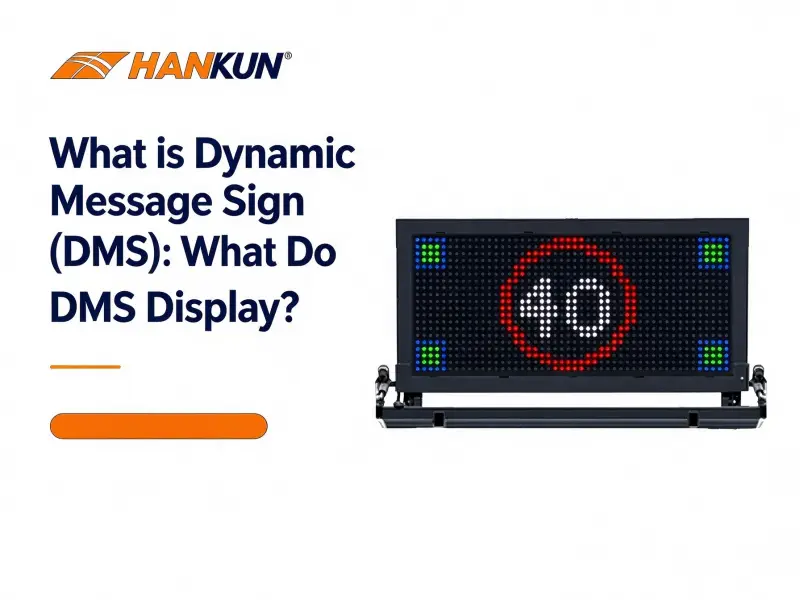
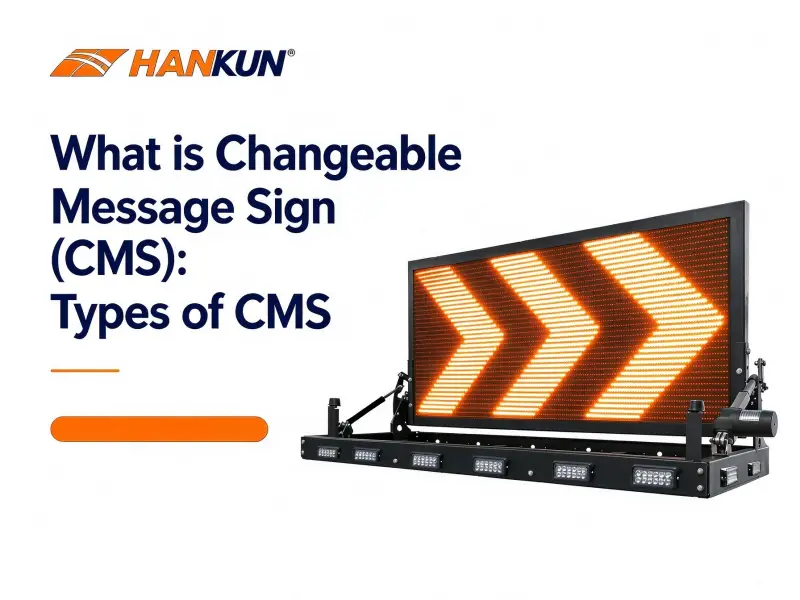
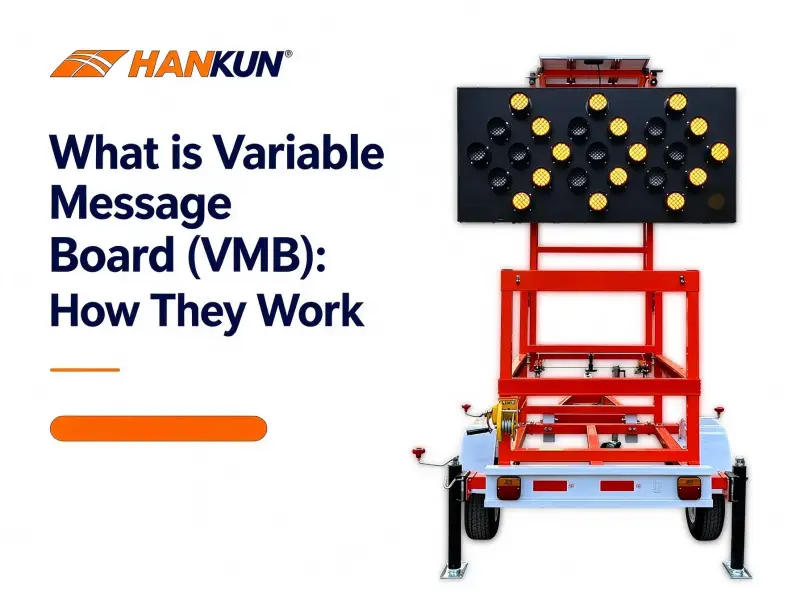
VMS stands for variable message sign. The same hardware appears in tender documents as a changeable message sign (CMS), a dynamic message sign (DMS), a variable message board (VMB), or, in the UK and Ireland, a matrix sign. The letters change with the issuing authority; the product does not.
The confusion has a cost. A specification copied from another country can name a device the local authority does not recognise, and the tender gets queried on a technicality. Use the term in the local standard.
| Term | Where it is used | What it signals |
|---|---|---|
| VMS | International | Broadest term, fixed and portable |
| CMS | North America | Common in state specifications |
| DMS | North America, traffic technology | Network-controlled operation |
| PCMS | North America, work zones | Portable only |
| Matrix sign | UK and Ireland | The dot-matrix build, not a separate product |
The technology moved faster than the names. The Wikipedia entry on variable-message signs records neon tubes, rotating prisms and flip-disc panels before LED took over in the late 1990s, so matrix sign describes a build rather than a category. Suppliers group the family under Variable Message Signs and split it by mounting method.
How a variable message sign works, from sensor to screen
A VMS works as a closed loop. Sensors and traffic platforms collect conditions, an operator or a rule set selects an approved message, the message travels over a network link, and the panel displays it at a brightness matched to ambient light. A status report travels back, which is why the controller matters as much as the display.
The five blocks inside a variable message sign board
A variable message sign board is five subsystems sharing an enclosure, each specified separately in a good tender.
| Subsystem | What it does | What fails first |
|---|---|---|
| LED modules | Render characters; pixel pitch sets readable distance | Dead pixels, module seals |
| Driver cards | Turn controller output into row and column signals | Connector corrosion |
| Controller | Holds the library, drives the panel, reports status | Firmware that no longer matches the platform |
| Communications | Links the sign to the traffic centre | Modem and SIM provisioning |
| Power and enclosure | Mains, battery or solar supply; cooling | Battery capacity on solar units |
Read that table from the bottom up. Power and enclosure choices are the hardest to change after delivery.
The message path, step by step
- Detection. Loops, radar, cameras, weather stations and patrol reports feed the traffic centre.
- Selection. An operator picks from an approved library, or a rule set triggers a message once a threshold is crossed.
- Transmission. Fixed sites use fibre or Ethernet. Portable units use cellular.
- Rendering. The controller writes the message and the photocell sets output for current light.
- Confirmation. Fault counters, power state and the active message return to the platform.
Step two catches out new buyers. Transmission is rarely the bottleneck; approval is. An agency with a fixed library publishes in seconds, while one drafting from scratch spends minutes on text a driver reads for four seconds.
LED output falls with age and gets replaced on schedule. The controller degrades invisibly, still driving the panel while losing step with the platform. A sign that cannot be updated gets bypassed.
The main types of VMS, and where each one fits
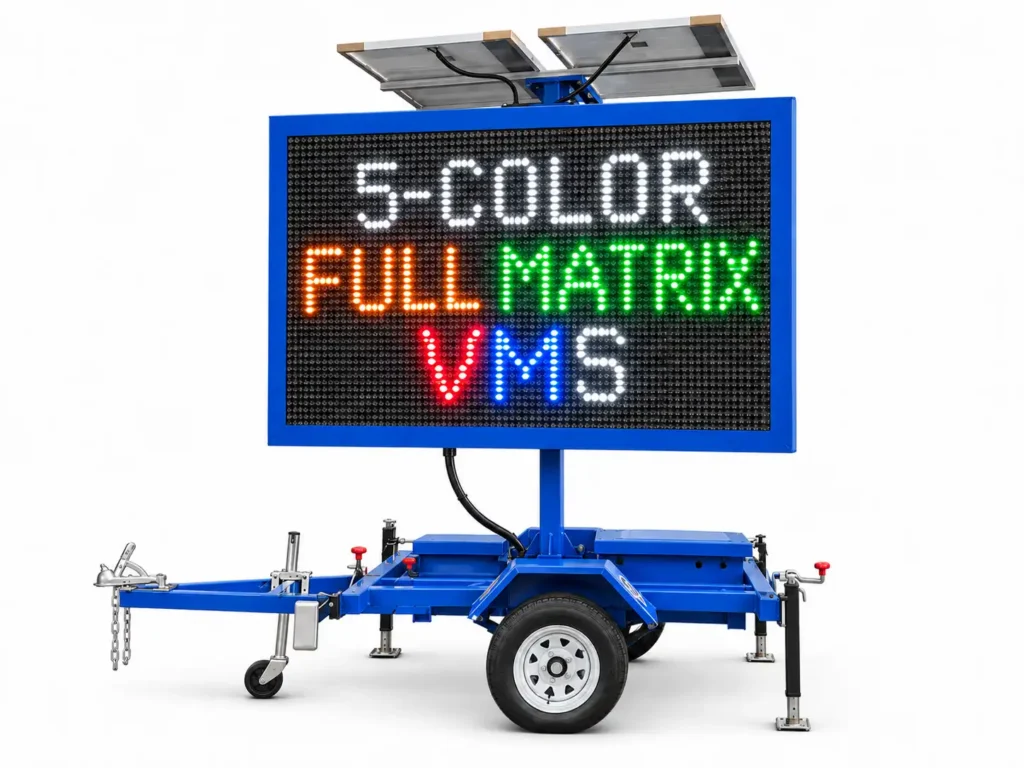
VMS hardware splits by how it reaches the roadside, not by what it displays. The categories are fixed roadside and gantry signs, trailer-mounted units, vehicle-mounted units, and compact portable panels. Work zones, diversions and events usually need the portable three, because the location changes with the job.
Road signs fall into four groups: regulatory, warning, guide, and temporary work-zone signs. A VMS carries all four, moving from a speed limit to a lane-closure warning to a travel-time guide without anyone visiting the site.
| Type | Deployment | Typical use | What to check |
|---|---|---|---|
| Fixed or gantry | Permanent, crane installed | Motorways, tunnels, toll plazas | Structural load, access, protocol |
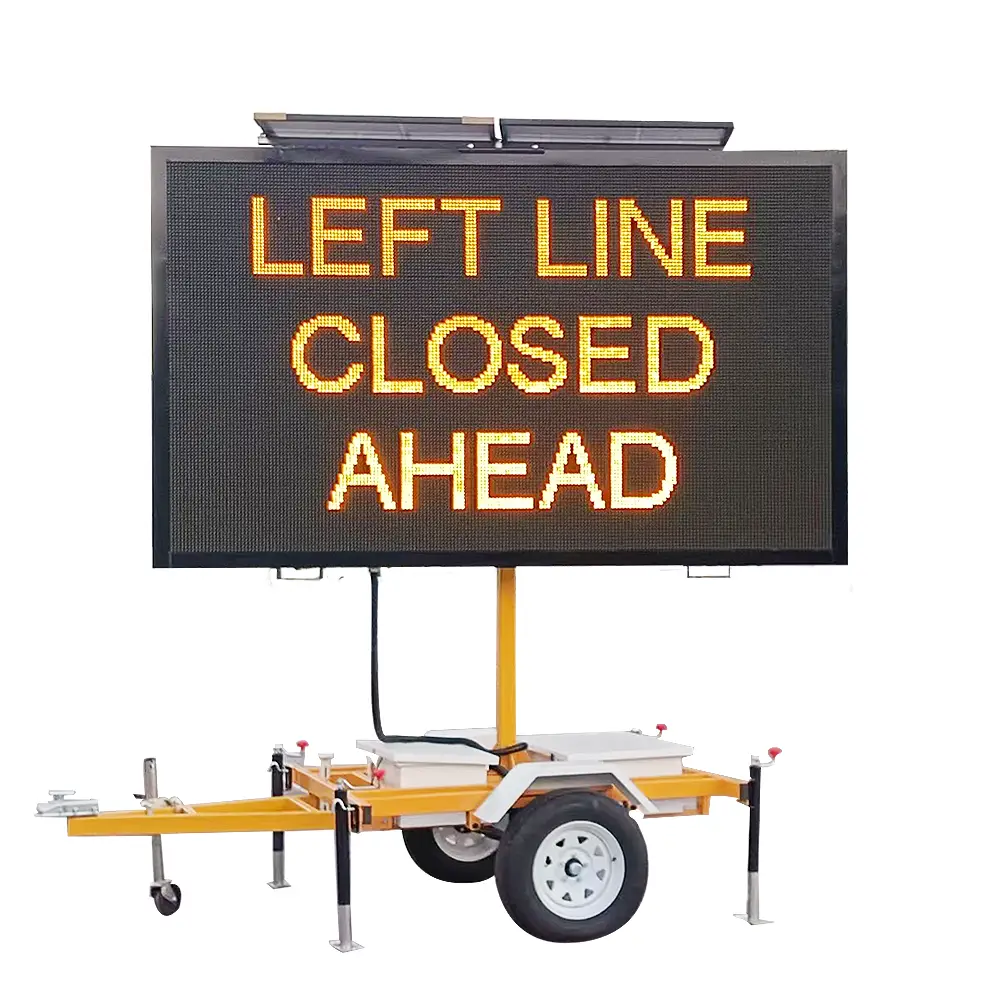
| Trailer-mounted | Towed, self-contained power | Work zones, diversions, events | Mast height, battery autonomy, trailer lighting |
| Vehicle-mounted | Bolted to a truck | Incident response, maintenance | Vibration, 12 or 24 V supply, rear visibility |
| Compact portable | Placed by hand or small trailer | Short-term works, car parks | Character height, weight, theft resistance |
For projects that relocate every few weeks, trailer-mounted variable message signs remove the need for a power connection, which often settles the specification.
Amber or full colour
Amber is the work-zone default: it reads at distance, draws less power, and matches the colour of equipment drivers already look for. Full colour costs more in LEDs and power budget, and earns it back only when the message needs lane-specific colour or pictograms.
What is VMS text, and what makes it readable?
VMS text is the character content a sign shows at one moment, written to fit the panel’s line count and character height. It is not free-form writing. A message has to be short enough to read at speed, specific enough to act on, and complete enough to stand alone, because the driver may see only that one screen.
Line count and character height
A three-line panel is the work-zone standard, and the layout is a compromise rather than a preference. Three lines give a problem, a location and an instruction without forcing the reader to hold anything in memory. Four lines fit more detail but shorten every line.
Character height sets how far back a driver can begin reading. Taller characters read from further away, and fewer fit across the panel, which is why a panel that works on an arterial can be useless on a motorway.
How many words fit in one phase
A phase is one screen of text held for a set period, long enough for a driver at design speed to read it twice. That window is shorter than most first drafts assume. The structure that survives has four parts: the problem, its location, its effect, and the action. A workable phase reads: LANE CLOSED, 2 KM AHEAD, MERGE LEFT.
Each line does one job, and nothing depends on the previous screen. Panels built around that fixed layout, such as three-line portable changeable message signs, accept the trade knowingly.
Contrast, pixel pitch, viewing angle and sun load decide whether the message survives the trip to the driver’s eye. Low sun flattens contrast, and dust on the lens costs more brightness than a dimming step.
What a variable message sign generator does
A variable message sign generator is software that composes messages, previews them at pixel level, checks them against the panel’s limits, and schedules when each one runs. It sits between the operator and the controller, and it replaces neither.
Writing on the sign itself means standing in front of a panel whose characters are unreadable at arm’s length. A generator shows the layout on a screen first.
- Pixel-accurate preview at the panel’s real resolution
- A character set and pictogram library matching the local standard
- Validation for line length, character count and permitted abbreviations
- Scheduling and triggers for time of day, sensor input and manual override
- A change log with operator identity and timestamp
The last item is the one procurement teams forget. When a message is questioned after an incident, the log is the only record of what was shown and who approved it.
Power: grid, battery, solar
A VMS can run from mains power, a battery bank, or a solar array with battery storage. Permanent sites almost always take mains, because the connection is made once. Portable units usually run solar, because trenching a cable to a work zone that moves before the season ends costs more than the panels.
Sizing is arithmetic: daily demand in watt-hours is average load multiplied by operating hours. Array wattage is that demand divided by peak sun hours and by system losses. Battery capacity is days of autonomy multiplied by demand, divided by voltage and usable depth of discharge.
What gets underestimated is rarely the panel rating. It is display duty cycle, since a dimmed sign at night draws far less than its rated load, and controller idle draw, which runs around the clock. A unit sized this way can be checked against solar-powered mobile changeable message signs.
Fixed gantry sites, tunnels and toll plazas belong on mains. Solar earns its place where there is no supply, where trenching is prohibited, or where the sign will be gone within two years.
What variable message signs cost, and what drives the number
There is no published price list for variable message signs. Cost is quoted per project and moves with panel area, pixel density, colour capability, mounting structure, power system, controller and certification. Two signs with the same screen size can land far apart once those variables shift.
| Cost driver | Why it moves the quote |
|---|---|
| Panel area and pixel pitch | More modules, more driver cards, heavier structure |
| Monochrome or full colour | More LED channels and a larger power budget |
| Mounting method | Skid, mast, trailer chassis and gantry bracket are different builds |
| Power system | Mains connection versus solar array, battery and charge control |
| Controller and protocol | Regional protocol support and platform integration |
| Certification | Type testing, production control records, inspection |
The cheapest line on a quotation is rarely the cheapest item over the life of the sign. A low panel price with a controller that cannot speak the local protocol becomes an integration project. Lifecycle items are predictable once listed: modules, batteries on solar units, mast hydraulics, firmware, cleaning, and crews sent to remote sites. Remote diagnostics cut that last line most.
Standards and compliance to check before you buy
Compliance is regional. European projects reference EN 12966, projects in the United States reference the MUTCD for devices and message presentation and the NTCIP family for communications, and other markets issue their own road authority specifications. A sign that satisfies one framework does not automatically satisfy another.
EN 12966 in Europe
EN 12966 covers continuous signs, such as rotating prism units, and discontinuous signs built from individual elements, which is where LED panels sit. It applies to mobile, temporary and permanent signs, and sets out visual and physical characteristics, durability, and the verification of constancy of performance. Read the published EN 12966 scope before writing a tender.
MUTCD and NTCIP in North America
The Manual on Uniform Traffic Control Devices is published by the Federal Highway Administration under 23 CFR Part 655 and defines which devices may be installed and how their messages are presented. The 11th Edition took effect on 18 January 2024, and Revision 1 on 5 March 2026, so a specification still citing the 2009 edition is out of date. NTCIP covers the messages exchanged between sign and central system, which is what lets a portable unit join an existing network.
Whatever the market, the document pack should contain type test reports, production control records, a protocol conformance statement, and a sample message library.
FAQ
Three questions come up in almost every VMS specification review: brightness at night, solar autonomy in bad weather, and what the sign does when the network drops.
How bright should a VMS be at night?
Bright enough to read, dim enough not to glare. The photocell should step output down as ambient light falls, and the dimming curve matters more than the maximum rating on the datasheet. A sign judged only on daytime brightness sends drivers looking away from it.
Can a solar VMS run through a week of heavy cloud?
It can if the battery was sized for days of autonomy rather than for one sunny day. Cloud cuts array output without cutting demand, so the battery carries the load until the array recovers. Ask for the autonomy figure in days at a stated load, then check whether that load assumes full brightness around the clock.
What happens when a VMS loses its network connection?
A properly configured sign keeps showing its last approved message, or falls back to a default safety message held in local memory, and raises a fault once the link returns. What it should not do is go blank on a live carriageway. Confirm the fail-safe behaviour at commissioning, including the case where power returns first.