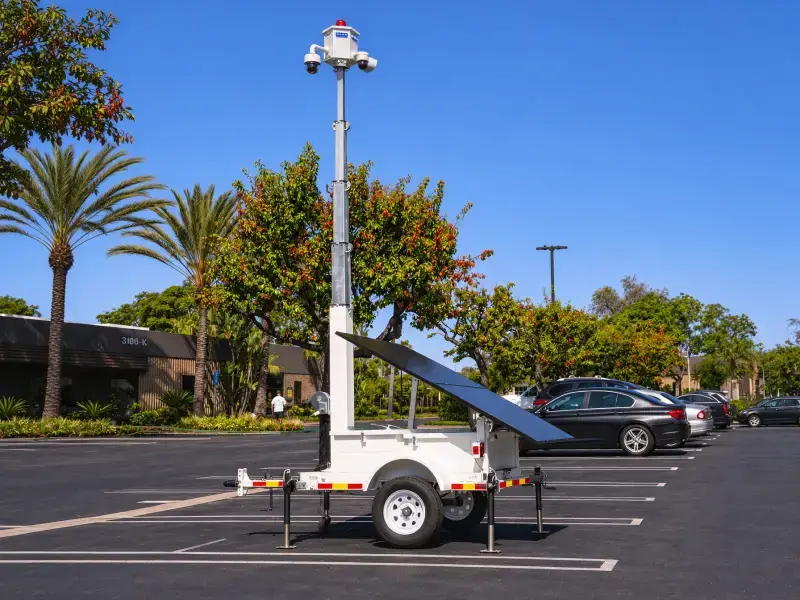
A printed sign describes the road as it was on the day it was made. Work zones change by the shift: a lane that opened at seven is closed by noon, and a printed panel cannot say so. That gap is why road agencies keep an electronic sign on a trailer in the inventory, and why the abbreviation shows up in almost every traffic control plan written in the United States.
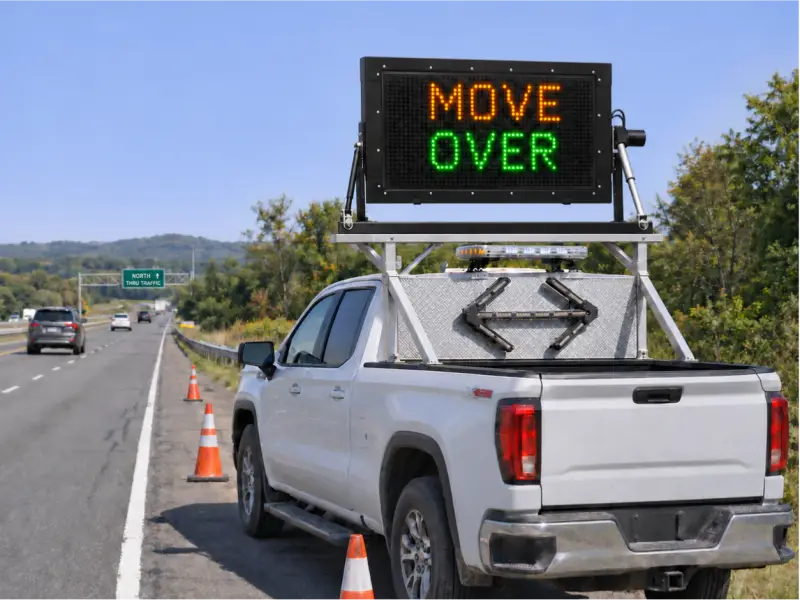
PCMS stands for portable changeable message sign. It is a trailer-mounted or truck-mounted electronic sign that displays short, programmable text to approaching drivers, and agencies deploy it when a temporary condition has to be explained before a driver is forced to act on it.
The letters are the easy part. What the device has to do to stay legal, legible and credible is where the substance sits.
What does PCMS stand for?
Portable changeable message sign. Each word carries a constraint, and dropping any one of them moves the device into a different category with different rules.
Portable means it is not a permanent installation. It arrives on a trailer or a truck bed, gets levelled, gets raised, and leaves when the job ends. Changeable means the message set is programmable rather than printed, so the same panel can carry a closure notice on Monday and a fog warning on Tuesday. Message means the content is restricted: traffic operational, regulatory, warning and guidance information only. Sign means it is a traffic control device, not a display, and it inherits every obligation that comes with that status.
The terminology around it is messier than it should be. A changeable message sign, or CMS, is the umbrella term in the national manual and covers permanent gantry signs as well as portable ones. Variable message sign, usually shortened to VMS, is the phrase most buyers and most suppliers use in conversation, and permanent highway installations are often called dynamic message signs. A PCMS is the portable subset, and that subset carries extra provisions because it sits inside a temporary traffic control zone rather than above a lane.
Those extra provisions live in Part 6 of the current manual, at Section 6L.05. Older procurement documents still cite Section 6F.60, which is where the same material sat in the 2009 edition. Both numbers describe the same device; only one of them is current.
What is a PCMS system made of?
Four parts: a display panel, a controller, a power system, and a mounting and transport structure. A unit fails the whole deployment when any one of them fails, which is why a specification should be judged on the weakest component rather than the panel.
| Component | What it does | What to check before ordering |
|---|---|---|
| Display panel | Forms characters, symbols and arrows | Matrix type, character height, pixel pitch, contrast in direct sun |
| Controller | Stores, sequences and schedules messages | Message capacity, phase timing, remote access, behaviour on fault |
| Power system | Keeps the unit running unattended | Solar array size, battery chemistry, days of autonomy, cold-weather performance |
| Mounting | Puts the panel at a legal height and holds it there | Lift type, mast height, wind rating, tow or truck-bed configuration |
Display panel and matrix types
Three matrix designs are sold, and the difference matters more than the marketing language around it.
A character matrix fixes each character into a set position with a fixed size, so the message is limited to what the factory programmed. A line matrix gives each row independent control but keeps character size constant. A full matrix addresses every pixel individually, which means text can be any size, symbols and arrows can be drawn anywhere, and a graphic can replace words when a picture reads faster. All three can be compliant; only the last one gives the operator freedom.
The familiar three-line, eight-character layout comes from legacy character-matrix hardware. Section 6L.05 still allows it, phrased as a sign limited to three lines of eight characters per line or built as a full matrix display. Full matrix units are not exempt from the reading budget; they simply allow the operator to spend it differently.
Controller and the message generator
A variable message sign generator is the software layer inside the controller. It holds the message library, composes phases, sets how long each phase stays up, and drives the brightness curve as ambient light changes. On a cheap unit it is a fixed list of factory strings. On a serious one it is a scheduling tool that can push different messages by time of day, day of week and site.
Control usually runs at three levels: a keypad on the unit for the field technician, a service laptop for building message sets, and a central traffic management platform over cellular for the agency. Procurement questions worth asking are how many messages the library holds, whether phases can be edited in the field, and what the unit displays when it loses power or signal. That last one is not cosmetic. A panel stuck on a stale closure notice damages the credibility of every sign the agency owns.
Power and mounting
Solar plus battery is now the default because trenching a work zone is not an option. The real constraint is not summer output but winter autonomy: shorter days, lower sun angles, cold cells and heaters that draw current all arrive at once. Units sized on a June calculation fail in January.
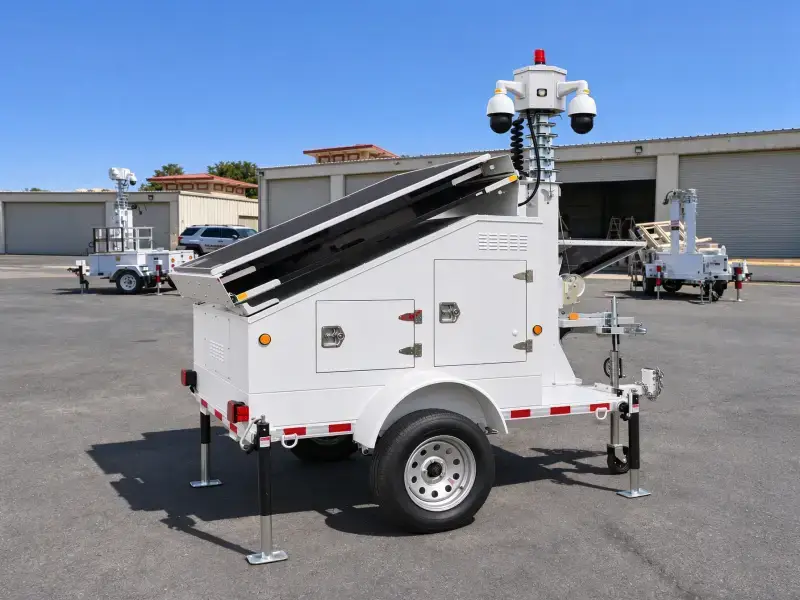
Mounting splits three ways. A trailer repositions fastest and levels on its own stabilisers, but it needs a tow vehicle and a site with room to stand it. A truck-bed frame moves with the crew and needs no separate towing, at the cost of tying up the vehicle. A temporary post mount suits long, static deployments where the panel only has to be right once.
What is the purpose of a PCMS in traffic control?
Its purpose is to tell drivers about an unexpected condition early enough that they can still decide what to do about it: change lane, slow down, or take another route. It supplements required static signing rather than replacing it.
Section 6L.05 describes the device as one installed for temporary use with the flexibility to display a variety of messages, and names its primary purpose as advising road users of unexpected situations. Three properties make it useful: it can carry a complex message, it can carry real-time information about conditions ahead, and it can deliver that information before the point where the driver has no choice left.
It is not interchangeable with an arrow board. An arrow board shows direction and nothing else, and it is the right tool at the taper. A PCMS explains why the taper exists, two thousand feet upstream. Most well-built work zones use both, spaced so that the second does not compete with the first.
Where a PCMS earns its place
- Lane, ramp or roadway closures where the merge point is not where drivers expect it.
- Incident management, when a queue builds faster than static signage can describe.
- Special events with inbound traffic that peaks inside an hour.
- Adverse weather: fog, ice, flooding, dust.
- Speed reductions ahead of an active work area.
- Queue warning and dynamic late merge inside a smart work zone system.
Where it should not be used
Advertising is prohibited outright, on the sign face and on its supports. Generic slogans are prohibited in most state manuals for a subtler reason: a driver who passes BUCKLE UP and DRIVE SAFELY every morning learns that the panel carries nothing worth reading, and stops looking. When the panel finally says LANE CLOSED, the glance never happens.
The same logic applies to overuse. Repeated exposure to a message that has no relevance to the driver produces habituation, which is why guidance recommends moving units every few weeks and blanking the display when there is nothing to report. A pcms sign left showing the same notice for a season is furniture.
How far should a PCMS be visible?
Half a mile, in daylight and at night. Section 6L.05 sets that as guidance, and the FHWA handbook uses the same figure for highway travel while accepting shorter distances at lower speeds.
Visibility and legibility are different tests, and buyers confuse them constantly. Visibility is whether a driver notices that something is there. Legibility is whether the characters resolve into words. The working rule behind most legibility tables is forty to one: one inch of character height buys roughly forty feet of reading distance, for a driver with normal vision under good conditions.
| Character height | Legibility distance | Where it fits |
|---|---|---|
| 18 in | About 720 ft | Work zone minimum at posted speeds of 45 mph and above |
| 24 in | About 960 ft | Two-line units on higher-speed approaches |
| 54 in | About 2,160 ft | Large-format permanent installations |
Placement distance upstream
How far ahead the unit goes depends on what the driver has to do, not on how fast the traffic is moving.
- Minor action, such as a lane change: 500 to 1,000 ft upstream of the decision point, at any speed.
- Major action, such as a detour, at 40 mph or below: at least 1,000 ft.
- Major action at 45 mph or above: at least one mile.
- Minimum spacing between two units, or between a unit and an arrow panel: 1,000 ft.
Laterally, the unit goes on or just outside the shoulder, as close to the affected lane as the site allows, on level ground. Turn the face about three degrees toward the roadway to cut glare. If a barrier does not protect it, cone or drum it, because an unprotected trailer at the edge of a live lane is a hazard in its own right. Trailer-Mounted Variable Message Signs are the usual choice where that positioning has to be repeated across a long programme.
How messages are built so drivers can actually read them
Short. Two phases at most, three lines per phase, and each phase held long enough to be read at least twice at the posted speed. Every other rule in message design follows from that reading budget.
The handbook’s timing is 1.5 seconds for a phase of one or two lines and 3 seconds for three lines, with the whole message readable at least twice. Three phases are discouraged because drivers on a three-line panel struggle to hold the sequence in memory. Each phase should also stand on its own, so the message still makes sense if the driver catches the second phase first. Where two units are legible at once, only one should be cycling.
Message board abbreviations
Standard abbreviations exist because a truncated word is a guess, and a guess at 60 mph is a wrong turn. Do not invent them; use the approved list.
| Approved | Meaning | Approved | Meaning |
|---|---|---|---|
| ALT | Alternate | MAINT | Maintenance |
| BLVD | Boulevard | SHLDR | Shoulder |
| CNTR | Center | TEMP | Temporary |
| EMER | Emergency | TRAF | Traffic |
| HOV | High-occupancy vehicle | WARN | Warning |
Some approved abbreviations need a prompt word beside them to avoid ambiguity: HAZ DRIVING, WET PVMT, CONG TRAFFIC. Others are banned because drivers read them as something else entirely: ACC is read as access rather than accident, B4 as a sequence rather than before, CLRS as colors rather than clears, DLY as daily rather than delay, FDR as federal rather than feeder.
The three-phase pattern
Problem, location, action. LANE CLOSED, ONE MILE AHEAD, MERGE LEFT. Two phases are usually better than three, and one is better still. What is not permitted is motion: no scrolling, no flashing text, no dissolving transitions, no animation. A panel that moves is a panel drivers watch instead of the road.
Changeable message sign MUTCD requirements to check before you buy
The requirements that disqualify a unit at inspection rarely appear on a spec sheet: panel height, character height, automatic dimming, positive contrast, and the prohibition on animation. All five are testable on delivery.
| Requirement | Where it sits | Why it matters on site |
|---|---|---|
| Bottom of panel at least 7 ft above the roadway in operating mode | Mounting provisions; FHWA handbook | A low panel disappears behind queued vehicles |
| 18 in minimum character height, 10 in allowed on incident response trucks | Section 6L.05 | Reading distance collapses with smaller letters |
| Brightness adjusts automatically to ambient light | Sections 6L.05 and 2L.04 | Fixed brightness is washed out at noon and blinding at night |
| Positive contrast, light legend on a dark background | Section 2L.04 | Reversed polarity fails the standard regardless of how it looks |
| No scrolling, flashing, animation or advertising | Sections 2L.01 and 6L.05 | Distraction, plus loss of credibility for every later message |
| Legend colours drawn from the standard colour table | Section 6L.05 | A non-compliant colour on a regulatory message is unenforceable |
Compliance is a framework, not a certificate. A supplier claiming a compliant unit should be able to point to each line above and show how the hardware meets it. Three-Line Portable Changeable Message Signs are the configuration most federal and state solicitations still specify, which makes that configuration the easiest to benchmark against.
Displaying a speed limit on a VMS
When a variable message sign shows a speed limit, it stops being an advisory panel and becomes a regulatory device. The manual treats that case separately, in the section covering speed limit signing, because a number in a lit matrix carries the same legal weight as a metal plate. Two uses are common: a portable unit displaying a limit that changes with operating conditions, and a radar feedback display showing the speed the approaching driver is actually doing. The first must match an authorised limit for that segment. The second must be unmistakably a feedback message, not a posted limit.
What does a PCMS cost?
There is no single figure, because what variable message signs cost is driven by five variables: panel area, matrix type, power autonomy, mounting, and communications. Two units with identical three-line displays can differ by a factor of three once those are priced in.
| Cost driver | Why it moves the price | Where there is room to trade down |
|---|---|---|
| Panel area and character height | LED count and driver count scale with area | Smaller face for low-speed or close-reading sites |
| Matrix type | Full matrix needs finer pitch and more channels | Character matrix where the message set is fixed |
| Power system | Array and battery sized for worst-case winter | Mains top-up on long-duration sites |
| Mounting | Trailer with lift and stabilisers versus truck-bed frame | Vehicle mounting reuses an existing chassis |
| Communications and control | Cellular modem plus central software licence | Local-only control for single units |
Rental versus purchase
Variable message sign rental fits programme windows measured in weeks, one-off events, and demand peaks that an owned fleet cannot cover. It also moves battery replacement, inspection and compliance paperwork onto the supplier, which is worth more than the day rate to a contractor without a yard or a maintenance team.
Buying fits multi-year programmes with several concurrent sites, operations that need one message library and one scheduling interface across a fleet, and projects where the unit is a fixed asset written into the traffic control plan. Variable message sign for sale pricing on B2B equipment marketplaces in late 2026 ran from roughly US$2,700 for basic trailer units to around US$10,000 for full-colour five-colour trailer units, with fixed gantry installations an order of magnitude above that. Those are listing prices seen on marketplaces, not a market average, and they exclude freight, duties and commissioning.
A working rule rather than a number: if a unit would sit deployed for less than a few months a year, rental usually wins. Beyond that the crossover favours ownership. Run the comparison on your own deployment calendar, not on list price. Trailer-Mounted Amber PCMS is the specification most often quoted for both paths because amber remains the cheapest compliant legend colour.
PCMS outside the work zone: airports and parking guidance
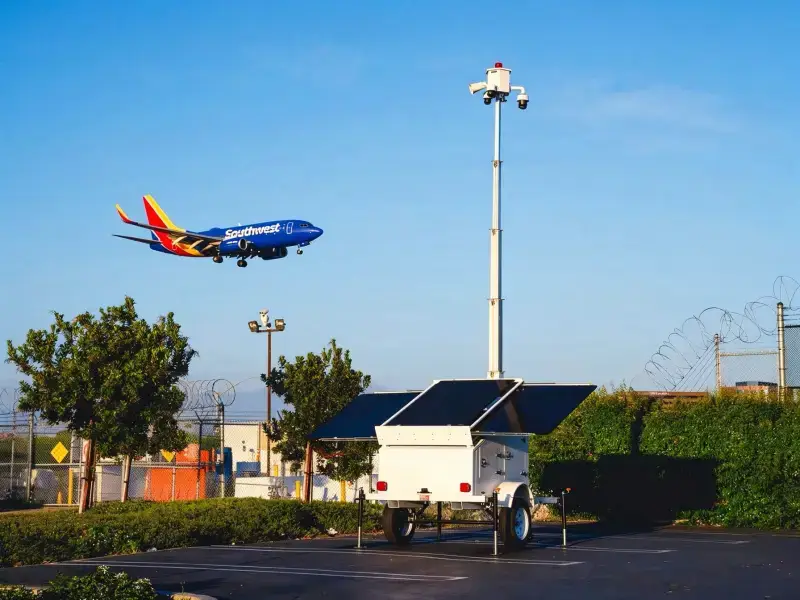
Airports use the same hardware for a different job. Instead of warning about a hazard, a variable message sign at an airport approach road allocates capacity, counting down available spaces by zone and level so drivers pick a structure before they commit to a lane.
The update cycle is the main difference. A work zone panel changes when a supervisor decides it should. An airport panel changes when a bay sensor reports a car, which can be every few minutes, and the count is fed from the parking management system rather than typed by a person. Reading distances are shorter, so character height requirements relax and the message set compresses into numbers, arrows and structure names.
The same panels appear at curbside for shuttle arrivals and lane assignment, and at height-restriction points where a wrong turn costs a driver the height of the vehicle. Vehicle-Mounted Variable Message Signs cover the mobile version of the same task, where the panel has to move with an operations team rather than wait at a fixed decision point.
A short specification checklist
Eight items decide whether a unit survives a project: display specification, character height, dimming behaviour, control levels, autonomy, mounting, structure, and paperwork.
- Confirm the matrix type against the message set you actually intend to run.
- Confirm minimum character height against the posted speed at the deployment site.
- Confirm the panel reaches 7 ft to the bottom in operating mode, on the terrain you will meet.
- Confirm automatic dimming across the full ambient range, not just day and night presets.
- Confirm all three control levels exist, and ask what happens on signal loss.
- Confirm days of autonomy at the lowest expected winter temperature.
- Confirm wind rating and stabiliser footprint for an exposed site.
- Confirm the compliance file covers each line in the table above, not a single certificate.
For the underlying rules rather than the procurement angle, the FHWA Portable Changeable Message Sign Handbook remains the clearest practical reference on message design, abbreviations and placement, and it is free to download.
FAQ
Is a PCMS the same thing as a VMS?
Not quite. VMS is the everyday phrase for any variable message sign, permanent or portable. PCMS is the specific subset built for temporary deployment, and it carries additional provisions in Part 6 of the manual that a permanent gantry sign does not. A supplier quoting a VMS may be quoting either.
Can a PCMS display any message the crew wants?
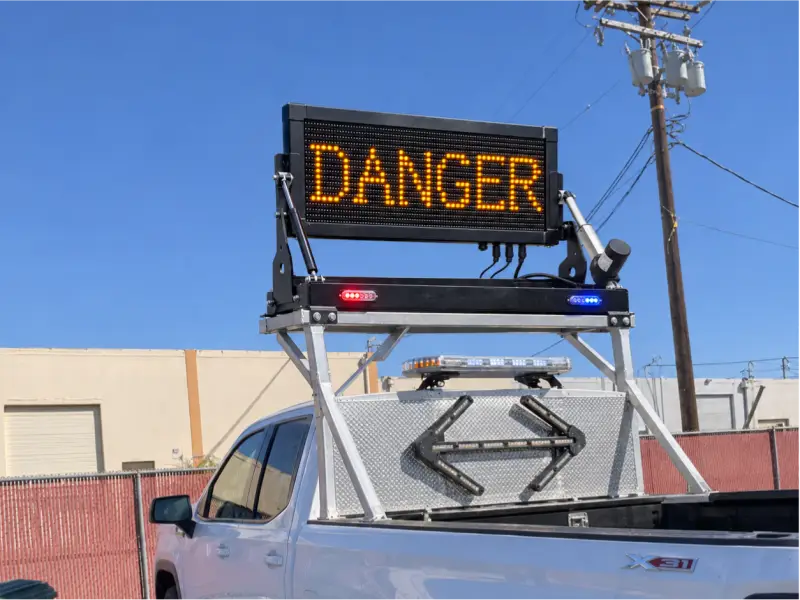
No. The display is limited to traffic operational, regulatory, warning and guidance information, with advertising prohibited. Several state manuals go further and prohibit generic slogans and non-standard words such as DANGER or CAUTION, on the grounds that they add no instruction and train drivers to ignore the panel.
Why do agencies move PCMS units every few weeks?
Because familiarity erodes attention. Drivers who pass the same notice daily stop reading it, and the panel becomes part of the scenery. Periodic relocation, blanking the display between messages, and keeping the content specific to the site are the three habits that keep a pcms message board worth the money it cost.