At 65 mph on a rural interstate, a board on the shoulder reads SPEED LIMIT 45. Two hundred feet later a metal sign still says 65. Drivers slow down, then argue about which one applied. Road agencies argue about the same number for a different reason: who may change it, and what the hardware costs.
A speed limit on a variable message sign (VMS) is a temporary limit set by the road authority for the section ahead, and while it is displayed it replaces the permanent posted limit there. It is a legal limit, not a suggestion, provided the display is regulatory and no later sign has replaced it. An advisory number carries no legal force.
What follows is why the number appears, when it overrides the fixed sign, and what a compliant board needs to show it.
Why a variable message sign shows a speed limit
A VMS shows a speed limit when conditions ahead make the permanent limit unsafe, and the authority wants drivers to slow before they reach the problem rather than at it.
Four conditions cover most deployments: weather that cuts stopping distance, queues that build faster than drivers expect, work zones that put crews within feet of traffic, and crashes that change the road. The permanent sign describes a dry, free-flowing road. The board describes the road as it is.
The board sits upstream of the hazard, so the limit applies from the sign forward, and a driver who waits for brake lights has already spent the distance the sign was there to protect. The Federal Highway Administration adds a threshold: variable limits are used where conditions regularly demand a drop of more than 10 mph.
Variable speed limit corridors
On a corridor the board is one part of a loop: loops or radar measure speed, weather stations report visibility, and a controller picks from a permitted set of values. Gantries repeat the number every mile, so the limit stays in force along the corridor.
Colorado replaced static signs on four miles of I-70 in Dowd Canyon with 18 variable speed limit signs in January 2026. Police enforce the number shown, and the state reports a 20 percent crash reduction in the eastbound Mountain Express Lanes since the change. The Federal Highway Administration puts the wider effect at up to 34 percent fewer total crashes and 65 percent fewer rear-end crashes.
Work zone limits on portable boards
A work zone limit comes from the traffic control plan, not a sensor. The engineer sets it against lane width, barrier type, crew distance and shift complexity, and portable boards carry it upstream of the taper. The contractor changes the number inside the approved plan; a corridor number comes from the control room.
Does the sign override the posted speed limit?
Usually yes, but the qualifier decides the case. Where the number is regulatory, the value shown when you pass the sign is the value in force and exceeding it is citable. Where it is advisory, the number describes a safe speed and sets no legal maximum. Either way the override ends at the next speed limit sign.
When the display is regulatory
Regulatory displays share markers. The legend reads SPEED LIMIT, or the number sits in a red circle, and the device is authorised by statute, traffic regulation order or the approved traffic control plan.
Authority is local. American states write their own variable speed limit statutes, so the same number can be regulatory in one and advisory in another. A temporary limit on a UK matrix sign is enforceable. UNECE guidance goes further: a VMS limit should outrank the fixed sign, and should never show a higher value than that sign does.
When the display is advisory
Advisory numbers sit on a yellow background or carry wording such as ADVISED SPEED, and describe a comfortable speed through a curve, ramp or temporary alignment. The legal limit has not changed. Messages without a number belong here too: FOG and REDUCE SPEED describe behaviour. The Federal Highway Administration calls advisory speeds non-regulatory (Speed Limit Basics).
Where the limit ends
Three things close a temporary limit: a speed limit sign showing a different value, a sign restoring the default limit, or an electronic end-of-restriction symbol. A blank board usually means the message has finished and the permanent limit is back.
| Feature | Regulatory display | Advisory display |
|---|---|---|
| Appearance | SPEED LIMIT legend, or the number in a red circle | Yellow background, or wording such as ADVISED SPEED |
| What it states | The legal maximum from that point | A safe speed for a specific feature |
| Legal force | Enforceable while displayed | No legal maximum; relevant to liability, not a citation |
| Who authorises it | Road authority, under statute, order or control plan | Road authority, as guidance |
Four ways drivers misread a speed limit on a message board
Most confusion comes from treating every number on a board as the same kind of instruction.
- Assuming the number is advice because it is electronic. In a corridor it is the limit.
- Assuming it covers only the lane under the board. A roadside trailer applies to the whole direction it faces.
- Reading a measured speed as a limit. A board showing YOUR SPEED 52 is reporting.
- Assuming a blank board means an unrestricted road. It usually means the message has ended.
A radar feedback sign looks similar and behaves nothing like a VMS. It measures approaching vehicles, and enforcement does not read it as a limit.
How the number gets onto the board: message design rules
A speed message is short because it has to be read at speed: three lines, about 20 characters per line, 18-inch letters on roads posted at 45 mph or higher, no animation and automatic dimming at night.
The rules sit in Chapter 2L of the Manual on Uniform Traffic Control Devices, with portable units covered again in Part 6. Letter height follows posted speed: 18 inches at 45 mph and above, 12 inches below. Content is limited to traffic operational, regulatory, warning and guidance information, and advertising is prohibited.
Legibility, not panel size, is the constraint. At 55 mph and above a sign should be visible from half a mile, with the message legible from 600 feet at night and 800 feet in daylight. When fog cuts those distances, the answer is a shorter message.
Why a two-word message beats a sentence
SPEED LIMIT 40 carries two units of information: the rule and the value. REDUCE SPEED AHEAD carries three, and a driver at 65 mph gets about two seconds per line. Operators strip a message to the problem, the location and the action, and each phase of a two-phase message has to stand alone.
| Parameter | Typical requirement | Why it matters |
|---|---|---|
| Lines and characters | Three lines, about 20 characters per line | Reading time at speed |
| Letter height | 18 in at 45 mph and above, 12 in below | Legibility distance |
| Visibility | Half a mile at 55 mph and above | Detection before the decision point |
| Contrast | Light legend on a dark background | Recognition in glare and at night |
| Content | Traffic operational, regulatory, warning and guidance only | Uniformity, and no advertising |
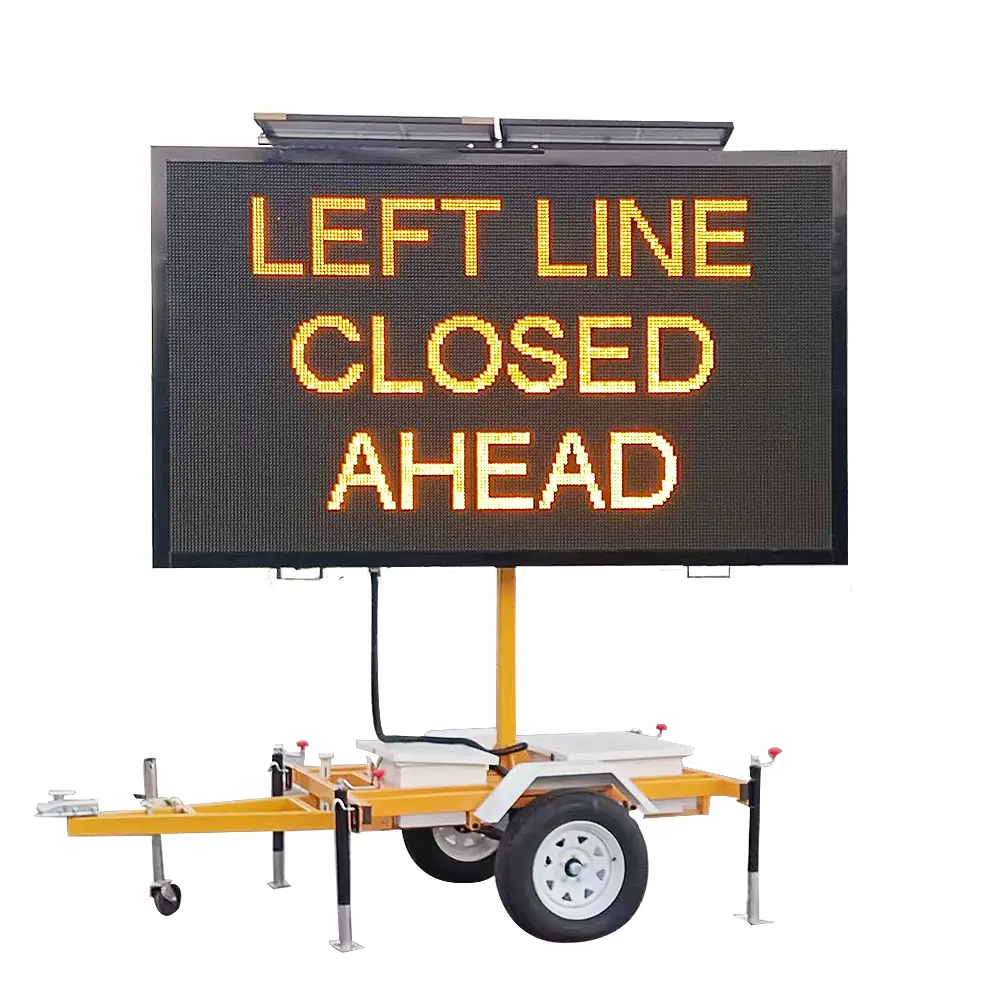
Most boards built for work zones are three-line units, which is why the format dominates rental fleets. Units of that shape, including Three-Line Portable Changeable Message Signs, are sized around the character height the posted speed demands, so a unit bought for a 35 mph arterial will not serve a 65 mph closure.
Where speed limits appear beyond highways
Highways are the main venue, but airport roads, event sites and ports run the same mechanic: a number that applies from the board to the next decision point.
Airport variable message signs rarely show a speed limit as their main job. Boards on approach roads do parking guidance and ground transport routing; Seattle-Tacoma uses them to shift arriving traffic between garage zones. Speed messages appear during roadway works and curb reconfiguration. Raleigh-Durham added 14 ground-mounted LED displays in a roadway and parking programme, and those boards also carry construction and weather messaging. On private ground, an event operator sets the limit rather than a traffic regulation order.
Equipment options for displaying a speed limit
Three formats cover almost every deployment: a fixed gantry or post-mounted cabinet, a trailer-mounted board, and a board carried on a vehicle. Posted speed and the length of the restriction decide which you buy.
Trailer-mounted units
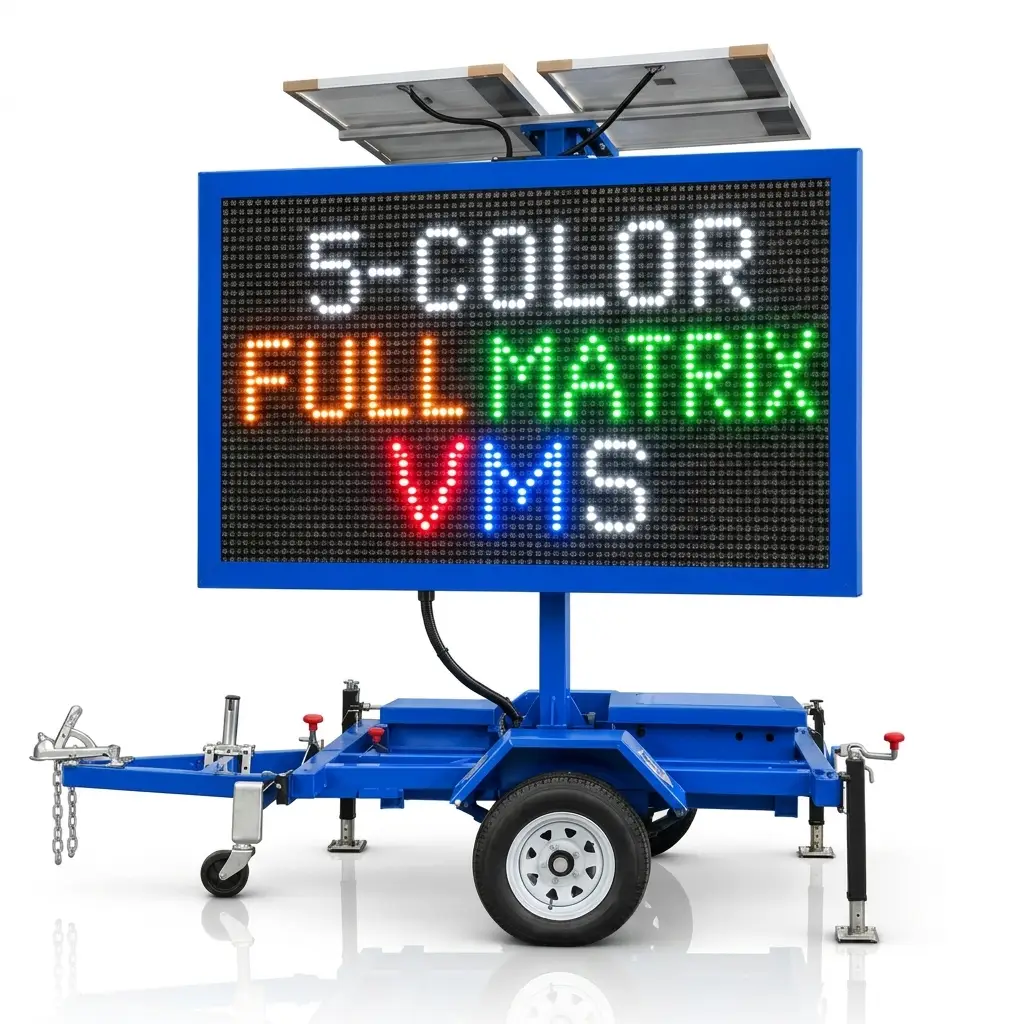
A trailer unit carries its own power, mast and running gear, so it needs no trench and no mains connection. Setup takes minutes: level the legs, raise the mast, unfold the array, confirm the message. Trailers dominate work zones, which makes Trailer-Mounted Variable Message Signs the usual entry point for a first purchase or a rental fleet.
Vehicle-mounted and truck-mounted boards
Boards on service patrol and incident response vehicles trade display area for arrival speed. The MUTCD allows letters as short as 10 inches there, because the vehicle sits close to the queue.
Power: solar and battery versus a generator
Solar and battery sizing decides whether a board holds a message through a cloudy week. Arrays are sized against the worst month, the duty cycle and the depth of discharge the battery tolerates. Units such as the Solar-Powered Mobile Changeable Message Sign are bought on array and battery figures rather than panel size.
A generator earns its place under a bridge deck, in tree cover, or on a winter deployment where the array cannot recover the daily draw. The trade is noise, fuel and service intervals, so many fleets keep one generator unit for shaded work.
Control and message scheduling
A controller decides who may change the number and which values they may enter. Entry units use a keypad and a fixed library; networked units take cellular or radio commands and speak NTCIP. Most controllers include a message generator that builds a compliant three-line message from a few fields, which keeps hand-typed text inside the character limits.
| Format | Typical deployment | Power | Best fit |
|---|---|---|---|
| Fixed gantry or post-mounted cabinet | Corridors, tunnels, bridge approaches | Mains with battery backup | Permanent variable speed limit systems |
| Trailer-mounted board | Work zones, events, hazard messaging | Solar array with battery, or a generator | Moving restrictions, rental fleets |
| Truck-mounted board | Incident response, short closures | Vehicle power with auxiliary battery | Service patrols, maintenance crews |
What variable message signs cost, and whether to rent
A trailer board costs a fraction of a gantry, but the spread inside each format is wide, and rental usually beats ownership when deployment is measured in weeks rather than months.
Published UK supplier ranges checked in November 2026 show the shape of the market: a single-zone car park sign at £800 to £1,500 supply only, a portable roadworks trailer at £5,000 to £15,000, hire from around £150 a week, and a motorway gantry at £30,000 to £80,000. North American listings for portable trailers sit in a similar band, from roughly $5,000 to $8,000. Treat these as market ranges, not quotations.
What moves the price
Six variables explain most of the cost gap between two boards of the same footprint. Matrix type comes first: a panel that draws arrows and graphics costs more than fixed character cells. Colour comes next, because a full-colour panel carries roughly three times the LEDs of an amber one, which is why units such as Colour Full-Matrix Portable VMS sit at the top of the range. Character height sets panel area, power follows the duty cycle, and certification and freight decide the landed price.
Buy versus rent
Rental bundles delivery, setup, recovery and fault replacement into a weekly rate, which suits a fortnight-long closure. Ownership suits a fleet that moves one unit between sites, because the trailer becomes a fixed cost rather than a line on every job. The comparison should include what never appears on a quotation: battery replacement, servicing, calibration, storage, insurance and towing labour.
Frequently asked questions
Can a VMS show a limit higher than the posted limit?
It should not. European guidance is explicit that a VMS must never display a limit above the fixed sign on the same stretch, and most agency specifications repeat the rule. A higher number is usually a controller fault, or a message left from a corridor whose static signs were removed.
Do you need permission before a board shows a speed limit?
On a public road, yes. A contractor cannot set a limit on its own authority: the number comes from the traffic control plan, and the plan is approved by the agency with jurisdiction. Where the field number departs from the plan, the change is a plan revision rather than a field decision.
Can a solar unit hold a speed display through winter?
It can if the array and battery were sized for the worst month rather than the annual average. Winter cuts yield through shorter days, low sun angles and snow cover, while a speed message at high brightness draws more than parking guidance. Ask for the winter duty cycle in writing, and keep a generator option for shaded sites.