A work zone changes by the hour. A lane closes at nine, reopens at noon, and shifts again after the evening peak. Static signs can’t follow that schedule, which is why road agencies now pair conventional devices with electronic boards that can be rewritten from a phone. Knowing which device does which job is the difference between a traffic plan that holds and one drivers quietly ignore.
The four traffic control devices are signs, pavement markings, traffic signals, and channelizing devices. Signs set the rule, markings show where the lane runs, signals assign the right of way, and channelizing devices physically steer vehicles away from a hazard. Electronic message boards are signs rather than a separate category, and they follow the same design rules as any other sign on the road.
The four categories look simple on paper. The difficulty starts when you have to choose a device for a specific road, speed, and budget.
What counts as a traffic control device
A traffic control device is any sign, signal, marking, or other device placed on, over, or beside a road by the agency that owns it, to regulate, warn, or guide traffic. The definition is functional, not physical. If it changes how someone drives, it counts.
A cone counts. A painted line counts. A gantry-mounted display counts. A billboard does not, because it sells something instead of directing movement.
The Manual on Uniform Traffic Control Devices, usually shortened to MUTCD, sets five principles that any device has to satisfy. It has to fulfill a need, command attention, convey a clear and simple meaning, command respect from drivers, and give them enough time to respond. Those five tests explain most of the arguments that come up on site. A board placed too close to a taper fails the last one. A message with four ideas on it fails the third.
The four traffic control devices
Signs, markings, signals, and channelizing devices cover four different jobs: informing, locating, allocating, and containing. A permanent road uses all four at once, and a work zone usually adds a temporary version of each.
| Device | Main job | Where it appears | Permanent or temporary |
|---|---|---|---|
| Signs | Sets a rule or gives warning | Roadside posts, overhead gantries | Both |
| Pavement markings | Marks the path and its limits | Road surface | Both, often temporary tape in work zones |
| Traffic signals | Assigns right of way | Intersections, ramp meters, lane control | Both, portable units in construction |
| Channelizing devices | Keeps vehicles out of a space | Tapers, shoulders, medians | Mostly temporary |
Signs
Signs carry the rule. Regulatory signs tell drivers what they must or must not do, and they use white, red, and black. Warning signs flag a change in conditions and use yellow diamonds on most roads. Guide signs give direction and distance, and they use green, blue, or brown depending on the road type.
The dividing line that matters for procurement is static versus changeable. A static sign is printed once and mounted. A changeable sign holds a set of messages and shows one at a time, which lets the same panel warn about fog in the morning and a lane closure at night.
Pavement markings
Markings do the work that signs cannot, because they sit in the driver’s field of view instead of at its edge. Longitudinal lines separate lanes and mark the edge of the road. Transverse markings set stop bars, crosswalks, and yield lines. Symbols and words repeat a rule directly under the vehicle.
Markings fail quietly. A line that looks fine at noon can disappear in rain at night once the glass beads wear down, so retroreflectivity is checked as a maintenance item rather than a one-time installation detail.
Traffic signals
Signals allocate time and space at a conflict point. Fixed-time signals run a preset cycle. Actuated signals extend or skip a phase based on detected demand. Pedestrian phases sit inside either type and need their own clearance timing.
Temporary signals appear where a work zone reduces a two-lane road to one shared lane. They alternate directions, and they replace a flagger only when the site has clear sight lines and the agency allows it. Portable units need a power plan, a backup, and a fallback procedure for the day the battery runs flat.
Channelizing devices and temporary barriers
This is the category that does the physical work. Cones, tubular markers, drums, barricades, and water-filled barriers all guide vehicles by occupying space rather than by asking for compliance. Arrow boards belong here too, since they direct a merge with light instead of text.
Arrow boards are classified by the road they serve. Lower-speed urban streets take the smallest panel, intermediate-speed roads take the middle size, and high-speed, high-volume highways need the largest panel because the display has to be legible from much farther back. Choosing by price instead of by speed class is one of the more common specification errors.
Where changeable message signs fit in that list
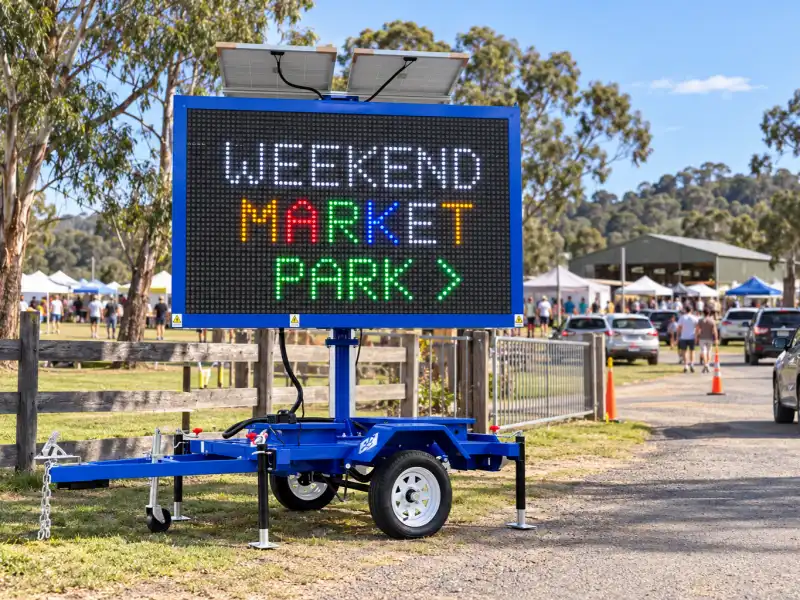
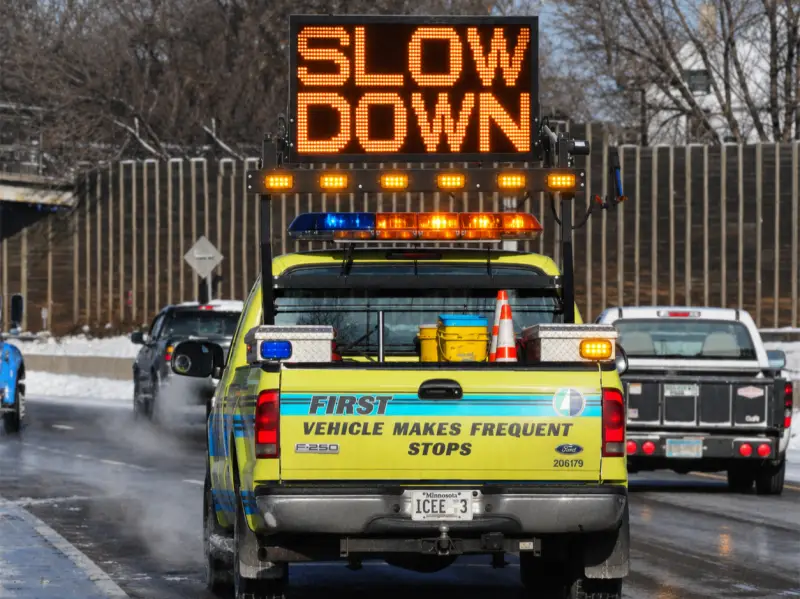
A variable message sign and a changeable message sign are the same device under two names. Portable versions mounted on a trailer or a truck bed are called portable changeable message signs, or PCMS. All of them sit in the sign family, and MUTCD Chapter 6L sets the limits on how they may be used in a work zone.
Naming varies by region and by document. European and Asian procurement tends to say variable message sign, or VMS. North American standards and most state manuals say changeable message sign, or CMS. Dynamic message sign appears in traffic management literature. The hardware is the same: an LED matrix, a controller, a power system, and a mounting structure. When a tender asks for a variable message sign board, it is asking for the physical panel and its housing, not a software product.
Work zone use is tightly defined. MUTCD Chapter 6L treats the portable sign as a supplement to conventional signs, never a replacement, and it prohibits advertising messages outright. The table below collects the operating limits that come up most often in procurement and inspection.
| Requirement | Limit |
|---|---|
| Display format | Three lines of eight characters, or a full matrix display |
| Message phases | Two at most |
| Phase timing | At least 2 seconds each, 8 seconds total |
| Letter height | 18 inches minimum, 10 inches allowed on incident response vehicles |
| Visibility | Half a mile, day and night |
| Brightness | Automatic dimming as light conditions change |
| Memory | Retained when power is lost |
| Mounting height | Bottom of the sign at 7 feet in urban areas, 5 feet in rural areas |
Portable changeable message signs
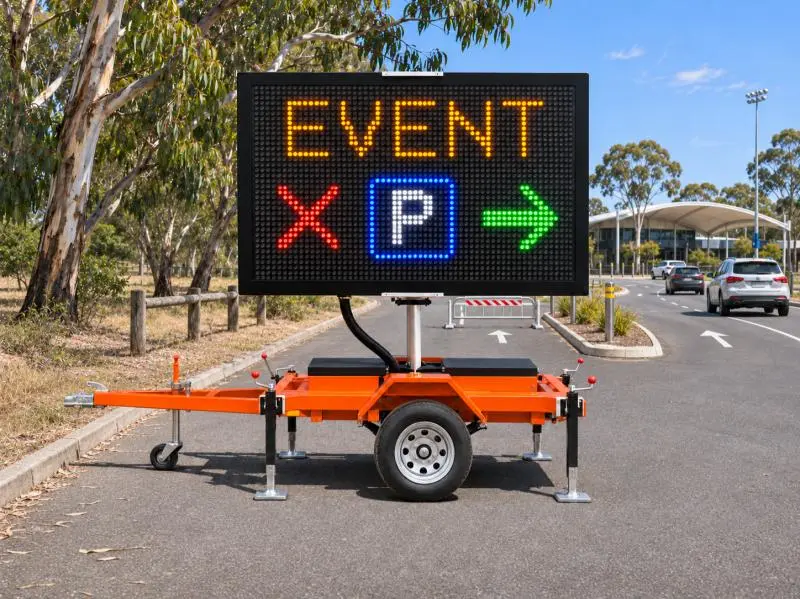
A PCMS lives on a trailer or a truck bed so it can be moved between sites. The trailer version carries its own mast, lights, brakes, and stabilising legs, which is why it costs more than a bare panel. The truck version trades that independence for faster deployment along a moving operation.
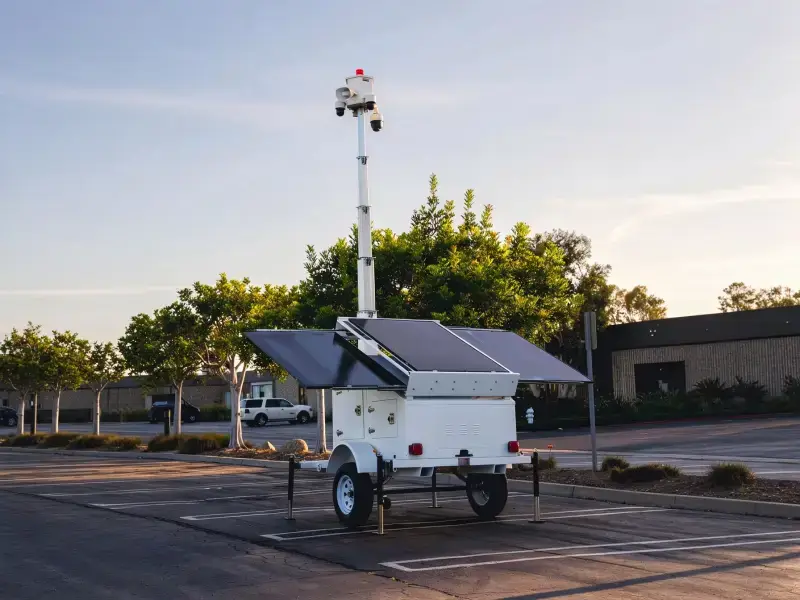
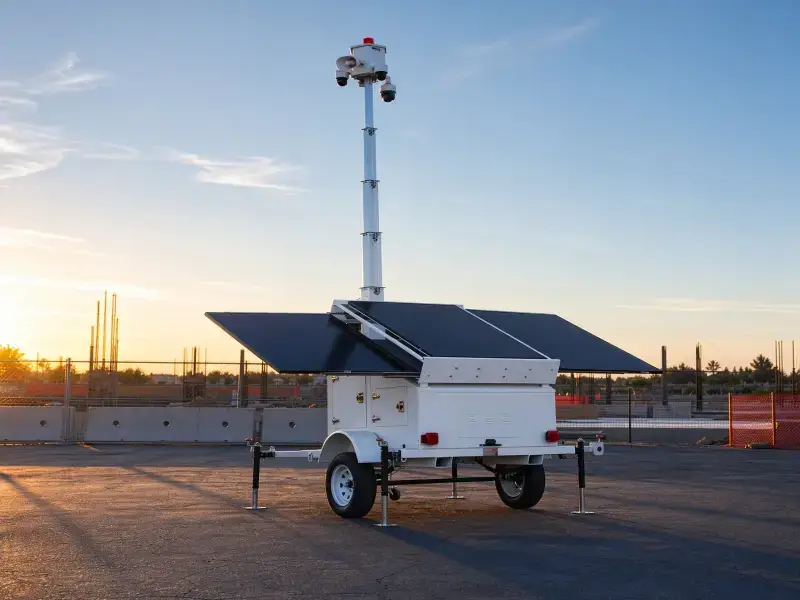
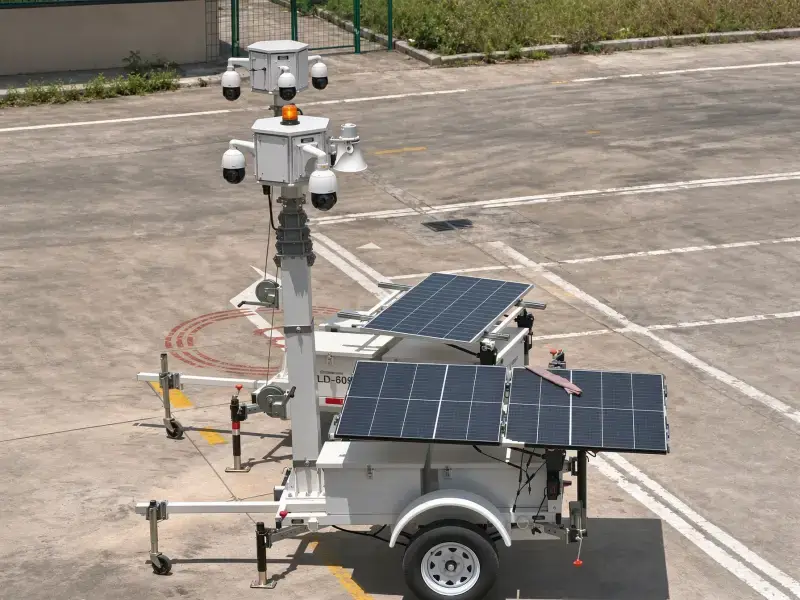
Power is the constraint that shapes most deployments. Solar panels plus a battery bank handle the common duty cycle, and a diesel generator is added when the site has long dark hours, heavy cloud, or a full-colour display running at high brightness. Trailer-mounted units with their own solar array are the default choice for multi-week construction, and trailer-mounted variable message signs in that configuration can be repositioned by one person with a suitable vehicle.
Boards that show a speed limit
A variable message sign that shows a speed limit can mean two different things, and mixing them up causes legal problems.
The first is speed feedback. A radar measures the approaching vehicle and the board displays that number, usually with a prompt like “your speed.” This is advisory. It has no legal force, and it works because most drivers slow down when they see their own number in lights.
The second is a variable speed limit. Here the displayed number is regulatory, and it changes with weather, congestion, or work activity. MUTCD Section 2B.21 covers the design of changeable signs used this way. A regulatory speed on a board needs authorisation from the road agency, correct sign colouring, and a documented policy for when each value applies. A contractor cannot post a reduced limit on a portable board just because the crew wants traffic slower.
Vehicle-mounted and compact boards
Truck-mounted and roof-mounted panels serve incident response and short-duration work, where a trailer would take longer to set than the job lasts. Compact folding units go further: they fit in a van, deploy in minutes, and suit school zones, small events, and parking control. Letter height drops with panel size, so these units belong on low-speed roads where drivers have time to read a shorter message.
What actually fits on the board
A message board gets two phases and roughly eight seconds of a driver’s attention. That buys one problem, one location, and one instruction, in three lines or fewer.
The standard structure is three thoughts, one per line. Line one names the situation ahead. Line two gives the location or distance. Line three tells the driver what to do. A message that reads “ROAD WORK / AHEAD 2 MI / MERGE LEFT” follows the pattern. A message that reads “DELAYS POSSIBLE DUE TO PAVING OPERATIONS” does not, and no amount of brightness will fix it.
Abbreviations carry the rest. The FHWA Portable Changeable Message Sign Handbook splits them into three groups: acceptable on their own, acceptable only with a prompt word, and unacceptable because drivers misread them.
| Word | Abbreviation | Note |
|---|---|---|
| Alternate | ALT | Stands alone |
| Construction | CONST | Usually followed by AHEAD |
| Emergency | EMER | Stands alone |
| Exit | EX | Followed by a number |
| Hazardous material | HAZMAT | Stands alone |
| Left | LFT | Stands alone |
| Roadwork | RDWK | Followed by AHEAD or a distance |
| Shoulder | SHLDR | Stands alone |
| Speed | SPD | Stands alone |
| Temporary | TEMP | Stands alone |
| Blocked | BLKD | Needs LANE as a prompt word |
| Avoid | Intended meaning | How drivers read it |
|---|---|---|
| ACC | Accident | Access road |
| CLRS | Clears | Colours |
| DLY | Delay | Daily |
| LT | Left | Light |
| PARK | Parking | Park |
| RED | Reduce | Red |
| WRNG | Warning | Wrong |
Three rules keep messages readable in practice. Do not invent abbreviations that are not on the approved list. Leave periods off every abbreviation. Use no more than one abbreviation per line and never abbreviate a destination or road name, since drivers cannot decode an unfamiliar place name at speed.
The controller matters as much as the wording. Most units ship with a library of pre-approved messages the operator can recall and a scheduler that swaps between them at set times, which is how a board warns about a closure during the day and parking restrictions at night without anyone driving out to change it. Animation, scrolling, and dissolving effects are prohibited under MUTCD except when a board is simulating an arrow board display.
Beyond the work zone
Outside construction, message boards carry parking status, event traffic, and site instructions. The message design rules do not change. Only the content does.
Airports and parking
An airport approach road is a sequence of decisions made under time pressure: which lot, which level, which lane for pick-up. A variable message sign airport deployment usually starts at the entry road and repeats at each garage entrance, showing occupancy, current pricing, and closures. Colour does the fast work here, with a red full indicator and a green open indicator readable before the text resolves.
Inside the terminal area, the same boards handle curbside changes, shuttle arrivals, and emergency instructions. Outside, portable units cover construction on access roads and temporary lot closures during peak travel periods, when a permanently installed gantry cannot be moved to where the queue actually forms.
Events, campuses, and industrial sites
Event traffic needs egress routing more than ingress routing, and boards placed at lot exits can split a crowd across two or three routes before the queue forms. Campuses use them for move-in days, graduations, and utility work that closes a service road for a week.
Industrial sites have their own pattern. Mine haul roads, energy sites, and large fabrication yards use portable boards for speed control, escort notices for oversize loads, and dust or fog warnings on unpaved sections. These sites often have no grid power and no fixed signage, which makes a solar trailer the only practical option.
What drives variable message sign cost
Price tracks four things: display size, colour capability, power system, and mounting. Two boards with similar screens can differ by more than the screen itself costs, because the trailer, battery, and controller carry a large share of the total.
| Cost driver | What changes | Why it matters |
|---|---|---|
| Display size and pixel pitch | Character matrix versus full matrix portable changeable message sign | Sets legibility distance at speed |
| Colour | Amber only versus full colour | Full colour adds channels, cost, and power draw |
| Power | Solar and battery, generator, or mains | Winter sun and duty cycle size the battery bank |
| Controller and connectivity | Local keypad versus cellular and network control | Remote scheduling and fleet visibility |
| Mounting | Skid, trailer, truck bed, or roof | A trailer adds chassis, mast, lights, and brakes |
| Compliance and testing | Photometric reports and regional approvals | Testing adds lead time before shipment |
| Logistics | Freight, duties, and spare modules | Long-haul shipping changes landed cost |
Rental and purchase solve different problems. A rental rate usually covers transport to site, commissioning, power, and fault response, and it keeps the maintenance burden with the supplier. Buying shifts all of that to the owner and only pays off when the board is deployed often enough to beat the rental cost. If a unit sits in the yard more than it sits on the road, rental is the cheaper route regardless of the sticker price.
Specifying a sign that will actually get used
Start from the road, not the catalogue. Speed, sight distance, and available power decide more of the specification than any feature on a datasheet.
- Match legibility distance to approach speed, not to panel size.
- Check sight distance and place the unit outside the clear zone where the site allows it.
- Set the mounting height to local requirements, typically 7 feet to the bottom of the sign in urban areas and 5 feet in rural ones.
- Size the power system for the worst week of the year, not the average one.
- Decide the control method before delivery: on-board keypad, local wireless, or remote management.
- Order spare LED modules and one spare power supply with the first unit.
- Collect compliance documents and test reports before the equipment ships, not after it lands.
- Train two operators. One person on leave should not take the board offline.
FAQ
Is a changeable message sign the same as a variable message sign?
Yes. Both describe a sign that can display more than one message. Regional usage differs, and some documents prefer dynamic message sign for permanently installed units on highways. The portable trailer version is a PCMS.
Can a message board display a speed limit?
Only within the rules the road agency sets. Speed feedback that shows a driver’s measured speed is advisory. A regulatory speed limit on a board requires authorisation, correct sign design, and a policy for when each value applies.
What power does a portable board need?
Most units run on solar panels and a battery bank sized for the local winter. A generator is added for long dark periods, heavy overcast, or a full-colour display running at high brightness. Sites with grid power can skip both.