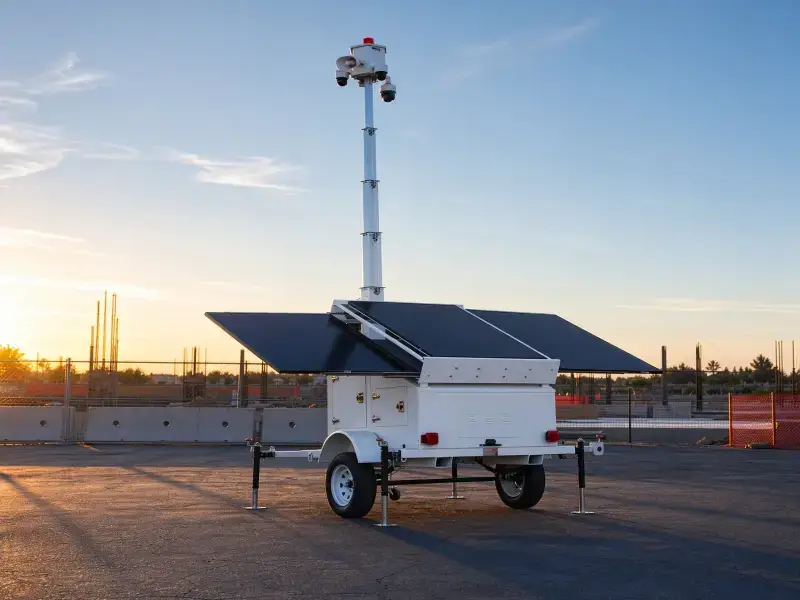
Most remote sites are not secure by default. A construction project can start months before permanent power and fiber arrive. A mine, a substation, a laydown yard, or a festival field may sit unattended for days with no router anywhere nearby. That gap is where a solar surveillance trailer CCTV system earns its place: it carries its own electricity, cameras, and recorder, and asks the site for nothing except a flat spot to park. The real question is not whether the location has internet. It is whether the system can still do its job when the connection is absent.
Yes. A solar camera records without internet, and a properly sized trailer can run on sunlight and battery power for weeks at a time. What disappears without a link is remote viewing, not recording. Video keeps writing to the onboard drive through an outage or a dead zone, while live video, phone alerts, and operator response need a cellular, satellite, or wired path off the site.
The sections below separate recording from connectivity, then match each setup to the kind of site it suits.
The Short Answer: Yes, With One Important Distinction
A solar camera works without internet because the recording happens on the unit itself. Take away the site network and you take away remote access, not the ability to capture and store video.
Two functions get confused here. Capturing and storing footage is a local job. A camera connected to an onboard recorder writes to a hard drive or memory card without an IP address, a router, or a SIM card. Power is a second, separate job. Panels charge a battery bank during the day and the system runs after dark. Sending footage somewhere else is a third job, and that is the one that needs a connection. Buyers sometimes assume a camera with no signal is a dead camera. In practice it can be recording every hour of the day and simply waiting for a drive swap or a restored link.
This distinction sets the budget too. A record-only setup costs less and has no monthly bill. A connected setup adds a data plan or a satellite service, but it can turn a detected intrusion into a phone alert or a live operator challenge while the incident is still underway.
How a Solar Surveillance Trailer Works Without Internet
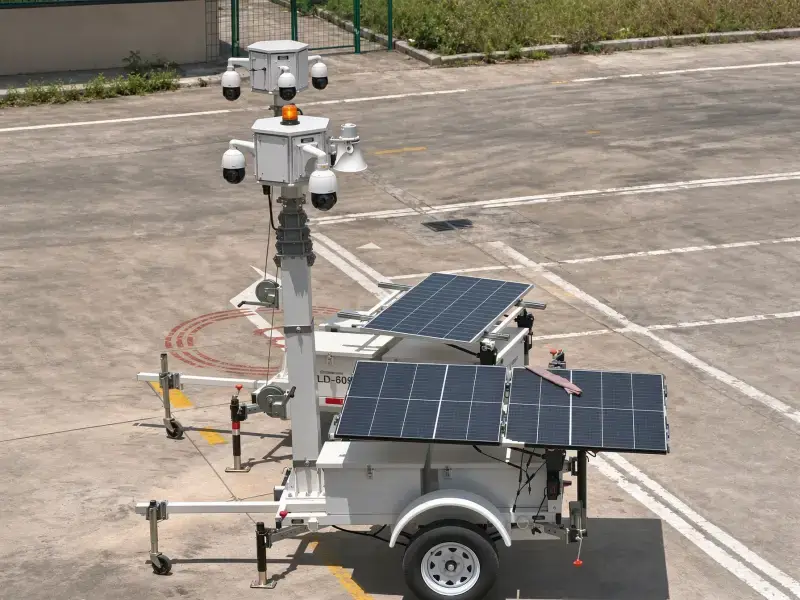
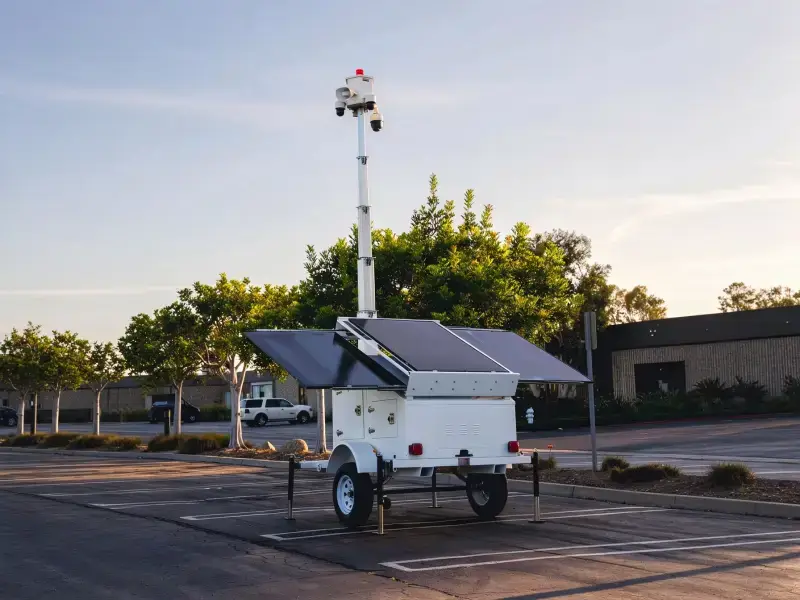
A solar surveillance trailer brings its own power, cameras, recorder, and usually a communications module, so the site contributes nothing more than a parking space.
That self-contained design gives a site four ways to handle video. Each has a different cost and a different ceiling for what an operator can do in real time.
| Path | Where the footage goes | Live viewing | Main limit |
|---|---|---|---|
| Onboard recording | Stays on the local drive | No | Someone must visit or collect the drive |
| LTE or 5G cellular | Uploaded over mobile data | Yes | Needs usable signal at the exact spot |
| Satellite | Uploaded through a dish | Yes | Clear sky and a higher service cost |
| Point-to-point or wired link | Bridged to a network elsewhere on the property | Yes | Line of sight or a cable run |
A mobile surveillance trailer camera system usually combines the first row with one of the next three. The recorder is the constant. Connectivity is the variable.
Onboard Recording and Local Storage
The recorder sits in the trailer cabinet, wired to cameras on the mast. Retention depends on four things: drive size, camera count, resolution, and whether the system records continuously or only on motion. A single camera at modest resolution can hold weeks of footage on a small drive. Four cameras at high resolution cut that window sharply. Motion-triggered recording stretches storage further, because an empty yard produces almost nothing worth saving.
Local storage has a practical advantage during network trouble. If the uplink drops during a storm, nothing is lost; the drive keeps writing. Retrieval can be physical, by swapping a drive, or remote, if a compressed clip can be pulled later when the link returns. Some setups encrypt the drive so that a stolen recorder does not hand over usable evidence.
Cellular and Satellite Uplinks
A cellular router with a SIM card behaves like a phone. It registers on the local network and pushes clips or a live stream to an app or a monitoring center. Coverage maps are only a starting point. Signal can change across a single property, so the check has to happen at the mounting height and the final position of the mast, not at the gate.
Data use is mostly a question of behavior. Continuous high-resolution streaming burns through a plan quickly. Recording full-quality video on the unit and sending only verified events, plus short on-demand live sessions, keeps a plan small. Where cell service is weak or absent, a satellite dish replaces the SIM card. The trade is cost and a clear view of the sky, but it extends the same live-view and alert functions to sites that cellular cannot reach.
Why Record-Only Is Different From Live Monitoring
A record-only unit produces evidence after an event. A connected unit can change what happens during the event. With speakers, strobes, and a live operator, a system can issue an audio warning, confirm that a person is on site, and call a guard or the police while the incident is still unfolding.
Neither approach is wrong. A remote fuel tank that is checked weekly may only need a reliable recording. An active build site with copper, tools, and machinery on the ground usually justifies live monitoring, because the loss happens in minutes and the drive is collected days later.
What Kind of Security Cameras Work Without Internet
Four options work without a site internet connection: cellular cameras, cameras with local storage, wired closed-loop CCTV, and solar trailers that pull all three ideas into one towable unit.
The right choice comes down to how much ground needs watching and how long the unit needs to stay put.
Cellular (4G/LTE/5G) Cameras
These use a SIM card instead of a router. They suit a single gate, a shed, or a far corner of a property where a mobile signal exists but a broadband line does not. The running cost is a data plan, and the main setup mistake is buying before checking signal at the exact mounting point.
Cameras With Local Storage
A camera with a memory card records independently of any network. It is the cheapest way to get footage from a place with no infrastructure at all. Viewing later means either visiting the camera or connecting a phone to the device while on site, since there is no path for remote access.
Wired Closed-Loop CCTV
Power over Ethernet runs data and power on one cable back to a recorder located on the property. No internet is required for the loop to work. This is the most stable option for a permanent facility with a fixed layout, but it loses its advantage the moment the site changes shape or the building is temporary.
Solar Surveillance Trailers
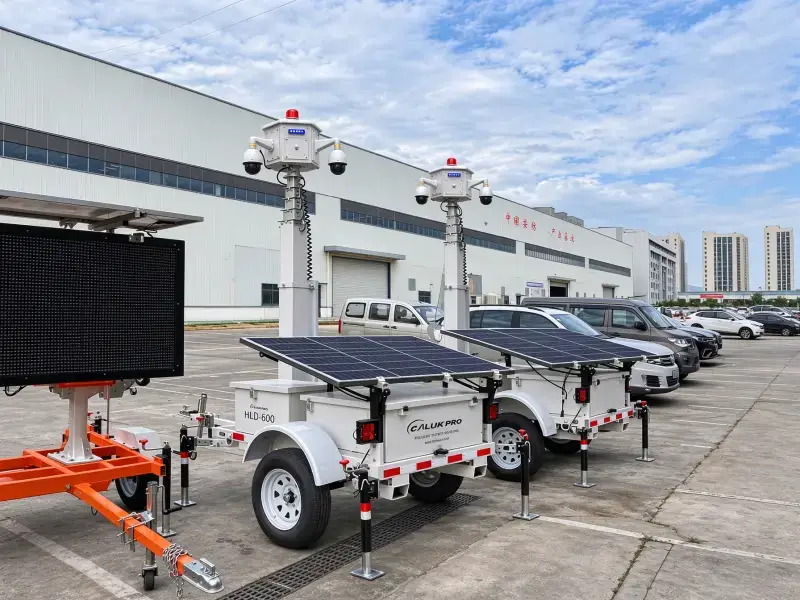
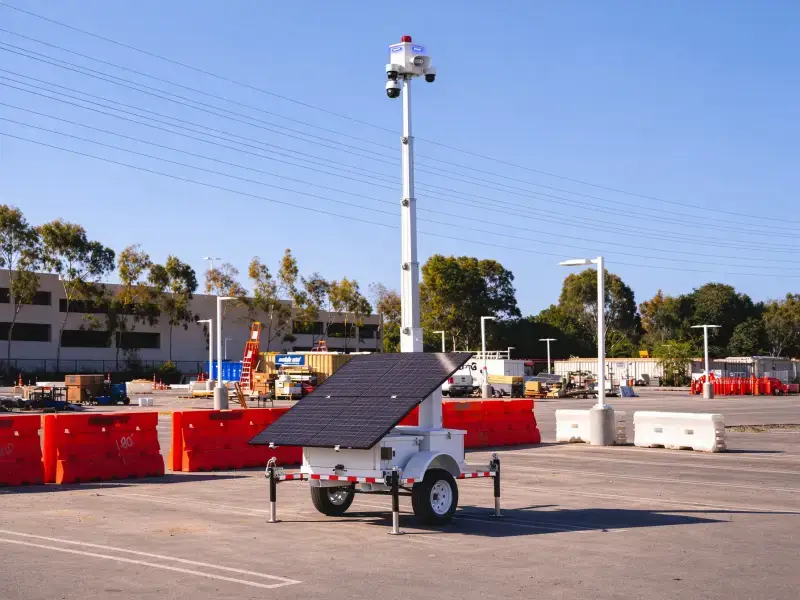
A solar CCTV trailer, also called a solar trailer CCTV unit, puts several cameras on a telescoping mast, with panels, batteries, and a recorder in the base. It moves when the job moves. That combination is why portable surveillance cameras on trailers have become common on construction sites, events, and utility work, where a fixed install makes no economic sense. An advanced mobile surveillance trailer adds AI detection, two-way audio, and active deterrents on top of the basic camera and power package.
Can You View Your Cameras on a Phone Without WiFi
Yes, provided the trailer has a cellular or satellite uplink and your phone has an internet connection of its own. The camera site does not need WiFi; the device you are watching on does.
This is the point that trips up most buyers. An app connects to the trailer over the mobile network, not over the WiFi at the site. That means a phone on 4G, 5G, or someone else’s WiFi can pull a live stream from a trailer sitting in a field with no router anywhere nearby. Without an uplink, the options shrink to local viewing on a monitor attached to the trailer or footage downloaded from the drive.
Motion-triggered clips keep the data bill modest. A system can record locally at full quality and send a short verified clip to the phone, then stream live only when someone opens the app. Two-way audio follows the same path, letting an operator speak to a person on site without being there.
Which Solar Cameras Can You Use With No Internet Connection
Match the setup to the size of the area and the value of the assets, rather than to a single product category.
| Site | Recommended setup | Why |
|---|---|---|
| Shed, gate, or one entry point | Single solar camera with local storage | Low cost and no monthly plan |
| Large or changing worksite | Trailer with four cameras and LTE | Coverage moves with the work |
| No cell coverage | Trailer with a satellite uplink | Clear sky replaces signal |
| Permanent facility | Wired closed-loop CCTV | No data fees and steady uptime |
For buyers comparing a solar surveillance trailer for sale with a mobile surveillance trailer for sale or a surveillance trailers for sale listing, the useful question is what happens after the purchase: who collects footage, who responds to alerts, and whether the site will still be there next month. A solar surveillance camera trailer is the better fit when the location changes or the coverage area is too wide for one lens. Teams that want a system matched to a specific site often start with solar traffic safety solutions rather than a fixed catalog model.
What to Look for in an Off-Grid Surveillance Trailer
Panel and battery capacity, storage, signal at the mounting point, and mast height decide whether a trailer stays useful through a cloudy week.
A spec sheet tells only part of the story. The numbers that matter are the ones tied to the site.
Power and Battery Reserve
Panels generate power during daylight; the battery bank carries the load at night and through low-sun periods. Size the system for the shortest days and the longest run of cloud at the location, not for a summer average. Shade, dust, snow, temperature, camera count, and lighting use all change the result. An advanced mobile surveillance trailer typically carries enough reserve for several consecutive days without direct sun, but the figure only holds if the panels stay clear.
Storage Capacity and Retention
Work backward from a retention target. If the site needs 30 days of footage, multiply camera count by hours recorded per day and by the bitrate, then add room for motion events. Continuous recording at high resolution fills a drive far faster than event-based capture. Confirm whether the recorder supports drive swaps without taking the whole system down.
Signal Strength at the Exact Location
Check coverage at the final mast position and height. A weak signal can turn a live system into a record-only one without anyone noticing, which defeats the reason for buying a connected unit. Where the cellular reading is marginal, a satellite option is worth pricing at the outset.
Weatherproofing, Night Vision, and Mast Height
Outdoor housings should carry an IP65 rating or better; IP66 handles heavier water exposure. Infrared night vision keeps a site visible without drawing attention, while color night vision with spotlights gives more detail and acts as a deterrent, at the cost of a visible light source. Mast height changes what the cameras can see over fences and stacked materials, and PTZ heads let one unit cover several angles. Anti-tamper mounts matter on sites where equipment is left alone for days.
Where Off-Grid Surveillance Earns Its Keep
Temporary and remote sites gain the most, because they hold valuable assets before permanent security exists.
Early-stage construction is the clearest case. The National Equipment Register estimates that $300 million to $1 billion in heavy equipment is stolen every year in the United States, a figure that excludes tools, building materials, and the cost of project delays. A site with no power and no network is exactly where a trailer can be dropped in a few hours and moved again when the work shifts.
Mining and utility work face the same problem over larger distances, often with substations, pumps, and fuel stores spread across a property. Event grounds need coverage for a few days and nothing afterward. Vacant redevelopment sites and rural land hold scrap metal and machinery long before a permanent camera system makes sense. Many of these operations pair cameras with solar surveillance lighting trailers, since lighting improves both the recorded image and the chance that an intruder moves on.
Where a fixed trailer does not fit the pattern, a mobile surveillance vehicle carries the camera system on a truck and supports patrol-style monitoring. It covers a different niche from a parked trailer, but relies on the same rule: the cameras and recorder work whether or not the site has internet.
Frequently Asked Questions
Three questions come up repeatedly when buyers compare an off-grid setup with a wired camera system.
How Long Can a Solar Surveillance Trailer Run Without Sunlight?
It depends on battery reserve and the local climate. Commercial units are commonly sized for three to seven days without direct sun, based on camera count and panel configuration. The figure assumes panels are kept clear of snow and dust and that lighting use is controlled. A unit designed for a mild climate may struggle through a northern winter, so ask for the sizing calculation rather than a single runtime number.
Does a Cellular Camera Keep Uploading When Nobody Is Watching?
Usually not, and that is by design. The recorder writes locally at full quality at all times. A motion or AI event triggers a short clip to be sent to the phone or monitoring center. Live video is uploaded only when someone opens the stream, so a camera that is not being watched consumes very little mobile data.
What Needs Rechecking After a Trailer Is Moved to a New Position?
Signal strength, camera sightlines, and lighting angles all change with a new location. Check the cellular reading at the new mast height, confirm that the cameras still show approach routes rather than just the asset itself, and look for glare or deep shadows. On a public site, also confirm that the placement is permitted and that response contacts still cover the new address.