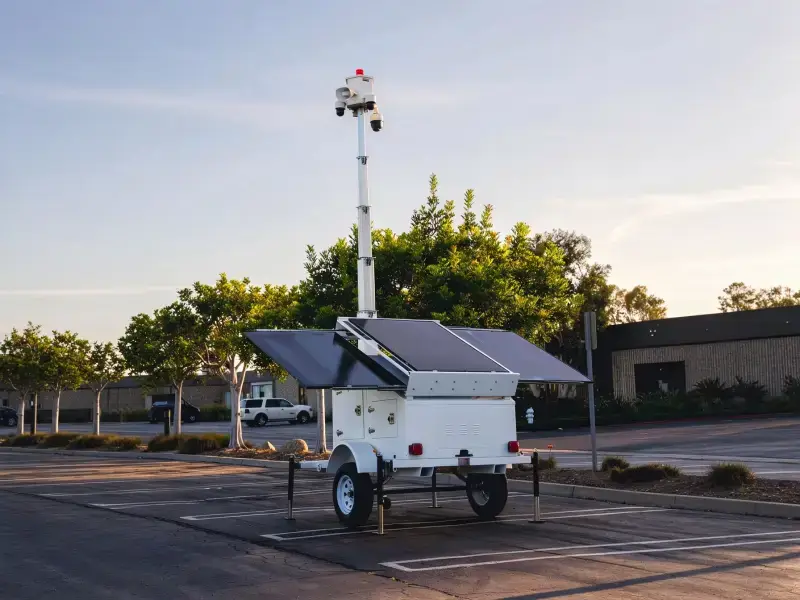
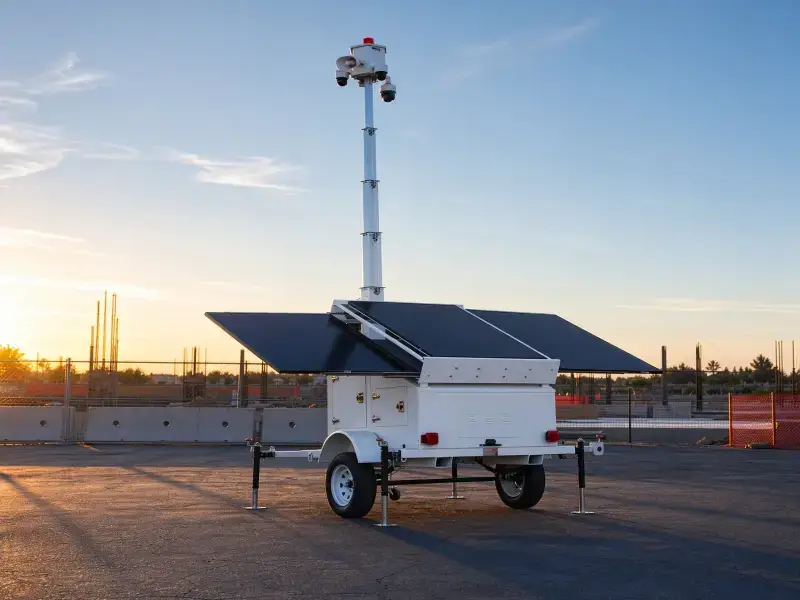
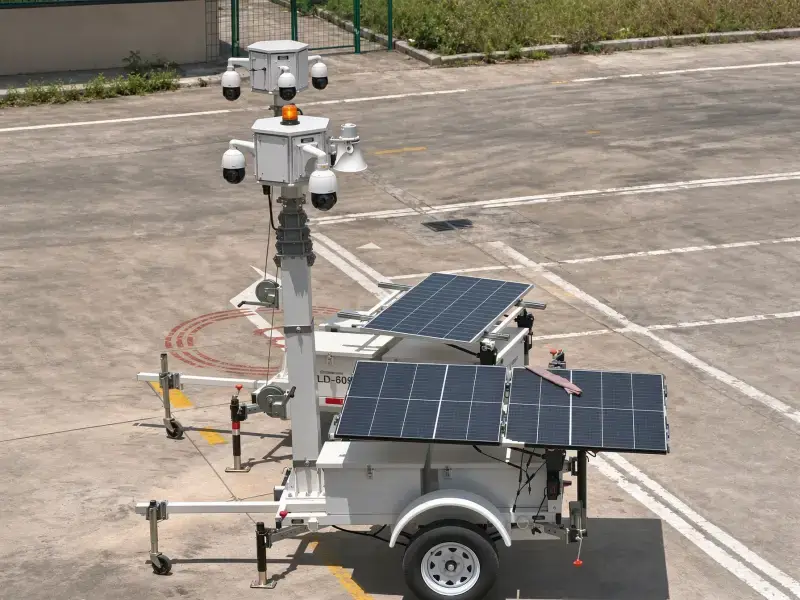
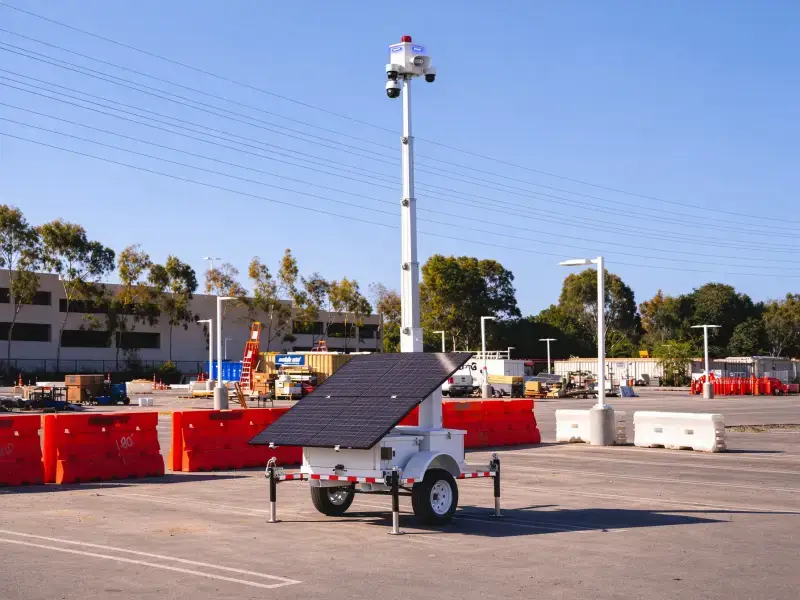
Remote sites have a problem that fixed cameras never had to solve. There is no power at the gate, no pole to mount on, and no one available to trench a cable across a muddy yard. A construction site empties out at dusk, a storage lot sits dark for weeks, and the nearest outlet is half a mile away. Units built around a telescoping mast, a battery bank, and a few solar panels have become the usual answer. Buyers then ask the obvious question: how far can the cameras actually see? They expect one number. The useful answer is a set of ranges, because noticing movement and identifying a face are two different jobs.
A solar surveillance trailer typically detects motion beyond 300 feet in good light and identifies a person or vehicle at roughly 150 to 200 feet. After dark those numbers shrink, and the exact figure depends on the lens, optical zoom, mast height, and weather.
The sections below break that answer down by task, by hardware, and by the conditions you will meet on site.
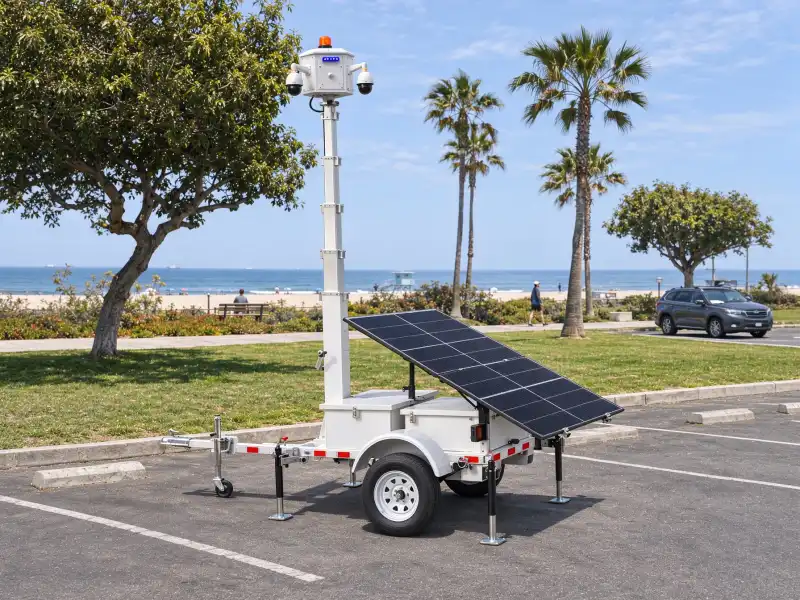
How Far Can a Solar Camera Actually See?
Distance is not one specification. The same camera may spot movement at 300 feet, recognize a familiar vehicle at 150 feet, and fail to identify a stranger beyond about 100 feet.
Installers describe camera performance in four levels of detail. The framework is often called DORI, short for Detection, Observation, Recognition, and Identification, and it comes from the international standard IEC EN 62676-4. Each level needs more pixels on the subject, so each one cuts the distance at which the footage stays useful. A moving shape is easy to catch at long range. A face that holds up as evidence is not.
Detection, Recognition, and Identification Are Different
The table below shows how the four levels translate to a typical trailer setup with a PTZ camera on a mast of 20 to 30 feet. Treat the distances as planning figures, not guarantees. Lens choice and site conditions move them in either direction.
| Level | What the image lets you do | Pixel density on target | Typical trailer range |
|---|---|---|---|
| Detection | Confirm that a person or vehicle is present | 25 px/m (8 px/ft) | 300+ ft |
| Observation | See direction of travel, clothing, general activity | 62.5 px/m (19 px/ft) | 200-300 ft |
| Recognition | Tell whether the person is someone you know | 125 px/m (38 px/ft) | 150-200 ft |
| Identification | Describe a stranger or read a plate | 250 px/m (76 px/ft) | 60-150 ft |
A fixed 1080p camera mounted at ground level tells a different story. It may detect a person around 100 feet away, observe general activity near 50 feet, recognize a familiar face near 30 feet, and identify a stranger only inside 10 to 15 feet. The gap between the two setups comes from height and optics rather than anything else. Lifting the camera above head height flattens the angle to a distant subject, and optical zoom fills more of the frame with that subject. That is the main reason a solar surveillance trailer covers more ground than a wall-mounted camera of similar resolution.
Typical Ranges by Task
Different parts of a site ask for different levels of detail. Matching the task to the range keeps you from buying more camera than you need, or less than the job requires.
| Area to watch | Practical distance | Detail needed | Usual setup |
|---|---|---|---|
| Perimeter fence or open boundary | 200-300+ ft | Detection | Wide camera, elevated mast |
| Gate or entry lane | 60-120 ft | Recognition | Varifocal or PTZ |
| Parking lot | 100-200 ft | Observation to recognition | PTZ with optical zoom |
| License plate at a driveway | 60-80 ft | Identification | Dedicated plate camera, narrow view |
| Door, office, or equipment cage | Within 30 ft | Identification | Fixed high-resolution camera |
A solar surveillance camera trailer works best when you stop asking one camera to do every job. A wide camera holds the whole scene together, while a PTZ unit swings in to read a plate or a face at a choke point. Buyers comparing solar cctv trailer options often focus on the longest advertised range, but the useful question is what you need to prove at the far edge of the site.
What Affects the Range of a Solar CCTV Trailer?
Focal length, optical zoom, sensor resolution, and mounting position decide most of the range. Lighting and weather decide how much of that range remains at night or in bad conditions.
For anyone comparing a solar trailer CCTV setup, spec sheets make this harder than they should. A camera can carry a high megapixel count and still show poor detail at 150 feet if the lens spreads those pixels across a wide field of view. The reverse also happens: a lower-resolution camera with a narrow lens can outperform it on one specific target. Understanding the trade-offs helps you read the numbers honestly.
Lens Focal Length and Optical Zoom
Focal length, measured in millimeters, controls how narrow the view is and how far the camera reaches. A 2.8mm lens gives a wide picture suited to a doorway or a small yard, with useful detail ending around 30 to 50 feet. A 4mm lens reaches a bit farther. Varifocal lenses in the 5-125mm range and PTZ units with 30x optical zoom can frame a subject 200 feet away tightly enough to recognize it.
Optical zoom and digital zoom are not the same thing. Optical zoom moves glass inside the lens and preserves real detail. Digital zoom enlarges the pixels already captured, so the picture gets bigger and blockier at the same time. If reading a plate at 80 feet matters, buy optical reach rather than relying on software after the fact.
Resolution and Pixel Density
Resolution sets the total number of pixels available. Pixel density sets how many of them land on the thing you care about. The distinction is established practice in closed-circuit television systems, where a 4K camera covering a wide lot can deliver fewer pixels on a face than a 1080p camera aimed down a single gate lane.
DORI turns this into arithmetic. Detection needs about 25 pixels per meter of target, identification about 250. Ten times the density means ten times the detail, and the camera reaches that density only inside a certain distance with a given lens. A 4MP sensor with a 12mm lens may identify a person at 100 feet, while an 8MP sensor with a 2.8mm lens may struggle past 40 feet on the same subject.
Mounting Height and Placement
Height is the cheapest range upgrade available. Raising a camera from six feet to twenty-five feet changes the viewing angle to a distant person from a shallow, ground-level glance into a clearer top-down view. Clothing, gait, and vehicle shape become easier to read, and foreground obstacles such as trucks or stacked material stop blocking the frame.
Placement still beats raw distance. Put cameras near the places that matter: gates, entry doors, loading bays, and fuel points. Cover the approach with a wide view and the exact spot with a tighter one. A solar cctv trailer can be repositioned as work shifts across a site, which fixed wiring cannot do. Move the mast twenty feet and you may solve a blind spot that no lens upgrade would have fixed.
Weather and Ambient Light
Fog, heavy rain, and snow scatter light and wash out contrast. Reflective surfaces such as white walls or water can bounce infrared back into the lens and ruin a night image. Heat shimmer over asphalt blurs fine detail in summer. None of these show up in a spec sheet, yet all of them shorten real range. A site survey at the hour you actually need footage tells you more than a catalog.
How Far Can Solar Cameras See at Night?
With infrared LEDs and a mast, most trailer cameras identify people at 100 to 200 feet in full darkness and detect motion beyond that. Night range is always shorter than daytime range, and illumination distance is longer than identification distance.
Night vision changes the math. The camera records light the human eye cannot see, usually in black and white, and the quality of that image depends on the LEDs, the sensor, the lens, and whatever ambient light the site already has.
Infrared vs Color Night Vision
Infrared night vision uses LEDs that emit wavelengths invisible to people. It works in complete darkness and stays discreet, but the footage is monochrome, so clothing color and paint color are lost. Color night vision uses spotlights, streetlights, or a low-light sensor to keep color information. It helps when you need to describe a vehicle or a jacket, though it depends on some usable light being present.
Thermal imaging detects heat rather than reflected light and can pick out a person through light fog or brush. It costs more and shows less fine detail, so it usually appears on specialized sites rather than general-purpose trailers.
Why IR Range Is Not Identification Range
A camera rated for 300 feet of infrared illumination lights an area 300 feet away. That does not mean a face at 300 feet is readable. Identification still needs roughly 250 pixels per meter on the subject, and distance, focal length, and motion blur all work against it. In practice, a trailer camera might illuminate 300 feet, observe activity at 200, and identify a person at 120.
Battery capacity decides whether that performance lasts all night. A typical setup runs five to seven days without direct sun, assuming normal recording and transmission. Cold weather reduces battery efficiency, and running floodlights or analytics draws more power, so size the bank for the worst week rather than the average one.
Are Solar Surveillance Cameras Worth It?
For a remote, temporary, or off-grid site, a self-powered unit is usually worth it because it removes trenching, poles, and grid connection while staying reusable on the next job.
The value shows up where permanent infrastructure does not exist. Construction sites lose tools and copper after hours. Vacant buildings attract dumping and squatting. Outdoor events need eyes on parking for a few days and then nothing for a year. Farms, solar fields, and utility yards sit far from a power line. In each case, a solar surveillance trailer for sale represents one asset that moves with the risk instead of a fixed installation tied to one address.
Compare the alternatives. A wired system needs a trench, a power run, and a network drop before the first camera goes up. A security guard covers one area at a time and costs every night. An advanced mobile surveillance trailer, sometimes described as a mobile surveillance vehicle, arrives on a lowboy, goes up in minutes, and sends alerts over cellular to whoever is monitoring. Buyers comparing surveillance trailers for sale should look at runtime and lens choice before price.
There are limits. A site with reliable grid power and a permanent building may be better served by fixed cameras. Heavy tree cover blocks both sunlight and the camera view. Long stretches of cloudy weather shrink runtime, and cellular coverage is not universal. Check these before committing.
Some units pair cameras with floodlights on the same mast, sold as solar surveillance lighting trailers. The light extends usable color detail at night and acts as a deterrent, though it draws extra power and can disturb nearby neighbors.
How to Extend the Range of a Solar Surveillance Trailer
Raise the mast, favor optical zoom over digital zoom, pair a wide camera with a tight one, add light where detail matters, and keep the lens clean.
A few adjustments change the effective range more than buying a new camera does:
- Raise the mast to its safe maximum. Twenty to thirty feet clears most foreground clutter and improves the viewing angle. Watch the wind rating and stabilize the unit before extending it in exposed areas.
- Set the lens for the task. Use a wide focal length for overall coverage and a longer one, or a PTZ, for the gate or plate reader.
- Add controlled lighting at choke points. A low-power floodlight near an entry gives color detail without lighting the whole site. Pairing it with a solar light tower keeps the area usable after dark when the panels have stopped producing.
- Position the trailer 20 to 150 feet from the area you need to see, then rotate the mast rather than towing the unit again.
- Clean the lens and the panels. Dust, salt spray, and bird droppings cut both image quality and charging output.
- Record at a useful stream setting. A sub-stream saved at 640 pixels destroys detail that the sensor captured. Check what the recorder actually stores.
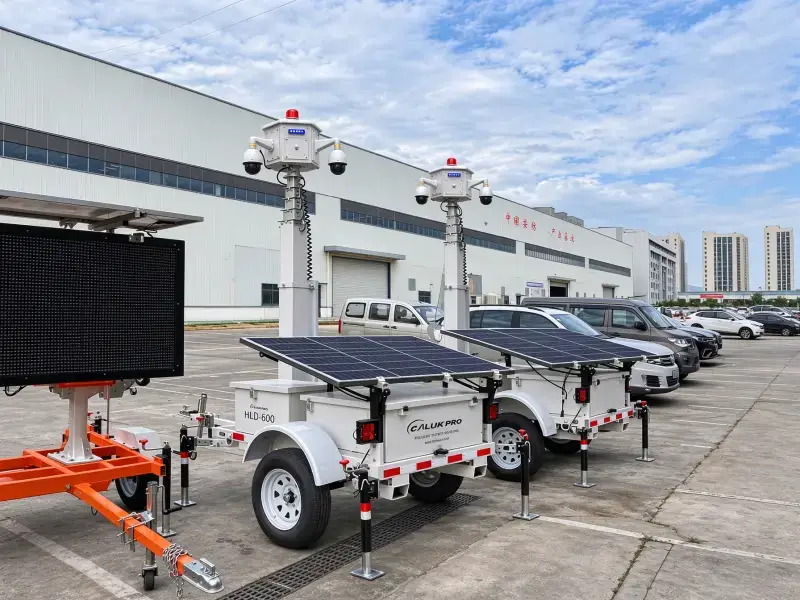
Portable surveillance cameras on trailers also benefit from a simple rule: one camera cannot cover a wide scene and identify a stranger at its far edge. Give each camera one job. A mobile surveillance trailer camera system with two or three lenses does this well, and the extra power draw is small compared with the detail gained.
FAQ
How long do solar surveillance trailers run without direct sunlight?
Most units hold five to seven days of battery power under normal recording and transmission. Panel wattage, camera count, night lighting, and temperature all move that figure. A larger array recharges faster in winter, while cold weather and constant floodlights shorten runtime.
Can solar cameras read license plates at night?
Yes, within a narrow zone. Plate cameras usually work at 60 to 80 feet with a dedicated narrow lens and controlled illumination. Headlight glare washes out ordinary cameras, so plate reading needs its own camera rather than a general-purpose PTZ doing everything.
Do solar surveillance trailers need Wi-Fi on site?
No. Most carry a 4G or LTE modem and send footage to a monitoring center or phone app over cellular. Check coverage at the exact location before deployment, since a strong signal at the office says nothing about the far corner of a site.