The tender documents describe a portable changeable message sign in one line: visible from half a mile, eighteen-inch characters, three lines. Then the trailer lands on the shoulder, a driver misses the bottom line, and the question turns practical.
A PCMS should be visible from about 2,640 feet, or half a mile, in daylight and darkness, because that is the figure the MUTCD asks for. Being read is a separate requirement. Eighteen-inch characters resolve at roughly 720 to 900 feet, and that is the distance a layout has to protect. The rest of this page separates those two numbers and shows what determines each one.
Detection distance and legibility distance are different numbers
Detection means the panel is noticed. Legibility means characters resolve into words. A board can pass the half-mile test and still leave a driver at 400 feet with nothing to read.
Section 6L.05 states the requirement as guidance: a portable changeable message sign should be visible from half a mile under both day and night conditions. The 2009 edition said the same in Section 6F.60. State specifications split the thresholds more bluntly. California requires eighteen-inch characters visible at 1,500 feet and legible at 750 feet, a two-to-one ratio worth holding against any supplier claim.
Why a panel is seen before it can be read
An LED panel makes its own light, so at 2,000 feet a driver registers a bright rectangle and nothing more. Character recognition needs angular size, and the pixels at that range sit far below it.
| Measure | Typical figure, eighteen-inch panel | What it decides |
|---|---|---|
| Detection | 2,640 ft | Whether drivers notice anything ahead |
| Legibility | 720 to 900 ft | Whether the words can be read |
| Reading time | 6 to 8 seconds | Whether they can act on them |
Tenders buy against detection because it is easier to meet, and most variable message signs clear it without effort.
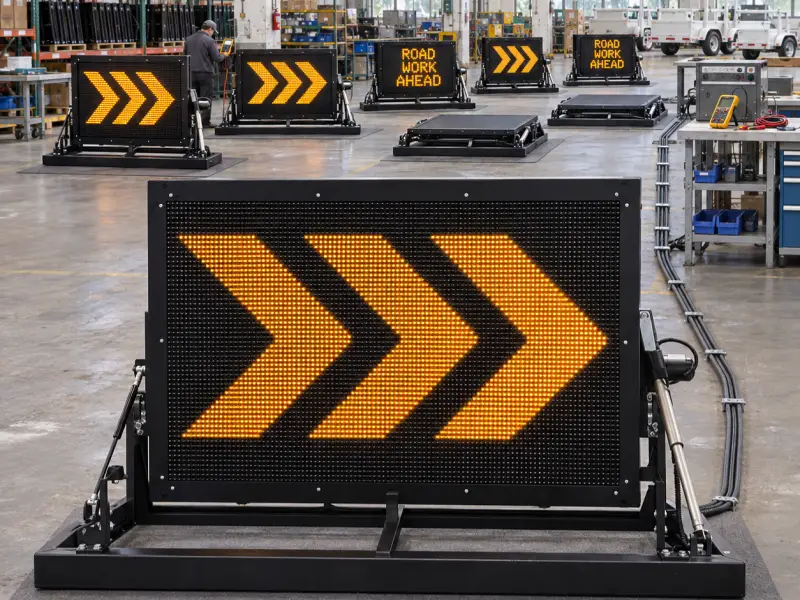
How far eighteen-inch characters actually read
Allow forty to fifty feet of legible distance per inch of character height in daylight. Eighteen inches therefore reads at 720 to 900 feet, and that is the figure to design around.
The FHWA handbook pairs character height with the speed at which a driver can still read a message twice. Eighteen inches, 720 feet, 40 mph. Twenty-four inches, 960 feet, 50 mph. The pairing is conservative: eighteen-inch boards run on 65 mph freeways daily, and the margin comes from a three-word message.
The forty-feet-per-inch rule
Legibility distance in feet equals character height in inches times forty, for daylight, positive contrast, a clean face, and ordinary acuity. A 5 by 7 uppercase matrix gives up about a fifth of the distance of a 7 by 9; rain or low sun can halve it; and a driver with 20/40 vision needs about one and a half times the distance that a 20/20 driver needs.
| Character height | Legibility distance | Speed paired in the handbook |
|---|---|---|
| 10 in | 650 ft floor | Incident response, low speed |
| 18 in | 720 ft | 40 mph |
| 24 in | 960 ft | 50 mph |
The three-line portable changeable message signs format is built around that eighteen-inch character, which is why a full-size display looks oversized for three short lines.
Reading time is the constraint that decides the number
Six to eight seconds is what a two-phase message needs to be read twice, and the legible distance has to cover the ground travelled in that time. At 65 mph that is about 760 feet before perception and reaction.
Eighteen-inch characters stay legible for roughly eight seconds at freeway speed, and each unit of information takes about two seconds. The MUTCD caps a message at two phases, each shown for at least two seconds, the pair at eight. Drivers glance rather than stare, so an eight-second exposure may yield two seconds of reading.
| Speed | Feet per second | Ground covered in 6 s | In 8 s |
|---|---|---|---|
| 45 mph | 66 | 396 | 528 |
| 55 mph | 81 | 486 | 648 |
| 65 mph | 95 | 570 | 760 |
| 70 mph | 103 | 618 | 824 |
At 70 mph, the eight-second read covers 824 feet, the top of the window for eighteen-inch characters. Nothing is left for a curve or a long message, which is the argument for eight characters per line rather than fifteen. The placement rules below come from the same source, the FHWA Portable Changeable Message Sign Handbook.
Placing the sign where that distance exists
Put it 500 to 1,000 feet upstream of a minor decision such as a lane change, at any speed. For a detour, allow 1,000 feet where the limit is 40 mph or lower, and a mile above 45 mph.
Those rules assume a straight, level approach. On a crest or curve, the sight line is shorter than the distance on the plan, so the board moves upstream until the measured sight distance clears the legible distance.
Upstream distance by decision type
| Situation | Speed | Minimum upstream distance |
|---|---|---|
| Lane change, shoulder work | Any | 500 to 1,000 ft |
| Detour, ramp closure | 40 mph or lower | 1,000 ft |
| Detour, ramp closure | 45 mph or higher | 1 mile |
| First warning sign, rural | Any | 500 ft |
| First warning sign, freeway | Any | 1,000 to 2,640 ft |
Sight lines that are shorter than they look
Keep the board closest to the lane the message applies to, behind barrier where there is one, otherwise delineated with cones or drums, and rotate it about three degrees toward the road to cut glare. The cone of vision narrows with offset, lane count, and curvature, so a board thirty feet off a six-lane arterial may hold the eye too briefly to finish line three. Incident response is harder, because a truck-mounted traffic control VMS goes wherever the truck can stop.
Height, offset, and the rural five-foot rule
The bottom of a PCMS panel sits at least seven feet above the roadway in urban areas and five feet in rural areas. Post-mounted signs differ: five feet in rural areas, seven feet where pedestrians or parked vehicles pass beneath.
Section 6L.05 makes the PCMS clearance a standard, so it is not negotiable on site. Several states also cap the top near 14.5 feet to keep the board under structures and inside a driver’s vertical field. A trailer that serves a rural highway on Monday and a city street on Friday has to meet both.
Why clearance changes the distance you get
A variable message sign board at five feet hides behind the car ahead in a queue. At seven feet, it clears a sedan but not a box truck. Beside a truck lane, height buys more than character size, and a panel at seven feet sits nearer eye level from 700 feet, which flatters contrast.
| Device | Height | Condition |
|---|---|---|
| PCMS panel, bottom | 7 ft | Urban |
| PCMS panel, bottom | 5 ft | Rural |
| Post-mounted sign, bottom | 5 ft | Rural, above edge of pavement |
| Post-mounted sign, bottom | 7 ft | Where vehicles pass beneath |
| PCMS panel, top | 14.5 ft maximum | State specifications |
A trailer-mounted amber PCMS usually ships with a mast that covers both clearances, so the only on-site question is which pin hole to use.
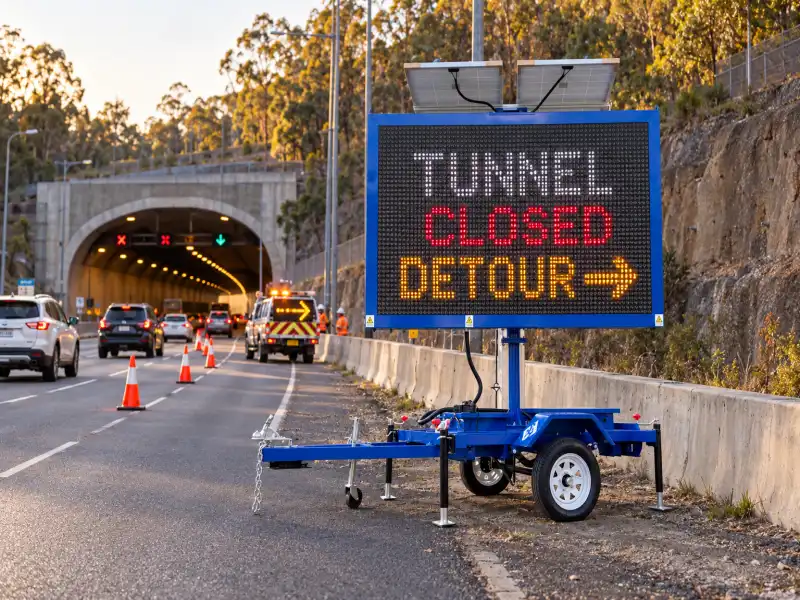
Sign spacing on the approach, and what speed limit signs do differently
The warning series steps back at 100, 350, or 500 feet by road type, and at 1,000 to 2,640 feet on freeways. Two PCMS units stay at least 1,000 feet apart on freeways and 500 feet elsewhere, which is close to the legible distance of the first board.
The advance warning series
| Road type | Distance between signs |
|---|---|
| Urban, low speed (25 to 30 mph) | 100 ft |
| Urban, high speed (35 to 40 mph) | 350 ft |
| Rural | 500 ft |
| Expressway or freeway | 1,000 ft, 1,500 ft, 2,640 ft |
The MUTCD calls these approximate. Its companion guidance is easier to apply: the first sign goes four to eight times the speed limit downstream in urban areas and eight to twelve times in rural ones. If the last sign in the series does not still leave legible distance for the message, the series must move rather than the message.
How often speed limit signs repeat
The MUTCD sets no fixed interval, only a requirement for a sign where the limit changes, at the downstream end of a zone, and beyond major intersections. Practice fills the gap. California posts 55 mph freeway limits at three-mile intervals and 65 or 70 mph at ten miles. Minnesota uses one hundred times the posted speed.
When a variable message sign (VMS) shows a speed limit, it reinforces a limit set by engineering study rather than creating one. Section 6L.05 points to Part 2 for speed displays, so characters, face, and placement match a fixed sign.
What shrinks the distance in service
Power and dimming decide whether contrast holds through a grey afternoon and a long night, and contrast decides how much of the theoretical distance survives. A right-sized board on a tired battery reads short.
| Supply | Where it fits | What it costs you |
|---|---|---|
| Solar plus battery | Remote sites, multi-week deployments, most trailers | Sizing for the shortest day, cleaning, battery replacement |
| Mains | Long-duration sites with a supply nearby | Cable, permit, theft risk, lowest running cost |
| Generator | Shaded sites, high-draw colour panels, continuous operation | Fuel, noise, refuelling labour, emissions |
On a solar board, a variable message sign generator is a backup rather than the primary supply. Automatic brightness adjustment is a requirement, not an upgrade: a board that cannot dim at night creates glare that cancels its own legibility.
Glare, weather, and message length
Low sun behind the panel can make the sign appear silhouetted; low sun behind the driver puts veiling glare on a dusty face; and over-bright night operation blooms the characters into one glow. The fix is a shorter message, not more output. Two units read at 600 feet beat four read at 900. A solar-powered mobile changeable message sign is sized on a duty cycle, so ask how many dark hours the battery covers.
Airports, terminals, and sites off the public road
A variable message sign at an airport is read at 15 to 25 mph, so a few hundred feet is enough and half a mile is wasted specification. Viewing angle, clearance above pedestrians, and a clear answer matter more.
Kerbside pick-up lanes, garage space counts, taxi hold lots, and internal detours during terminal works all run at slow speeds. At 20 mph a car covers 29 feet per second, so 300 feet of legibility gives ten seconds, more than a freeway board ever gets. Access roads open to public travel still fall under the MUTCD; service roads and aprons usually do not.
Cost, rental, and what the visibility figure does to a specification
Price follows panel area, matrix type, mast height, and power, not the distance claim. A tender asking for half-mile visibility gets a bigger panel and a taller mast, and both show up on the invoice.
Buyers ask what variable message signs cost before settling panel size, and the range is too wide to quote without a configuration. A compact board for a car park and a full-size colour trailer are different products sharing a name, so the request for a variable message sign for sale should start with road class, message length, and operating hours.
What drives variable message sign cost
- Panel area and character count, which set module count and frame weight.
- Matrix type, since full-matrix colour costs more than amber character-matrix and draws more power.
- Mounting, whether trailer with mast, truck frame, or skid.
- Power system, meaning solar array, battery bank, charger, and enclosure.
- Compliance hardware such as retroreflective border, conspicuity tape, and automatic dimming.
Rent or buy
Variable message sign rental suits one season, one event, or a duration nobody can forecast. Ownership suits a repeating programme with several sites. Both carry forgotten costs: mobilisation and return freight, battery condition, tyres, insurance, storage. Amber VMS for traffic management projects works through the trade-off.
Checking the distance in the field
Measure the approach at the posted speed rather than trusting the drawing. The sight line a driver gets is the only distance that counts.
- Drive the approach at the limit and note the odometer where the panel first reads as a bright shape, then where the third line becomes legible.
- Repeat after dark with low beams, then with a vehicle behind you.
- Park a box truck one lane over and repeat. On a busy shoulder that is the normal case.
- Tape the clearance, and confirm the board sits ahead of the first warning sign rather than between that sign and the taper.
PCMS message boards live or die on that rule: the standard message board abbreviations exist because two read faster than six.
Common questions
Is a PCMS the same thing as a VMS?
Not quite. Variable message sign is the umbrella term for any electronic sign that can change its legend, permanent gantries included. Changeable message sign is the device class the MUTCD treats in Part 2, and portable changeable message sign is the subset used in temporary traffic control under Part 6.
What is the smallest PCMS that still meets the standard?
The floor is ten-inch characters, with conditions. The board either rides on a service patrol or incident response vehicle, or it sits on a low-speed road and the message is legible from at least 650 feet. Below that you are into a different device class, such as a compact board for car parks.
Can a PCMS be used for a one-day event?
Yes, and rental is the usual route. Power is the first decision, because a solar board needs a full day of charge. Approval comes next, since the road authority wants the message and the location before the date. Content decides last: traffic, regulatory, warning, and guidance only, with no sponsor logo.