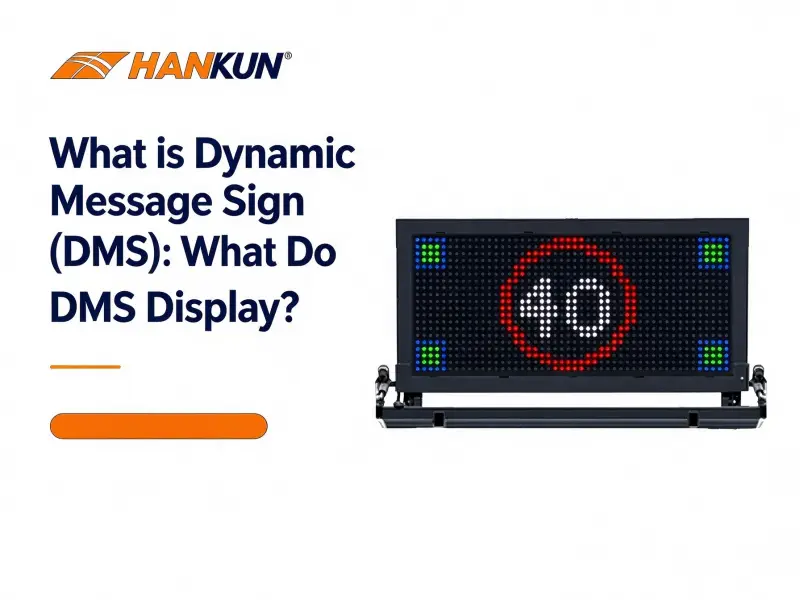
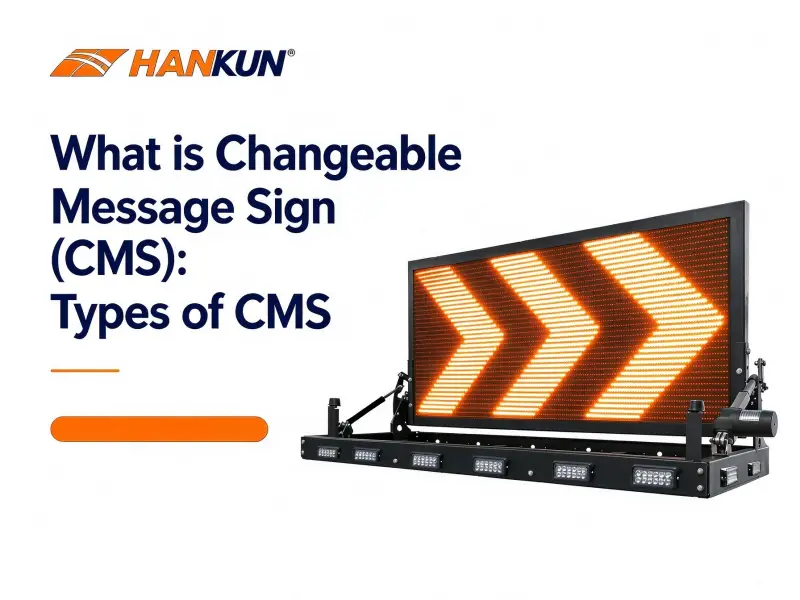
A driver at 100 km/h has about four seconds between seeing a roadside sign and acting on it. In those four seconds the useful question is not what the permanent rule is. It is what is happening on this road right now. A crash two kilometres ahead, fog sitting in the valley, a lane that closed at six this morning. None of that fits on a fixed panel.
A variable message sign (VMS) is an electronic roadside display that shows text, symbols or both, and can be changed on command from a control room, a laptop or a phone. It lets an operator tell drivers what is happening ahead, and what to do about it, while the information still matters.
The following sections cover what these signs do, what sits inside one, what they cost, and how to judge a unit before you order it.
What is a variable message sign (VMS)?
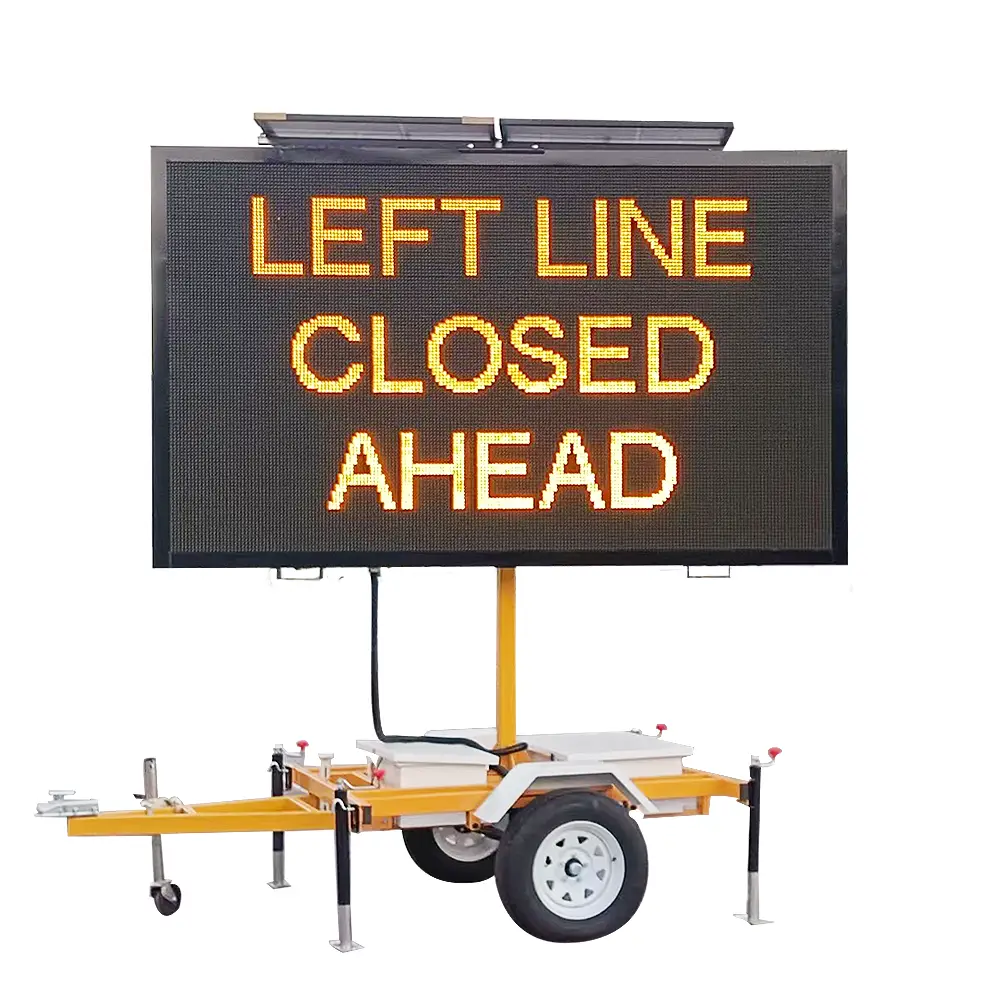
A variable message sign is a traffic display whose message can be altered remotely or on site, showing one of several stored messages or free text. Units are usually LED, and they mount above a carriageway, beside it, on a trailer, or on a vehicle.
The naming is messier than the hardware. The same device appears in North American standards and tender documents as a changeable message sign or a dynamic message sign, and portable trailer units get shortened to PCMS. Buyers also search for a variable message sign board or a message board trailer and find the same product under a different label. A three-line character matrix, an amber full-matrix panel and a full-colour screen all get sold as a variable message sign, at three different prices. A quote that does not name the display format is not yet a comparable quote.
How a VMS differs from a static sign
A static sign states a permanent fact. A VMS states a temporary condition. The same panel can warn of ice at five in the morning, hold a reduced limit at eight, and sit blank by noon.
A static sign cannot be wrong. A VMS can, which changes the maintenance model. Operators need to know the unit is alive and what it is currently showing, so self-diagnosis and message logging matter as much as brightness. A static sign also needs no power and no connection. A VMS needs both, unless a solar array and battery bank remove the first two.
What variable message signs are used for
They are used where conditions change faster than signage can be replaced: incidents, roadworks, weather, temporary speed limits, event traffic and parking guidance. The purpose is narrow. Give drivers advance warning and one specific action.
Incident and congestion management
When a lane is blocked, the queue builds faster than response crews can place cones. A sign upstream repeats the warning to every approaching vehicle, which is what reduces secondary collisions. The Minnesota Department of Transportation is explicit in its guidance for changeable message sign use that these messages should go up once an event is verified and come down once it ends, because a sign still lit after the queue clears teaches drivers to ignore it.
Work zones and lane closures
Long-term works are where a unit earns its cost. Lane shifts, night closures and changed access points can be communicated without printing new panels for every phase. The same guidance warns against the obvious shortcut: a variable sign supplements a traffic control plan, and it does not replace static signs that should exist anyway.
Urban guidance, parking and events
In cities the job changes from warning to routing. Signs point drivers to available parking, hold traffic back from a saturated junction, or sequence arrivals at a stadium. Because the message can be rewritten between the morning peak and the evening peak, one unit does the work of several fixed signs, which is the practical argument for the capital cost.
What’s inside a variable message sign board
Five parts do the work: the LED display and its drivers, a controller that stores and schedules messages, a communication link, a power system, and the structure holding it up. Most specification arguments come down to how those five are sized.
Display and legibility
Character height and pixel pitch set the reading distance, and reading distance sets everything else. A panel sized for a 60 km/h approach will be unreadable on a motorway no matter how bright it is. Three other properties decide whether the message gets read:
- Brightness that tracks ambient light, so the panel is legible at noon and not blinding at night
- Contrast and beam width, which determine whether drivers in the adjacent lane can read it at an angle
- Colour capability, from single-colour amber through three colours to full colour
European buyers will see these expressed as EN 12966 classes for luminance, contrast, beam width and colour. Ask for the class, not the certificate cover page.
Power, and the generator question
The phrase variable message sign generator gets used two ways, and they lead to different purchases.
The literal reading is a generator set carried on the trailer to charge the battery bank. It works, and it is still common on older or heavy-duty units. It also brings fuel deliveries, noise, exhaust and a service interval into a job that otherwise has none.
The second reading is software: a message generator that builds display frames, or emulates the sign so messages can be tested before they go live. That is an engineering tool, not equipment on the trailer.
For most temporary work the generator set has been displaced by solar panels and a battery bank sized for the worst month on site rather than the best one. A solar-powered mobile changeable message sign trades higher upfront cost and extra roof weight against fuel logistics and most charging failures. A unit working through a low-sun winter at heavy display duty may still need a backup charging path, which should be specified rather than assumed.
Control and connectivity
How a supervisor changes the message at two in the morning is a design decision, not an afterthought. Options run from an on-unit keypad through a phone app to a central platform using a standard protocol. Central control suits permanent networks. Local or app control suits trailers that move between sites and may sit outside reliable coverage.
Fixed, trailer-mounted, or vehicle-mounted
The mounting follows the deployment pattern, not the budget. Permanent structures serve roads that do not move. Trailers serve projects. Vehicle mounts serve fleets that already drive to the work.
| Format | Deployment | Best for | Trade-off |
|---|---|---|---|
| Fixed gantry or roadside | Installed and wired | Motorways, permanent networks | Highest capital cost, cannot be relocated |
| Trailer-mounted | Towed, levelled, self-powered | Roadworks, closures, events, long temporary sites | Needs a towing vehicle and storage space |
| Vehicle-mounted | Fixed to truck or utility roof | Rapid response, short works, moving operations | Smaller display area, tied to one vehicle |
Trailer-mounted variable message signs cover the widest range of work. They arrive charged, stand on their own legs, and leave when the job ends. Vehicle-mounted boards trade display area for speed of response, which suits incident crews and short mobile works more than multi-month construction sites.
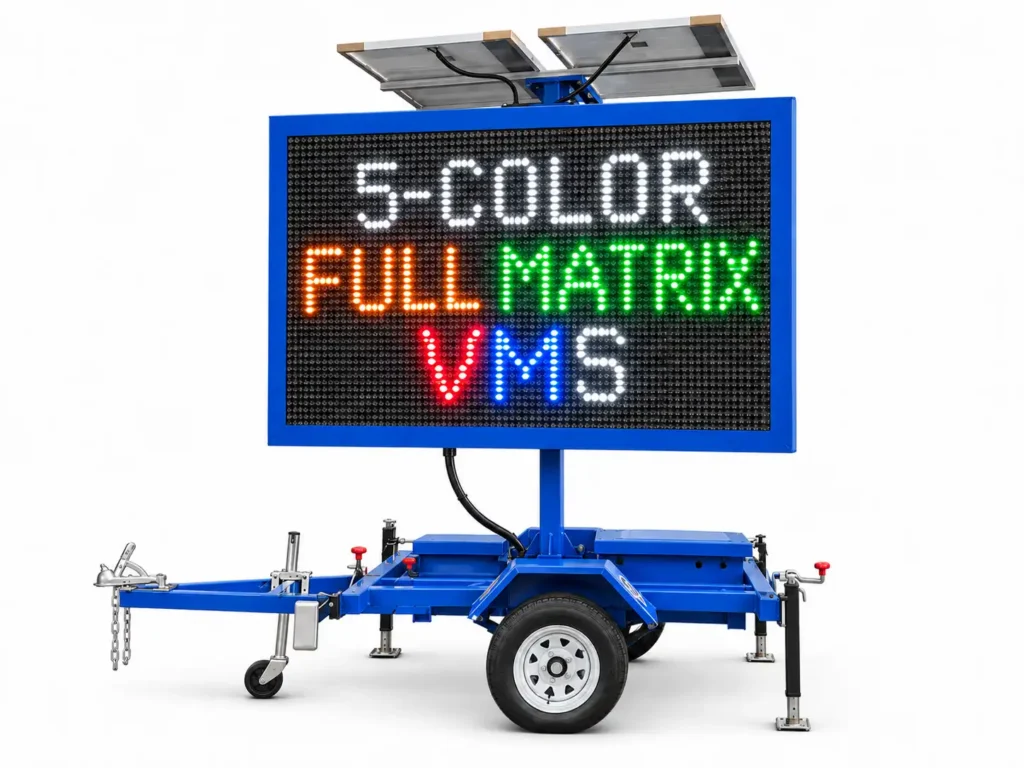
What variable message signs cost
There is no list price, because a sign is configured rather than picked from a shelf. Public supplier listings for trailer-mounted solar units generally fall between roughly $5,000 and $16,000 depending on display size, colour capability and battery capacity (supplier listings checked October 2026). Permanent gantry installations are priced per project and sit in a different bracket.
What drives the price
The order below is roughly the order of impact.
- Display area and pixel pitch. Doubling panel area moves the price more than any other single choice.
- Colour capability. Single-colour amber is the cheapest format, and full colour adds cost at every size.
- Power system. Solar array, battery capacity and charge control scale with the winter duty cycle you expect.
- Structure and trailer. Chassis, mast, levelling and wind rating are a large share of a trailer unit.
- Control and communications. A basic controller and a platform-integrated one are different products.
- Compliance testing. Tested optical classes and environmental ratings cost money to obtain and to prove.
- Volume and spares. Single units carry the full setup cost, and fleet orders spread it.
Running cost, and the honest answer on payback
Operating cost comes down to three items: energy, battery replacement and site visits. Solar removes fuel but not batteries, and battery banks have a finite cycle life that belongs in the offer rather than in a conversation two years later. Every avoided site visit is a real saving, and remote monitoring is what converts it into money.
Payback cannot be stated as a fixed number of months, and a supplier who offers one is guessing. Use the arithmetic instead: payback period equals total installed cost divided by annual savings from avoided fuel, avoided site visits, avoided reprinting and reduced incident exposure. The inputs have to come from your own project, including shifts per year, running hours, fuel or charging cost, current number of site visits, and the value you place on a closure communicated well enough to prevent a secondary crash.
What different traffic signs mean, and why the conventions matter
Road signs do three jobs. Regulatory signs state a rule, warning signs flag a hazard, and guide signs give direction. Colour carries the first cue: red for prohibition, amber or yellow for warning, green or blue for guidance, orange for temporary work zones.
A variable message sign borrows that language instead of inventing its own, and that is the point. A driver who sees amber expects a warning. A driver who sees a red circle expects an instruction. A display that uses full colour for decoration slows reading down, which is the opposite of what it is there to do.
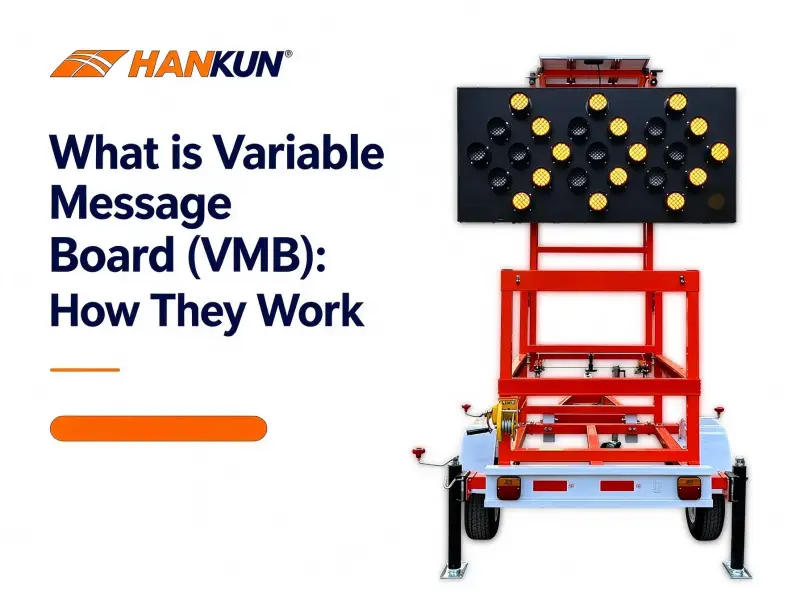
Two consequences follow. Message design is constrained, so the text has to use short words, one idea, and no abbreviations that only staff understand. And a VMS is not the same device as an arrow board. A flashing arrow board conveys a single preset pattern and cannot display text, so it is not classed as a changeable message sign at all, and it should not be used as one.
How to spec a VMS before you buy
Start from the road, not the catalogue. Approach speed, viewing distance and the message you actually need to display set the display size, and the rest follows from there.
- Work out reading distance from approach speed, then ask for the character height that meets it.
- Decide message length. One line, two lines, three lines or a full matrix each answer a different need.
- Choose colour against the use, not the brochure. Amber covers most warnings. Full colour earns its cost when you need pictograms or lane-specific instructions.
- Size the power system for the worst month on site, and ask what autonomy is quoted and at what display duty.
- Agree how messages will be changed, and by whom, at night and at short notice.
- Ask which standard the unit is tested to, and ask for the test report rather than the logo.
- Check the structure: wind rating, tow rating, levelling and mast height.
- Fix the support terms: board-level spares, replacement lead time, and who trains the crew.
FAQ
Can a variable message sign run with no mains connection?
Yes. A solar array and battery bank sized for local winter sun hours will carry a trailer unit through a normal deployment. The limit is duty cycle: a panel running bright messages for eighteen hours a day in low sun needs more battery than one running eight.
Is a variable message sign the same as an arrow board?
No. An arrow board shows one fixed pattern and cannot display text. Traffic authorities classify it separately for that reason, and it cannot stand in for a message sign on a job that needs written instructions.
Can a VMS replace static signs in a work zone?
Usually not, because it supplements them. Regulatory signs still have to be in place, and the message sign adds the real-time layer: what changed today, and what the driver should do about it.