Roadworks move. A closure opens at 7am and shifts by lunchtime. A driver reading a wrong sign at 50 mph has no time to work out that it is wrong, and no time to pick a different lane once they have committed. The gap between what the road is doing and what the sign in front of it says is the problem variable message signs were built to close.
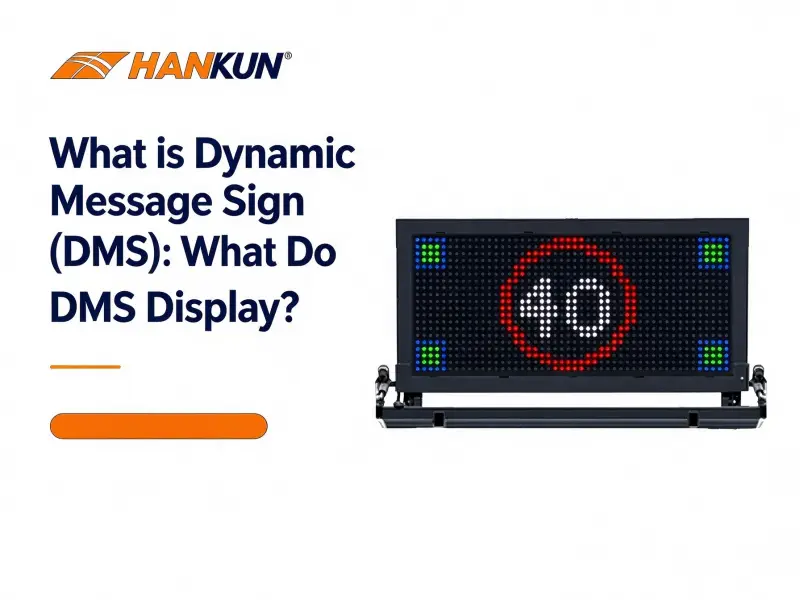
A variable message sign (VMS) is an electronic roadside display that can be reprogrammed remotely, so one board can carry a lane closure, a speed limit, a diversion and an incident warning instead of one fixed message. In the UK, a portable trailer-mounted unit typically costs £5,000 to £15,000 to buy, or roughly £150 to £470 a week to hire. Display area, colour, power and the approvals the sign has to carry set where in that range a unit lands.
What follows covers what the board is made of, how a message travels from an operator to the panel, the types worth comparing side by side, and where UK costs actually sit.
What is a variable message sign board?
A variable message sign board is a display panel built from individually addressable pixels, driven by a controller that holds a library of permitted messages. The board is the visible half of the system. The controller, the communications link and the power supply are the half that decides whether the sign still works on an unlit site in February.
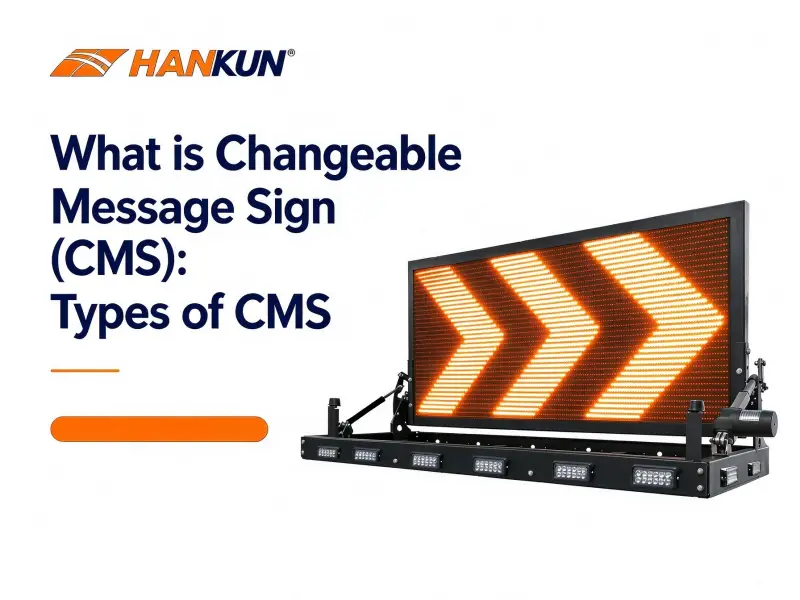
The terminology shifts by market. US practice calls the portable version a changeable message sign (CMS) or portable changeable message sign (PCMS). Dynamic message sign (DMS) appears in traffic management software. UK engineers often just say matrix sign. They all describe the same class of equipment: a panel whose content is data rather than paint.
A working unit has six parts:
- Display panel, usually discrete LEDs arranged in a pixel matrix.
- Controller, which stores messages, enforces character limits and drives the panel.
- Communications module, over 4G, Ethernet or fibre.
- Power system, either mains or a solar array with a battery bank.
- Enclosure, rated for weather and impact. EN 12966 sets a floor of IP44, and coastal or high-wash sites usually specify IP56.
- Optional sensors, such as radar or ambient light measurement.
Compared with a static sign, the difference is not just that the text changes. A static sign has to be right when it is printed. A VMS has to be right at the moment a driver reads it, which moves the cost from fabrication to power, control and compliance. The full Variable Message Signs range on this site splits along exactly those lines.
How variable message signs work, from sensor to display
The sequence is short: something detects a condition, a controller turns that condition into a permitted message, and the panel shows it. What separates one product from another is who writes the message, and where the electricity comes from.
Detection can be automatic or human. Radar measures approach speed, inductive loops and cameras count vehicles, and in most incident work an operator simply types the message. The controller then checks the message against the layout it can physically render, and pushes it out.
Two parts of that chain deserve their own attention, because they account for most of the specification arguments.
Message generation and control software
Message capacity is a property of the matrix, not of the software. A panel with 3 lines of 8 characters cannot be made to display 4 lines of 12 by a firmware update. Good control software therefore does two things: it holds a template library sized to the panel, and it refuses to publish a message the panel cannot render legibly.
Most modern controllers support NTCIP 1203, the message sign control standard that lets one management platform drive equipment from several manufacturers. Portable units typically connect over 4G with GPS position reporting, and many publish an open API or SDK so a sign can be folded into an existing fleet platform rather than run through a second dashboard.
Search traffic for a variable message sign generator splits in two, and both halves belong here. One is the software that generates the message. The other is the generator that keeps the sign alive when the sun does not cooperate.
Power: solar arrays, batteries and generators
A representative full-size trailer-mounted unit carries a 720 W solar array, two 250 Ah AGM deep-cycle batteries and an MPPT controller running 30 to 40 A. That is enough for continuous roadside operation without a mains connection or a towed generator, which matters because a generator needs fuel, servicing and someone to visit the site.
Automatic dimming is part of the power design, not a display feature. Brightness and grey level follow ambient light, so the panel draws less at night, when the battery is doing the work. On a long overcast spell, a large full-colour panel refreshing complex graphics will still outrun a modest array. That is the case where a generator or a mains feed earns its place, and it is worth settling before the trailer is ordered rather than after the first winter.
Types of variable message signs
Four comparisons decide most purchases: fixed or portable, full-matrix or character-matrix, trailer or vehicle mounted, and amber or full colour. Each one moves the price more than it moves what the sign is capable of saying.
Fixed or portable
| Fixed VMS | Portable VMS | |
|---|---|---|
| Power | Mains supply | Solar array and battery, sometimes generator |
| Installation | Permanent structure, civils and cabling | Towed in, levelled, mast raised |
| Communications | Fibre, Ethernet, cellular | Cellular as standard |
| Typical use | Gantries, tunnels, car park guidance | Roadworks, events, incident response |
| Cost shape | Capital project | Unit price plus weekly hire |
Fixed units win on uptime and message volume. Portable units win on the fact that the work zone moves, and so should the sign.
Full-matrix or character-matrix
A full-matrix panel addresses every pixel, so text, arrows and work-zone symbols share the same surface. A character-matrix panel only renders characters.
On a full-size trailer unit, a 56 by 28 pixel matrix carries 3 lines of 8 characters at 400 mm, and the same rows regrouped into 8-pixel characters reach 457 mm at the cost of a line. Character height and line count are one decision, not two, and good datasheets state them together for that reason.
Trailer-mounted or vehicle-mounted
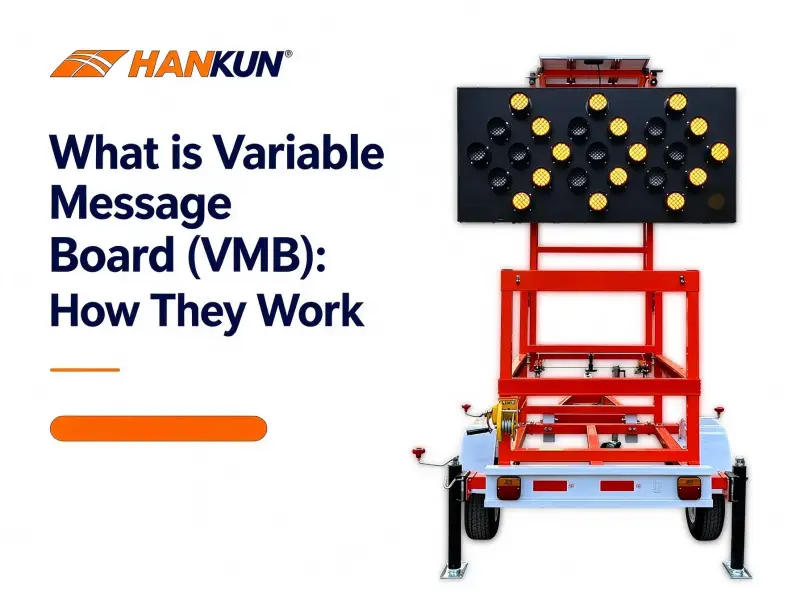
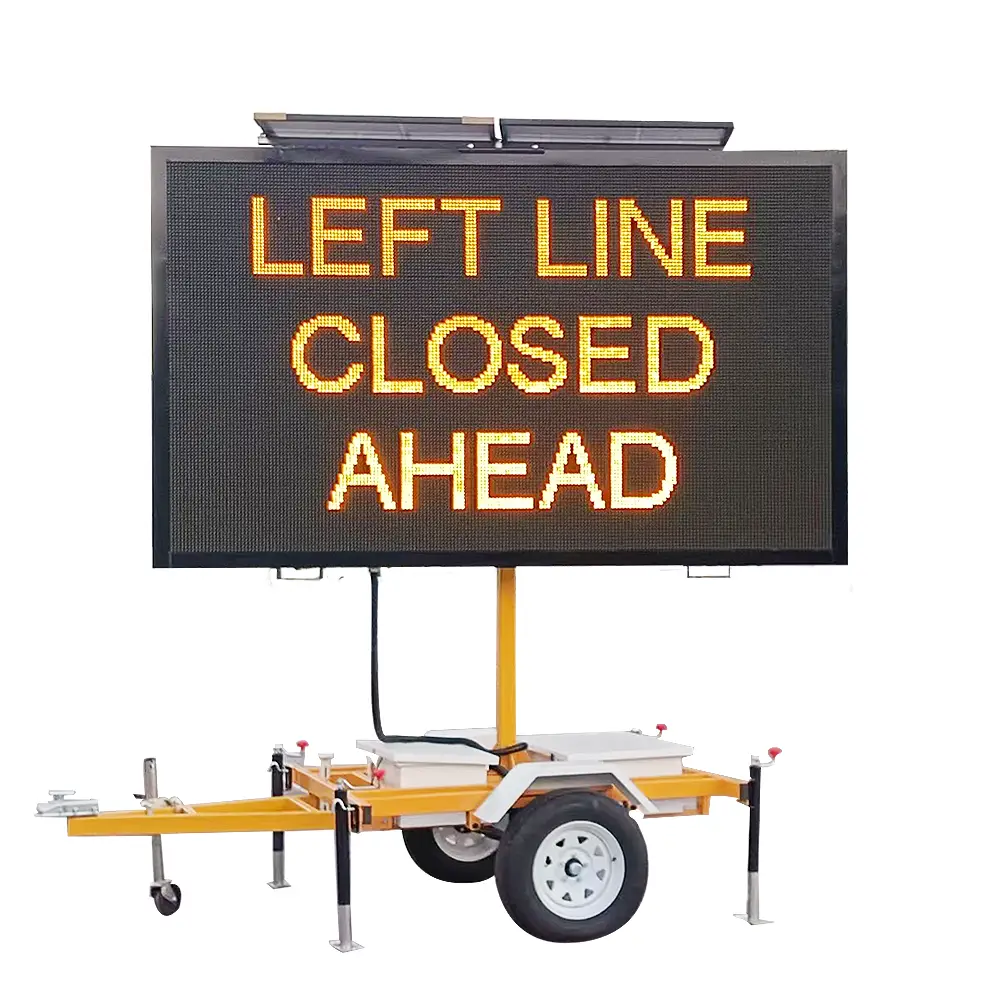
Trailer-mounted signs suit long-duration deployment. They tow behind a vehicle the contractor already runs, stand on their own outriggers, and stay put for weeks. The Trailer-Mounted Variable Message Signs category covers that configuration.
Vehicle-mounted boards suit mobile operations and short-duration work where the sign should arrive with the crew and leave with it. Truck-mounted units are usually paired with a crash cushion, because the vehicle is part of the protection as well as the messaging. The Vehicle-Mounted Variable Message Signs range covers the mounting options.
Amber or full-colour
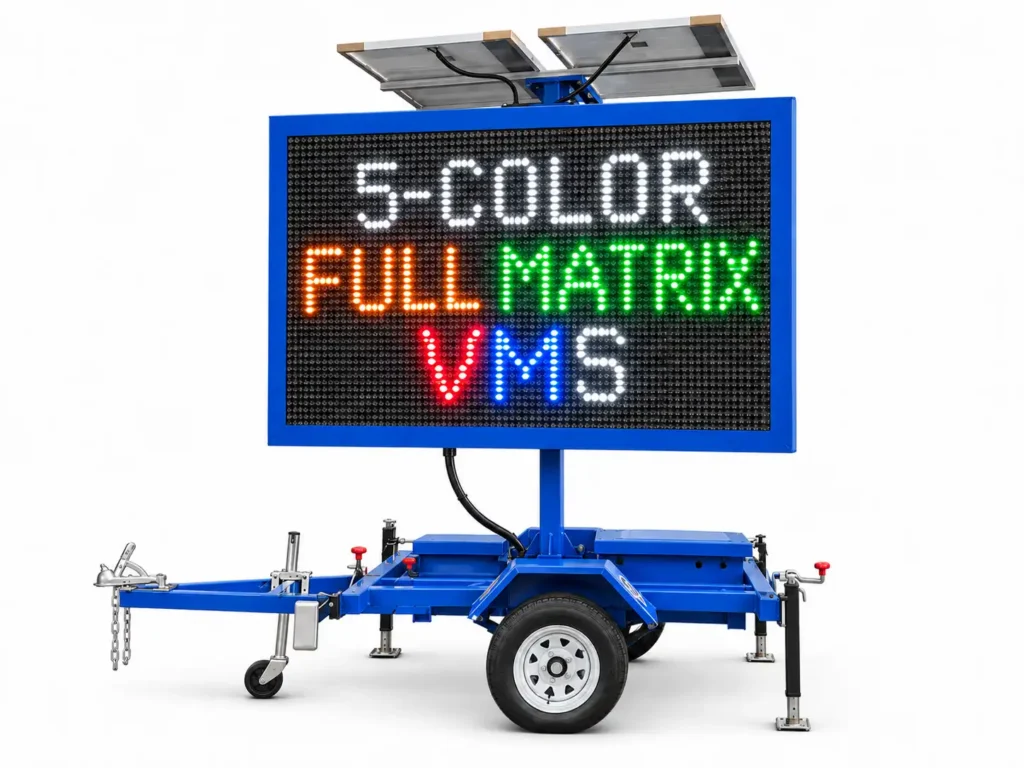
Single-colour amber panels sit in the 590 nm band, where atmospheric scattering costs less contrast than it does at shorter wavelengths. In fog, rain and low sun, amber holds up. A five-colour panel puts up to 17 LEDs in each pixel, typically 4 red, 4 amber, 3 green, 3 blue and 3 white.
Colour buys one thing: a priority layer that separates a mandatory instruction from supporting text. It costs on three lines, being power draw, battery cycling and spares. A fleet that issues one class of message usually finds amber cheaper to own. A site that has to distinguish a red closure from an amber advisory usually does not.
What variable message signs are used for in the UK
In the UK the equipment is deployed wherever the message has to change faster than a sign can be reprinted: roadworks, events, and incidents that rewrite the network within an hour.
Roadworks, lane closures and diversions
This is the core use. A board placed on the approach gives a driver the decision early enough to act on it, which is why positioning matters more than brightness. A perfect sign at the closure itself arrives too late to be useful.
Events, venues and temporary parking
Stadiums, festivals and exhibition sites use portable boards to route arrivals across several days, changing the message between build-up, event day and egress. The same units handle overflow parking and temporary access restrictions.
Incident response and temporary speed limits
Pair a board with Doppler radar and the sign becomes speed-responsive, switching to a warning when an approach exceeds the threshold set for the zone. That is how a portable unit functions as a temporary speed limit sign, and it is a configuration choice at order, not a retrofit.
What variable message signs cost in the UK
UK costs split into three lines that buyers often merge: the unit, the hire, and the permission. A purchase price tells you almost nothing about what a three-week deployment costs, and a weekly hire rate tells you nothing about what a five-year fleet costs.
Purchase price by type
UK market ranges published in March 2026 give a reasonable starting frame. These are supply figures for commercial projects, not list prices.
| Application | Unit cost, supply only |
|---|---|
| Small single-zone car park count sign | £800 to £1,500 |
| Multi-zone car park guidance sign | £1,500 to £3,000 |
| Portable roadworks VMS trailer | £5,000 to £15,000 |
| Motorway overhead gantry VMS | £30,000 to £80,000 |
A portable trailer sits in the middle of that table because it combines a display, a chassis, a solar array, a battery bank and a controller in one towable package. Larger display area, five-colour output and higher-specification chassis all push toward the top of the £5,000 to £15,000 band. Full-size amber trailer units, including the Three-Line Portable Changeable Message Signs class, are where message capacity stops being the constraint.
Hire, delivery and licence costs
Hire is the cheaper route for short work, and the published numbers are easier to pin down than purchase prices.
| Item | Published charge |
|---|---|
| Commercial VMS trailer hire | From £150 per week |
| Local authority PVMS hire | £470 per week |
| Delivery and collection | £160 per hire |
| PVMS highway licence application | Free to apply |
The council figures come from Dorset Council’s published highway charges for 2026, which also require at least 10 working days’ notice before deployment. The gap between £150 and £470 is not a pricing anomaly. It reflects the unit, the support package, and whether the hire includes the authority’s own message control.
What moves the price
- Display area and matrix. Doubling active display area is not a linear cost, because the chassis, mast and power system all scale with it.
- Colour. A five-colour panel carries up to 17 LEDs per pixel against 5 on an amber unit, which changes both panel cost and power design.
- Power autonomy. A larger array and battery bank add cost up front and remove generator hire from every week of the project.
- Communications and software. Cellular control is standard. NTCIP integration, fleet APIs and radar triggering are configuration items with their own price.
- Certification. EN 12966 type testing, and market-specific evidence for MUTCD or AS 4852.2, is a real line in the budget.
- Volume and spares. Fleet standardisation pays twice: one spare-part set, and one training path.
Whole-life cost follows the same pattern. An amber board draws less current for the same display area, cycles its battery less deeply, and needs one spare module across a fleet. Those three lines usually outweigh the purchase difference over five years.
UK rules and standards to check before you buy
On a public road in the UK, a VMS is a traffic sign before it is a product, so the legal framework comes first and the datasheet second.
The Traffic Signs Regulations and General Directions 2016 set what may be displayed and how it is sized, with x-height limits running from 35 mm to 400 mm. Traffic Signs Manual Chapter 8 turns that into practice for temporary works, sizing characters by approach speed: 62.5 mm at 30 mph, rising to 200 mm on dual carriageways at the national speed limit.
Placement on the highway also needs the highway authority’s agreement. A portable variable message sign licence is normally free to apply for, but the authority approves the message, not just the location, and notice periods run to 10 working days.
EN 12966 is the product standard behind CE marking, and it does not pass or fail a sign. It declares classes on four axes, and a tender that names only “EN 12966 compliant” has told you nothing usable.
| Axis | What it controls | Classes |
|---|---|---|
| Luminance | Daylight brightness | L1 to L3, plus tunnel variants |
| Beam width | Angular cone over which rated brightness holds | B1 to B7 |
| Colour | Chromaticity limits | C1, C2 |
| Luminance ratio | Lit to unlit contrast | R1 to R3 |
For export, the mapping changes. US projects reference MUTCD Part 6, which sets 18 in (457 mm) as the minimum letter height for a portable changeable message sign and limits messages to two phases. Australia and New Zealand work to AS 4852.2 and AS 1742.3. A sign certified for one market does not automatically satisfy another, so the destination market belongs in the enquiry.
How to specify a VMS without overbuying
Most over-specified signs are bought for a viewing distance that never existed. Work backwards from the driver, not forwards from the catalogue.
- Measure the reading distance. Character height follows from it, and everything else follows from character height.
- Decide line count and characters per line from the messages you actually intend to display, not from the longest message you can imagine.
- Choose colour on message structure. If every message is a single instruction, amber is sufficient.
- Size the power system for the worst month on site, not the best. Ask for the array, battery capacity and controller current in writing.
- Confirm the interface. If the sign has to talk to an existing platform, ask for NTCIP 1203 support and the API documentation before ordering.
- Ask for the declared EN 12966 classes, the ingress rating and the chassis specification as numbers, not adjectives.
If the deployment is short, or the site has no realistic towing access, a trailer is the wrong answer and hire is the right one. That decision comes before the specification, not after it.
FAQ
How long do variable message signs last?
LED panels degrade gradually rather than failing outright, so the practical life is set by how much brightness you are willing to lose. Ten to fifteen years is a reasonable expectation for a well-maintained unit, with individual modules replaced as output drops. The battery bank is the shorter-lived component on a solar unit and should be costed as a service item.
Can a portable VMS be used for advertising in the UK?
Not on the public highway. Signs placed under a highway licence carry messages approved by the authority, and commercial content falls outside what a traffic sign may display. On private land the position changes, but brightness, animation and placement can still be controlled by planning or landowner conditions, so confirm before booking a campaign.
Can a VMS run through a UK winter on solar alone?
Usually, if the array and battery are sized for December rather than June, and if the panel dims at night as it should. The failure mode is not darkness, it is a large full-colour panel running complex graphics through consecutive overcast days. Ask the supplier for the daily energy budget and the assumed solar yield, then check both against the site.