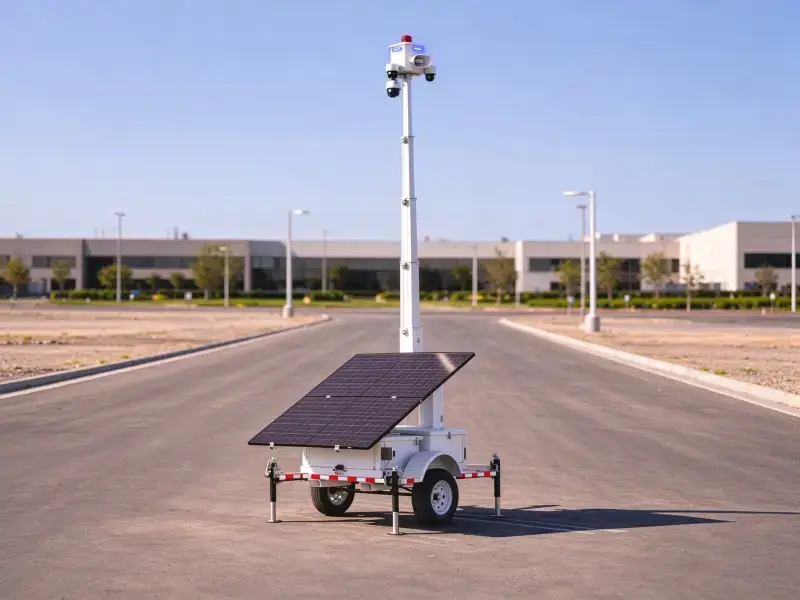
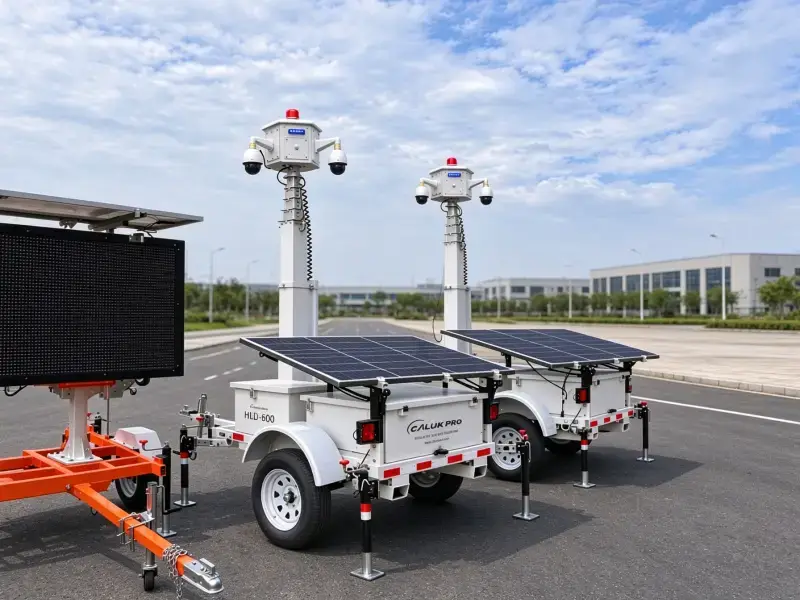
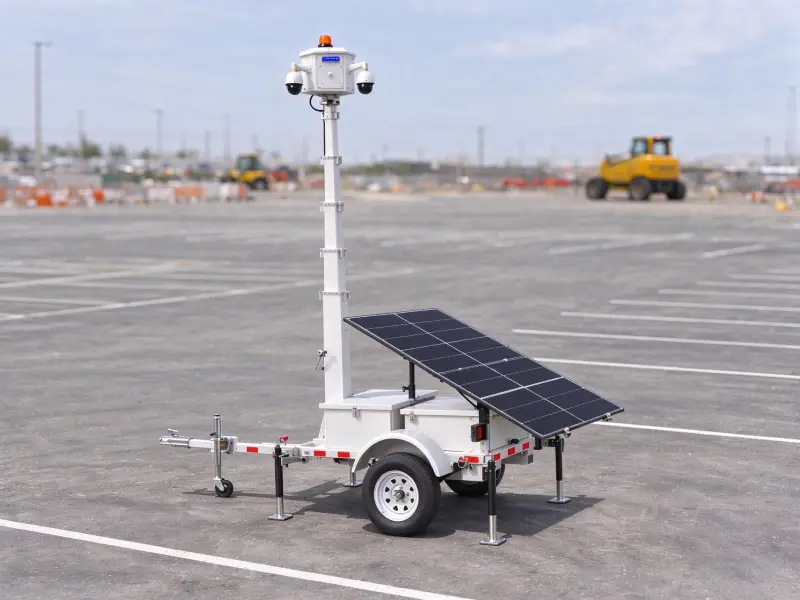
Video surveillance has become a default fixture of modern security. Industry estimates put the number of cameras in use worldwide above 1.5 billion, and the installed base keeps growing. For a construction firm, a warehouse operator, or a municipal planner, a camera is often the first tool specified. A fixed unit on a pole is only one option now: a solar surveillance trailer can put the same lens wherever the work is, without trenching power or data cables. That flexibility solves a practical problem, but it does not remove the trade-offs that come with watching people.
The main downsides are privacy intrusion, weak evidence of crime prevention, crime displacement, high lifetime cost, technical failure and hacking, a false sense of security, and uneven legal compliance. Cameras record everyone in view, not just suspects, and footage is often stored, shared, or reviewed without the consent of the people in it. Mobile and solar-mounted systems avoid some wiring and siting problems, but they inherit the same core trade-offs.
The sections below look at each drawback in turn and explain where a mobile setup changes the calculation.
Privacy concerns and the loss of anonymity
A surveillance camera records everyone who passes through its view, which means most people on the footage have done nothing wrong. That loss of anonymity is the drawback people object to most, and it applies whether the device is bolted to a wall or carried on a trailer.
Fixed cameras watch a defined area, so the same neighbours, workers, or shoppers appear in recordings day after day. Over time the footage becomes a log of ordinary behaviour: when someone arrives, who they meet, how long they stay. Operators rarely review it in real time, but the possibility that they might changes how people act in that space. Researchers call this a chilling effect. People who know they are watched tend to avoid unpopular but lawful behaviour, and the effect falls hardest on groups that already distrust authority.
Why people oppose surveillance
Opposition is rarely about the hardware itself. It comes from three specific concerns. People are treated as potential suspects until they prove otherwise, which feels like a reversal of the normal presumption of innocence. Footage collected for one purpose tends to be reused for another: a camera installed to deter theft may later be reviewed to check attendance, discipline a worker, or support an inquiry. Notice is often poor, too. A small sign near an entrance does not tell delivery staff or passers-by that they are being recorded across a wider area.
A related objection is proportionality. In public spaces, cameras point at everyone, including people who will never be suspected of a crime. Privacy commissioners in several jurisdictions have argued that surveillance should be a last resort, used only after less intrusive measures have failed. That principle is seldom applied to routine commercial security, which is why resistance persists even where cameras demonstrably reduce loss.
Who appears in the footage and how long it is kept
The people most often captured by an exterior camera are not the owners. They are visitors, contractors, neighbours, and anyone who walks past the boundary. None of them chose to be recorded, and few can ask to be removed.
Retention is the second half of the problem. Footage is typically kept for 30 to 90 days, sometimes longer, then overwritten. Short retention limits the harm but also means evidence disappears before an incident is investigated. Long retention preserves evidence but creates a larger pool of personal data to secure, search, and eventually delete. The decision is usually made by whoever buys the system rather than by the people in frame.
Security camera vs surveillance camera: what’s the difference
In practice the two terms describe the same hardware. “Security camera” is the label used for a device that protects private property, while “surveillance camera” describes a system watched over a wider area or by a third party. The distinction is about deployment and oversight, not the lens.
Retailers and homeowners tend to say security cameras. Police agencies, transit authorities, and critical infrastructure operators tend to say surveillance cameras. The second phrase carries the heavier connotation because it implies systematic monitoring rather than a simple recording device.
The same fuzzy boundary applies to the word trailer. In this industry a trailer is a wheeled platform that carries a mast, cameras, power, and storage to a temporary site. It is not a camera movie trailer, the promotional clip used to advertise a film. Search engines sometimes blend the two phrases, but the products are unrelated. A mobile surveillance trailer for sale is a piece of field equipment, and buyers should read specifications rather than assume the phrase refers to media.
Terminology matters because it affects how systems are specified. A camera described as a security device for a private yard may face fewer notification requirements than the same camera operated by a public body. Know which category applies before purchase.
Limited crime prevention and displacement
Cameras do not reliably prevent crime. Reviews of decades of studies find modest reductions in some settings and no effect in others, with the strongest results in car parks and the weakest against violent crime. Where cameras do work, they often push the problem to the next street rather than remove it.
Published findings vary more than most buyers expect. A research summary covering surveillance cameras notes reported changes in crime ranging from reductions of around 90 percent to increases approaching 20 percent, depending on location and method. That spread reflects real differences in how studies are run, not simply disagreement among researchers.
What the research actually shows
A 40-year review of CCTV evaluations found a small but consistent drop in crime, concentrated in parking facilities and residential areas. Property crimes such as vehicle theft fell more than violent crimes. The likely reason is that violent incidents are often impulsive, involve alcohol or drugs, and happen too quickly for an offender to notice a camera and change course.
Active monitoring matters. Schemes where staff watch feeds and respond produced larger effects than systems that only record footage for later review. A passive camera may help an investigation after the fact, but it does little to stop an incident in progress.
Displacement and the halo effect
Crime displacement describes what happens when an offender moves to a nearby location without cameras. A shopping centre car park may see fewer break-ins while the adjacent street sees more. The halo effect is the opposite claim: people feel safer around a camera because they assume its coverage extends further than it does.
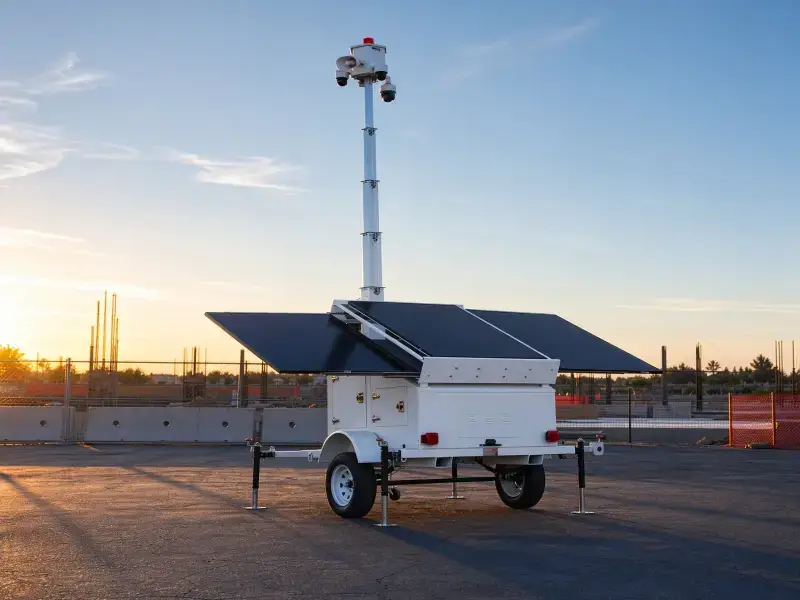
Neither pattern is guaranteed, but both are reasons to treat a camera as one part of a security plan. A fixed installation covers one patch of ground. A mobile surveillance trailer camera system can be moved when the problem moves, which is why contractors and event operators often favour them for temporary sites.
High upfront and maintenance costs
The purchase price is only the start. Cabling, mounting, monitoring staff, storage, software licences, and replacement all add up over a system’s life, and a camera that cannot be moved wastes much of that spend when the site changes.
Budget dollars for a fixed system go to four places: hardware, installation, connectivity, and ongoing operations. Hardware includes the camera, lens, housing, and recorder. Installation includes brackets, poles, trenching, and electrical work, which often costs more than the camera in remote areas. Connectivity means a data link and, increasingly, a cloud subscription. Operations cover monitoring, maintenance visits, firmware updates, and storage expansion.
Where the budget actually goes
The table below compares the main cost drivers for a wired fixed installation and a solar surveillance trailer CCTV setup. Figures are indicative and vary by region and scale.
| Cost driver | Wired fixed CCTV | Solar Surveillance Trailer CCTV |
|---|---|---|
| Power | Mains connection and trenching | Batteries and panels, no trenching |
| Installation | Pole, conduit, civic works | Set down and level, minimal ground work |
| Data | Fixed line or wireless bridge | Cellular or wireless bridge |
| Relocation | Requires reinstallation | Tow to a new site |
| Maintenance | Lens cleaning, cable faults | Panel cleaning, battery replacement |
| Storage | On-site recorder or cloud | On-board recorder or cloud |
The advantage of the trailer is not that it is cheaper every time. It is that the same asset serves several sites, so relocation cost stays low. Organizations that already run integrated solar surveillance lighting trailers often combine lighting and cameras on one unit, which removes the need to pay for a separate light tower at a night work site.
For buyers comparing a solar surveillance trailer for sale against a fixed bid, the useful question is how many locations need coverage over three years. If the answer is one, fixed wiring usually wins. If it is five or more, a movable system changes the maths.
Technical failures, blind spots, and cyber risks
A camera only sees what its lens, light, and storage allow. Poor positioning leaves blind spots, weak light destroys detail, overwritten drives erase evidence, and an exposed network connection lets strangers watch the feed.
Security teams tend to focus on whether a camera is present, not on whether it produces usable footage. Both questions matter. A high-resolution camera pointed at a gate will miss everything happening behind the gate. A wide-angle lens covers more ground but loses the detail needed to identify a face or a registration plate.
Image quality and coverage gaps
Three factors decide whether footage is useful: resolution at the subject, lighting, and angle. Low light is the most common failure. Budget sensors produce grain and smear after dark, which is exactly when many incidents occur. Infrared illuminators help but have limited range and can be defeated by glass or heavy rain.
Blind spots come from poor siting rather than poor hardware. Cameras fixed on a building corner cannot see along the wall. A trailer mast can be raised above a fence or a stack of materials, which is why temporary sites often rely on portable surveillance cameras on trailers instead of wall mounts. Coverage should be checked on site at night, not assumed from a plan.
Hacking and data breaches
IP cameras are computers with lenses. Default passwords, unpatched firmware, and open ports make them easy targets. Consumer models are frequently recruited into botnets, and cloud accounts have been abused by staff as well as outsiders. In one documented case, a major regulator ordered a doorbell maker to pay millions after employees and contractors were found to have had broad access to customer footage.
Basic controls reduce the risk: change credentials, disable unused features, segment the camera network, apply firmware updates, and encrypt stored footage. These steps apply to every system, including a solar trailer CCTV unit that transmits over cellular.
False sense of security and over-reliance
A camera records an event; it does not stop it or respond to it. Teams that treat cameras as a complete security plan tend to drop other measures, and response times can get worse when staff spend time reviewing footage instead of acting.
There is a comfortable assumption that a visible camera makes a place safe. The footage may be useful afterwards, but unless someone is watching in real time the camera only documents the loss. Deterrence depends on the offender noticing the device, understanding that it works, and believing someone will respond. Many offenders do none of those things.
Over-reliance shows up in practical ways. Guards patrol less because the cameras cover it. Locks and lighting get less attention. When an alarm fires, operators check the feed before calling anyone, which adds minutes. Reports from the security industry have linked heavy camera use to slower emergency response in some organizations.
The fix is layering. Cameras work best alongside access control, lighting, barriers, and human response. At a temporary site, a mobile surveillance trailer camera system can be paired with a patrol schedule and a lit perimeter rather than left alone to do the whole job. The camera is one input into a decision, not the decision itself.
Legal and ethical compliance
Camera rules change by country and by who operates the system. Private sites usually need only basic notice, while public bodies face stricter tests. Recording in places where people expect privacy is prohibited almost everywhere, and footage has to be stored and shared within the rules that apply where it was captured.
Most jurisdictions share a few core principles. Cameras must have a lawful purpose, be necessary for that purpose, and be proportionate to the problem. Signage must tell people that recording is taking place. Access to footage must be restricted, and retention periods must be defined and enforced.
Placement, notice, and retention rules
Bathrooms, changing rooms, bedrooms, and medical areas are off limits in almost every framework. Worksites are more permissive, but even there a camera should not point at a rest area or a private conversation. Notice should be visible before a person enters the monitored zone, not hidden in a policy document.
Cross-border data adds another layer. A system that stores footage in a different country may trigger transfer rules, and a contractor operating in several states or provinces has to satisfy each one. A privacy impact assessment is a sensible step before deployment, particularly where cameras are paired with analytics or facial recognition.
The ethics question is simpler to state than to solve: the people in the footage usually gain nothing from being recorded, while the operator gains security. That imbalance is why transparency matters more than the hardware.
When a mobile or solar surveillance trailer makes sense
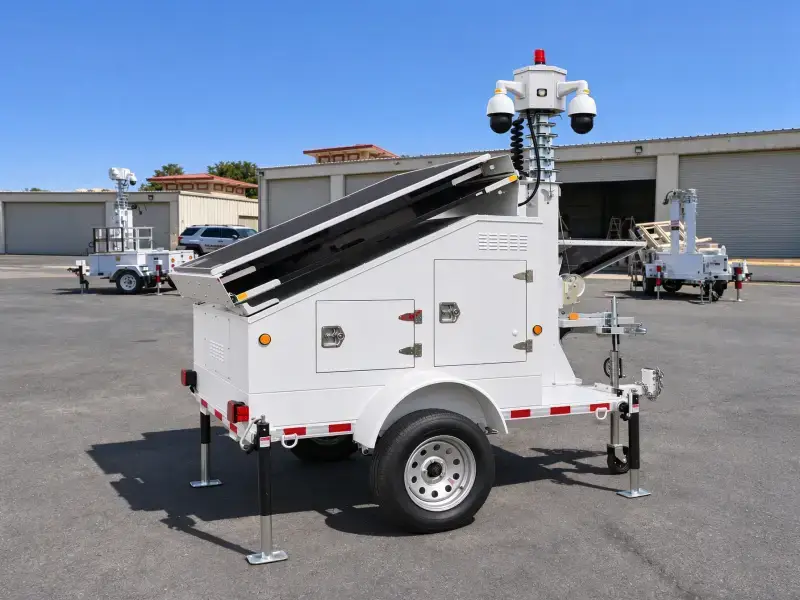
Fixed cameras suit permanent sites. Temporary work, remote locations, and crowded events are where a trailer earns its keep, because the camera, mast, power, and storage arrive on one chassis and can be towed to the next job.
Construction projects move. So do pipeline camps, mining trials, festival grounds, and emergency response bases. Wiring a camera at each stop wastes money and leaves gaps between deployments. A solar surveillance trailer CCTV unit puts the mast and the lens where they are needed on the day they are needed.
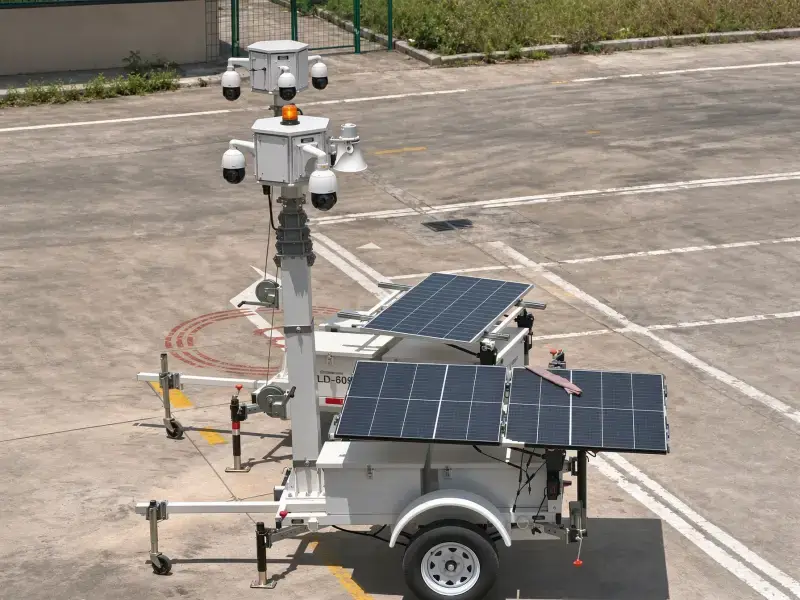
Three practical points decide whether the switch is worth it: how long the site will be active, whether mains power exists, and how often the camera must move. Short, remote, and mobile all favour a trailer. Long, fixed, and grid-connected favour a wired build. An advanced mobile surveillance trailer typically combines a telescopic mast, pan-tilt-zoom camera, battery bank, solar panels, and an on-board recorder. Some units add lighting, a variable message sign, or a wireless link to a control room.
Where portable surveillance cameras on trailers fit
Temporary sites are the obvious case. A contractor can set the unit at the entrance, move it to the material store when theft shifts, and then tow it to the next project. Event organizers use the same pattern for crowd monitoring and car parks. Because the unit is self-powered, it also works at remote infrastructure where a generator would otherwise run all night.
What to look for in an advanced mobile surveillance trailer
- Mast height and wind rating, checked against the site’s exposure.
- Camera zoom and low-light performance, checked with a night test on site.
- Battery capacity and panel output, sized for the local worst-case weather.
- On-board storage plus a defined retention and retrieval process.
- Secure cellular or wireless transmission with encrypted access.
- A clear plan for who reviews footage and how long it is kept.
A mobile surveillance vehicle or a towed unit will not remove the privacy and compliance questions in this article. What it does remove is the excuse that coverage was impossible because there was no power or no time to install. Compare the portable CCTV surveillance tower designs on the market on mast height, power budget, and recording policy before choosing.
FAQ
Are surveillance trailers for sale legal on private property?
Usually yes, with conditions. Private landowners can generally record their own property, but the rules on audio recording, signage, and where a lens may point still apply. Audio is the common trap: in many places recording a conversation without consent is illegal even when video recording is allowed. Check the law where the unit will be used, and keep the camera aimed at areas you control.
How long can a solar surveillance camera trailer run off-grid?
It depends on panel output, battery capacity, and how much the camera and any lights draw. A well-sized unit runs through normal weather on solar alone and uses its batteries overnight and during short storms. Extended cloud cover, a heated housing, or continuous pan-tilt-zoom movement all reduce runtime. Ask for the worst-case figure, not the sunny-day number, and check whether the system shuts down gracefully or loses footage.
Does a solar CCTV trailer deter crime better than a fixed camera?
Not by itself. Deterrence comes from being visible and from someone responding, not from the power source. A trailer can be placed exactly where the risk is and moved when the risk moves, which a fixed camera cannot do. That placement advantage often matters more than the technology. Pair it with lighting, patrols, and clear signage, and treat the footage as evidence rather than as a guarantee of safety.