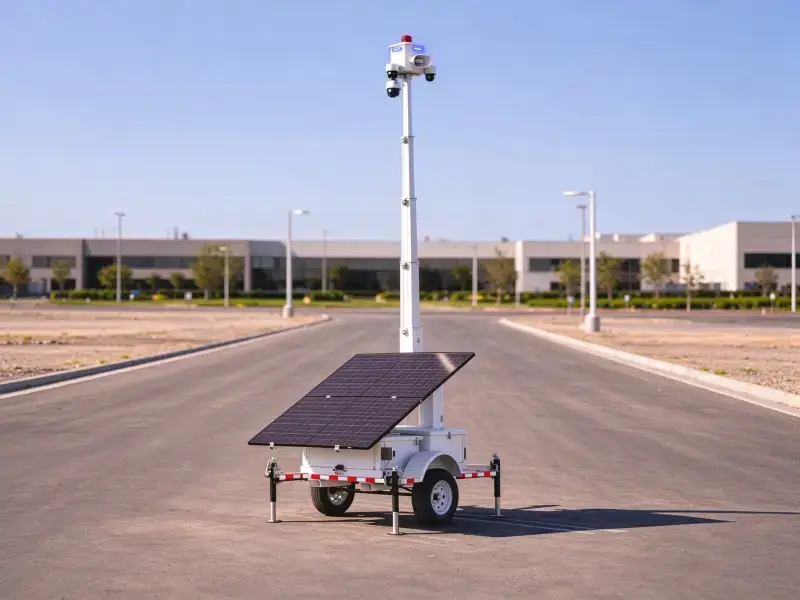
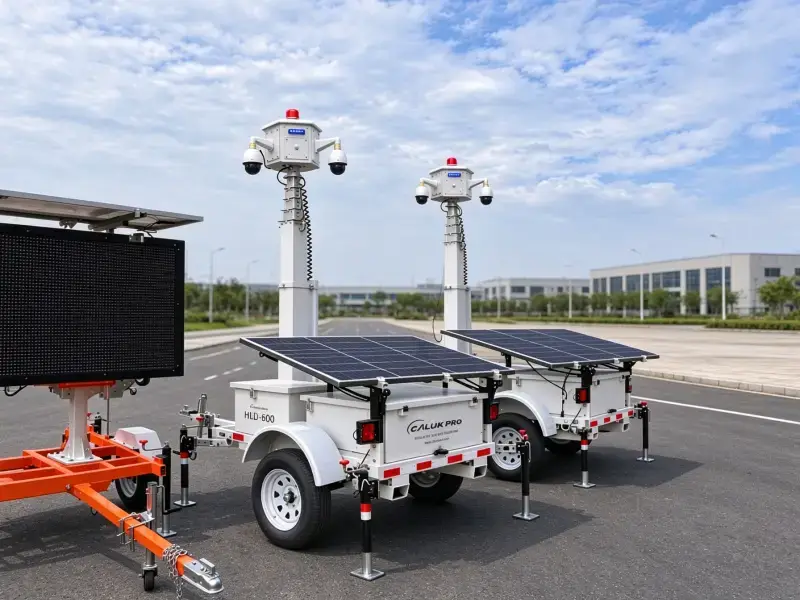
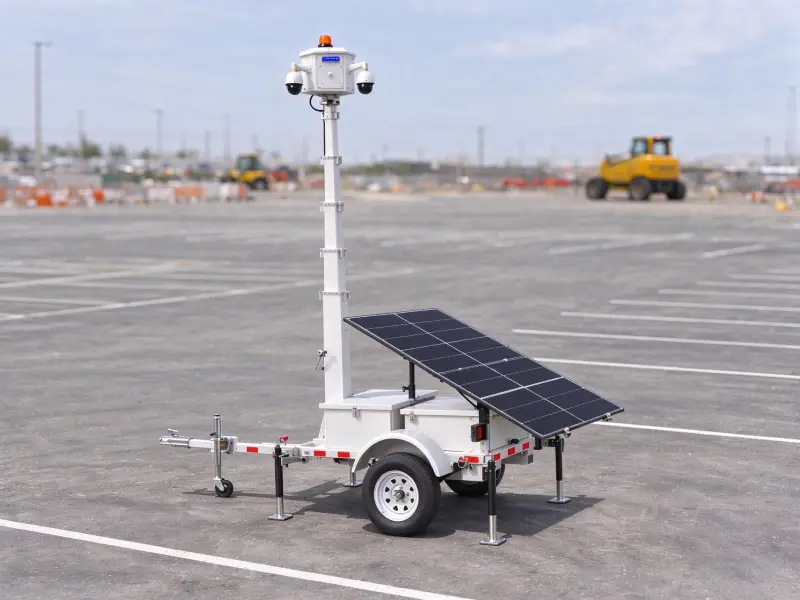
A solar CCTV camera has no mains cable to plug in, which is exactly why people buy one for a construction site, a remote gate, or a temporary event. The trade-off is that everything depends on a small power system sitting outdoors in the sun and weather. Buyers comparing surveillance trailers for sale usually want a straight answer before they commit, and the honest answer has two parts: the camera itself can run for years, while the battery keeping it alive at night is the part that wears out first.
A complete solar surveillance trailer CCTV system typically lasts 5 to 15 years. The camera hardware and solar panel usually outlive the battery, which most owners replace after 2 to 7 years depending on chemistry, heat, and how deeply it is cycled. With a clean panel and a sensible workload, the system keeps working well past the point where a wired camera would need a power upgrade.
The numbers behind that answer depend on which component you are looking at, so it helps to separate them before getting into the details.
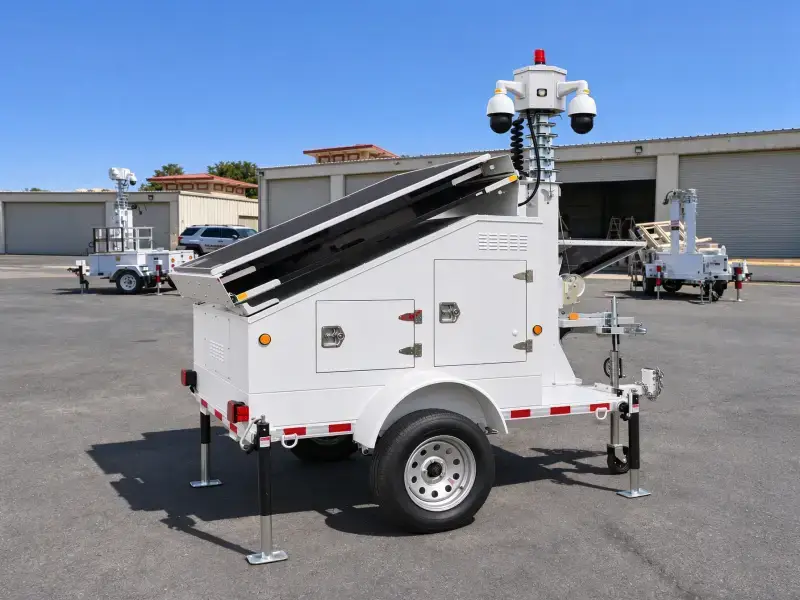
How long do solar surveillance trailers actually last?
In normal use, expect five to fifteen years from the whole unit, with the camera body and panel lasting longer than the battery. The figure is a range rather than a promise because build quality and climate move it in either direction.
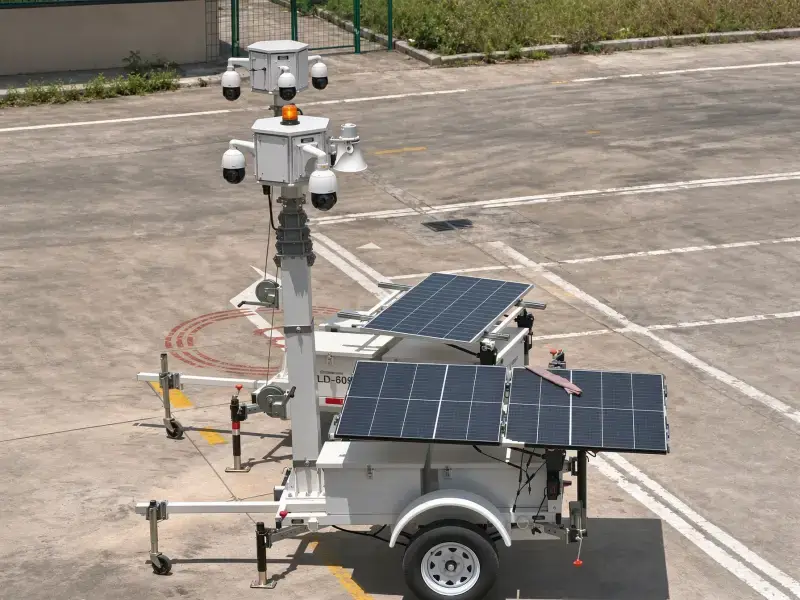
A solar surveillance trailer is a collection of parts with different service lives. The panel has no moving parts and degrades slowly. The camera has a sealed lens and sensor that can stay sharp for a decade, provided the housing holds up. The battery is the consumable. It is charged and discharged every single day, and every cycle adds a little wear.
| Component | Typical service life | What usually ends it |
|---|---|---|
| Solar panel | 20 to 25 years | Slow efficiency loss, physical damage |
| Camera body, lens, sensor | 5 to 10 years | Sensor degradation, water ingress |
| Battery pack | 2 to 7 years | Cycle wear, heat, deep discharges |
| Mast, mounts, cables | 10 years or more | Corrosion, wind damage, UV exposure |
| Wireless link and controller | 5 to 10 years | Hardware failure, outdated network support |
This is why a solar cctv trailer is often still a useful asset after the original battery is finished. Swapping a battery is cheaper than replacing the camera and mast, and it restores the system to close to its original performance.
Camera hardware, battery, and panel on different clocks
The three main parts age in different ways. A panel loses a small fraction of its output each year but keeps producing power long after the camera is ready for retirement. The camera ages mostly from its environment: moisture, dust, and temperature swings do more damage than the hours it spends recording. The battery ages from use and from time itself. Even a battery that is barely used will slowly lose capacity as its chemistry changes, which is why a spare bought years ago may not hold much charge when you finally fit it.
Battery life: the part that ages first
The battery on a solar trailer CCTV setup is the first component most owners need to replace. A quality lithium iron phosphate pack can deliver several thousand cycles, but heat and repeated deep discharge will cut that number well before the camera itself wears out.
Two things are often confused here. Runtime is how long the camera keeps working after the sun goes down, measured in hours or days. Lifespan is how many years the battery stays usable before it can no longer hold enough charge to get through a normal night. A battery can have excellent runtime on day one and be close to failure by year four if it is installed in a hot enclosure.
Most modern systems use lithium iron phosphate cells rather than older lead-acid types. They tolerate far more cycles and handle partial states of charge better, which suits a solar application where the battery may sit at eighty percent for days and then drop quickly during a cloudy stretch.
Cycle life vs. calendar life
A battery has two clocks running at once. Cycle life counts how many full charge and discharge passes it manages before capacity falls to around eighty percent of the original rating. Calendar life is how long it lasts simply by existing, regardless of how often it is used. Whichever clock reaches the end first sets the real service life.
A camera on a busy site that dips into the battery every night is cycle limited. A unit on a quiet fence line that rarely uses more than a little stored power is usually calendar limited. Both need attention, but for different reasons. If you are comparing advanced mobile surveillance trailer options, ask for the cycle rating and the test temperature behind it, since a number quoted at a cool lab bench says little about a box mounted under a panel in midsummer.
What shortens the lifespan of a solar CCTV camera?
Heat, deep discharges, and poor charging do most of the damage. A shaded or dirty panel is just as harmful as a heavy workload, because the battery never gets a full refill and spends its life running on a partial charge.
The table below maps the common causes to what actually happens inside the system.
| Cause | Effect on the system |
|---|---|
| Sustained high temperature | Speeds up chemical aging in the battery |
| Repeated flat discharges | Reduces usable capacity over time |
| Spotlights, sirens, constant live view | Drains the pack harder each night |
| Busy detection zones | Frequent wake-ups increase daily cycles |
| Shaded or dirty panel | Battery never reaches a full charge |
| Cheap cells and weak protection | Fewer safe cycles, earlier failure |
Heat and high voltage
Temperature is the single biggest factor in how fast a lithium pack ages. Research summarized by Battery University notes that holding a cell at high voltage and elevated temperature can cause more damage than cycling it, and that sustained heat above roughly 40°C accelerates capacity loss sharply. On a mobile surveillance trailer camera system, the battery box often sits under the panel or near the mast, where it can cook for hours even when the ambient temperature looks mild.
The practical fix is unglamorous: mount the battery where air can move around it, avoid dark enclosures in direct sun, and check that the charger is not holding the pack at a full state of charge through the hottest part of the day.
Deep discharges and heavy features
Every time the pack is drained close to empty, the cells see more stress. A camera that runs infrared lighting, a loud siren, and a continuous live stream will cycle far deeper than one that records a few short clips. Motion sensitivity and detection zones matter more than most buyers expect, because a camera pointed at a busy road can wake dozens of times an hour.
Use infrared instead of a spotlight where colour is not needed. Trim the detection area to the entrance you actually care about. These changes cost nothing and can add years to the battery.
Shading, dirt, and weather exposure
A panel that is partly shaded or coated in dust will still produce some power, but not enough to refill the pack after a heavy night. Over weeks, the battery sits at a lower state of charge and ages faster. Clean the panel on a schedule, and check it after storms or harvest seasons when dust and pollen build up quickly.
Weather affects the rest of the unit too. Water getting past a seal is the classic killer of camera hardware, and high winds can loosen a mast that was not braced properly. A solar surveillance camera trailer deployed on an exposed site should be checked after severe weather rather than only at the end of the season.
Are solar-powered CCTV cameras any good for long-term use?
Yes, when the site has reliable sunlight and the system is sized for the workload. They are a strong fit for temporary or remote locations where running mains power would cost more than the camera itself. They are a weaker fit for shaded, permanently overcast spots.
The case for off-grid surveillance is strongest where there is no easy power source. Construction sites move every few months. Mining and energy operations cover ground that a cable cannot economically reach. Event organisers need coverage for a weekend and then need it somewhere else. In these situations, solar surveillance lighting trailers remove the cost and delay of trenching a supply line.
The trade-off is that you are now managing a power system as well as a camera. Owners who treat the panel and battery as an afterthought get short life and unreliable footage. Owners who size them properly get a system that runs for years with little more than an occasional clean.
When a mobile surveillance trailer makes sense
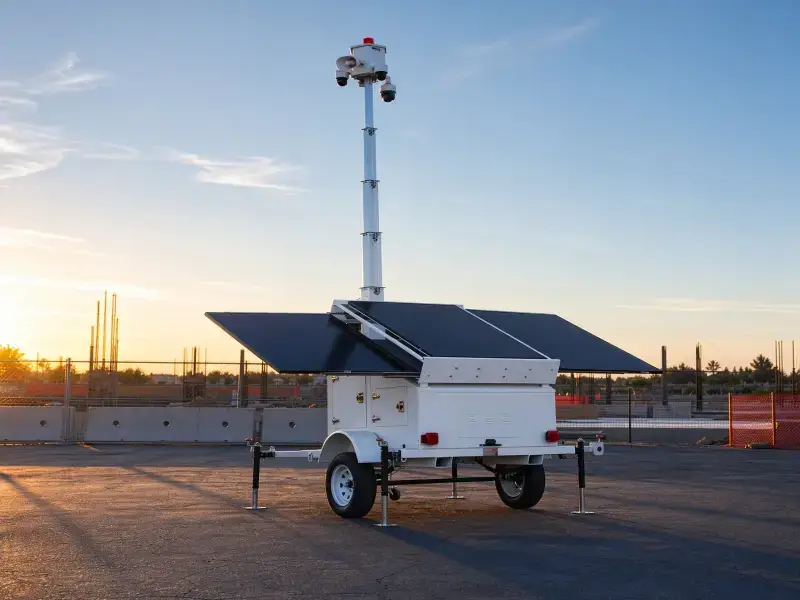
A mobile surveillance vehicle or towable unit earns its keep when coverage needs to move. Look at how long the site will be active, how many sun hours it gets in the worst month, and whether a cellular signal reaches the mast. If all three check out, the running cost is close to zero and the camera can be repositioned in minutes.
Buyers comparing solar surveillance trailer for sale listings should also check whether the battery is accessible. A sealed pack may be fine for a short project, but for a long-term installation it can turn a small fault into a full replacement. The same applies to a mobile surveillance trailer for sale that looks identical on paper but uses a smaller panel or a cheaper cell supplier.
Does solar CCTV work at night?
It does. The camera runs from the battery charged during the day, and infrared or low-light sensors provide the image after dark. The limit is not night itself but how many consecutive dull days the stored energy can cover.
Most cameras draw more power at night than during daylight, because infrared LEDs and heaters switch on. A well-sized system banks enough charge through the afternoon to cover a full night and two or three cloudy days on top. In practice, the nights are rarely the problem; the problem is a week of grey weather after the panel has already been neglected.
Thermal and PTZ payloads add another layer. A high mast PTZ unit can see a much wider area, but the motor and heater add to the nightly draw. That is fine when the panel and pack are sized for it.
How much reserve does a trailer camera system need?
Work backwards from the worst week you expect, not the average one. If the camera uses a certain amount of power each night and the panel replaces it on a sunny day, the battery only needs to cover the gap between them. Three to five days of autonomy is a sensible target for remote sites, and more than that where winter sun is weak.
A solar trailer CCTV setup with a generous reserve also avoids the deep discharges that shorten battery life, so the sizing decision pays twice.
Do solar panel cameras still run off Wi-Fi?
Some do, but many do not. Wi-Fi models need a network within range, while cellular models use a SIM card and work wherever there is mobile coverage. Local storage means the camera can keep recording even when the link drops.
The choice affects lifespan more than people expect. A Wi-Fi camera on a remote site will spend extra power searching for a weak signal, and a lost connection can mean no remote view at all. Cellular units avoid that problem on farms, quarries, and roadside projects, provided the operator checks coverage at the exact mounting point before drilling.
Either way, recording to an on-board card is worth having. It keeps footage available during a network outage and reduces how often the radio needs to transmit. For a system that has to survive a long winter, lower power use is always a benefit.
Signs the battery is ageing and it’s time to replace
The warning signs are gradual: the camera runs flat sooner than it used to, the charge percentage jumps around, or it drops offline after a couple of cloudy days when it never did before. Any of these means the pack is no longer holding a full charge.
Watch for the following:
- The battery falls to a low percentage much faster than when the system was new.
- The reported charge level drops suddenly instead of falling steadily.
- The camera restarts on its own during the night.
- It will not reach a full charge even after several sunny days.
- The unit goes offline in weather it previously handled without trouble.
If the panel is clean and the charger is working, these symptoms point to the battery rather than the camera.
Repair the battery or replace the whole unit?
| Situation | Sensible action |
|---|---|
| Battery is accessible and the camera works fine | Replace the pack |
| Unit is still under warranty | Claim before opening the housing |
| Battery is sealed and the unit is old | Compare pack and unit cost |
| Panel or cable fault, not the battery | Fix the charging side first |
A replaceable pack is one of the most useful features to look for when choosing portable surveillance cameras on trailers for a long deployment. It turns a failing battery into a routine service item rather than a capital purchase.
How to make a solar CCTV camera last longer
Keep the panel clean, keep the battery cool, and ask the camera to do less work. Those three habits add more years than any upgrade you can buy at the point of failure.
A short maintenance routine covers most of it:
- Clean the panel every few months, and after dust storms or heavy pollen.
- Position the panel for the worst month of sun, not the best.
- Narrow motion detection to the area you actually need covered.
- Use infrared rather than a spotlight where colour is not essential.
- Keep live view sessions short, since streaming draws significant power.
- Apply firmware updates, which often improve power management.
- Check seals, cables, and mast bolts after severe weather.
- Keep the battery enclosure shaded and ventilated.
None of this is complicated, but it is easy to skip on a site that nobody visits. A quarterly walk-around is enough to catch the issues that cause early failure. Sites in harsh industrial environments benefit from a planned schedule, as described in the case studies on integrated energy mining site solutions, where dust and heat make panel cleaning and enclosure checks more urgent than usual.
Frequently asked questions
A solar CCTV system can last well beyond its battery, but only if the rest of the unit is looked after. The questions below cover the practical details that usually come up after the lifespan numbers are understood.
Does cold weather shorten the life of a solar camera battery?
Cold reduces the power a battery can deliver at the time, though it usually causes less permanent damage than heat. Lithium cells should not be charged below freezing unless the pack has a heating function, so a unit in a cold climate needs a battery rated for low-temperature charging or an enclosure that warms before the sun reaches the panel.
Can I fit a different battery than the one supplied?
Only use a pack the system is designed for. Capacity, voltage, and the protection circuit all need to match, and an incompatible cell can be unsafe. If the original type is no longer available, check the approved alternatives before buying, since a cheap replacement may have fewer safe cycles and fail sooner than the one it replaced.
How large should the solar panel be?
Size it for the dullest week you expect, not the average day. Add up the camera’s nightly draw, allow for cloudy stretches, and make sure the panel can refill the pack on a short winter day. A panel that is too small keeps the battery in a partial state of charge, which is one of the fastest ways to shorten its life.