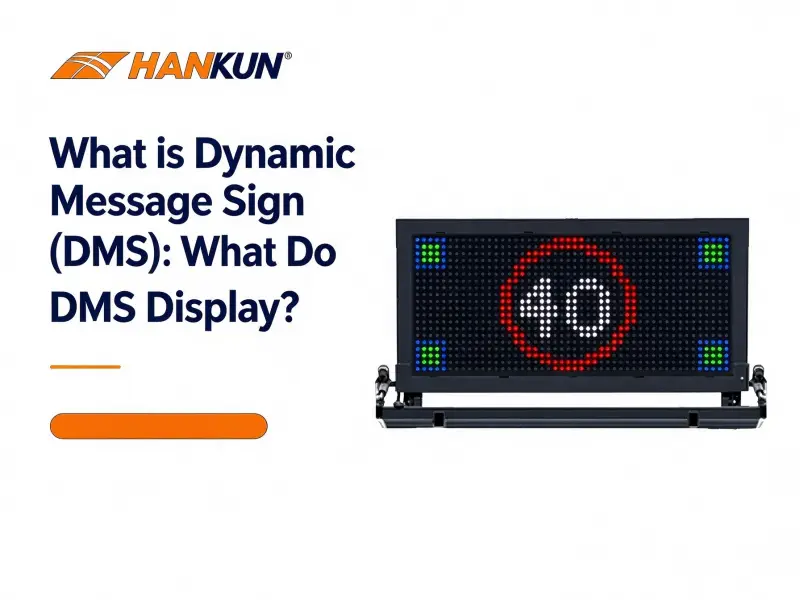
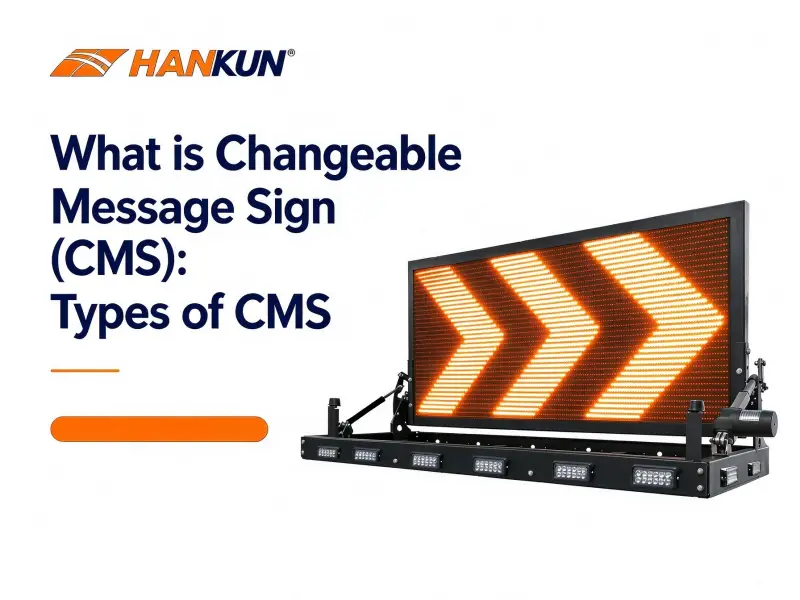
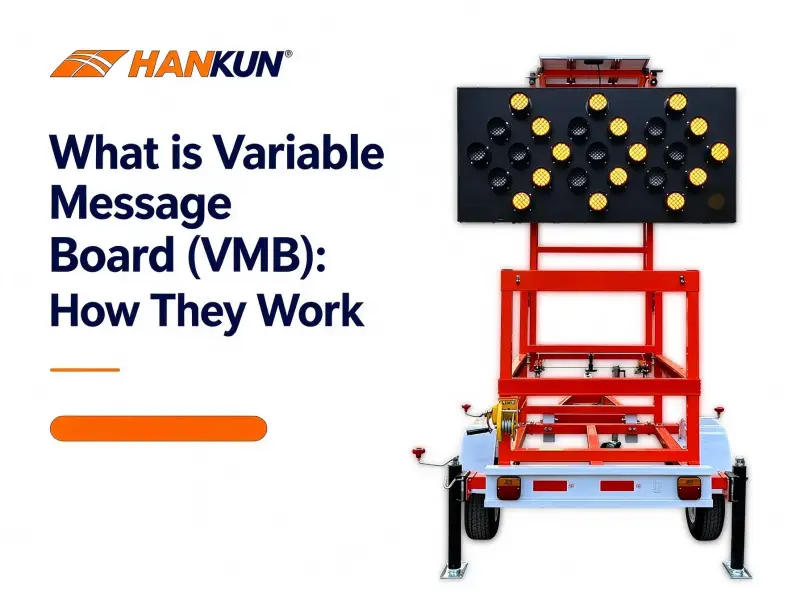
A lane closure, a shifted work zone, a car park filling before kick-off: each needs a message at a specific place, for a few hours or a few weeks. Painted boards cannot do that. Highway teams, contractors and event organisers use signs they can rewrite on site, and the equipment has moved a long way from the fixed gantries it started on.
A variable message sign (VMS) is an outdoor electronic display that shows traffic information as changeable text, symbols or graphics, and can be updated from an onboard controller, a phone or a traffic management centre without anyone touching the panel. The same device appears in tender documents as a portable changeable message sign (PCMS) in North America and as a VMS board in Australia and New Zealand.
This guide covers what sits inside a VMS, how the formats differ, what the units cost and how to specify one.
What is a variable message sign (VMS)?
It is an LED sign built around a pixel matrix, mounted on a trailer, a vehicle or a fixed structure, and paired with a power system and a controller that let the message change as conditions change.
The technology has been rebuilt twice: neon tubing, then flip-disc panels, then LED arrays that brought brighter output, lower power draw and free-form text. Once linked to a control centre, a sign became part of the traffic management system rather than a roadside object. The range now runs from a compact three-line board to a full-matrix panel on a hydraulic mast, which is why suppliers list Variable Message Signs across such a wide spread of sizes.
The three layers of a unit
| Layer | What it contains | What to check |
|---|---|---|
| Display | LED modules, pitch, cabinet, anti-glare face | Pitch against viewing distance, IP rating |
| Power | Solar array, battery bank, charge controller | Autonomy in days without sun |
| Control | Controller, modem, cloud platform | Message library, remote access, protocol |
Weak links sit between layers. A cabinet rated IP65 with an unrated module still lets water in. A solar array sized for June will not carry a sign through a wet week in December.
One device, several names
VMS is the general term in Europe, Australia and most contracts. PCMS means portable changeable message sign and comes from North American practice. CMS is the governing legal term in US federal documents, and DMS describes a fixed, network-controlled sign. A tender asking for either describes the same equipment.
How a variable message sign works
A message is composed on a controller, converted into a pixel pattern, sent to the driver boards and lit by the LED matrix. Power comes from a battery charged by solar panels or mains, and the controller reports faults so a dark sign does not sit unnoticed at the roadside.
The chain is short but has more steps than buyers expect: draft the wording, check it against local rules, load it, schedule it, then confirm the sign is displaying. Diagnostic reporting is what makes that last step possible without a site visit.
Message design and the generator
A variable message sign generator is the software layer that turns written wording into a display-ready frame. It counts characters against panel width, converts a character height into a pixel count for the installed pitch, flags wording that breaks local rules and previews the result at distance.
Be precise when buying. A generator is not hardware and not controller firmware. Confirm which one a unit ships with, whether its files open on another controller, and whether the preview accounts for the actual pitch. A preview built on a generic grid shows a message that fits on screen and overflows on the real board.
Communication options
Remote update runs over whichever link the site supports: a keypad where there is no connectivity, Bluetooth for short deployments, a 4G modem for trailer fleets, radio where cellular is unreliable, and fibre for fixed signs on a control centre. North American systems generally expect NTCIP.
Types of variable message sign board
The main split is temporary against permanent. Temporary boards travel on a trailer or a vehicle and run off their own power. Permanent boards sit on a gantry, cantilever or post and draw mains power through a fixed connection.
Within that split, the choices are about deployment speed rather than display quality: a trailer takes one person and a tow vehicle, while a gantry carries the largest panels along with civil works.
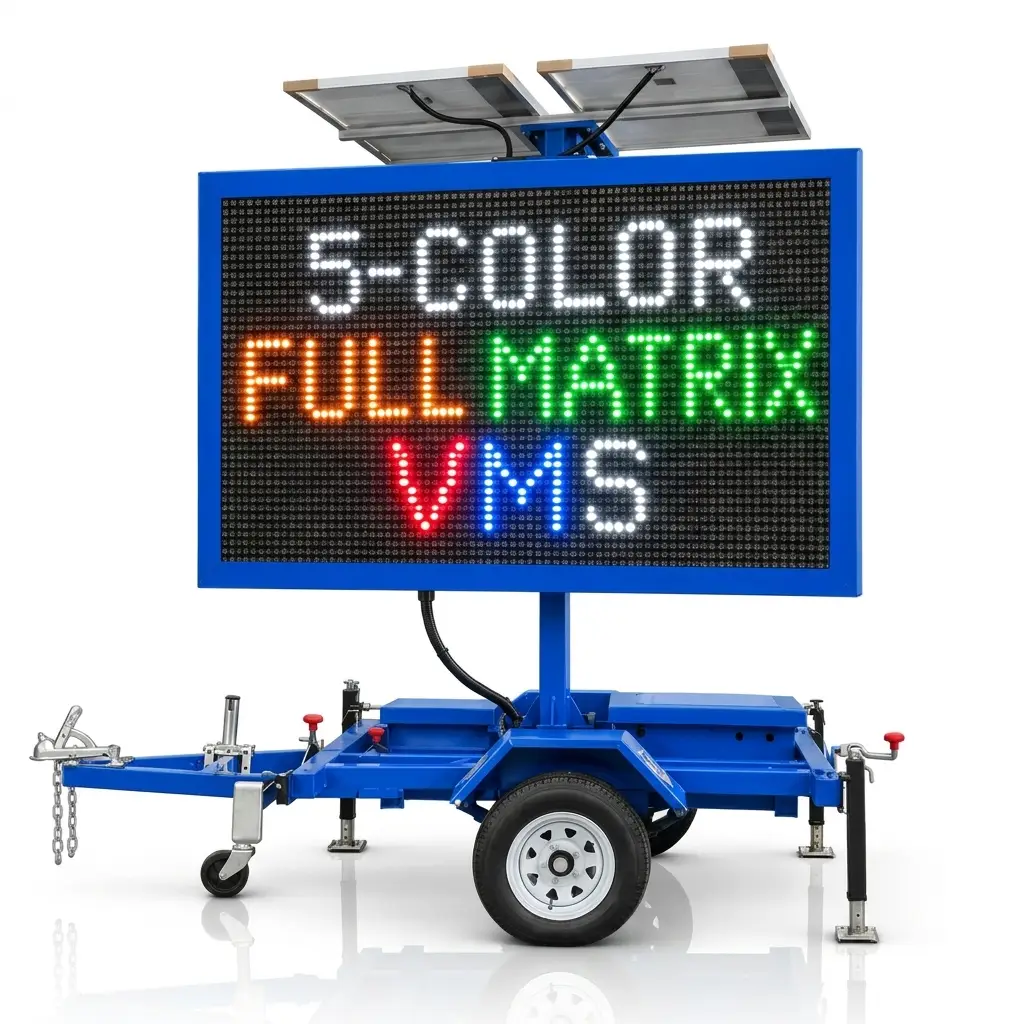
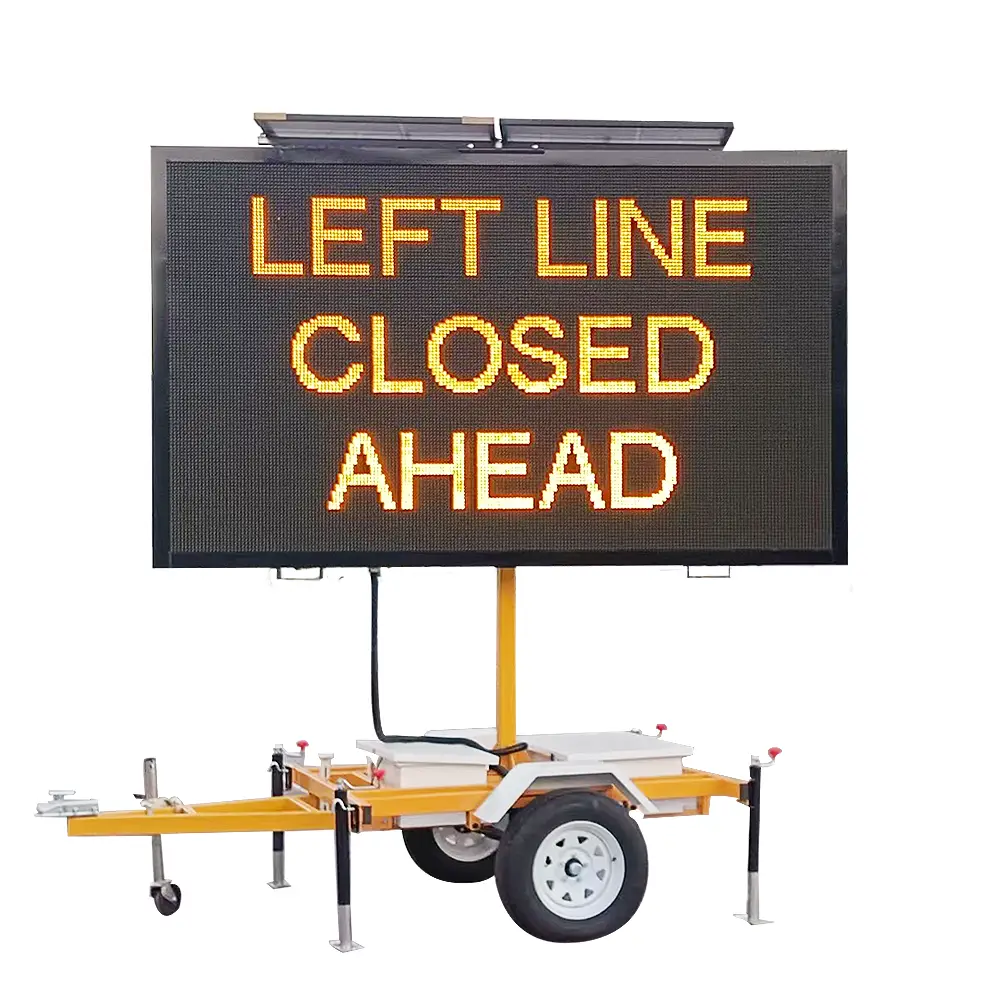
Trailer-mounted units
The display sits on a mast that lifts hydraulically, typically through 80 to 100 cm, and the panel usually rotates 360 degrees so it can face traffic from either direction. Stabiliser legs take the load off the suspension, and a hand brake holds the trailer. Operating mass lands between 600 and 1,100 kg, which keeps towing within reach of a light commercial vehicle.
Vehicle and truck-mounted boards
A truck-mounted traffic control VMS attaches to a work vehicle rather than a separate chassis. That removes the tow and the setup step, which suits operations that advance along a corridor through the day. Paired with a truck-mounted attenuator, one vehicle provides rear impact protection and the merge message. The trade-off is that the sign is unavailable while the vehicle does anything else.
Fixed gantry and roadside signs
Permanent installations carry the largest displays and the strictest integration requirements. They draw mains power, report over NTCIP, and are usually procured through a civil works contract rather than a product order. Placement has to account for sight lines and maintenance access.
Display formats and what drivers see
Format decides what a board can show. A character matrix shows text only, a row matrix adds some flexibility, and a full matrix treats the panel as one canvas so it can display symbols, arrows and simple graphics. Colour is a separate decision from format.
Buyers often conflate the two. A full-matrix panel in amber is still single-colour: it gains graphic capability, not colour. A three-line display in five colours gains colour, not layout freedom. Both affect price, so settle both before requesting a quotation.
Character, row and full matrix
A character matrix gives each position a fixed pixel grid, usually two or three rows, and cannot do more than alphanumeric text. A row matrix treats each row as an independent strip, allowing variable fonts. A full matrix drives the whole panel as one array, so text, lane arrows, merge symbols and pictograms all become possible on the same board. Procurement now mostly specifies it, because work zone messaging depends on that symbol library.
Amber, five-colour and RGB
Amber on black remains the default for work zones because it gives the highest contrast and satisfies the positive-contrast rule in most standards. Five-colour panels add white, red, green and blue clusters, covering regulatory colours without full RGB cost. Full-colour panels suit event direction, wayfinding and branded layouts, but not highway work zones, where an amber legend signals a regulatory message. Where a standard three-line board is what the project needs, amber full-matrix units such as these trailer-mounted amber PCMS are the direct fit.
Keeping a message readable
The rules exist because a driver has two to four seconds of glance time. Keep one idea per screen, three lines maximum, the action on the line read first, and no scrolling or animation. Match character height to approach speed, not panel capacity.
What variable message signs cost
Price is set by panel size, pixel pitch, colour, power system, control hardware and trailer build, in roughly that order. A three-line amber trailer and a five-colour full-matrix unit of the same size can differ by a factor of two.
What moves the number
Panel area and pitch drive cost first, since both change the module count. Colour adds clusters and driver complexity. Solar array and battery capacity are often trimmed to hit a price, at the cost of autonomy. Cloud platforms and NTCIP are add-ons, and freight plus certification raise a delivered price.
Typical ranges
| Configuration | Market range | Basis |
|---|---|---|
| Portable roadworks trailer, UK | GBP 5,000 to 15,000 | Published supplier ranges, checked November 2026 |
| Portable trailer, North America | USD 8,000 to 35,000 | Published supplier and industry ranges, checked November 2026 |
| Motorway gantry VMS | GBP 30,000 to 80,000 | Installed project pricing, not supply only |
| Short-term hire | From GBP 150 per week | UK hire market, excluding delivery |
Every row is a market range from published material, not a quotation. The lower end excludes delivery, commissioning and certification, so a delivered price sits well above the supply figure.
Service life and running costs
LED units commonly reach 10 to 15 years with routine maintenance, and modules are rated around 100,000 hours. The battery bank goes first, then the charge controller, then modules or driver boards, so field-replaceable parts keep a unit working long after a sealed one would be scrapped. Hire suits a season; ownership wins once deployment passes a few months a year.
How to specify a VMS for a project
Name the standard, the power autonomy and the trailer requirements, in that order. That gives suppliers something comparable to quote against, and gives the buyer grounds to reject a cheaper unit that meets none of them.
Standards carry legal weight on public roads. The American Manual on Uniform Traffic Control Devices sets federal requirements for changeable message signs in Chapter 2L, covering character height, line limits and prohibited display effects. European procurement works to EN 12966, which classifies luminance, chromaticity and beam width. Australian and New Zealand projects reference AS 4852.2 for portable signs. A supplier offering “configuration options” for each market is describing a build choice, not a certificate.
What to write in the tender
| Requirement | Wording |
|---|---|
| Display performance | EN 12966 class, MUTCD statement or AS 4852.2, matching the market |
| Ingress protection | IP65 minimum for module and cabinet, stated separately |
| Communication | NTCIP 1203 where the sign must join an existing system |
| Documentation | Test certificates, wiring diagram, credentials, spare parts list |
Power, autonomy and towing
Ask for runtime in hours at a stated brightness and message mix, then for consecutive days without useful sun. Eight hours a day of text draws far less than 24-hour operation with dense graphics. Arrays are usually sized in 150 W increments with matching 120 Ah batteries, and the right combination depends on latitude, season and shading rather than panel size. On the chassis, confirm mass, nose weight, coupling, brakes and lighting, then check the footprint: legs need ground, and soft verge will sink.
Where VMS boards are deployed
Anywhere a message has to change faster than a printed sign can be replaced: roadworks, closures, incident response, event traffic, parking guidance and remote industrial sites.
The common thread is a decision point where the right instruction depends on conditions the driver cannot see.
Roadworks remain the largest use. Portable units warn of lane shifts, reduced widths and temporary limits, and stay useful as the works move because the message changes with the phase. Place them upstream of the decision point, not beside the cone line.
Event traffic needs direction more than warning: which gate, which car park, which exit. Full-colour boards handle that well because colour and graphics carry meaning across languages. On public roads, changeable message signs are reserved for traffic information, and most standards prohibit advertising, so a promotion belongs on private land with the landowner’s approval.
Mine haul roads, quarries, ports and large sites use the same equipment for dust, blasting schedules, one-way routes and visitor directions. Solar power removes the need to trench cable to a location that may move next season.
Frequently asked questions
Can one unit handle speed feedback and general messaging?
Not usually as one device. A radar speed sign is purpose-built, with optics optimised for showing vehicle speed. Combined units exist, but the display is a compromise.
What documentation should arrive with a shipment?
Ask for test certificates covering the standard named in the tender, the wiring diagram, controller credentials, a spare parts list with module codes, and generator licence details. Missing credentials are the most common reason a new sign cannot join an existing platform.
Can an amber board be upgraded to colour later?
Rarely, and not economically. LED clusters, driver boards and often the power supply differ between amber and colour builds, so an upgrade approaches the cost of a replacement panel. If colour is a realistic requirement, specify it at purchase.