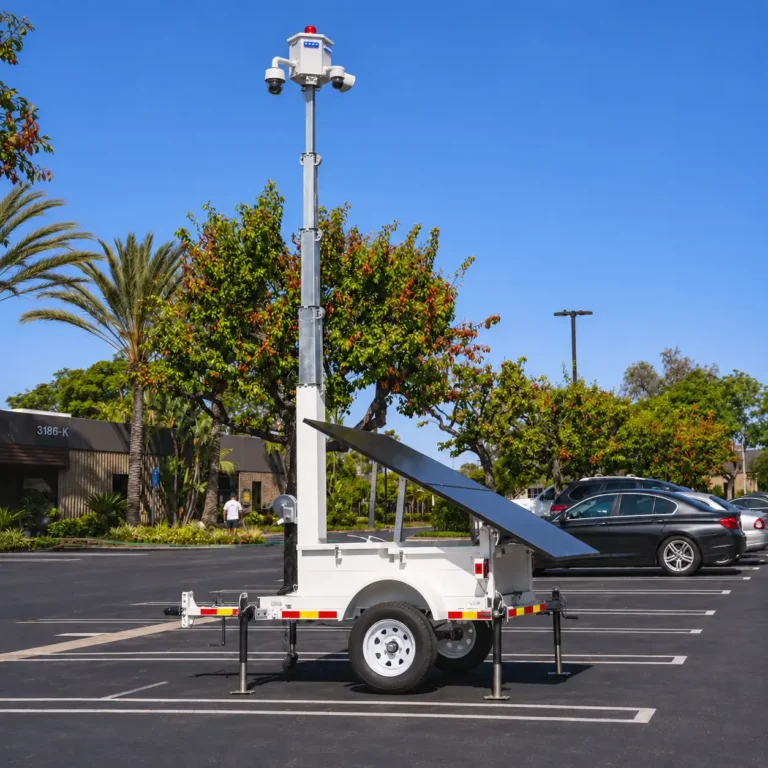
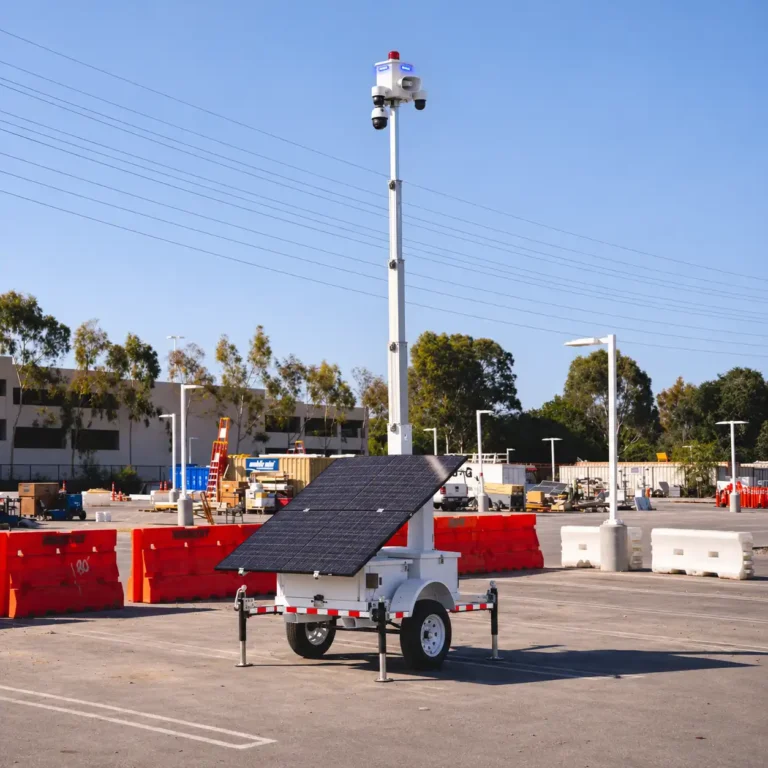
* Maximum quantities and optional functions depend on the selected camera package, payload and power configuration.
Yes → the skid may remove unnecessary road-running equipment. Frequent moves → compare the 5000 trailer.
Confirm equipment capacity, fork length, access geometry, center of gravity, total ordered weight and lifting plan.
Compare 2–4 × 460 W and 2 × 760 W after calculating daily energy, then confirm the raised height, deployed envelope and site-set tilt angle from location, season, shading and wind procedure.
Select lead-acid or lithium-ion from autonomy, temperature, cycle life, weight, transport and budget requirements.
Consider deployment frequency, operator procedure, service access and available auxiliary power.
Define target distance, blind spots, PTZ patrols, panoramic coverage, thermal detection and the optional pan-tilt platform.
Include NVR, PoE switch, router, heater, fan, strobes, speaker and optional AC loads.
State the required hours or days and the minimum site temperature before selecting the battery bank.
Confirm ground support, leveling range, clearance, mast state and wind procedure.
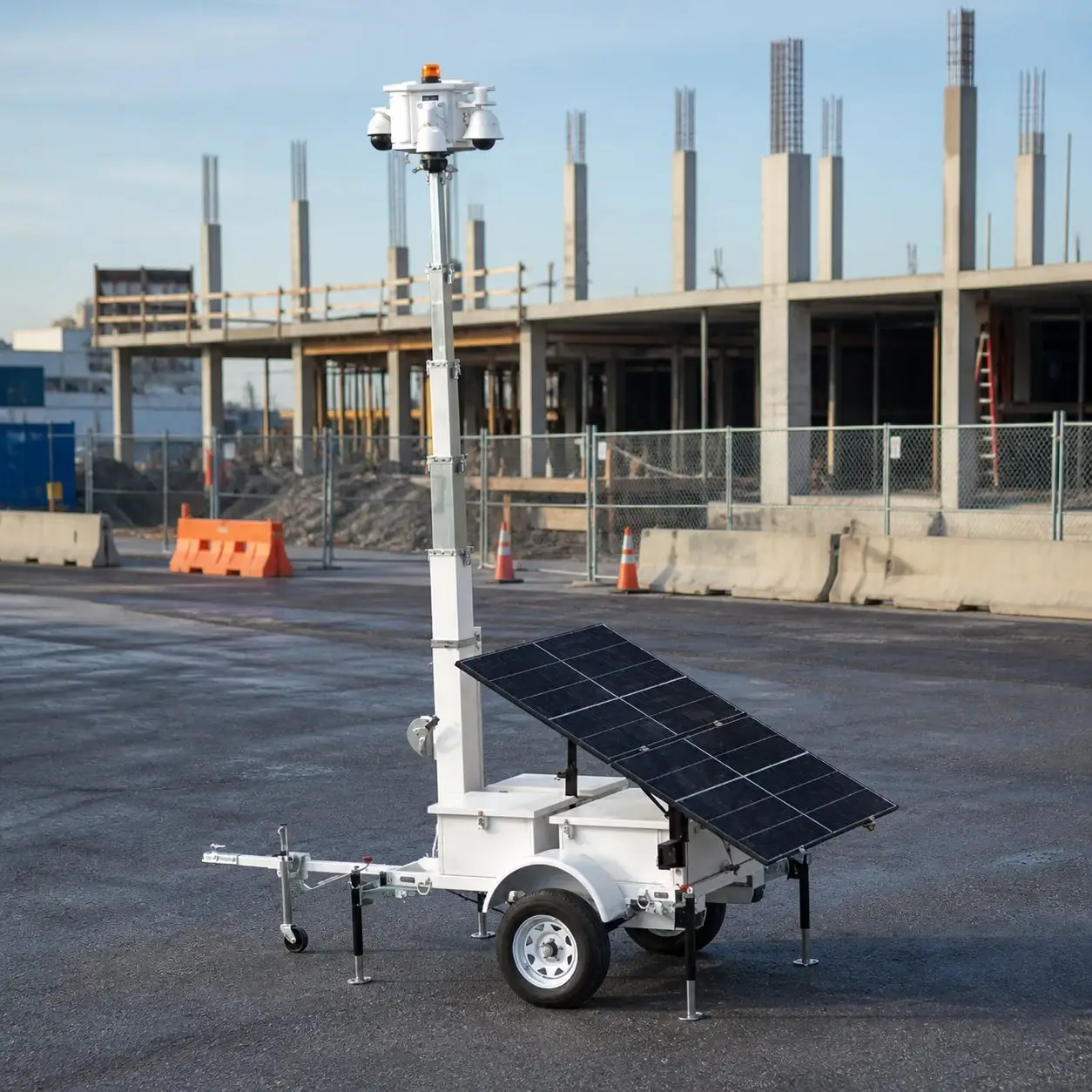
No axle, road wheels or tow hitch; relocated by long-fork forklift or crane.
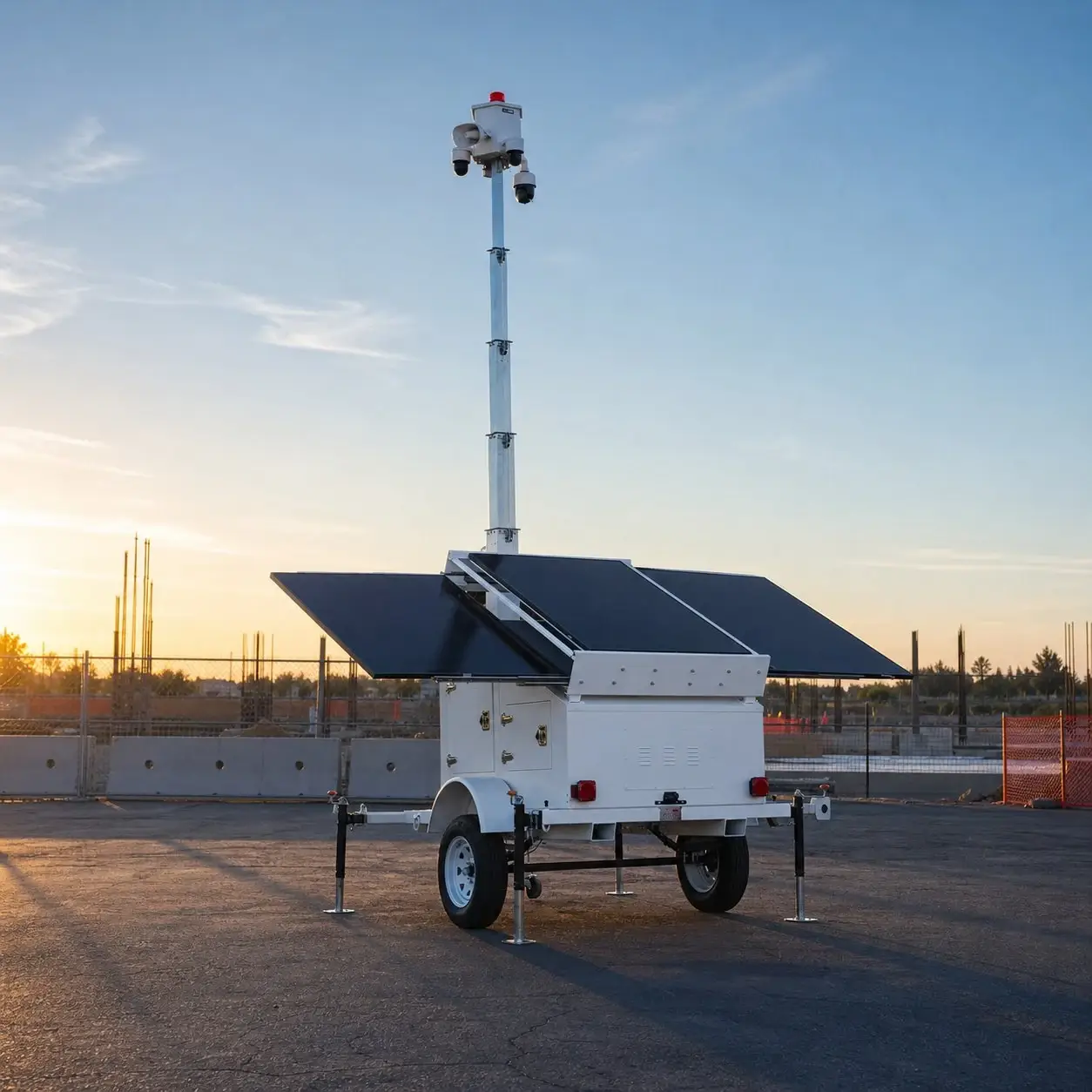
2–4 × 460 W or 2 × 760 W; raises, lowers, deploys, retracts and sets the project tilt angle.
Manual or electric lifting with a 100 kg structural payload.
Fitted to the approved camera head when remote orientation is ordered.
Leveling jacks with 1100 mm outward extension.
Internal power and Cat6 cabling with rear service access.
1 · Confirm handling equipment
Confirm long-fork forklift or crane capacity, fork length, access geometry and total ordered weight.
Released handling drawing and lifting plan.
2 · Prepare the skid
Lower and retract the solar array into its defined stowed state before any equipment-assisted move.
Array stowed state and locking confirmation.
3 · Lift and position
Use the released fork pockets or the four 2,000 lb lifting points with the approved rigging plan.
Center of gravity, rated load and exclusion zone.
4 · Set stabilizers
Deploy the four retractable outriggers and leveling jacks at the 1100 mm extension position before raising the mast.
Ground support, leveling range and clearance.
5 · Commission
Raise the array, set the project tilt angle and raise the 8 m mast after payload and wind checks.
Approved configuration list and site wind procedure.
Primary generation
2–4 × 460 W or 2 × 760 W elevating array
Daily energy, raised height, deployed envelope, tilt and wind procedure.
Battery storage
Up to 18 kWh nominal lead-acid or 40.96 kWh nominal lithium-ion
Usable energy, temperature, reserve and actual system load.
Internal loads
NVR, PoE switch, router, heater, fan, strobes, speaker and optional AC loads
Verified device datasheets and total average load.
AC supply
AC 110–230 V 50/60 Hz charging; optional AC output via ordered inverter
Input voltage, socket, protection and inverter rating.
Autonomy
Illustrative 80 W and 120 W examples at maximum battery accommodation
Approved battery architecture, BMS limits, temperature, battery age and reserve.
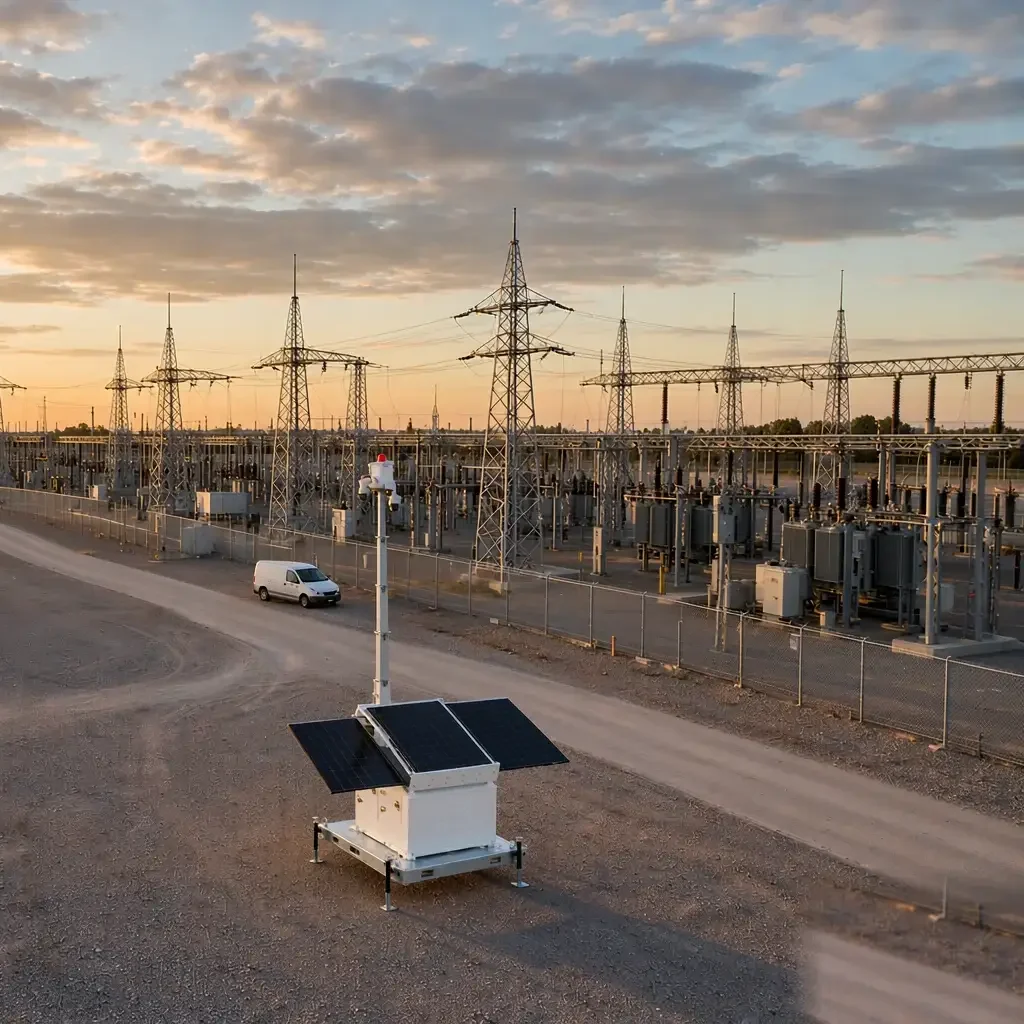
Maintain a longer-duration monitoring point for gates, materials, equipment and work zones without installing permanent grid power.
Monitor controlled access, equipment compounds and remote operating areas using a skid placed by site equipment.
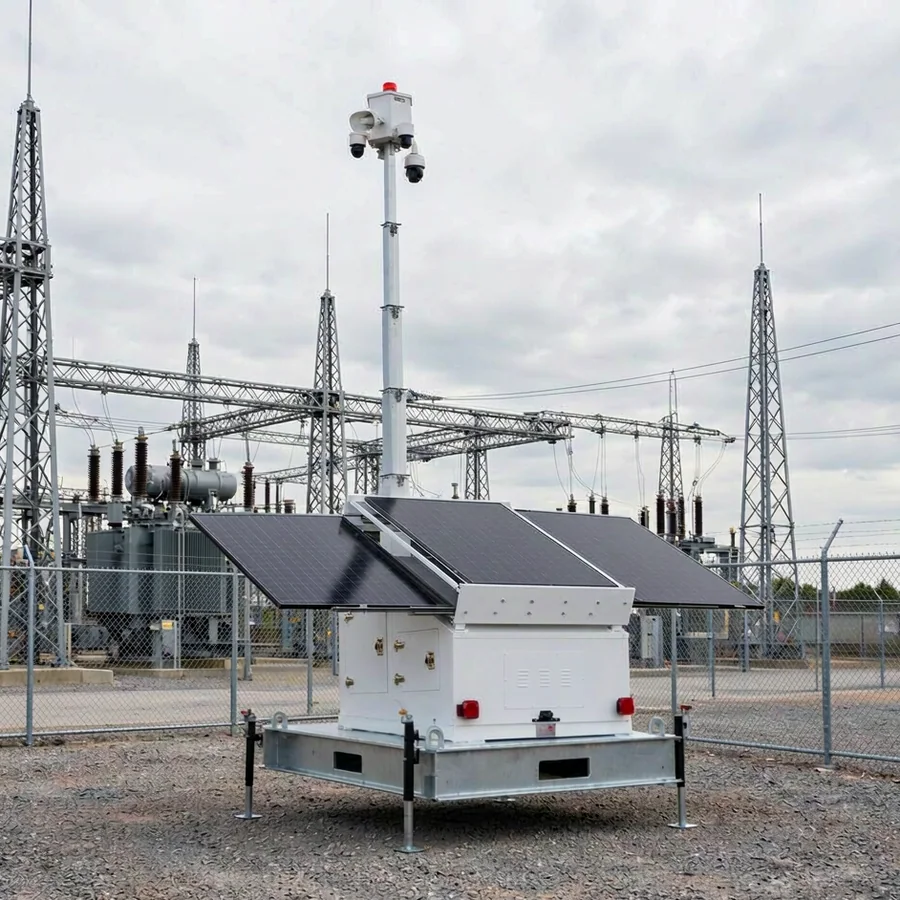
Place surveillance and communications where trenching power or data cables is impractical.
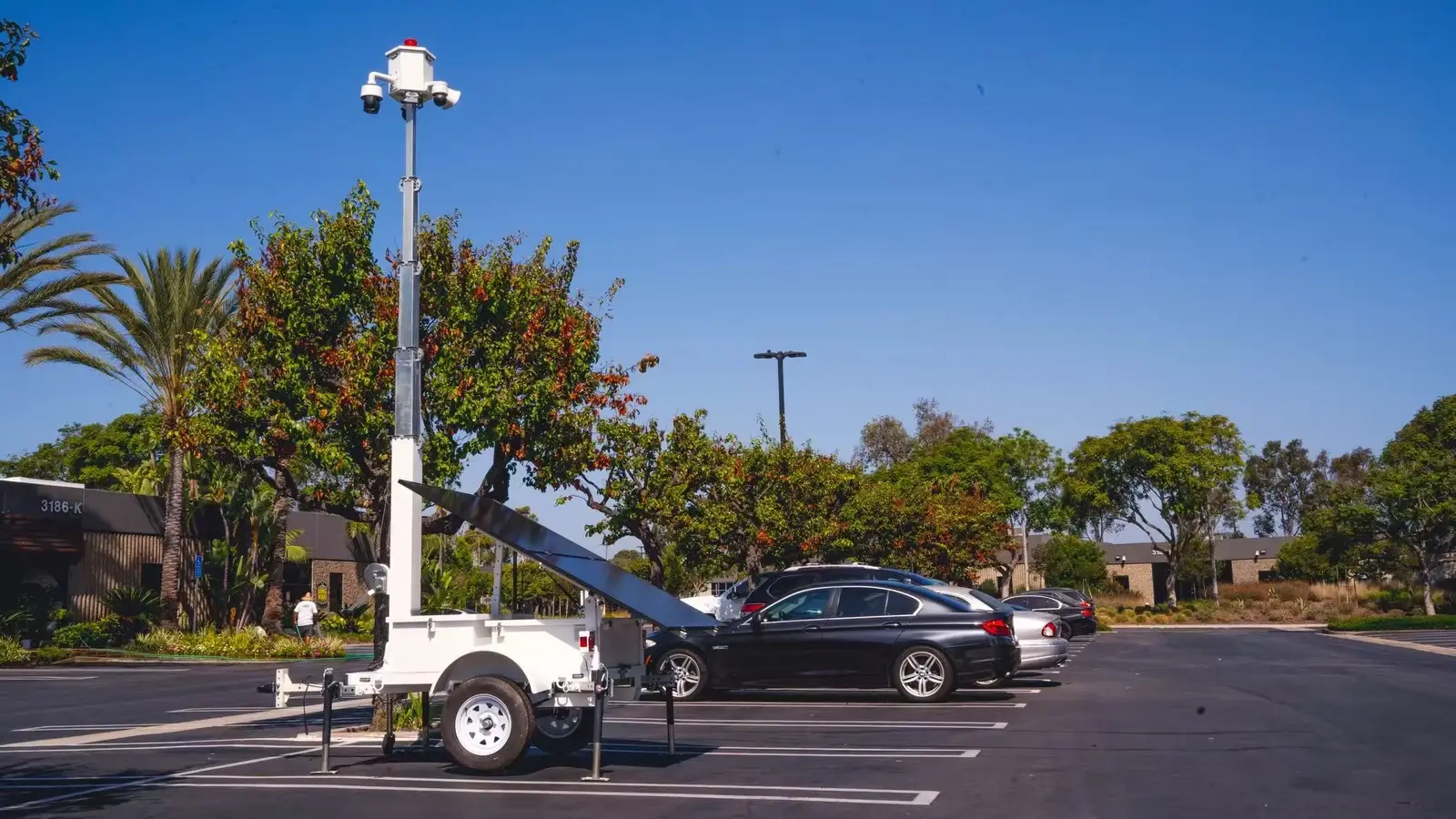
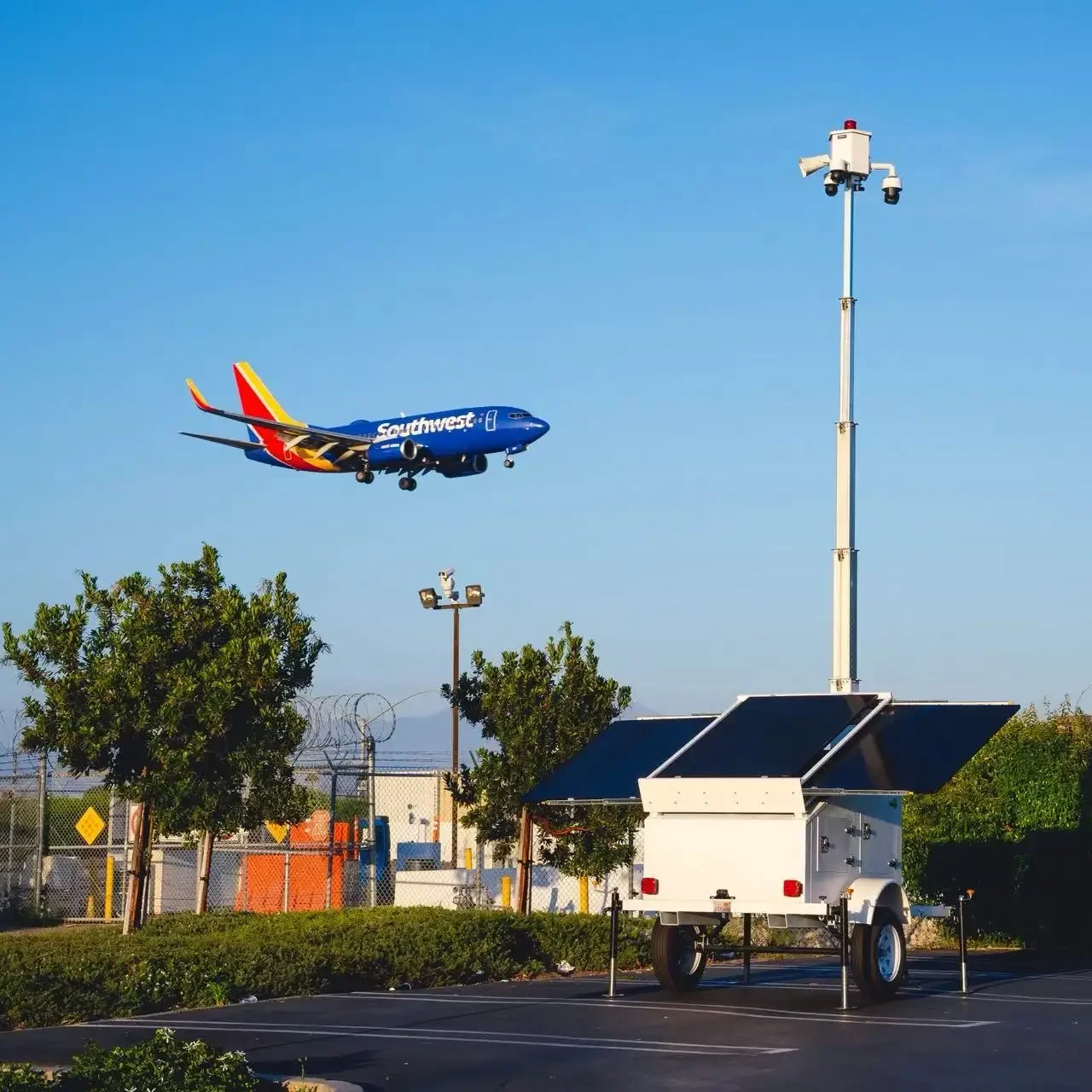
Combine elevated overview, PTZ verification and optional audio deterrence around stored or moving vehicles.
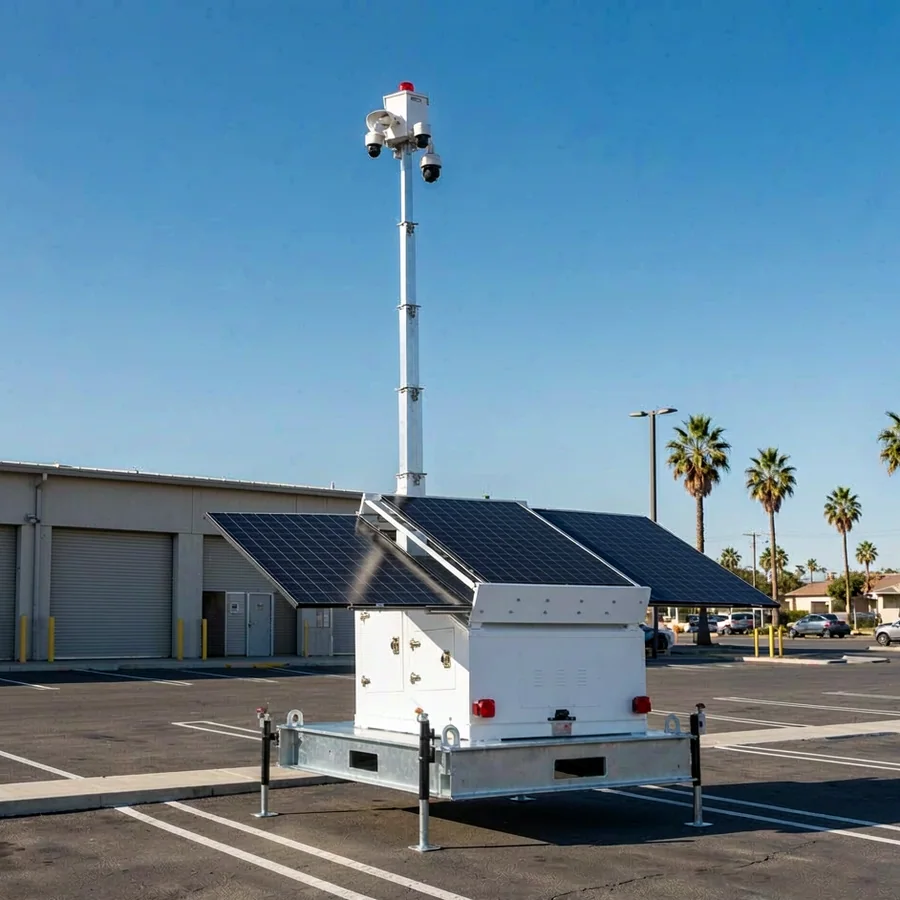
Cover entrances, payment areas, pedestrian routes and parked assets from a longer-term monitoring point.
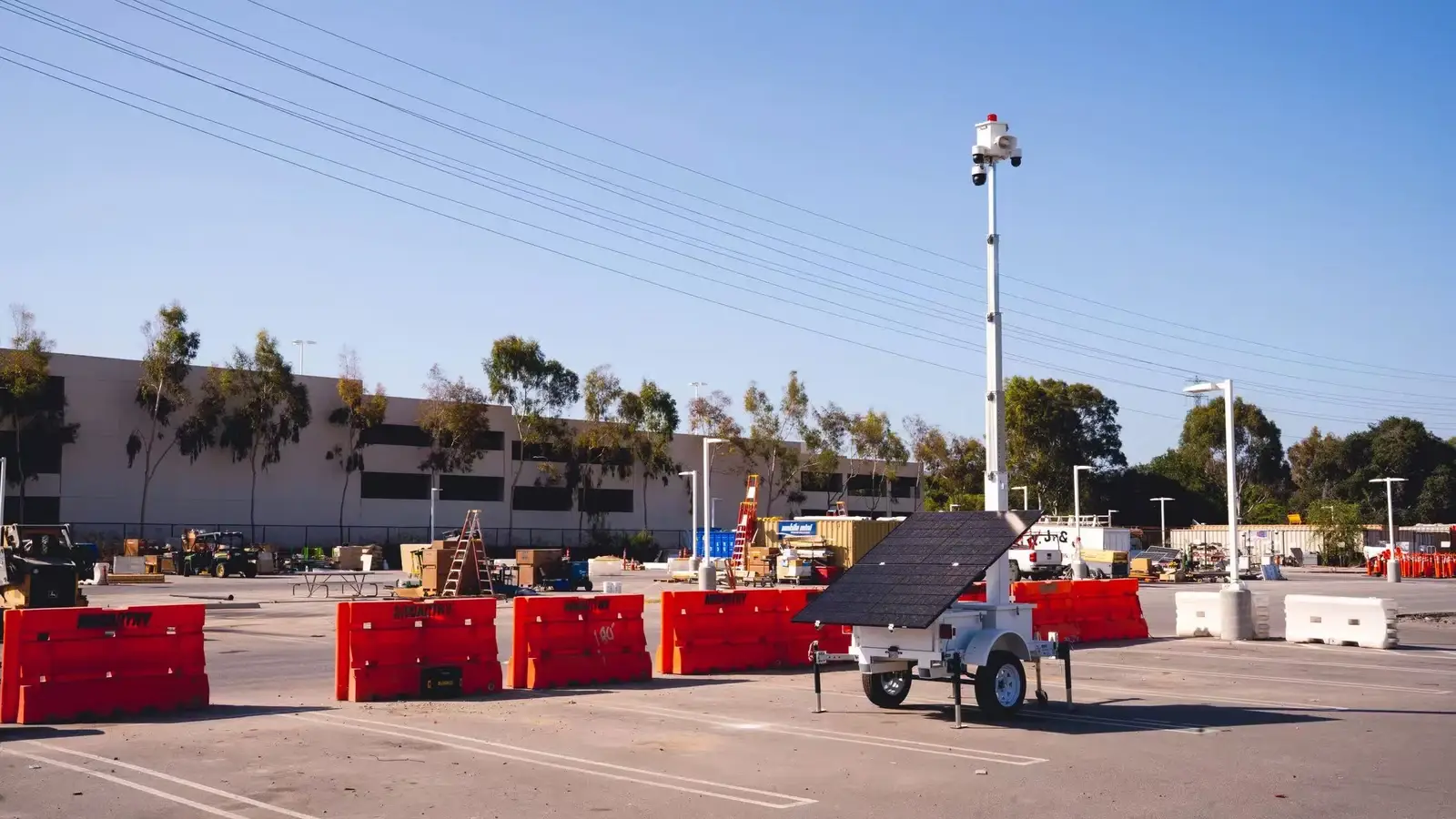
Monitor loading areas, outdoor stock and restricted yard access from a stable off-grid position.
▤
Principle 01
The 5000B removes road-running equipment when the unit will stay in one position for longer periods and be relocated only with site handling equipment.
⇄
Principle 02
The elevating support raises the array into its operating position, deploys the selected panels and sets the tilt angle for the approved site and season. The array is lowered and retracted before equipment-assisted relocation.
◷
Principle 03
Manual lifting suits simpler projects; electric lifting reduces repetitive manual operation. The ordered mechanism, height and safety procedure must match the project.
▮
Principle 04
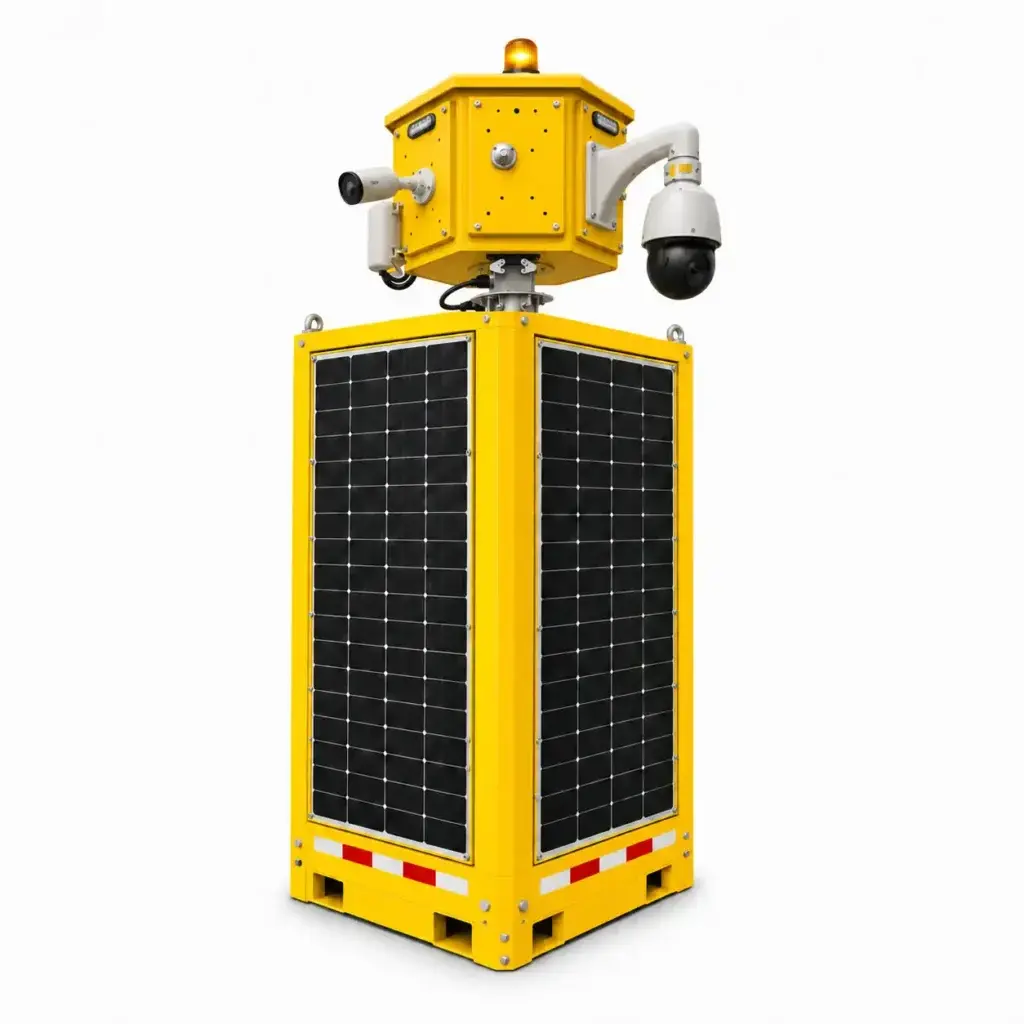
The six-sided enclosure creates defined mounting faces for cameras, strobes, antennas or a speaker while retaining rear service access and internal wiring.
⚡
Principle 05
The four retractable outriggers and leveling jacks provide a defined support and leveling condition before the 8 m mast is raised; they do not turn the skid into a road trailer.
◈
Principle 06
A six-camera head may contain low-power fixed cameras, PTZ, panoramic or thermal devices with very different daily energy, network, storage and payload requirements.
→ Choose the 5000 or 8500 trailer platform.
→ Select a platform whose verified handling method matches the available equipment.
→ Compare the smaller 100S before specifying a full 5000B skid.
Prepare the ground or select another mounting method after a site review.
Complete the camera, network, recording and auxiliary-load schedule before confirming battery runtime.
IMG-01
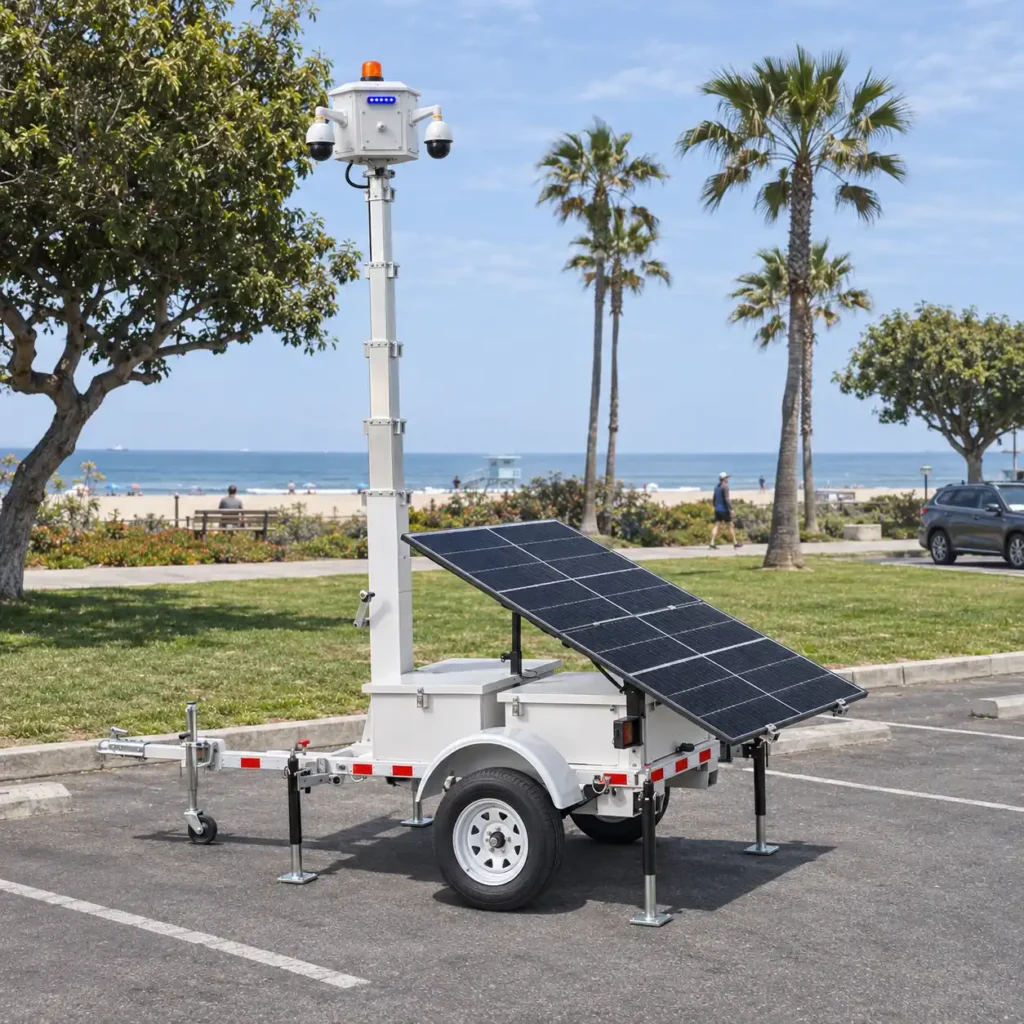
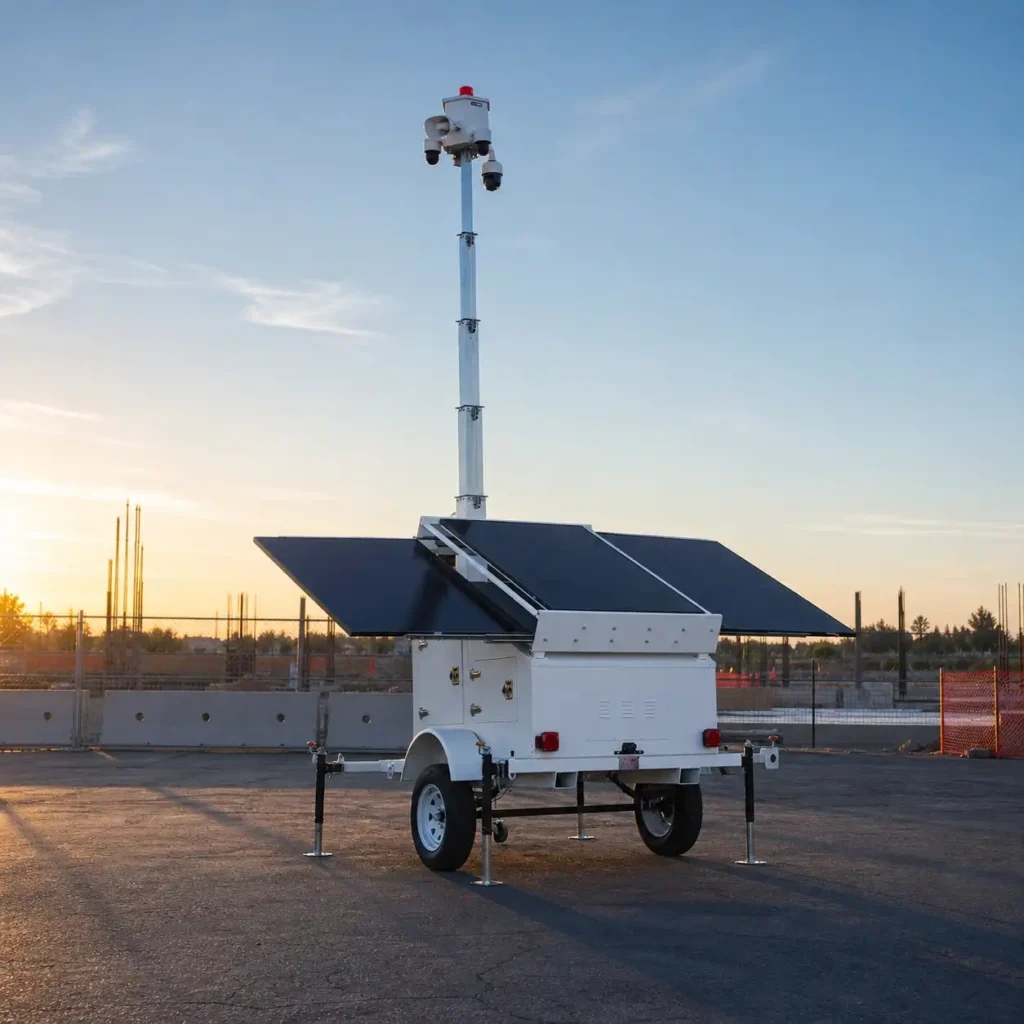
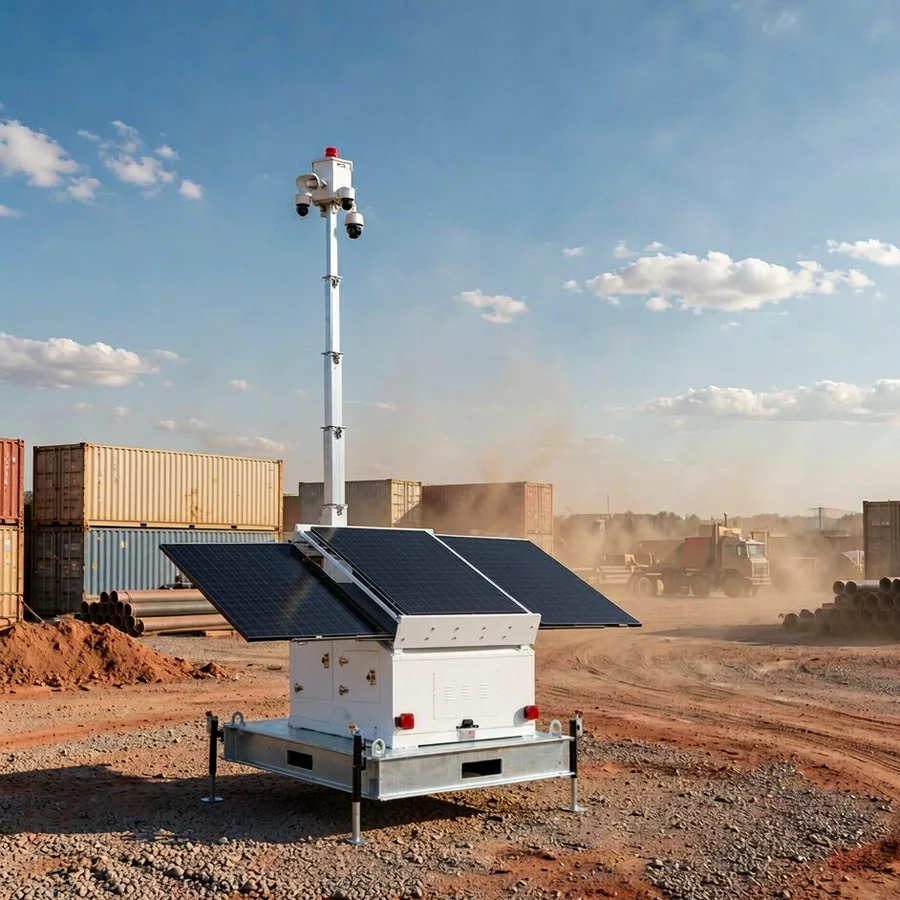
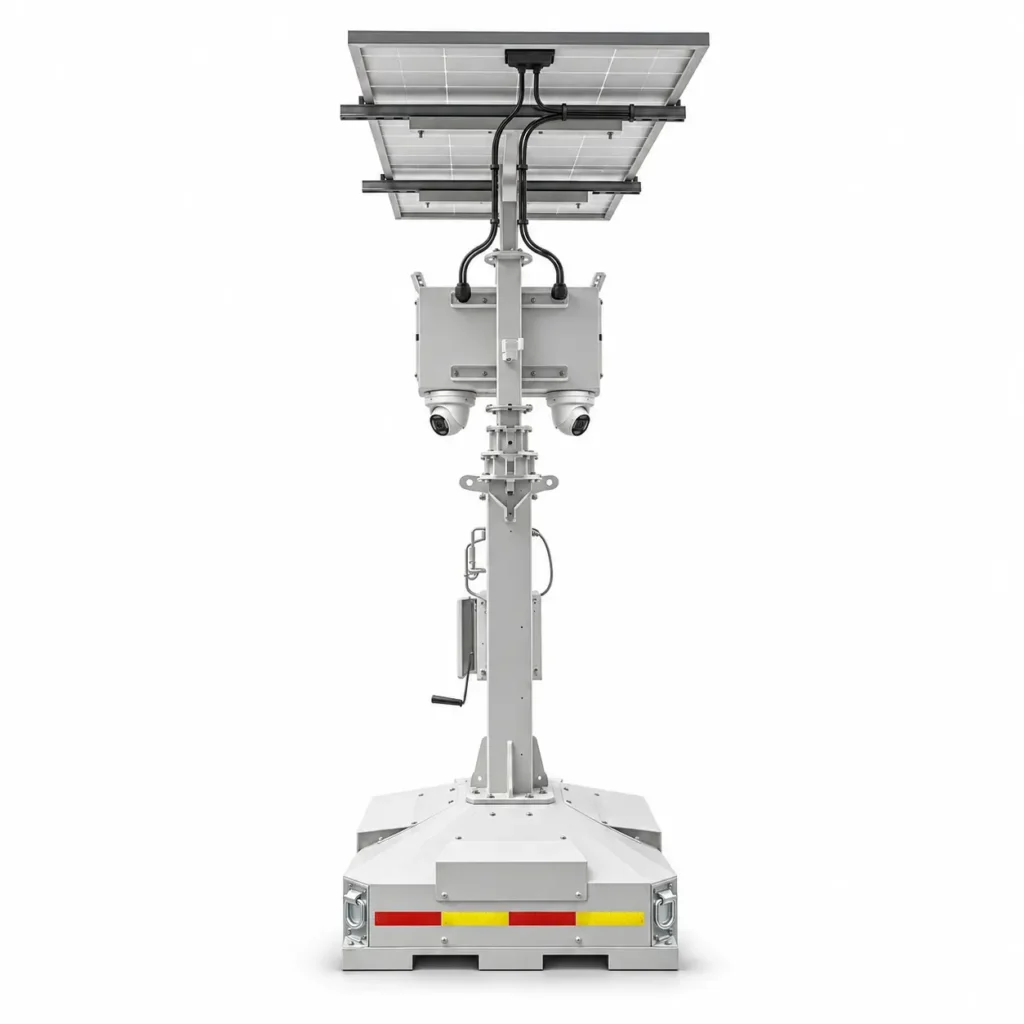
Three-quarter operating view showing the raised and deployed solar array, skid base and 8 m mast
HANKUN 5000B Skid-Mounted Solar Surveillance Tower — Three-quarter operating view showing the raised and deployed solar array, skid base and 8 m mast
IMG-02
Solar-array sequence showing lowered/retracted, raised and fully deployed states
HANKUN 5000B Skid-Mounted Solar Surveillance Tower — Solar-array sequence showing lowered/retracted, raised and fully deployed states
IMG-03
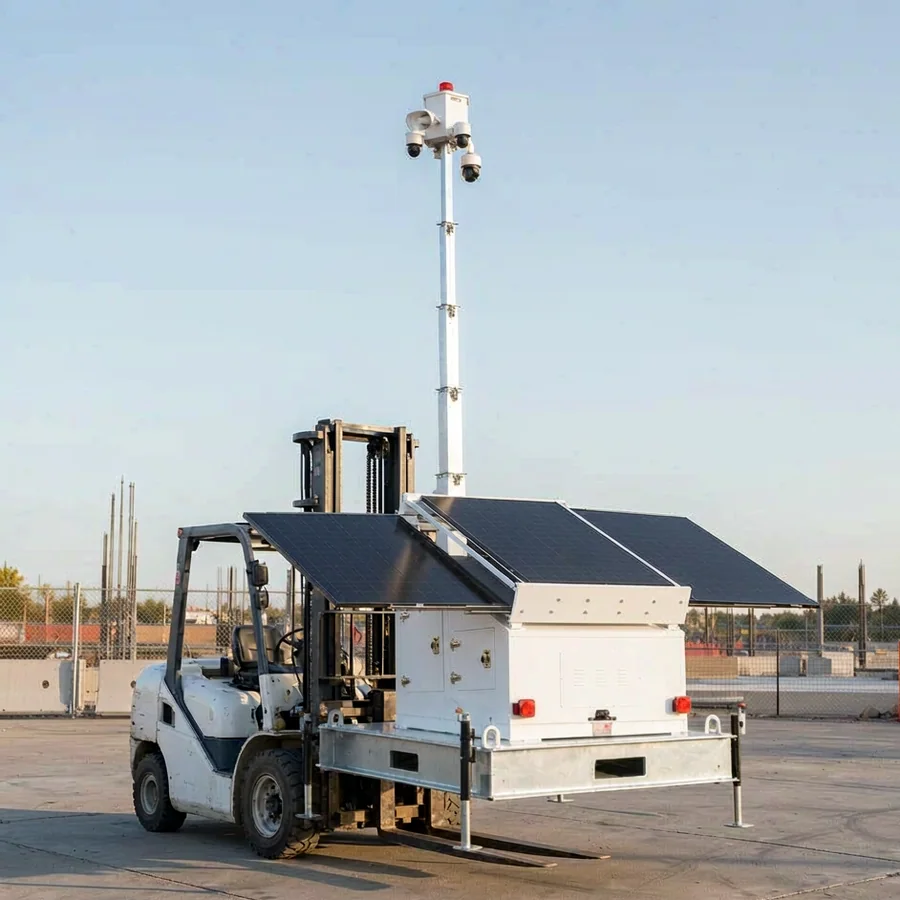
Long-fork forklift placement using the released fork interfaces
HANKUN 5000B Skid-Mounted Solar Surveillance Tower — Long-fork forklift placement using the released fork interfaces
IMG-04
Four-point crane lift showing four 2,000 lb lifting points and the approved rigging plan
HANKUN 5000B Skid-Mounted Solar Surveillance Tower — Four-point crane lift showing four 2,000 lb lifting points and the approved rigging plan
IMG-05
Four retractable stabilizer outriggers shown at the 1100 mm outward-extension position with the leveling jacks set
HANKUN 5000B Skid-Mounted Solar Surveillance Tower — Four retractable stabilizer outriggers shown at the 1100 mm outward-extension position with the leveling jacks set
IMG-06
Six-sided camera box with rear service access and internal cabling
HANKUN 5000B Skid-Mounted Solar Surveillance Tower — Six-sided camera box with rear service access and internal cabling
IMG-07
Lead-acid and lithium-ion battery accommodation layouts shown separately
HANKUN 5000B Skid-Mounted Solar Surveillance Tower — Lead-acid and lithium-ion battery accommodation layouts shown separately
IMG-08
Typical fixed, PTZ, panoramic and thermal camera packages with their load worksheet
HANKUN 5000B Skid-Mounted Solar Surveillance Tower — Typical fixed, PTZ, panoramic and thermal camera packages with their load worksheet
IdentityEngineering model
Engineering model
HK-SC-SK-5000B
PlatformStructure and stowed envelope
Product classification
Skid-mounted, non-wheeled, non-road-towable solar surveillance tower
Stowed dimensions (W × L × H)
2000 × 3500 × 2230 mm
Approximate base-configuration weight
Approx. 980 kg; final ordered weight varies by batteries, array and payload
Corrosion protection
Hot-dip galvanized coating thickness ≥ 90 μm
Handling
Long-fork forklift / crane; fork-pocket and lifting details follow the released handling drawing
Lifting points
4 lifting points × 2,000 lb rated load per point
DeploymentStabilizer system
Stabilizer system
4 retractable outriggers with leveling jacks
Outrigger outward extension
1100 mm
SolarArray configurations
Available panel configurations
2–4 × 460 W panels or 2 × 760 W panels
Array support mechanism
Elevating, deployable and retractable solar-array support system
Vertical and deployment movement
Raises / lowers and deploys / retracts into the defined stowed state
BatteryAccommodation and usable energy
Lead-acid maximum accommodation
6 × 12 V 250 Ah; 18 kWh aggregate nominal nameplate energy
Lithium-ion battery-bank maximum accommodation
8 × 25.6 V 200 Ah; 40.96 kWh aggregate nominal nameplate energy
Tilt-angle adjustment
Project-set according to the approved site configuration; range follows the ordered drawing
MastLifting and payload
Maximum height
8 m
Lifting options
Manual or electric
Rated structural payload
100 kg; optional motorized pan-tilt platform
CameraMounting and supply
Equipment box
Six-sided camera equipment box
Camera supplyPackage options
Camera package
Factory-integrated cameras optional; customer-supplied compatible cameras accepted
Camera types
Fixed / PTZ / panoramic / thermal, subject to the approved camera schedule
Internal cablingPower and data
Power and data
4-core × 2.5 mm² power cable + Cat6 data cable
EnclosureIngress protection
Electrical enclosure
IP65 control enclosure option; confirm the ordered enclosure and supporting document
ThermalVentilation and cooling
Ventilation / cooling
Temperature-controlled ventilation fan option
PowerCharging and outputs
AC charging input
AC 110–230 V, 50/60 Hz
DC outputs
DC 12 V / 24 V; optional AC output with the ordered inverter
Road useTowability
Towability
Not a trailer and not road-towable
LogisticsContainer loading
20GP loading
6 units
LogisticsContainer loading
40HQ loading
14 units
CommercialLead time and warranty
Sample lead time
Approx. 2 weeks
Batch lead time
Approx. 45 days
CommercialWarranty
Limited warranty
3 years
Usable energy and autonomy
Calculated from the approved battery architecture, BMS limits, temperature, depth of discharge, conversion loss, actual load and reserve
It is a non-wheeled skid-mounted solar surveillance tower for longer-duration placement and equipment-assisted relocation rather than road towing.
No. It has no axle, road wheels or tow hitch. Movement requires the approved long-fork forklift or crane procedure.
The current options are 2–4 × 460 W panels or 2 × 760 W panels on an elevating support system. The array can be raised or lowered, deployed or retracted, and set to the approved project-specific tilt angle. The ordered drawing defines the adjustment range and stowed position.
The stated maximum accommodation is six 12 V 250 Ah lead-acid batteries or eight 25.6 V 200 Ah lithium-ion batteries, subject to the approved electrical and mechanical arrangement.
An 8 m telescopic mast with manual or electric lifting, a 100 kg structural payload rating and an optional motorized pan-tilt platform.
Cameras are optional. Buyers may select a factory-integrated package or supply compatible cameras for integration.
The stated stowed dimensions are 2000 × 3500 × 2230 mm (W × L × H), with an approximate 980 kg base configuration. Final weight depends on the selected batteries, array and payload.
They compare the maximum stated lead-acid and lithium-ion accommodation at illustrative 80 W and 120 W average loads. Replace every assumption with the ordered battery limits, temperature and actual device schedule before selection.
Yes. Camera type, quantity, lens, analytics, mounting and interfaces are confirmed through the approved camera schedule.
4G/5G remote viewing can be configured. Availability depends on coverage, bands, data service, network design, cybersecurity and the selected VMS or cloud platform.
Usable battery energy is divided by the verified average load and adjusted for temperature, conversion losses and reserve margin. It is not one universal number.
Provide location, site objective, coverage, camera tasks, retention, network, solar and temperature conditions, wind requirement, deployment period, movement method, quantity and target date.
Fill in your information to reserve a free exclusive video consultation. Our team will contact you within 24 hours to arrange a dedicated online meeting.