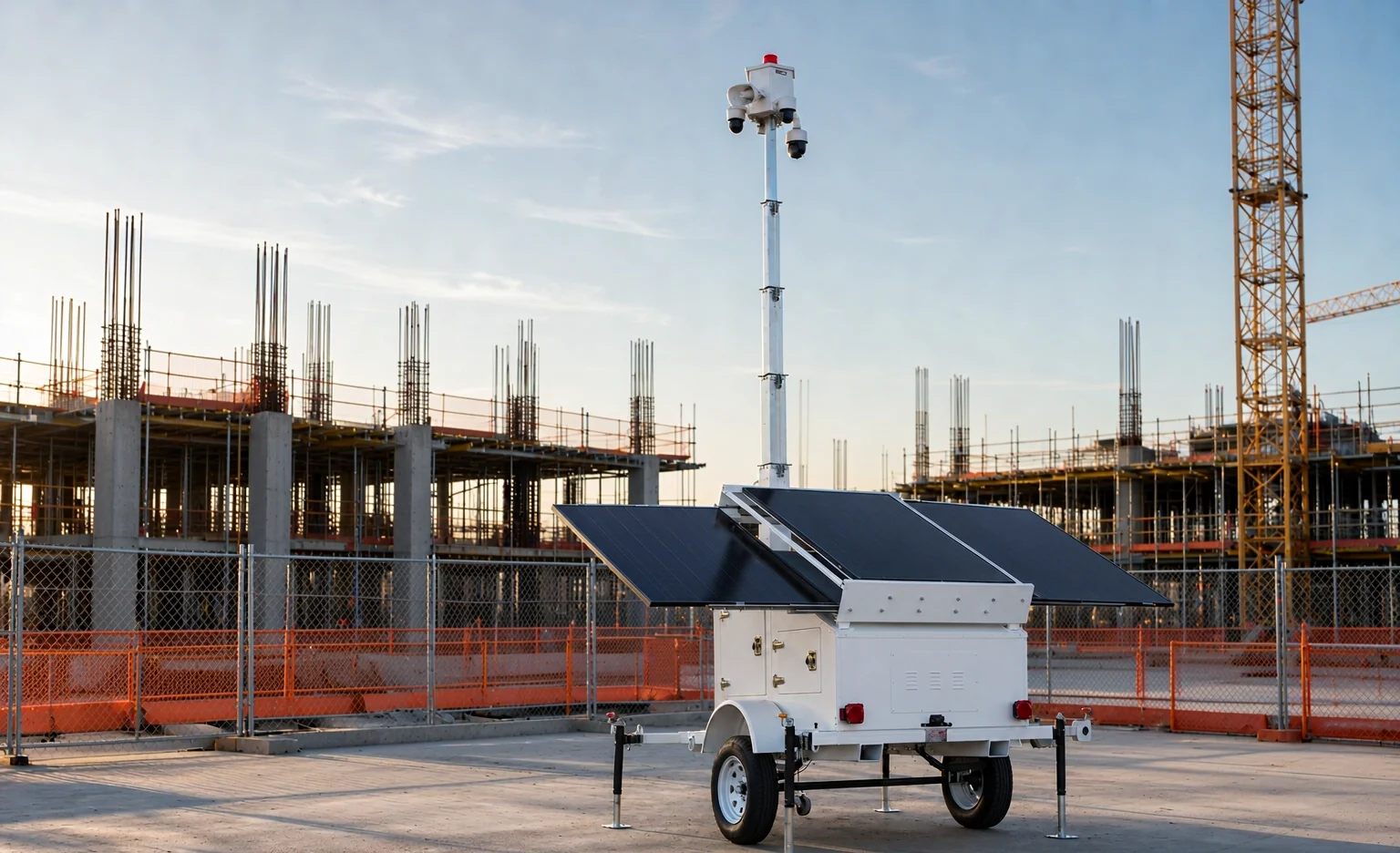
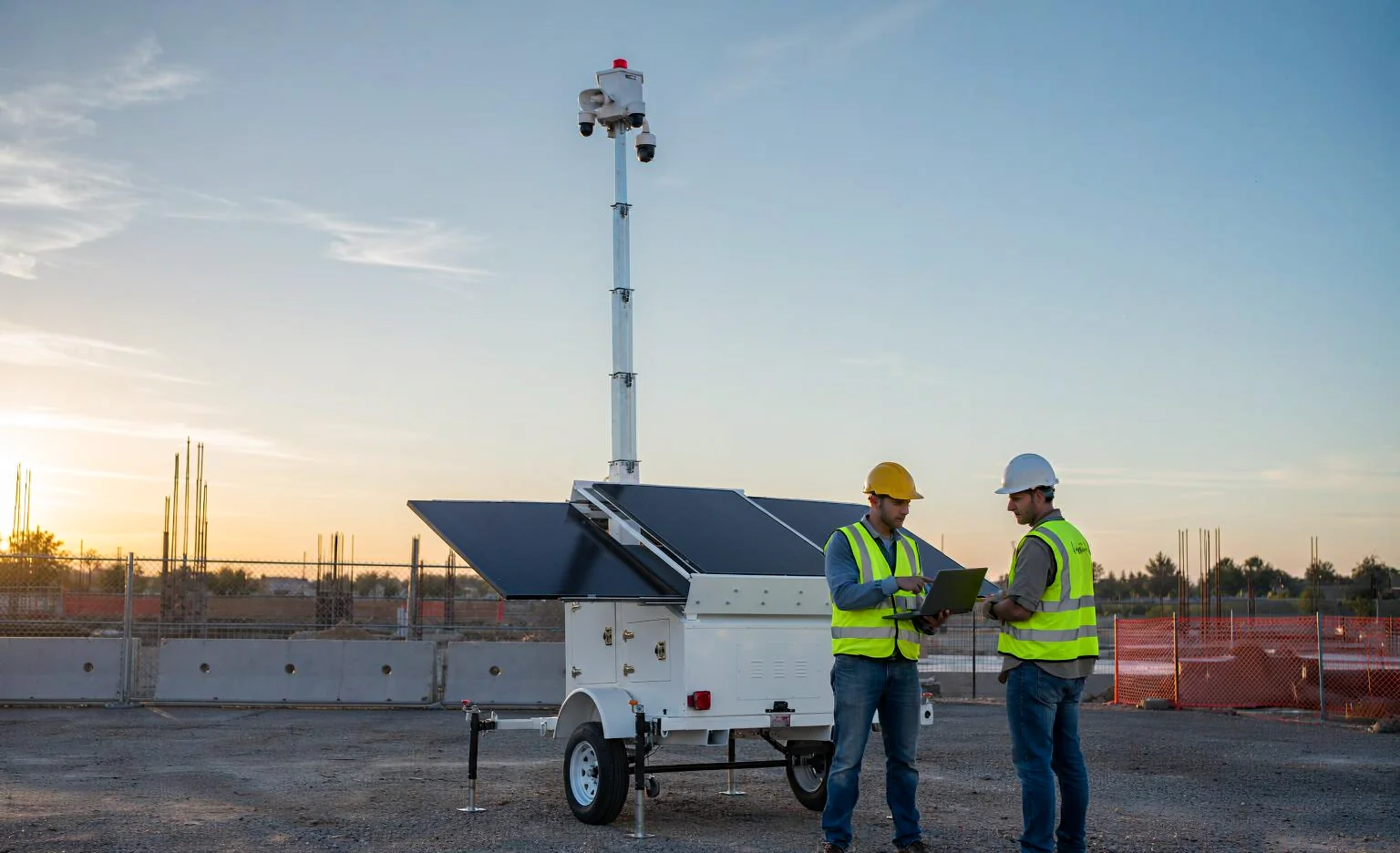
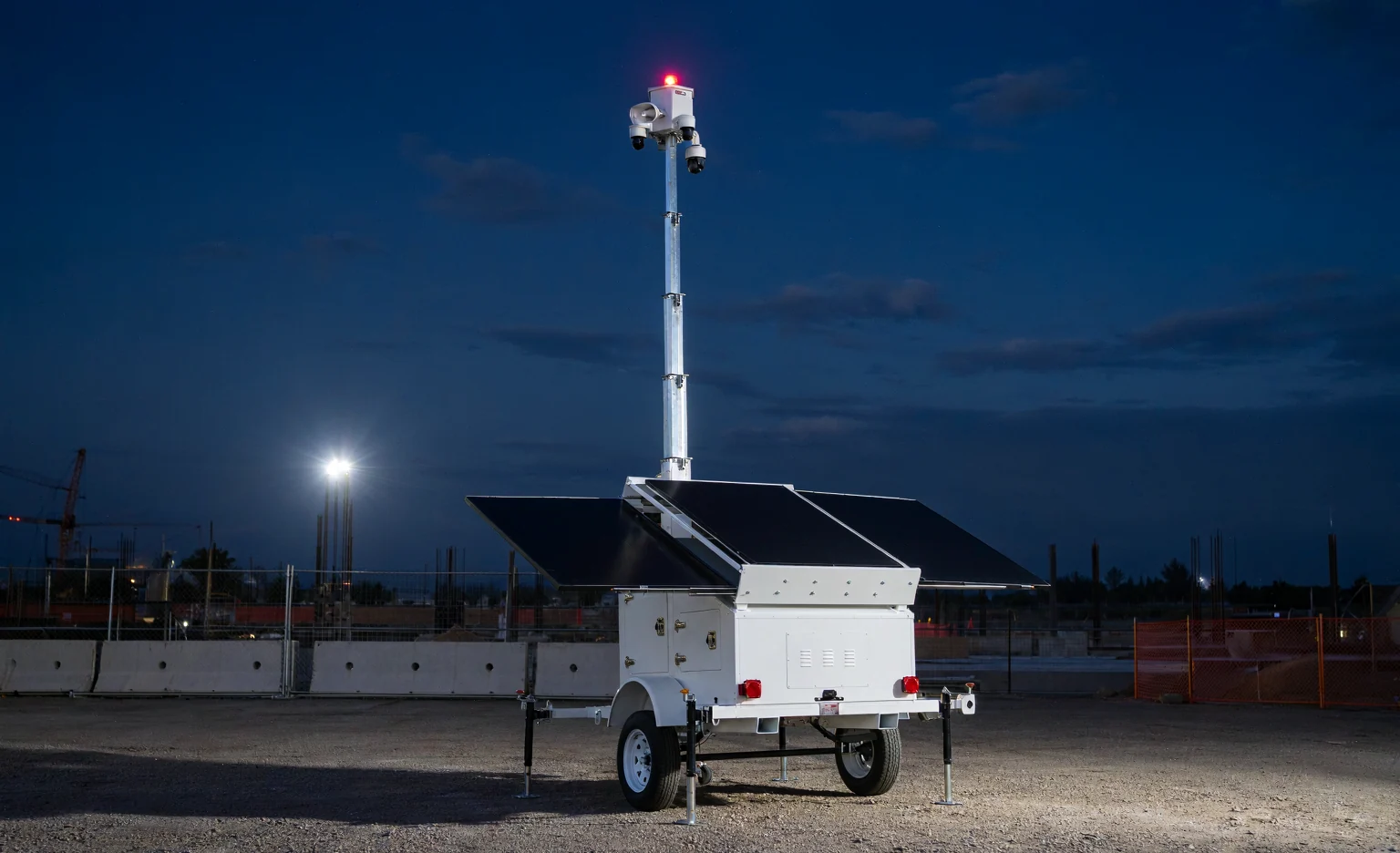
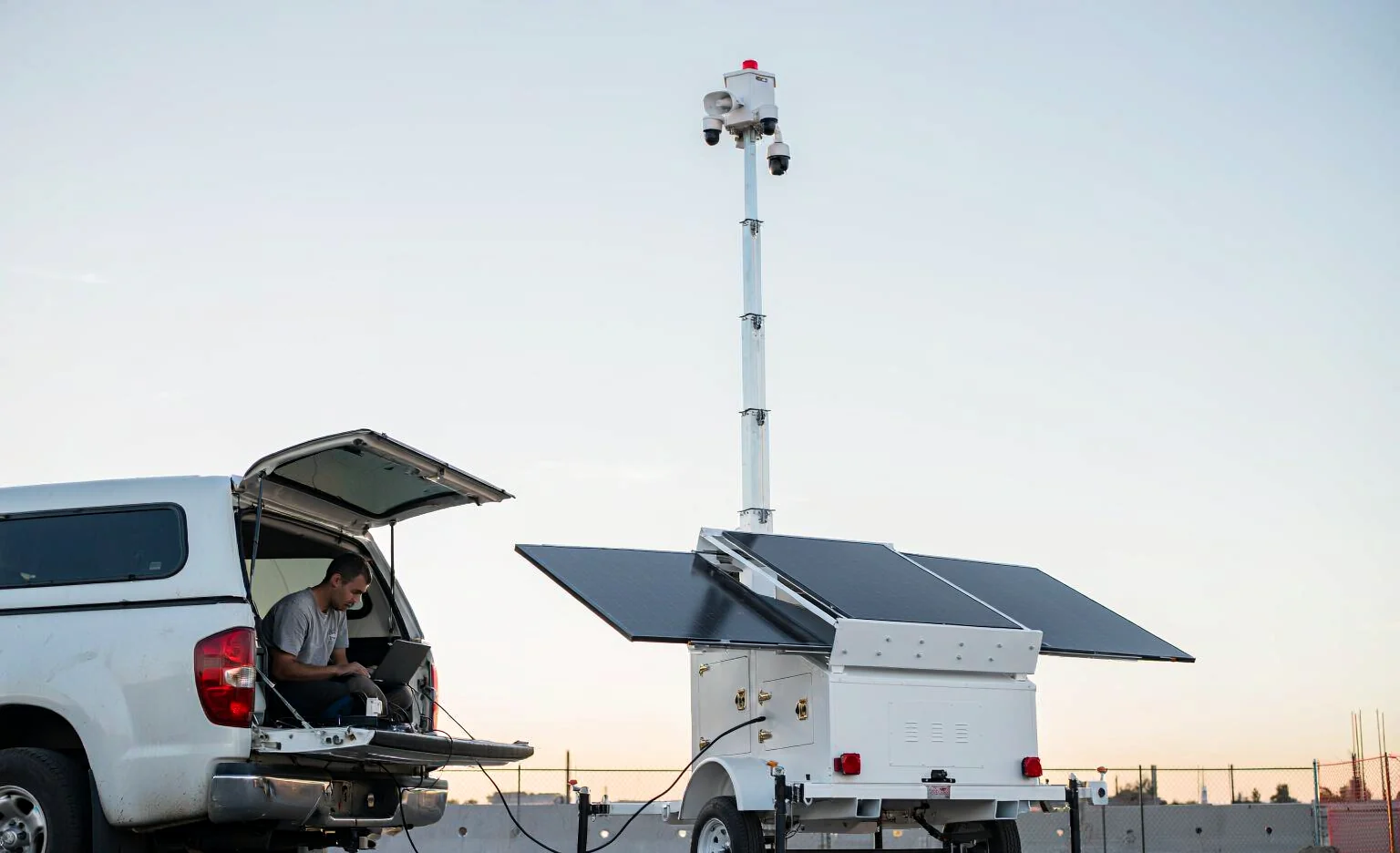
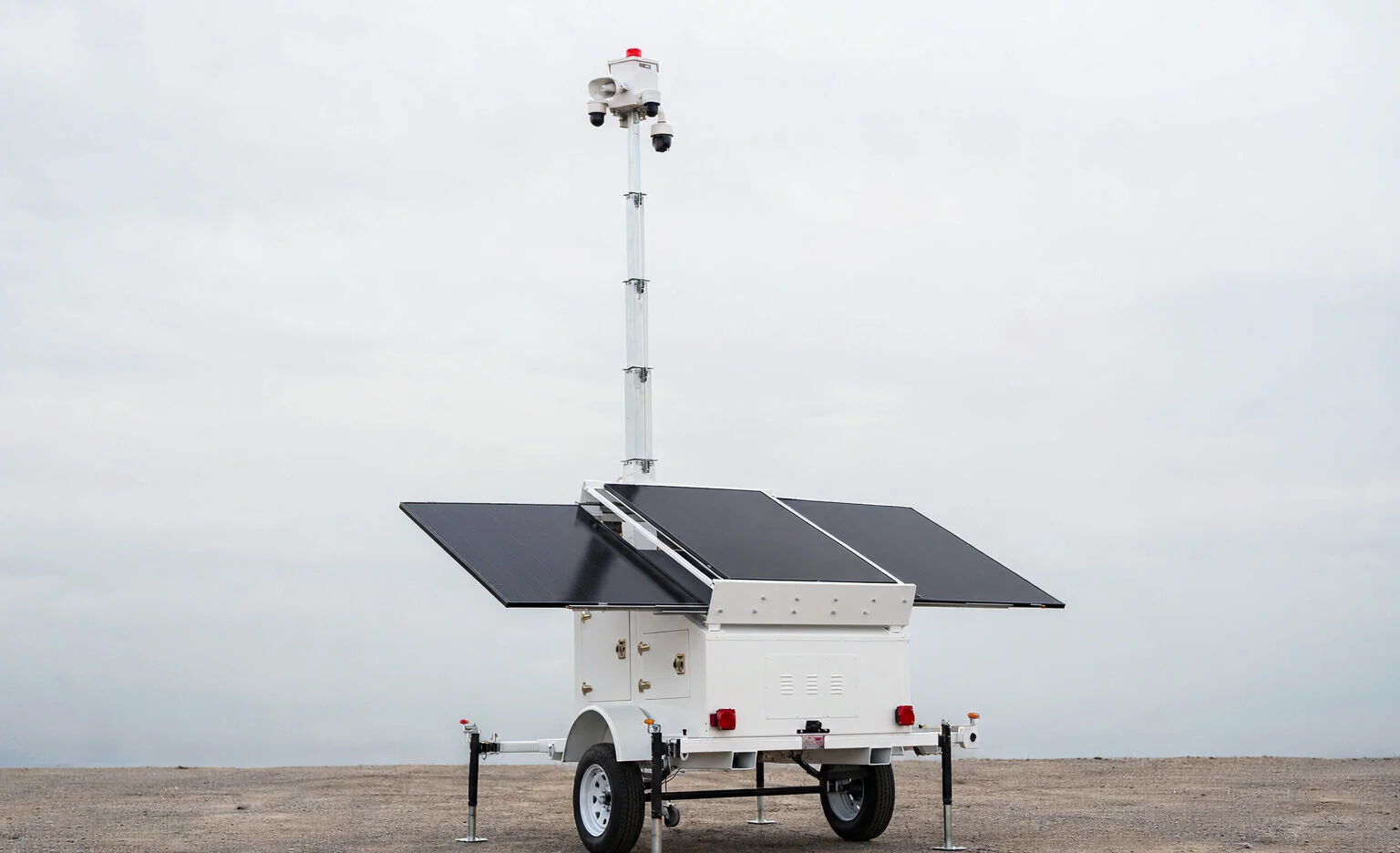
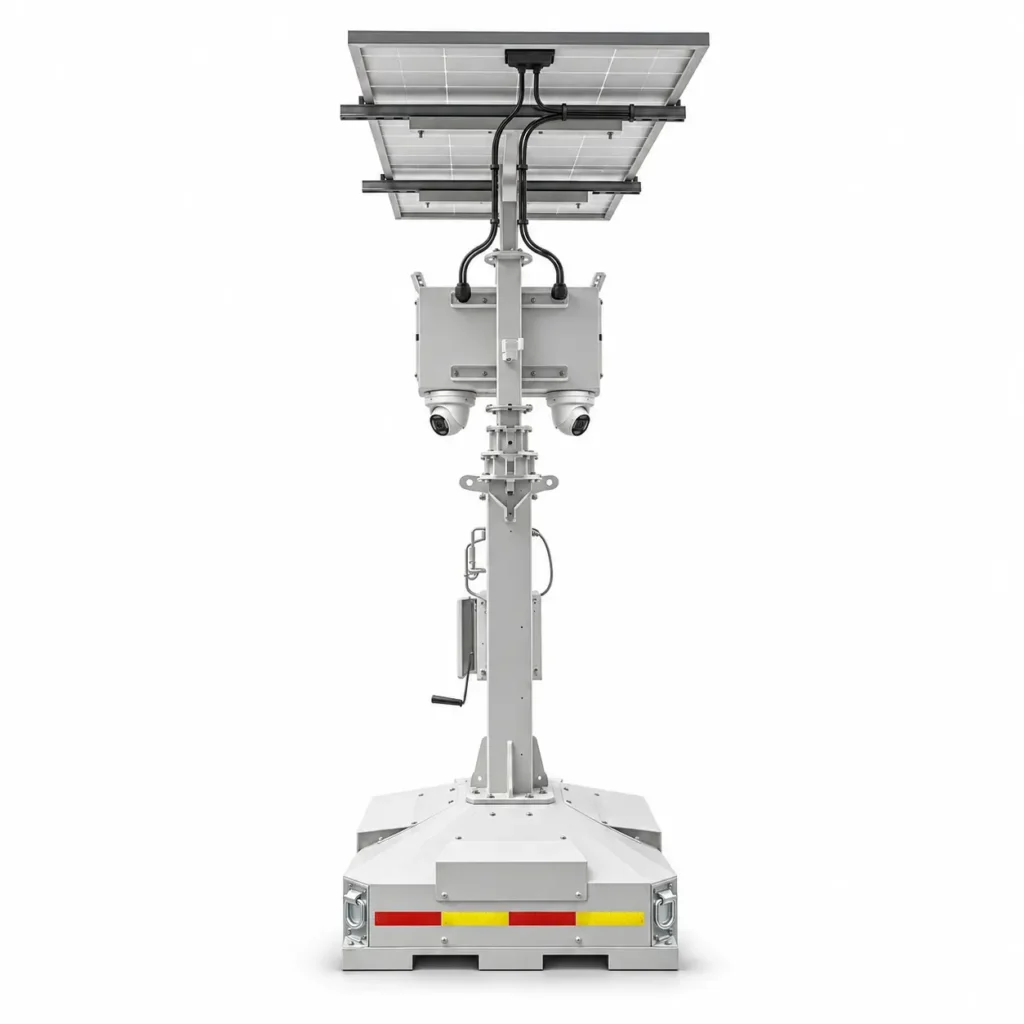
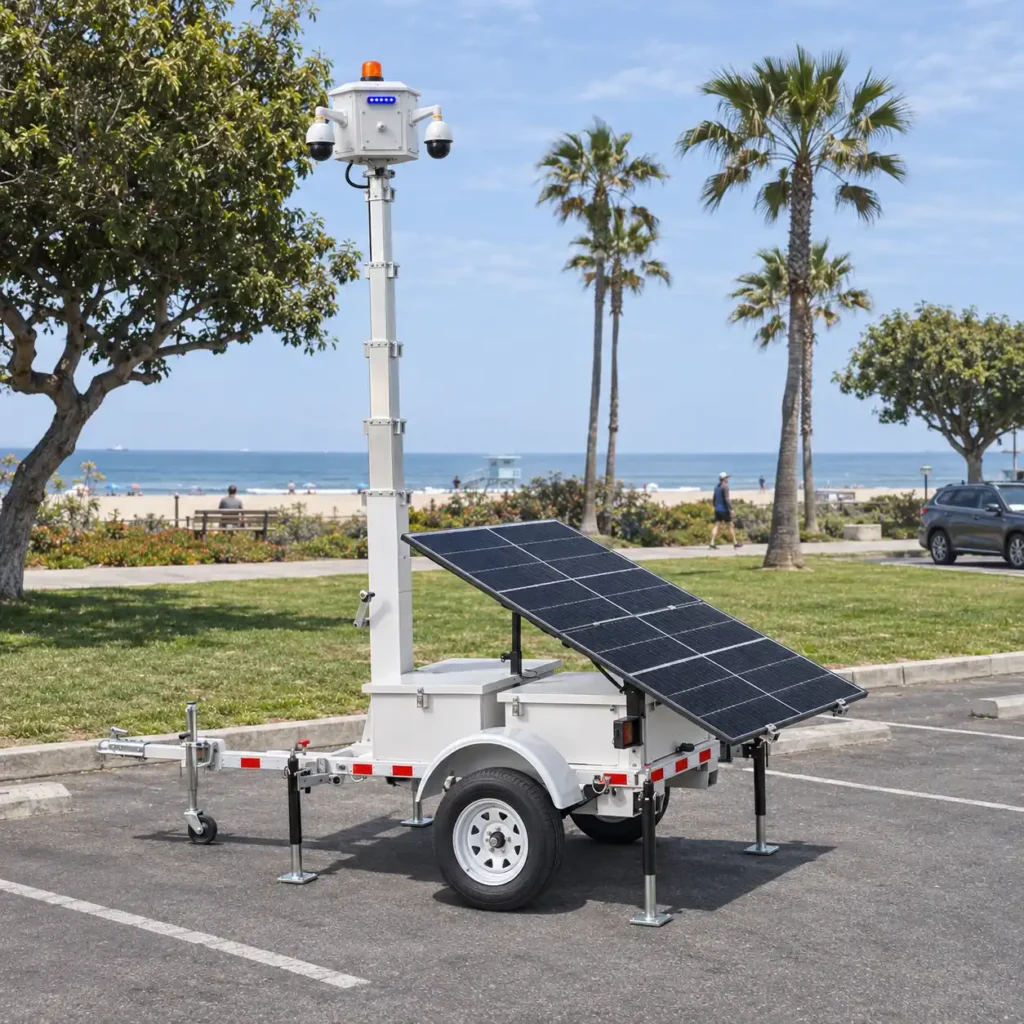
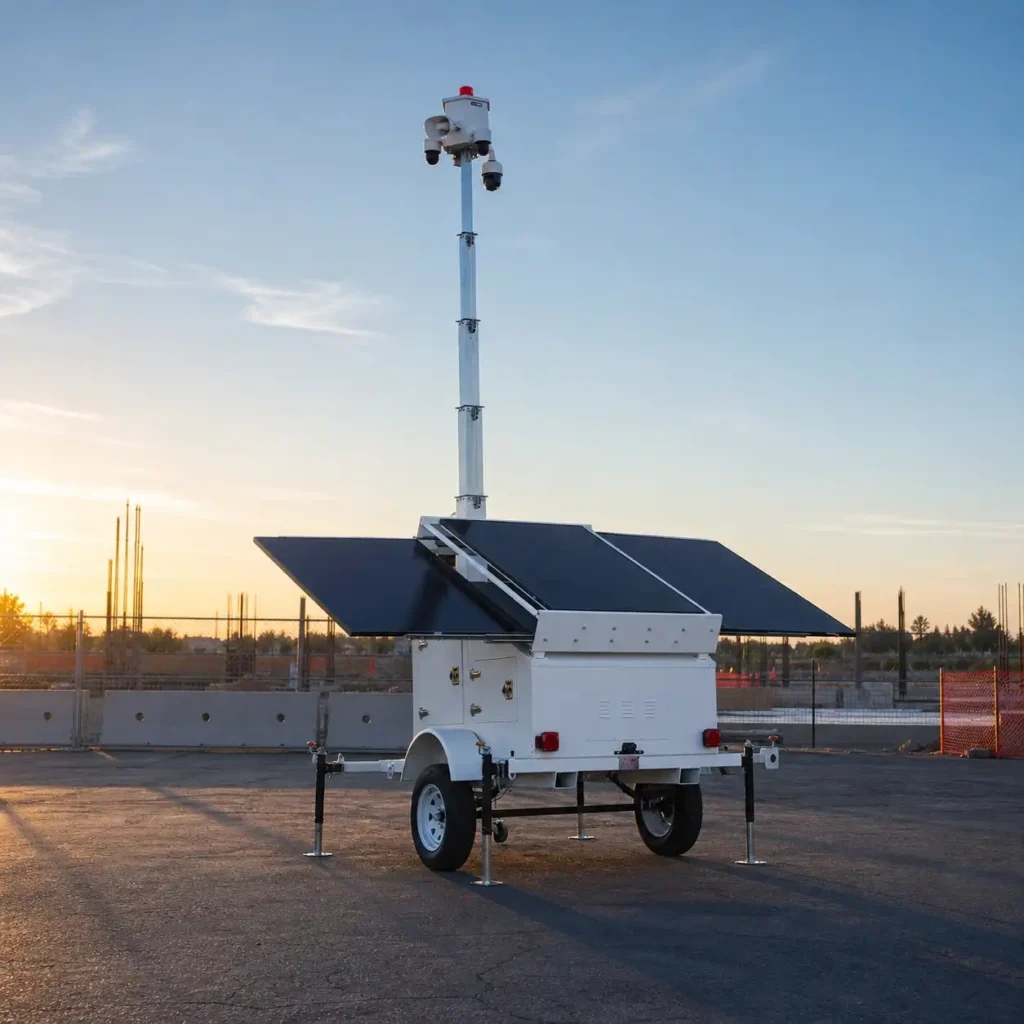
Solar-Powered Mobile Surveillance SystemsFour-panel, four-direction folding non-trailer tower

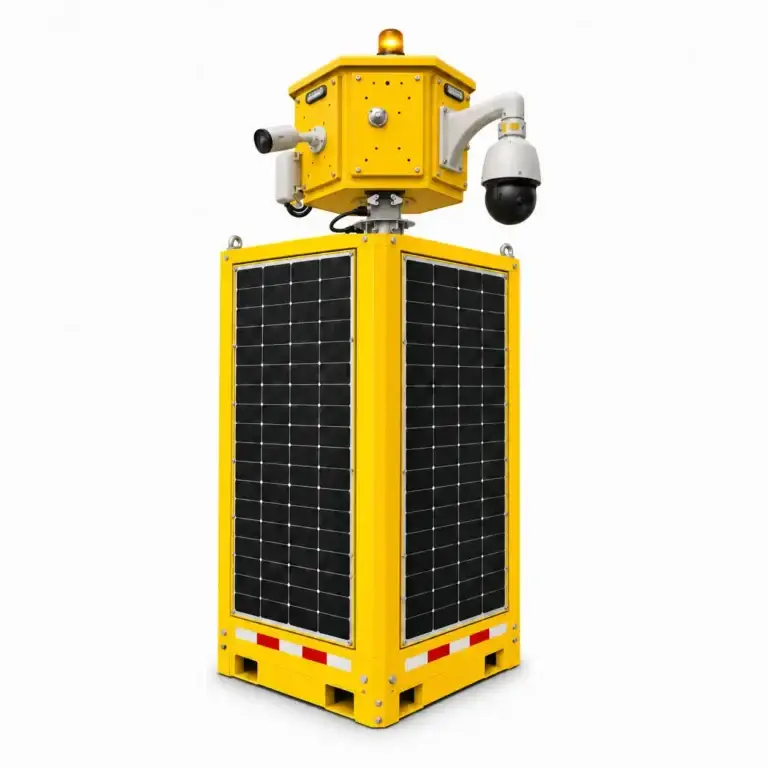
HANKUN 100S40 Four-Panel Non-Trailer Solar Surveillance Tower

Home›Products›Solar Surveillance Towers›HANKUN 100S40 Four-Panel Non-Trailer Solar Surveillance Tower
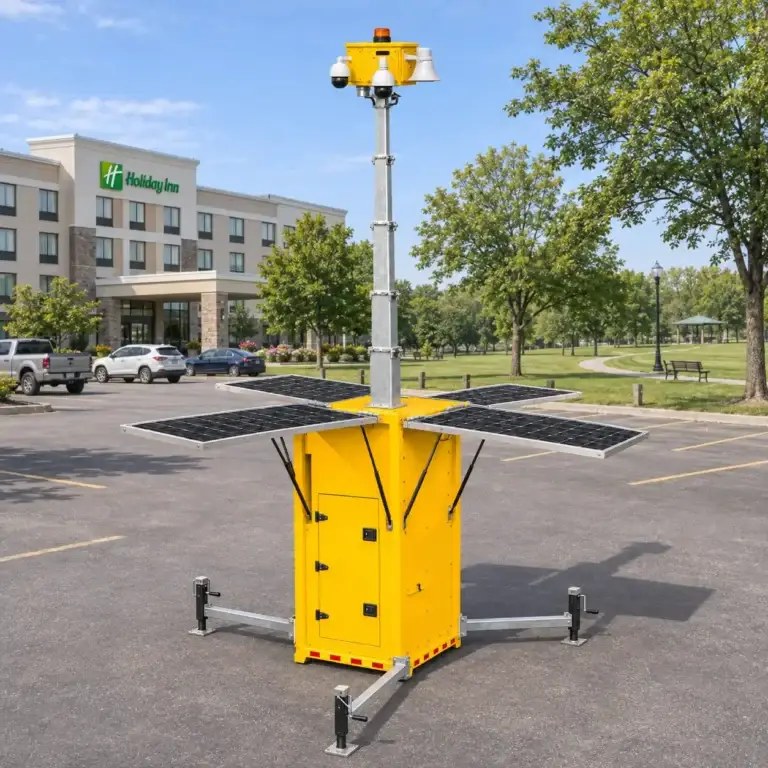
A compact non-trailer solar CCTV tower with four 360 W panels that deploy and retract in four directions, a 7 m electro-hydraulic telescopic mast, four retractable outriggers with stabilizer jacks, and an enclosed four-battery compartment.
Who should choose it: Choose the 100S40 when the site needs a 1,440 W retractable solar array, a 7 m electro-hydraulic mast and an approved package of up to six cameras, but movement will be by forklift or crane rather than road towing.
HANKUN 100S40 Four-Panel Non-Trailer Solar Surveillance TowerHANKUN 100S40 Four-Panel Non-Trailer Solar Surveillance Tower2HANKUN 100S40 Four-Panel Non-Trailer Solar Surveillance Tower3HANKUN 100S40 Four-Panel Non-Trailer Solar Surveillance Tower5

HANKUN 100S40 Four-Panel Non-Trailer Solar Surveillance Tower

Model HK-SC-P-100S40 Four-Direction ArrayNon-TrailerUp to 6 Cameras*
BEST FOR
CAMERA FIT
RELOCATION
STRUCTURE
Multi-direction site coverage
Up to 6 cameras*
Forklift / crane only
Non-trailer · 1200 × 1200 × 2200 mm stowed · approx. 780 kg
SOLAR & BATTERY
MAST & CAMERA
LEVELLING & HANDLING
POWER INTERFACES
4 × 360 W · 1,440 W nominal · accommodates 4 × 12 V 200 Ah
7 m electro-hydraulic telescopic mast · 100 kg rating · up to 6 cameras*
4 retractable outriggers with stabilizer jacks · forklift / crane
110–230 V AC 50/60 Hz charging · 3 kW inverter · DC 12 V / 24 V
* Maximum quantities and optional functions depend on the selected camera package, payload and power configuration.
“Mobile CCTV tower” describes controlled site relocation by forklift or crane. The approximately 780 kg HANKUN 100S40 has no axle, road wheels or tow hitch and must never be presented as a towable solar CCTV trailer. AC charging input and optional inverter-fed AC output are separate functions.
— Model Definition

7 m Electro-Hydraulic Four-Panel Solar CCTV Tower For Non-Trailer Deployment

The HANKUN 100S40 is a four-panel solar CCTV tower, portable solar surveillance tower and compact off-grid surveillance tower with a four-direction retractable solar array, a 7 m electro-hydraulic telescopic mast and four retractable outriggers with stabilizer jacks. It supports AC charging input, optional AC output and DC 12 V / 24 V camera outputs.
One platform, three procurement descriptions — the wording changes with the specification, not the hardware.
▤
Category name

Four-Panel Solar Surveillance Tower

HK-SC-P-100S40
The name used in this page’s specification table and approved configuration list.
◎
Relocation-led name

Mobile Solar CCTV Tower

Relocation-led
Describes controlled site relocation by forklift or crane; it does not mean road towing.
⬤
Structure-led name

Non-Trailer Solar CCTV Tower

Structure-led
Used when procurement must distinguish equipment-assisted movement from a towable trailer.
Choose the 100S40
Choose the 100S40 when the site needs a 1,440 W retractable array, a 7 m electro-hydraulic mast and up to six approved cameras, while relocation is by forklift or crane rather than road towing.
Choose the 100S
Choose the single-panel 100S when only one low-power camera is required and a simpler, more economical non-trailer format is preferred.
— Selection Guide

Not Sure This Is The Right Structure? 9 Selection Questions

Nine questions decide whether the 100S40 structure fits the load, the site and the handling plan.
Q1

Does the approved load exceed the practical 100S energy budget?

Provide every camera, recorder, router, speaker and accessory load before selecting the 100S40.
Q2

Can all four panels and four outriggers deploy with safe clearance?

Confirm the released deployed footprint, personnel access and exclusion zone instead of estimating from an image.
Q3

How many and what types of cameras are required?

The platform can carry up to six cameras, but PTZ, turret, thermal and other devices must be checked as an actual package.
Q4

What else must the tower power?

Separate DC 12 V / 24 V loads from any optional inverter-fed AC loads and include all conversion losses.
Q5

Is a 7 m mast appropriate for the required field of view?

Confirm target distance, camera lens, mounting arrangement, overhead clearance, wind condition and the 100 kg structural payload limit.
Q6

How much no-sun autonomy is required?

State the required hours or days so the four 12 V 200 Ah batteries can be validated against usable energy and reserve margin.
Q7

What solar conditions apply at the site?

Provide location, peak-sun-hours, season, shading, temperature and panel orientation conditions.
Q8

Can a forklift or crane handle an approximately 780 kg unit?

Confirm equipment capacity, fork reach or lifting plan, centre of gravity and the released handling procedure.
Q9

Will the panels or mast remain deployed in wind?

Confirm the permitted operating state, deployed outriggers and stabilizer jacks, ground condition and wind evidence before release.
— Core Structure

Six Statements That Define The Platform

Each item is a fixed property of the 100S40. Anything not listed here belongs to the ordered configuration and is confirmed in writing.
HANKUN 100S40 Four-Panel Non-Trailer Solar Surveillance Tower
01

Non-trailer square base

Non-trailer 1200 × 1200 mm square base; stowed height 2200 mm.
HANKUN 100S40 Four-Panel Non-Trailer Solar Surveillance Tower
02

Four-direction array

4 × 360 W solar panels deploy and retract in four directions.
HANKUN 100S40 Four-Panel Non-Trailer Solar Surveillance Tower
03

Electro-hydraulic mast

7 m electro-hydraulic telescopic mast with a 100 kg rated structural payload.
HANKUN 100S40 Four-Panel Non-Trailer Solar Surveillance Tower
04

Four outriggers

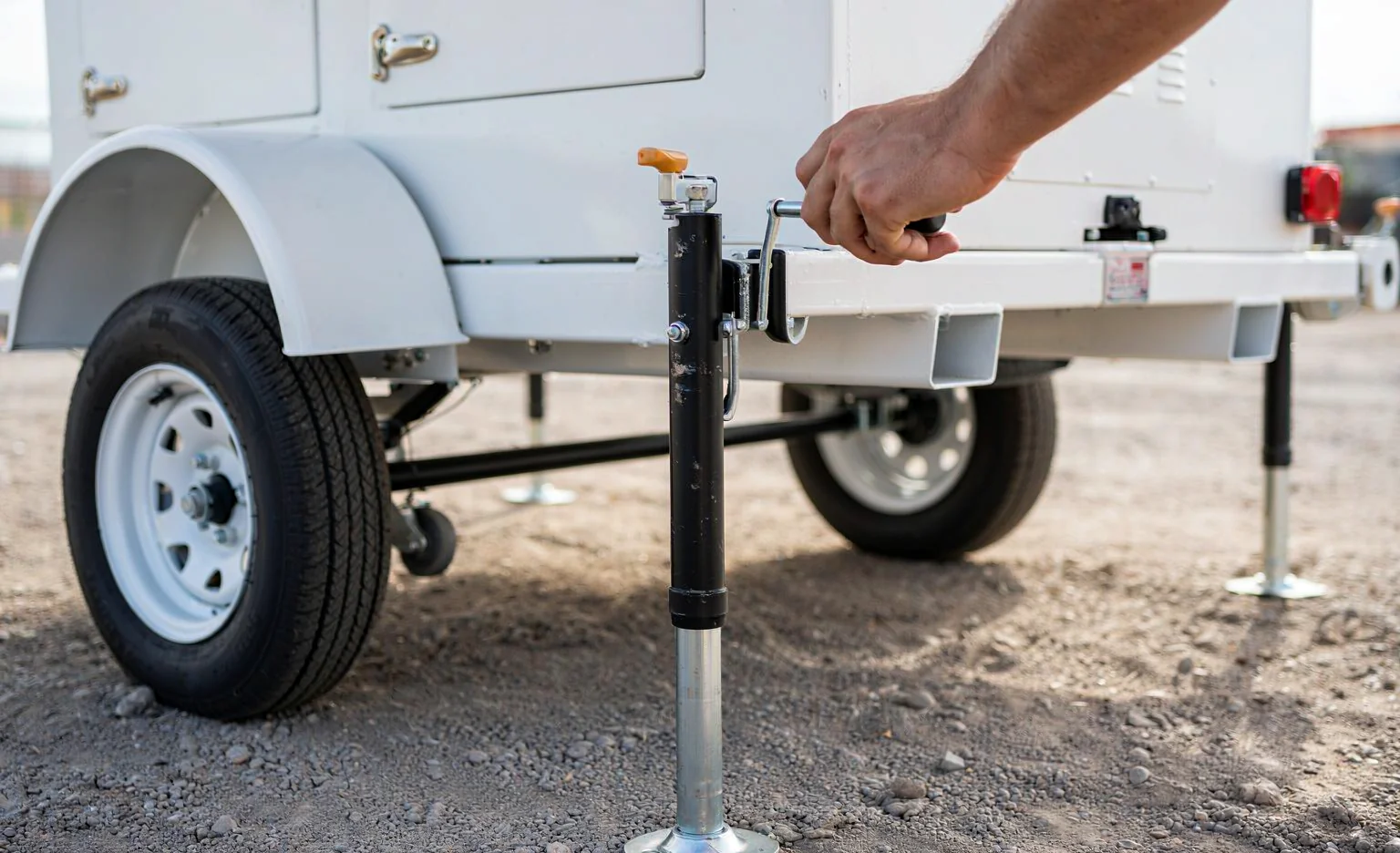
Four retractable outriggers with stabilizer jacks for site support and levelling.
HANKUN 100S40 Four-Panel Non-Trailer Solar Surveillance Tower
05

Four-battery compartment

Base accommodates 4 × 12 V 200 Ah batteries.
HANKUN 100S40 Four-Panel Non-Trailer Solar Surveillance Tower
06

Separate power interfaces

110–230 V AC, 50/60 Hz charging input; 3 kW inverter AC output; DC 12 V / 24 V outputs.
— System Layers

How The System Works

Four layers, each released separately. A change in one layer does not silently change the others.
01

Harvest

Solar generation under the approved site conditions.
02

Store & manage

Charge control and batteries sized from the real load.
03

Capture & record

Camera and recording architecture follow the task.
04

Connect & respond

Remote access and alerts depend on network and software design.
— Handling & Deployment

Equipment-Assisted Deployment And Relocation

The 100S40 is moved by forklift or crane, not by road towing. Each step follows the support, clearance, payload and handling conditions published for this model.
Stage
Operator action
Evidence / release requirement
1 · Prepare the support
Extend the four retractable outriggers and use the stabilizer jacks to level the unit on prepared ground.
Released support configuration, ground condition and exclusion zone.
2 · Deploy the array
Release the four 360 W panels in four directions and verify the deployed footprint and safe clearance.
Released footprint drawing, personnel access and exclusion zone.
3 · Raise the mast
Raise the 7 m electro-hydraulic telescopic mast after overhead-clearance and payload checks.
Target distance, camera lens, 100 kg payload limit, wind condition and overhead clearance.
4 · Configure the cameras
Fit up to six approved cameras within the reviewed mounting, power, field-of-view, network and recording plan.
Approved camera schedule, recording architecture and autonomy calculation.
5 · Relocate by equipment
Retract the panels and use the forklift pockets or four lifting eyes for controlled site relocation.
Equipment capacity, fork reach or lifting plan, centre of gravity and released handling procedure.
— Power Continuity

Solar, Storage And Power Interfaces

Five power decisions keep the camera point up. Generation, storage, AC charging, AC output and DC outputs are stated separately; nominal nameplate energy is not usable energy.
Nominal array
1,440 W4 × 360 W panels
Battery accommodation
9.6 kWhaggregate nominal nameplate
Power layer
100S40 configuration
What the buyer must confirm
Primary generation
4 × 360 W four-direction retractable array
Site solar resource, shading, season and daily energy demand.
Battery storage
Space for 4 × 12 V 200 Ah; 9.6 kWh aggregate nominal nameplate
Usable energy, temperature, reserve and actual system load.
External charging
110–230 V AC, 50/60 Hz; 1,000 W charger
Input voltage, connector and protection follow the ordered electrical design.
AC output
Optional 3 kW inverter supplies AC loads
AC-output voltage, socket and protection follow the ordered electrical design.
DC camera outputs
DC 12 V / 24 V outputs
Load, conversion losses and recording architecture confirmed in the approved schedule.
— Applications

Where This Model Is Used

Six deployment types are published for the 100S40. Each one keeps road-towing equipment out of the design while requiring approved forklift or crane handling.
HANKUN 100S40 Four-Panel Non-Trailer Solar Surveillance Tower

Multi-Camera Construction Points

Cover gates, material storage and active work areas from one approved camera package.
HANKUN 100S40 Four-Panel Non-Trailer Solar Surveillance Tower

Remote Compounds

Use a compact off-grid monitoring point where permanent power and road-trailer access are unavailable.
HANKUN 100S40 Four-Panel Non-Trailer Solar Surveillance Tower

Industrial Access Areas

Combine multiple verified views around one controlled entrance or operating area.
HANKUN 100S40 Four-Panel Non-Trailer Solar Surveillance Tower

Temporary Perimeter Nodes

Deploy a higher-load surveillance point with a clearly defined four-panel safety footprint.
HANKUN 100S40 Four-Panel Non-Trailer Solar Surveillance Tower

Parking And Logistics Areas

Support several camera directions around vehicle, loading or asset zones.
HANKUN 100S40 Four-Panel Non-Trailer Solar Surveillance Tower

Repositioning Without Road Towing

Relocate by approved forklift or crane when the project changes, while keeping trailer running gear out of the design.
— Design Rationale

Why It Is Designed This Way

Six structural decisions, and the problem each one answers. They are the reason this platform is specified as a non-trailer tower rather than a towable chassis.
▤
Principle 01

Why four panels deploy in four directions

4 × 360 W→1,440 W array
The 4 × 360 W array provides 1,440 W nominal solar capacity and increases collection area around the compact square base without adding a trailer chassis.
⇄
Principle 02

Why the panels retract

Retractable→Not towable
Retracting the four panels reduces the equipment envelope for controlled storage and equipment-assisted site relocation; it does not make the unit road-towable.
◷
Principle 03

Why an electro-hydraulic mast is used

Electro-hydraulic→7 m mast
The electro-hydraulic lifting system raises and lowers the 7 m telescopic mast without relying on a manual winch. Operation still requires the prescribed support, clearance and wind procedure.
▮
Principle 04

Why four outriggers and stabilizer jacks are used

Outriggers→Levelled base
The retractable outriggers increase the support footprint; the stabilizer jacks contact the prepared ground and are used to level the unit before the mast is raised.
⚡
Principle 05

Why AC input and AC output are separate

AC input→Separate AC output
The 1,000 W charger accepts 110–230 V AC at 50/60 Hz to replenish the battery system from an external supply. The optional 3 kW inverter supplies AC loads; neither function replaces the DC 12 V / 24 V camera outputs.
◈
Principle 06

Why payload and camera count are stated separately

No running gear→Forklift / crane
The 100 kg mast rating is a structural limit. Up to six cameras still require checks for mounting, power, field of view, communications, recording and autonomy.
— Fit Boundary & Alternatives

When This Model Is Not The Right Choice

Five situations point to a different platform or to a different conversation. One of them is a claim that needs correcting before a quotation is issued.

Only one low-power camera is required

→ The single-panel 100S may provide a simpler and more economical solution.

Frequent public-road towing is required

→ Choose a verified 5000 or 8500 trailer platform; the 100S40 has no road-running gear.

The site has no safe four-direction deployment area

→ Use the released footprint drawing and select another platform if clearance cannot be maintained.

Forklift or crane access is unavailable

→ The 100S40 is not a hand-moved or towable unit; confirm suitable handling equipment before selection.

A very tall mast or long-range elevated coverage is essential

→ Review a larger engineered platform after confirming height, wind, payload and coverage requirements.
— Adjacent Model

How It Compares With The Adjacent Model

Both platforms are compact non-trailer solar towers. The procurement distinction is the array, the battery enclosure and the camera package — not the handling method.
This page
Adjacent model
Procurement distinction
HANKUN 100S40 Four-Panel Non-Trailer Solar Surveillance Tower
HANKUN 100S
100S40: 4 × 360 W four-direction retractable array, four-battery enclosure, up to six approved cameras and equipment-assisted movement. 100S: one 460 W panel and a focused lower-load camera package in a smaller non-trailer format.
— Image Evidence Plan

What The Supplied Photography Has To Prove

Eight images carry the claims made above. Each one is specified with the exact state it must show and the ALT text published with it.
ID
Required visual evidence
ALT direction
IMG-01
Three-quarter deployed view showing four 360 W panels, the 7 m mast and all four outriggers
HANKUN 100S40 Four-Panel Non-Trailer Solar Surveillance Tower — Three-quarter deployed view showing four 360 W panels, the 7 m mast and all four outriggers
IMG-02
Top view proving the four-direction panel layout and deployed support footprint
HANKUN 100S40 Four-Panel Non-Trailer Solar Surveillance Tower — Top view proving the four-direction panel layout and deployed support footprint
IMG-03
Electro-hydraulic mast shown in stowed, intermediate and fully raised states
HANKUN 100S40 Four-Panel Non-Trailer Solar Surveillance Tower — Electro-hydraulic mast shown in stowed, intermediate and fully raised states
IMG-04
Stowed 1200 × 1200 × 2200 mm state with no trailer running gear
HANKUN 100S40 Four-Panel Non-Trailer Solar Surveillance Tower — Stowed 1200 × 1200 × 2200 mm state with no trailer running gear
IMG-05
Four retractable outriggers and stabilizer jacks shown supporting and levelling the base
HANKUN 100S40 Four-Panel Non-Trailer Solar Surveillance Tower — Four retractable outriggers and stabilizer jacks shown supporting and levelling the base
IMG-06
Forklift pockets and four lifting eyes, each rated at 2,000 lb, for the approximately 780 kg unit
HANKUN 100S40 Four-Panel Non-Trailer Solar Surveillance Tower — Forklift pockets and four lifting eyes, each rated at 2,000 lb, for the approximately 780 kg unit
IMG-07
Approved six-camera configuration within the 100 kg structural payload
HANKUN 100S40 Four-Panel Non-Trailer Solar Surveillance Tower — Approved six-camera configuration within the 100 kg structural payload
IMG-08
Electrical interface evidence for 110–230 V AC 50/60 Hz charging, 3 kW inverter output and DC 12 V / 24 V outputs
HANKUN 100S40 Four-Panel Non-Trailer Solar Surveillance Tower — Electrical interface evidence for 110–230 V AC 50/60 Hz charging, 3 kW inverter output and DC 12 V / 24 V outputs
— Technical Data

Technical Specifications And Configuration

Review the current product structure and available configuration. The quotation and approved configuration list define the system supplied for each project.
Parameter
Published value / current configuration
IdentityEngineering model
Engineering model
HK-SC-P-100S40
PlatformProduct classification
Product classification
Four-panel non-trailer solar surveillance tower
Stowed dimensions (L × W × H)
1200 × 1200 × 2200 mm
Approximate complete-unit weight
Approx. 780 kg
Road-running gear
No axle, road wheels or tow hitch
Fully deployed footprint
Approx. 3000 × 3000 mm including the deployed array / support envelope
Movement method
Forklift pockets and four designated lifting eyes; approved procedure required
DeploymentSupport and levelling
Support and levelling
4 retractable outriggers with stabilizer jacks
Pre-raise levelling
Stabilizer jacks contact the prepared ground and level the unit before the mast is raised
SolarPanel quantity and rating
Panel quantity and rating
4 × 360 W
Nominal array rating
1,440 W under rated test conditions
Panel arrangement
Four panels deploy and retract in four directions
BatteryAccommodation
Accommodation
Space for 4 × 12 V 200 Ah batteries
Aggregate nominal nameplate energy
9.6 kWh before usable-energy and reserve adjustments
Series / parallel architecture and chemistry
Match the approved DC system, protection design, load and autonomy target
MastType and lifting method
Type and lifting method
Telescopic mast with electro-hydraulic lifting system
Maximum extended height
7 m
Rated structural payload
100 kg
HandlingMovement method
Movement method
Forklift pockets and four lifting eyes; forklift / crane only
SurveillanceMaximum camera count
Maximum camera count
Up to 6 cameras
Camera mix
PTZ, turret, fixed or other approved devices according to mounting, power and field-of-view review
Road useTowability
Towability
Not a trailer and not road-towable
CommunicationsCellular
Cellular
4G / 5G regional module
RecordingArchitecture
Architecture
Local recording / VMS / cloud-connected workflow
PowerAC charging input
AC charging input
110–230 V AC, 50/60 Hz
Charger rated power
1,000 W
OutputsAC and DC outputs
AC and DC outputs
Optional 3 kW inverter AC output; DC 12 V / 24 V outputs
EnvironmentWind with panels or mast deployed
Wind with panels or mast deployed
Permitted state, support configuration and ground condition require released evidence
ClearanceFour-direction deployment
Four-direction deployment
Confirm the released footprint drawing, personnel access and exclusion zone
Handling evidenceLifting-eye rated load
Lifting-eye rated load
2,000 lb per lifting eye × 4 lifting eyes
Site relocation
Controlled equipment-assisted relocation by forklift or crane; no road towing
ConfigurationApproved configuration
Approved configuration
The quotation and approved configuration list control the delivered system
Reference configuration
A reference or maximum configuration is not standard equipment
A reference or maximum configuration is not standard equipment. The quotation and approved configuration list control the delivered system.
— Configuration & System Design

Configuration And System Design

HANKUN 100S40 Four-Panel Non-Trailer Solar Surveillance Tower
01

Camera and recording

Fixed, varifocal, PTZ, thermal and LPR/ANPR options follow the approved camera schedule. Brand examples do not define the standard camera package.
HANKUN 100S40 Four-Panel Non-Trailer Solar Surveillance Tower
02

Battery terminology and autonomy

“Lithium-ion” identifies the battery family only; LiFePO₄ / LFP is used only when the ordered cell chemistry is confirmed. Nominal nameplate energy is not usable energy. The BMS limits, permitted depth of discharge, temperature, conversion losses, actual load and reserve setting determine usable energy and operating time.
HANKUN 100S40 Four-Panel Non-Trailer Solar Surveillance Tower
03

Project documentation

Drawings, configuration lists and applicable documents are supplied according to the ordered system and destination market.
— Before You Specify

Frequently Asked Questions

It combines four retractable 360 W panels, a 7 m electro-hydraulic telescopic mast, four retractable outriggers with stabilizer jacks and a non-trailer base handled by forklift or crane.
The public website treats 100S40 as a model identifier and does not assign an unapproved technical meaning to the suffix.
No. It has no axle, road wheels or tow hitch. The approximately 780 kg unit is moved by an approved forklift or crane procedure.
The telescopic mast reaches 7 m and uses an electro-hydraulic lifting system. The support, overhead-clearance and wind procedure must be followed before operation.
Up to six cameras can be configured, subject to the 100 kg mast payload rating and the approved mounting, power, field-of-view, network, recording and autonomy calculations.
Four 360 W panels provide 1,440 W nominal solar capacity, and the cabinet accommodates four 12 V 200 Ah batteries. Usable energy and autonomy depend on the final electrical architecture and operating conditions.
The stated stowed dimensions are 1200 × 1200 × 2200 mm (L × W × H). The separate deployed-footprint drawing must include the four panels and four outriggers.
The 1,000 W charger accepts 110–230 V AC at 50/60 Hz. The system provides DC 12 V / 24 V outputs and can be equipped with a 3 kW inverter for AC output. AC-output voltage, socket and protection follow the ordered electrical design.
Yes. Camera type, quantity, lens, analytics, mounting and interfaces are confirmed through the approved camera schedule.
4G/5G remote viewing can be configured. Availability depends on coverage, bands, data service, network design, cybersecurity and the selected VMS or cloud platform.
Usable battery energy is divided by the verified average load and adjusted for temperature, conversion losses and reserve margin. It is not one universal number.
Provide location, site objective, coverage, camera tasks, retention, network, solar and temperature conditions, wind requirement, deployment period, movement method, quantity and target date.

Related Products for Your Traffic Safety Solutions

North America Local After-Sales

Canada

US

Canada, Monte

Become a Distributor

Get a Traffic Safety Quote

Design a Solar Traffic Solution

Drag & Drop Files, Choose Files to Upload

Get Technical Proposal

Drag & Drop Files, Choose Files to Upload
Max. File Size: 100 MB

Video Consultation

Fill in your information to reserve a free exclusive video consultation. Our team will contact you within 24 hours to arrange a dedicated online meeting.