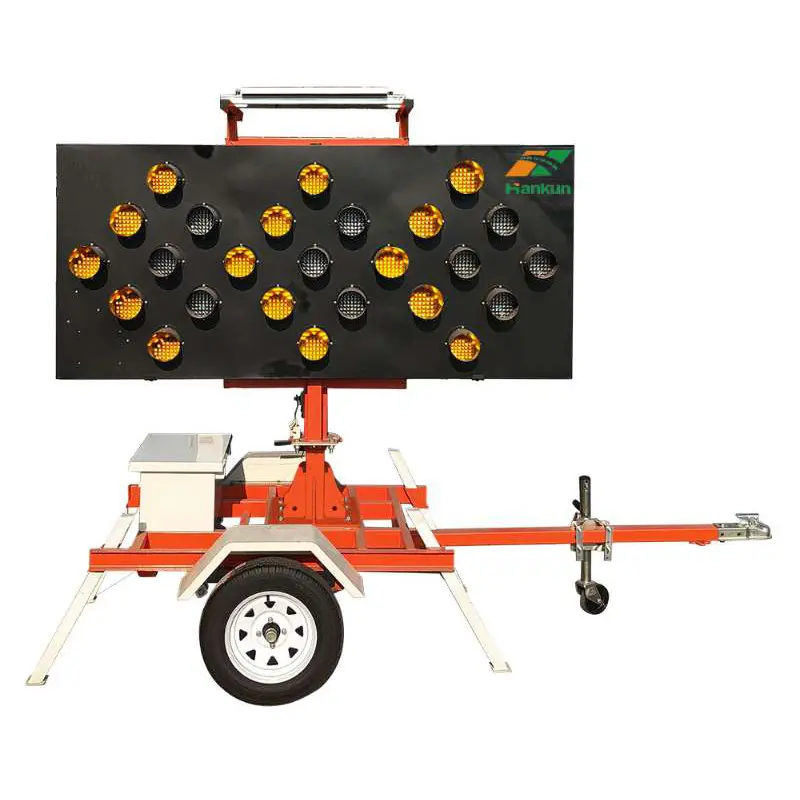
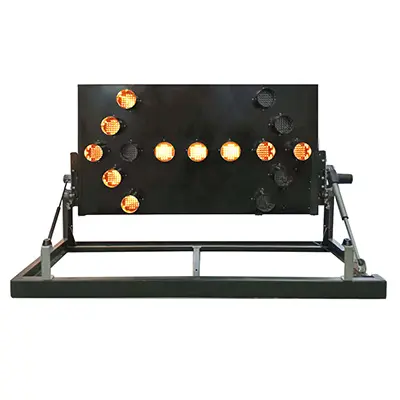
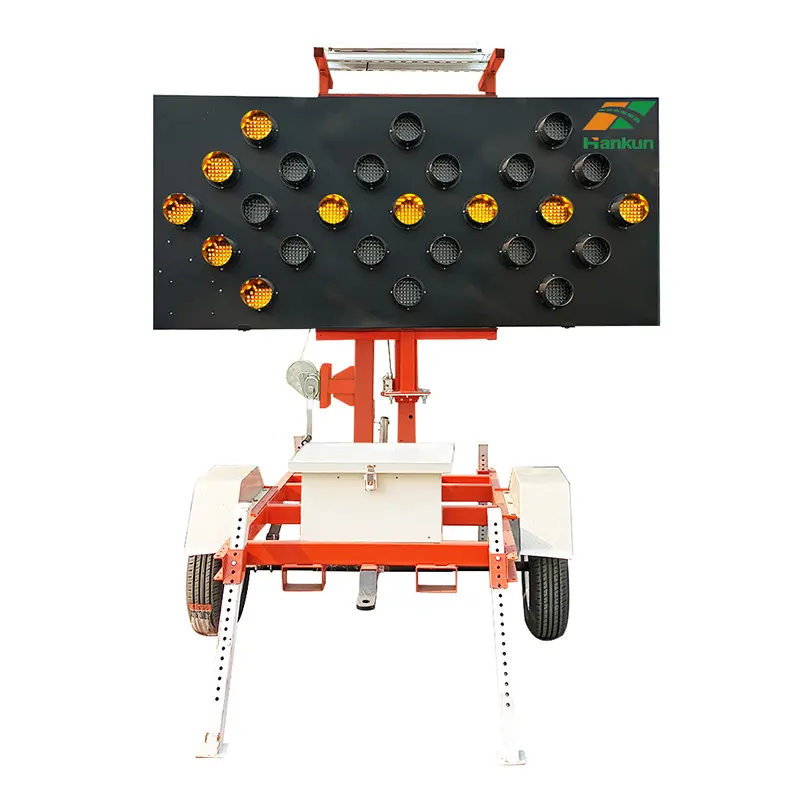
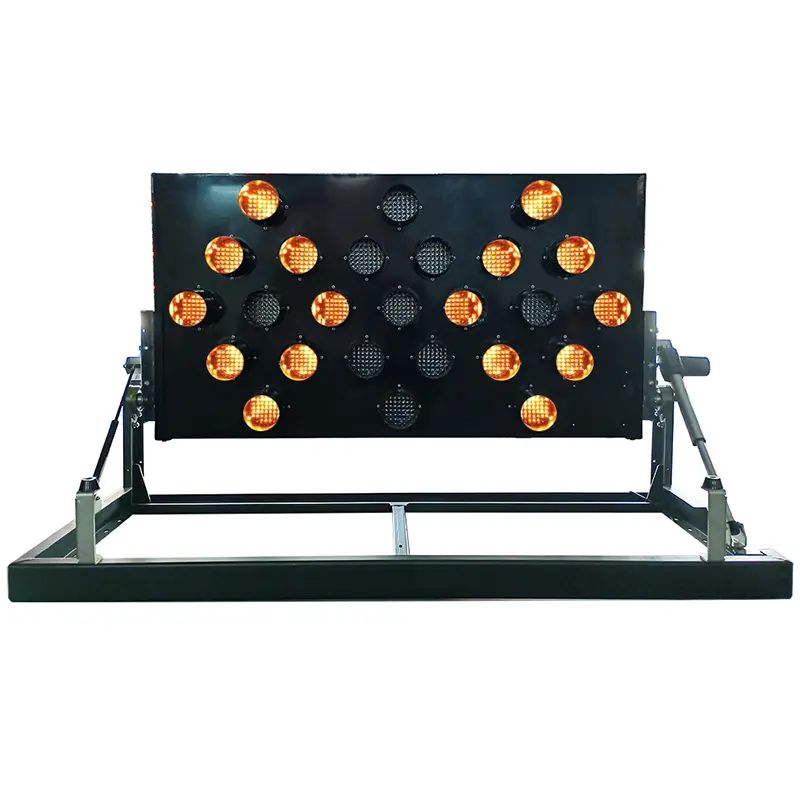
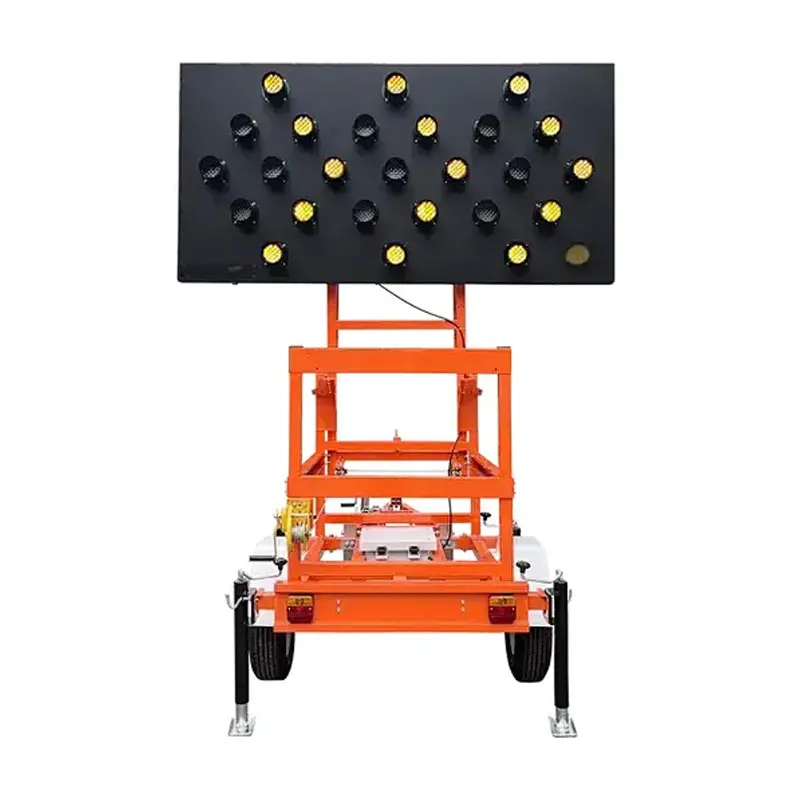
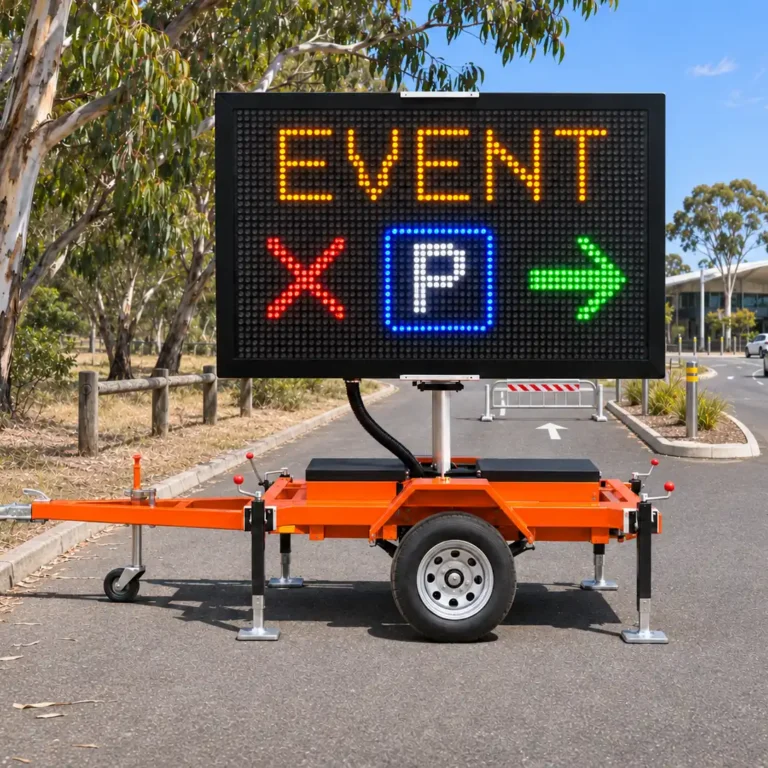
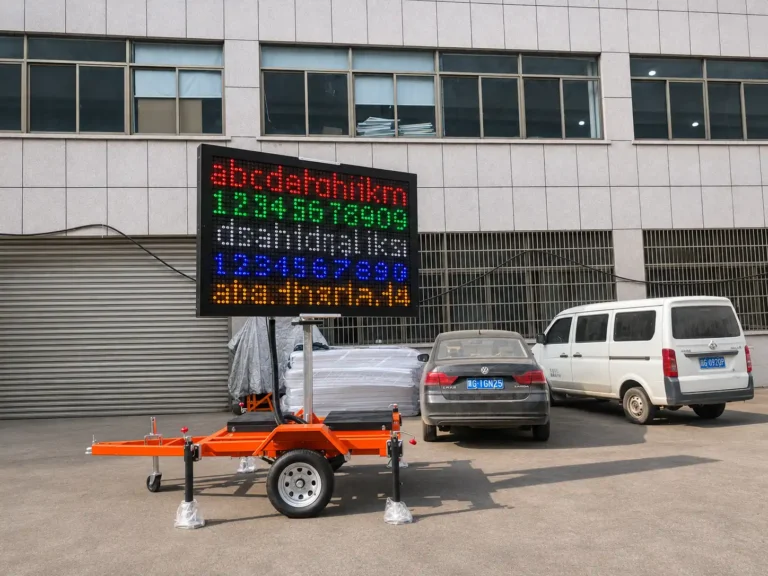
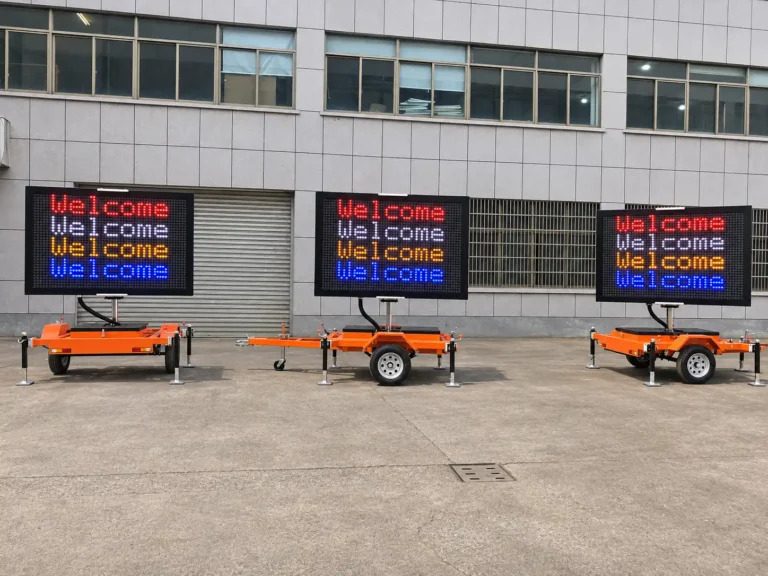
The HANKUN Mid-Size Five-Colour Trailer-Mounted VMS is a versatile portable variable message sign engineered for urban traffic control, roadside safety, and dynamic graphic alerts. Featuring a 5-color full-matrix display, this solar-powered electronic variable message sign system (PCMS sign) supports high-visibility text and safety graphics compliant with changeable message sign MUTCD standards. Built on a compact foldable variable message sign trailer, it ensures fast deployment.
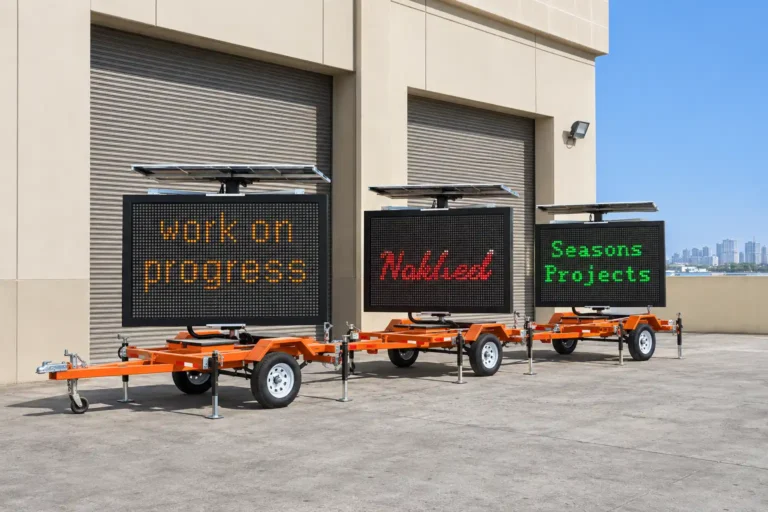
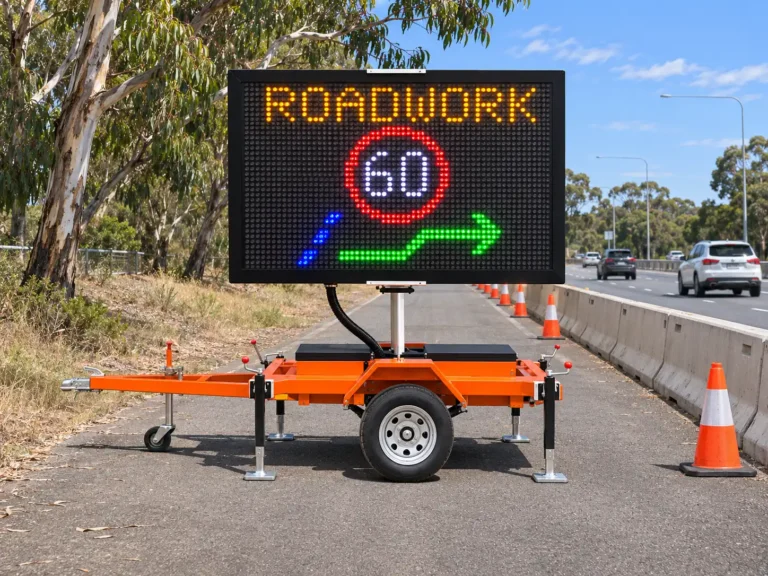
Mid-Size Five-Colour Trailer-Mounted VMS
Model HK-PTMS-MS-0809-37-5C Mid-Size Five-Colour Trailer-Mounted VMS
| Active Display Area | Max Character Height | Pixel Structure | Display Colour | Cabinet Dimensions |
|---|---|---|---|---|
| 2619.1 × 1321 mm / 103.11 × 52.01 in | 347.7 mm (13.69 in) with the 5 × 7 character matrix; no extended character matrix offered on this platform | 56 × 27 pixels | discrete per-colour LEDs — up to 17 individual LEDs per pixel (4 red, 4 amber, 3 green, 3 blue, 3 white); no colour blending | Five-colour — 17 LEDs per pixel (4 red, 4 amber, 3 green, 3 blue, 3 white), no colour blending. The same platform is also available in amber. | 2819.1 × 1521 mm (100 mm border basis; depth 200–250 mm) |
The HK-PTMS-MS-0809-37-5C is a mid-size, trailer-mounted variable message sign featuring a 2619.1 × 1321 mm five-colour LED matrix display with 3-line text and graphic symbol capabilities, powered by a self-sustaining solar array for continuous remote operations.
Share:
The HK-PTMS-MS-0809-37-5C is part of the HANKUN variable message sign range, built for road authorities, contractors and rental fleets that need a legible, power-autonomous message sign at the roadside. It is a mid-size trailer-mounted variable message sign (VMS), and its published figures are taken from the released engineering drawings.
PCMS
In North America this class of equipment is called a portable changeable message sign, or PCMS — the term used in DOT documents and contractor specifications for this roadside equipment.
Trailer VMS
In Australia and New Zealand the trailer-mounted version of this equipment is commonly specified as a trailer-mounted VMS board, per AS 4852.2 practice.
Trailer VMS
UK and European road authorities and contractors refer to the trailer-mounted version as a mobile VMS or trailer-mounted VMS in tenders and specifications.
— Core Characteristics
01
Every model in this range is a full-matrix display — each pixel is individually addressed — so message text, left and right arrows and work-zone warning symbols can all be combined on the same panel. Models differ in pixel matrix, display colour and active display area, not in whether symbols can be shown. Symbol capability is stated as a display capability and is not tied to any compliance claim.
02
347.7 mm (13.69 in) with the 5 × 7 character matrix. No extended character matrix is offered on this platform. Character height depends on the character matrix selected, so the two are always published together.
03
56 × 27 pixels, discrete per-colour LEDs — up to 17 individual LEDs per pixel (4 red, 4 amber, 3 green, 3 blue, 3 white); no colour blending.
04
2619.1 × 1321 mm (103.11 × 52.01 in) — the illuminated area, stated separately from the cabinet.
05
3 lines × 8 characters per line (variable format) — stated together with the number of characters per line.
06
Five-colour for a colour hierarchy on high-priority warnings; the same platform is also available in amber.
07
Cabinet 2819.1 × 1521 mm on a 100 mm border basis, depth 200–250 mm. Trailer-mounted with a road-tow configuration.
08
Automatic dimming — display brightness and grey level are adjusted to ambient light conditions; a manual brightness setting is also available. The display therefore draws less power in low light, which extends the working time available from the solar array and battery bank.
09
Powder-coated and oven-baked finish. 2,000 lb (907 kg) capacity; 5-on-4.5 in. bolt-circle idler hub. Double-eye leaf spring group, 1.5 t (3,300 lb) gross capacity. Wheel track 1,800–2,200 mm matched to the active display area. Tires ST205/75 D15. Lifting: electro-hydraulic; manual winch (optional).
10
4G; GPS position reporting. Message management from phone, tablet or PC. Open API and SDK protocol provided, for integration into an existing fleet management platform.
11
This page states what is confirmed and what is not. Confirmed for this model: the 56 × 27 display matrix, the 2619.1 × 1321 mm active display area, the character height of 347.7 mm (13.69 in) and the pixel structure, together with the solar array, battery, chassis and lifting figures. The remaining items are listed as to be confirmed rather than estimated, so nothing on this page is a placeholder value.
12
Every published dimension — including the 56 × 27 matrix and the 2619.1 × 1321 mm (103.11 × 52.01 in) active display area — is taken from the released engineering drawings and is internally re-checkable, so the figures can be quoted in a project specification.
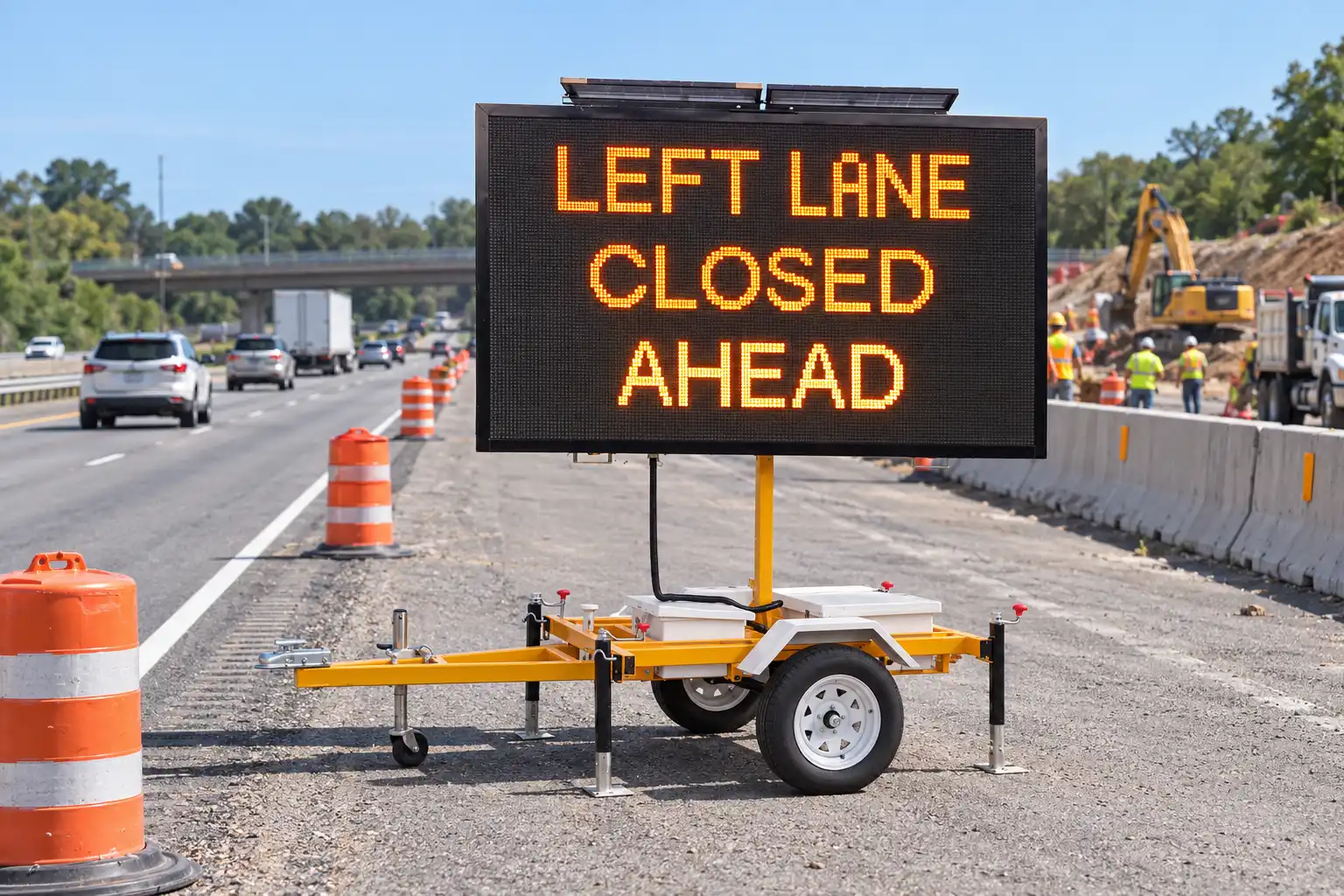
Work zones on multi-lane arterial roads. This model carries 3 lines of 8 characters on a 56 × 27 matrix with 2619.1 × 1321 mm (103.11 × 52.01 in) of active display area — 347.7 mm (13.69 in) characters — and the five-colour output, which lets one priority message carry its own colour above the advisory text, matches the reading task on an arterial approach.
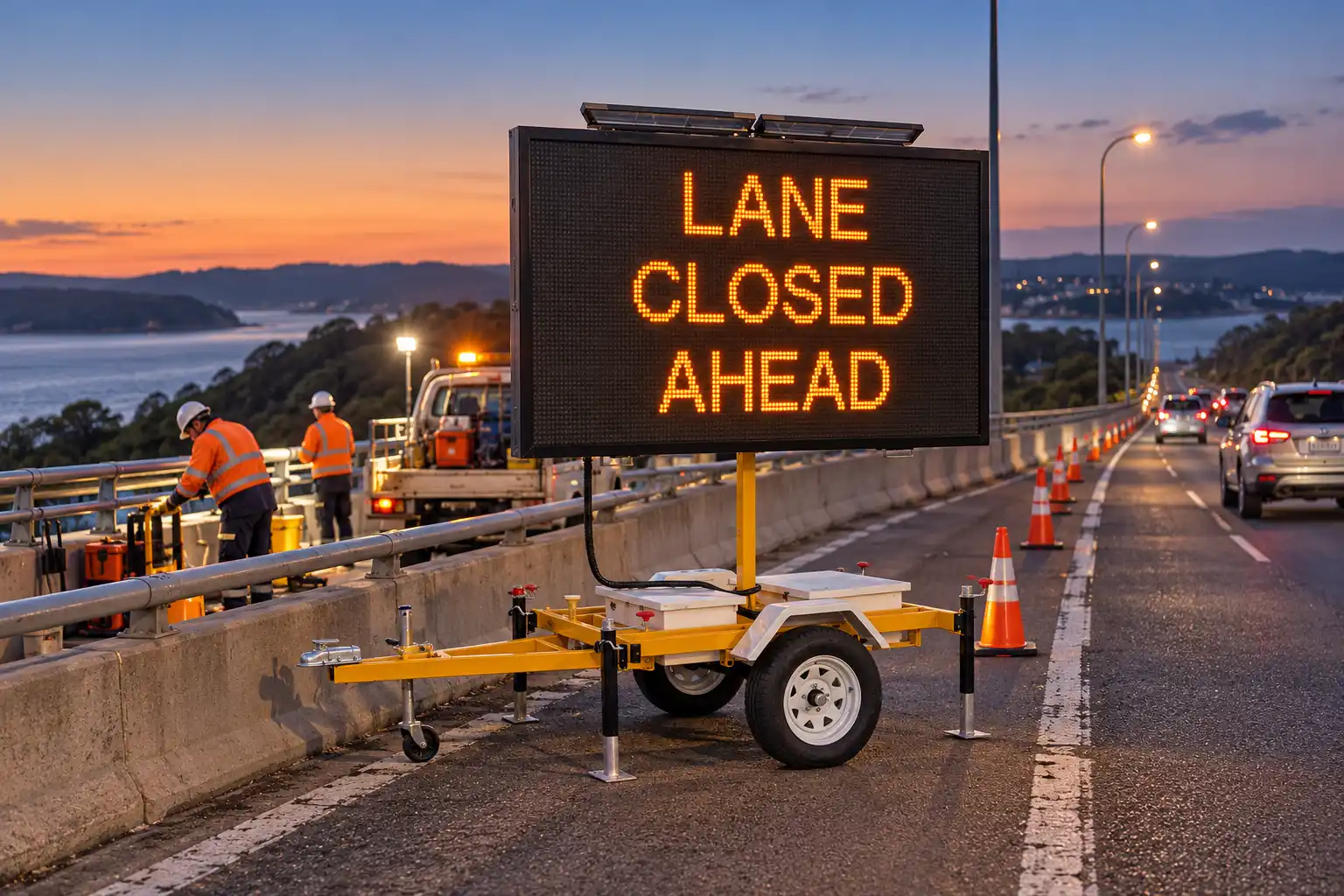
Tight corridors and junction works. A 2819.1 × 1521 mm cabinet fits kerbside and lay-by placement, the 56 × 27 matrix decides how much of the closure sequence fits on one screen, and five colours let the closure line be picked out from the supporting text.

Diversions that need two or three lines rather than a full programme. 3 lines × 8 characters per line (variable format) keeps the closure and the direction together, and a two-layer message — the priority layer in a second colour on the same matrix — is enough where the message does not change through the day.
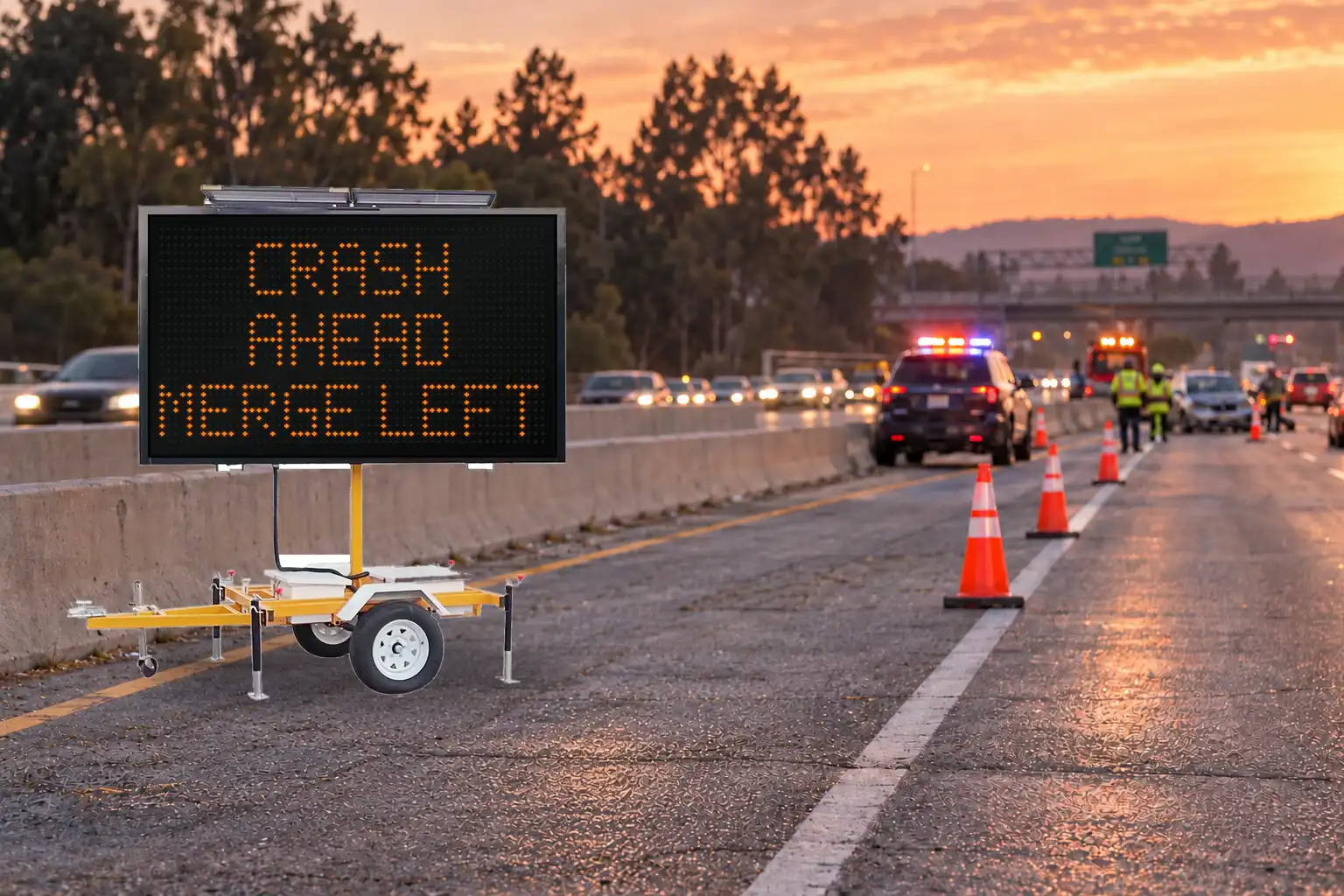
Rapid deployment at short notice. Road-tow trailer mounting with an independent solar array means no site power arrangement and no cabling, the 2619.1 × 1321 mm display area is read from the approach rather than from the kerb, and a five-colour panel lets the incident controller colour the line that carries the instruction.
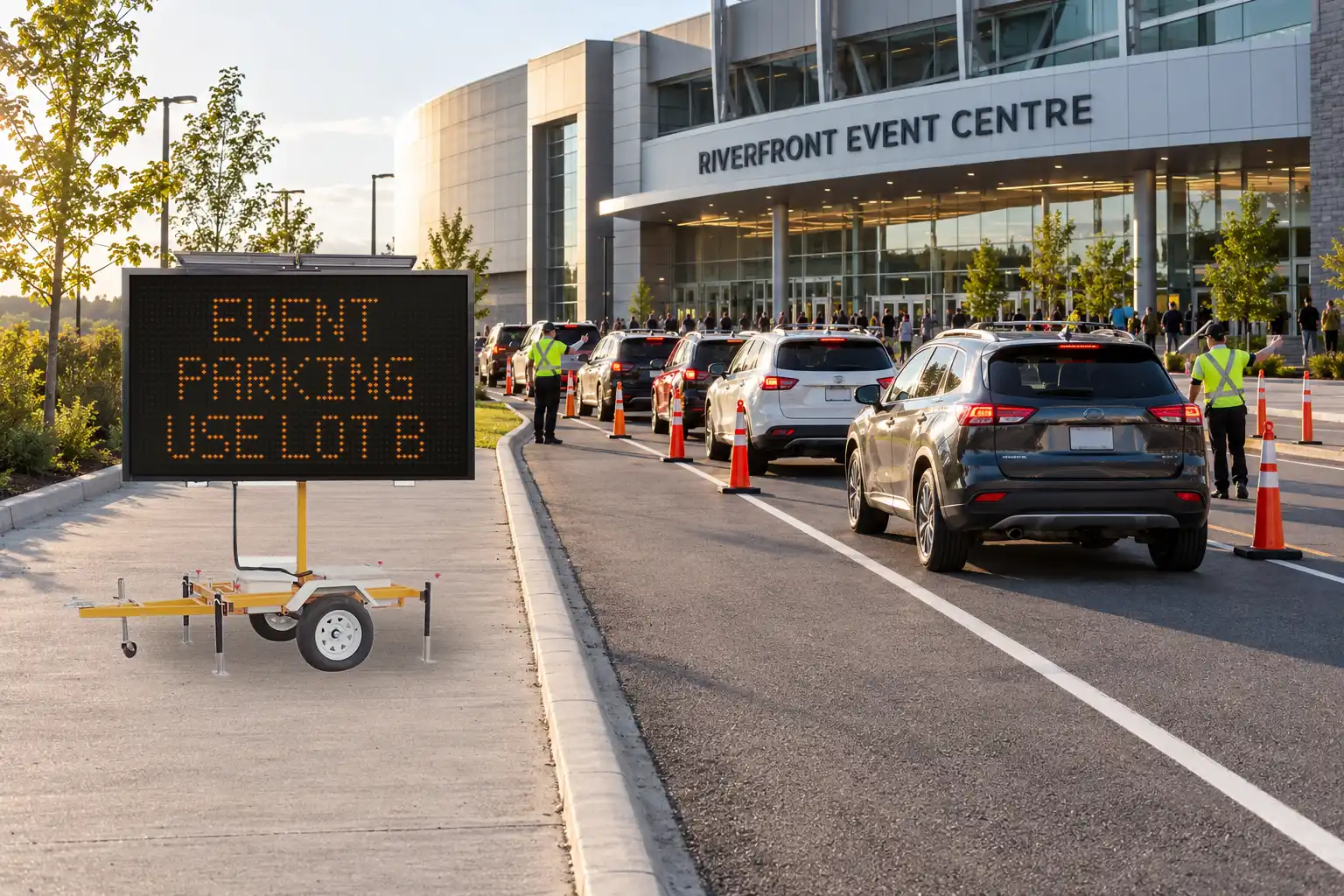
Staged traffic control across a day or a weekend. The 56 × 27 matrix carries the sequence, and a colour-coded message lets the marshalling instruction be picked out from the parking and access lines at a site that carries a priority item beside routine instructions.
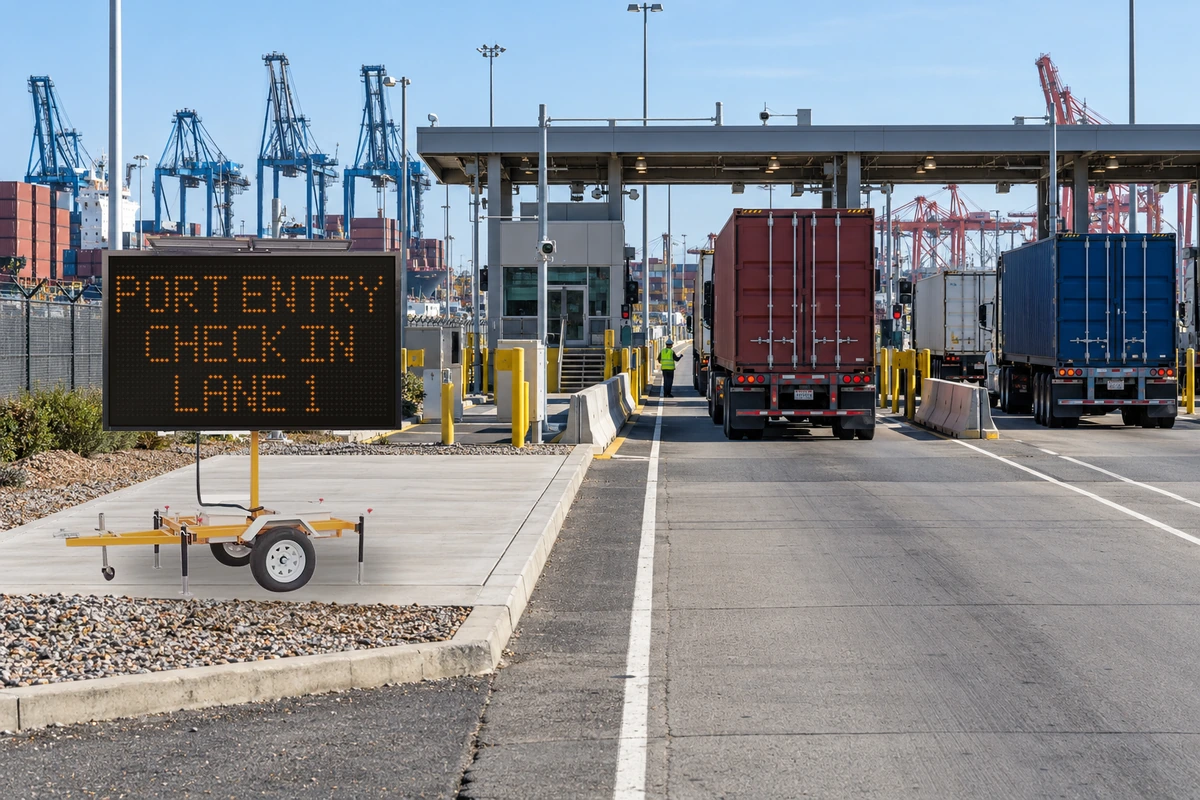
Long-term placement inside a site. A 347.7 mm (13.69 in) character height is set by the position on the road, the 2619.1 × 1321 mm display area is specified against that distance, and the five-colour panel separates site-safety notices from routine information.
§ MUTCD Part 6 (Chapter 6F)
§ MUTCD Table 2E-4
US practice sets letter height from the posted approach speed. MUTCD Part 6 (Chapter 6F) gives 18 in (457 mm) as the minimum letter height for a portable changeable message sign and permits shorter letters on low-speed facilities; Table 2E-4 adds that 450 mm (18 in) should be used where speeds are greater than 90 km/h (55 mph), in persistently poor weather, or where the driving task is complex. Messages are limited to two phases, and animation, flashing and scrolling are not used.
§ AS 1742.3:2019
§ State roadworks guidance
AS 1742.3:2019 and the state roadworks guidance size characters to the approach speed, at roughly 120 mm for 60 km/h approaches and 160–200 mm for 80 km/h approaches, with the larger alphabet series applied to high-speed and multi-lane works. The sign face is confirmed with the road authority for each project.
§ NZTA CoP for Temporary Traffic Management
§ Published NZ figures for LED message signs
The NZTA Code of Practice for Temporary Traffic Management sets a temporary speed limit at least 20 km/h below the normal limit, gated across the carriageway, with repeat signs at 400 m intervals. The published NZ figures for LED message signs set characters at not smaller than 300 mm inside a 50 km/h area and not smaller than 347.7 mm elsewhere.
§ Traffic Signs Manual Ch. 8, Table A1.2
§ TSRGD 2016
The UK sizes characters by x-height rather than cap height. Traffic Signs Manual Chapter 8 (Table A1.2) runs from 62.5 mm at 30 mph to 200 mm on dual carriageways at the national speed limit, and TSRGD 2016 sets the legal x-height limits at 35 mm to 347.7 mm, so a cap-height figure has to be converted before it can be placed in that table.
§ EN 12966:2014+A1:2018
EN 12966:2014+A1:2018 classifies a variable message sign on luminance, beam width, colour and luminance ratio, with a temperature class. The class required follows the road type, the viewing geometry and the climate at the site, and it is stated per configuration rather than as a single figure.
3 lines of 8 characters at 347.7 mm (13.69 in) keeps one message phase readable while the closure moves, and the 2619.1 × 1321 mm display area is the figure used to place it against the advance warning arrangement. The same platform is also published in amber if a single colour is sufficient for a second scheme.
A crew that arrives for a few days gets the message up and then moves it to the next outage, and the 56 × 27 matrix with a 2619.1 × 1321 mm display area are the two figures that decide whether the site fits.
One 2819.1 × 1521 mm cabinet and one controller across the fleet means one spare-part set and one training path, and the 56 × 27 matrix is the figure to quote when a client asks what the unit can display.
2619.1 × 1321 mm of active display area is sized for arterial work, where the sign stands closer to traffic than a motorway deployment, and 3 lines of 8 characters covers the message set a district office actually posts.
One matrix · one layout
56 × 27 matrix→3 lines × 8→347.7 mm
347.7 mm→fixed 5 × 7→no taller matrix
Character height and line count are the same decision, and this platform answers it with its matrix rather than with a menu: a 56 × 27 grid laid out for 3 lines of 8 characters, giving 347.7 mm (13.69 in). No taller character matrix is offered on this platform, so the character height stays where it is instead of being traded against line count. That is the deliberate answer for a board whose job is one fixed message format.
Pixel → colour → character
17 LEDs / pixel→per-colour→no blending
priority line+347.7 mm character
The 56 × 27 grid carries a discrete per-colour pixel — up to 17 individual LEDs per pixel with no colour blending. That is a design decision rather than a bigger display: a priority line takes its own colour while the advisory text stays amber, on the same 2619.1 × 1321 mm of active display area, which is why five-colour is published as its own configuration instead of being folded into one blended panel.
Power on board · site off the brief
Solar + battery→no generator / cabling→towable 2819.1 × 1521 mm
The platform carries its own power, which takes the site out of the design brief: no generator, no cabling and no mains connection has to be arranged before the sign can work. What is left to design is a 2819.1 × 1521 mm cabinet that tows between long-duration sites behind vehicles the customer already runs
North AmericaAustralia / New ZealandUK / EuropeOther
Long-duration highway work zoneShort-term / incident responseSpecial eventsFixed facility (port, airport, utility)
Arrows (left / right)Arrows plus other symbols (work-zone triangle, speed roundel, etc.)
Amber is sufficientWe need five-colour
Answered the four? Send them with your enquiry.
We reply with the configuration that matches your market, duty and message set — five-colour on this platform, or the amber configuration if Q4 says so.
Colour branch
Identical display geometry, only the colour configuration changes.
Choose amber if colour hierarchy is not needed; it does not reduce any display figure.
Size branch
Larger matrix and display area: 56 × 28 with a 3156 × 1563 mm active display area.
Choose the larger model when the viewing distance needs more than 3156 × 1563 mm; choose this model when that area is enough.
Mounting branch
The same display class in the other mounting configuration.
Trailer-mounted suits long-duration deployment and towing; truck-mounted suits vehicle-integrated operation.
If the viewing distance or the message volume is beyond what a 2619.1 × 1321 mm active display area can serve, the HK-PTMS-FS-0807-47-5C is the next step up in the five-colour trailer-mounted range, with a 56 × 28 matrix and a 3156 × 1563 mm active display area.
If the sign can be placed closer to the traffic, the HK-PTMS-MS-0607-49-5C covers the same message format at a smaller footprint, with a 54 × 28 matrix and a 2025 × 1050 mm active display area.
If a trailer is not practical, the HK-TMVMS-1207-44-5C is the truck-mounted alternative in the same size class: vehicle mounting with power taken from the vehicle.
Between two sizes? Send the viewing distance and the message set.
We confirm the model against your site geometry — or point you to the 56 × 28 step up before you commit.
The HK-PTMS-MS-0809-37-5C is one of 19 catalogued models — 15 of them published and available for specification — and it is the 12th by active display area among the published models. Within the mid-size five-colour trailer group it is the 3rd of 4. It carries a 56 × 27 pixel matrix — 56 pixels across and 27 down — over 2619.1 × 1321 mm (103.11 × 52.01 in) of active display area, with a character height of 347.7 mm (13.69 in). Those five figures are the whole basis on which this model is chosen: the rest of the range differs in matrix, colour and display area, not in what a full-matrix display can do.
Those five figures are the whole basis on which this model is chosen: the rest of the range differs in matrix, colour and display area, not in what a full-matrix display can do.
catalogued models
in the HANKUN PCMS range
published & available
for specification
by active display area
among published models
Published range · by active display area12 / 15
This model sits in the middle band of the published range — larger units above it step up to a 56 × 27 matrix.
Mid-size five-colour trailer group3 / 4
Two larger five-colour trailer configurations sit above it in its own group.
Need a different position in the range? Tell us the viewing distance.
We place your requirement on the same scale and name the model — this one, a step up, or a step down.
| Item | Value |
|---|---|
| Model | HK-PTMS-MS-0809-37-5C |
| Mounting | Trailer-mounted (road tow) |
| Display colour | Five-colour |
| Active display area | 2619.1 × 1321 mm (103.11 × 52.01 in) |
| Cabinet dimensions | 2819.1 × 1521 mm (100 mm border basis; depth 200–250 mm) |
| Display matrix | 56 × 27 pixels | discrete per-colour LEDs — up to 17 individual LEDs per pixel (4 red, 4 amber, 3 green, 3 blue, 3 white); no colour blending |
| LEDs per pixel | 17 per pixel — 4 red + 4 amber + 3 green + 3 blue + 3 white = 17 LEDs per pixel (3 mm through-hole LED) |
| Message format | 3 lines × 8 characters per line (variable format) |
| Character height — standard matrix | 347.7 mm (13.69 in) with the 5 × 7 character matrix |
| Character height — extended matrix | no extended matrix offered on this platform |
| Compliance path | MUTCD configuration options · North AmericaEN 12966 compatible configuration · Europe & UKAS 4852.2 configuration options · Australia & New Zealand |
— System & Operation
| Item | Value |
|---|---|
| Power | |
| Solar array | 2 × 360 W (720 W total) |
| Battery | 2 × 250 Ah AGM deep-cycle battery |
| Charge controller | MPPT charge controller, 30–40 A charge current |
| Panel mounting | Fixed as standard; tilt-and-rotate mounting (optional) |
| Trailer chassis | |
| Coating | Powder-coated and oven-baked |
| Axle assembly | 2,000 lb (907 kg) capacity; 5-on-4.5 in. bolt-circle idler hub |
| Suspension | Double-eye leaf spring group, 1.5 t (3,300 lb) gross capacity |
| Wheel track | 1,800–2,200 mm (model dependent) |
| Tires | ST205/75 D15 |
| Lifting | Electro-hydraulic; manual winch (optional) |
| Automatic dimming | |
| Ambient light control | Automatic dimming — display brightness and grey level are adjusted to ambient light conditions; a manual brightness setting is also available. |
| Remote operation and integration | |
| Connectivity | 4G; GPS position reporting |
| Operating terminal | Message management from phone, tablet or PC |
| Fleet integration | Open API and SDK protocol provided, for integration into an existing fleet management platform. |
— Compliance & Regional Configuration
MUTCD configuration options; NEMA TS-4 testing available on request.
✓MUTCD
✓NEMA TS-4
EN 12966 compatible configuration (class confirmed per project); CE marking and Declaration of Conformity available.
✓EN 12966
✓CE + DoC
AS 4852.2 configuration options; trailer build to applicable ADR requirements.
✓AS 4852.2
✓ADR
— Procurement Case
01
A 56 × 27 display over 2619.1 × 1321 mm of active display area deploys on a road-tow trailer with its own power, so the site needs no generator and no cabling for the duration of the works.
02
The five published figures for this mid-size trailer model — 2619.1 × 1321 mm active display area, 347.7 mm (13.69 in) character height, 56 × 27 matrix, five-colour display colour and a 2819.1 × 1521 mm cabinet — can be quoted straight into a project specification, because each one is traceable to the engineering record.
03
The five-colour output adds a priority layer on the same 56 × 27 matrix in this mid-size trailer model, and the amber configuration of the same display is also published, so the colour choice stays reversible — and the same-platform options mean one spare-part set and one training path across a mixed fleet.
04
At 2619.1 × 1321 mm this model is the 12th largest active display area among the 15 published models, and the 3rd of 4 in the mid-size five-colour trailer group — so it can be placed against the other models on published figures rather than on a sales description.
— Before You Specify
Footprint & Colour Layer
Mid-size buys the footprint; full-size buys the pixels — and graphic impact is decided by contrast and colour layering before it is decided by panel size. On this platform the mid-size five-colour board carries a 56 × 27 matrix with 2619 × 1321 mm of active display area, about 70% of the full-size 3156 × 1563 mm panel, using the same pixel structure: 4 red + 4 amber + 3 green + 3 blue + 3 white = 17 LEDs per pixel, no colour blending. What changes is how much message and how large a symbol fit on the grid, not the colour capability. If the approach speed or the reading distance calls for the 56 × 28 panel, step up; if the constraint is where the trailer can stand, the mid-size unit is the one that gets placed.
Colour is the first thing the eye sorts, so a symbol that carries its own colour is picked up before the text beside it is read. A five-colour panel lets a red triangle, an amber warning or a green arrow sit beside the instruction instead of being rendered in the same amber as everything else — the driver identifies the hazard by shape and colour, then reads the line that applies to them. On this platform the colour is discrete per pixel (17 LEDs), not blended, so what the driver sees is a defined colour rather than a mix. The gain only exists where the message has a hierarchy: on a simple two-phase message where nothing needs separating, the extra colour layer carries no information and only adds a decision.
Compliance & Urban Deployment
Yes — the same unit covers both, because the difference between an event and a maintenance job is the message set rather than the hardware. A compact portable changeable message sign (PCMS) in this size class sets up on a narrow shoulder, a footway or the edge of a congested intersection where a full-size trailer would take a live lane or overhang the kerb. It tows behind a light commercial vehicle, sets up by electro-hydraulic lift with the outriggers levelled, and takes its message over 4G. Deployed width, outrigger spread and the clear width left for pedestrians are confirmed from the configuration drawing before the site arrangement is approved, since they change with mast and outrigger options.
MUTCD governs the message, not the number of colours on the panel: line capacity and character height for the approach speed, a concise message in up to two phases, and no animation, flashing or scrolling. Colour-coding and symbol dimensions are configuration items against the market’s own edition — which is why our specification states MUTCD configuration options rather than a blanket colour-ratio claim. This five-colour 56 × 27 model is published with the compliance path for its destination market: MUTCD configuration options for North America, EN 12966 compatible configuration with CE marking and a Declaration of Conformity for Europe and the UK, and AS 4852.2 configuration options for Australia and New Zealand. Testing documentation is available on request, and we do not describe a sign as certified unless a certificate number applies to that configuration.
Power, Radar & Transport
Size the array for five colours, not for amber. A five-colour pixel draws roughly four times the current of a single-colour pixel on the same grid, so a bank and array that carry an amber board will not carry this one — the power system is specified against the colour configuration, not against the panel area alone. Beyond sizing, automatic dimming is what makes a shaded site workable: brightness and grey level follow ambient light, so the panel draws less exactly when the array is also generating less. Array wattage, bank capacity and panel tilt for this size class are confirmed per project, and continuous operation through a shaded period is quoted as an autonomy figure rather than published as a fixed number of days.
Yes, and colour is where the board earns its cost in a speed programme: the controller reads the approach, compares it with the threshold set for the zone, and can show a compliant speed and an over-threshold warning in different colours rather than in one amber face — which is how the same panel runs as a dynamic speed awareness station and a variable speed limit sign. Radar is a configuration item, not a base function: the sensor, trigger logic, threshold and message set are agreed at ordering, because the threshold belongs to the site. Where speed data has to be logged or shared with the authority, that reporting arrangement is confirmed with them.
A closure or a utility repair needs a sign on the approach the same day. A foldable trailer-mounted VMS tows at highway speed with the panel in its transport position, then raises on site by electro-hydraulic lift and takes its message over 4G from a phone or tablet — tow, level, raise and set, a sequence one operator completes without lifting equipment. Working time on site is measured in minutes rather than a shift; total call-out time is set by the distance to the location and the site’s own traffic control. Mast lift height and the deployment procedure for this size class are confirmed per configuration rather than published as a single figure.
Because the tow vehicle does not have to be a heavy hauler. A mid-size trailer has a lower gross vehicle weight rating (GVWR) than a full-size unit, so a standard pickup or a municipal service van can pull it — which matters for fuel, for driver licensing and for how many crews can move a unit without booking a truck. Three figures still have to be checked before hitching: the trailer GVWR against the vehicle’s rated towing capacity, the coupling and lighting arrangement, and the local rules on trailer braking and overall width. GVWR, axle rating and transport dimensions for this size class are confirmed at the configuration stage, because they move with battery, mast and panel options.
Low Clearance & Whole-Life Cost
Where the panel has to fit rather than dominate: a parking structure entrance, a low-clearance portal approach, a tunnel approach, or an arterial whose verge leaves no room for a full-size trailer. In those positions the board works as a high-visibility warning and guidance sign — lane availability, height restriction and the hazard ahead — within the distance available before the decision point, and the five-colour layer is what lets a lane status read as red or green instead of as text alone. Mounting, controller interface, luminance class and the approval path sit with the road or facility authority, so tunnel and covered-approach deployment is confirmed against their requirement rather than assumed from a product description.
Four lines decide the total cost of ownership, and only one of them is the purchase price. Purchase — factory-direct removes the reseller margin and lets the configuration be specified item by item, which is what makes two quotes comparable. Power — five colour costs more to run than amber on the same grid, because 17 LEDs per pixel draw more current and therefore need the larger array and bank. Spares — one pixel module covers the fleet and there is no colour calibration to perform, but the driver electronics are more complex than a single-colour board’s. Service life and maintenance — ask for the figures in writing rather than a longevity claim. Five colour buys a capability: a priority colour layer. Where the fleet issues one class of message and nothing has to be separated, that layer is cost without a return.
A question not listed here? Send it with your project location — the answer comes back with the configuration sheet.
Fill in your information to reserve a free exclusive video consultation. Our team will contact you within 24 hours to arrange a dedicated online meeting.