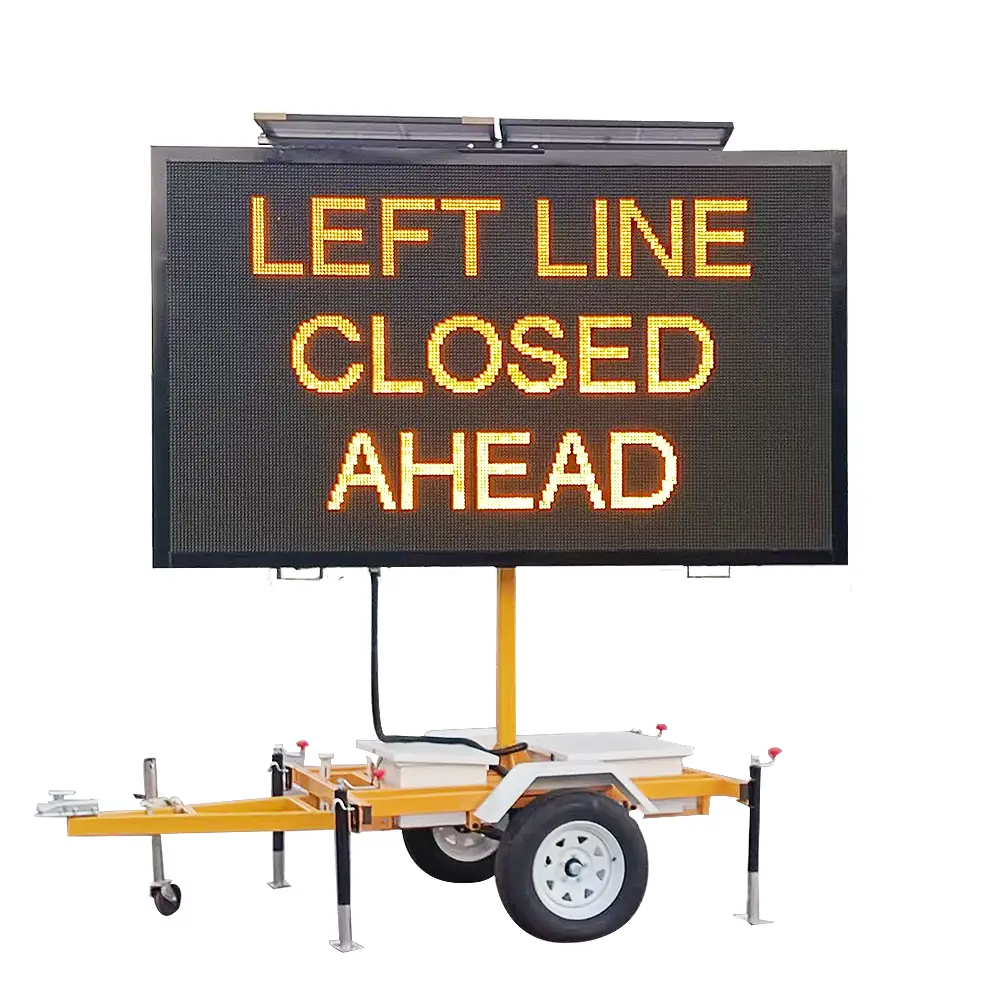
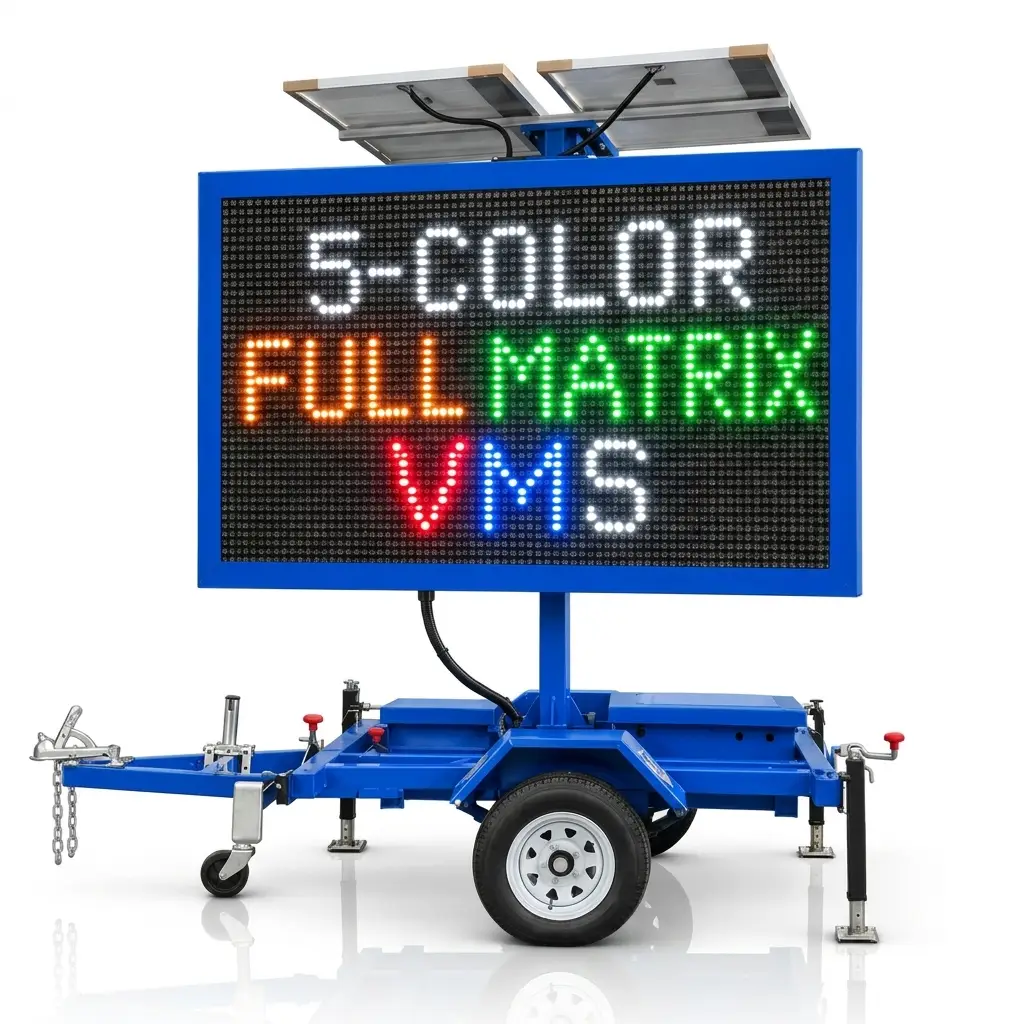
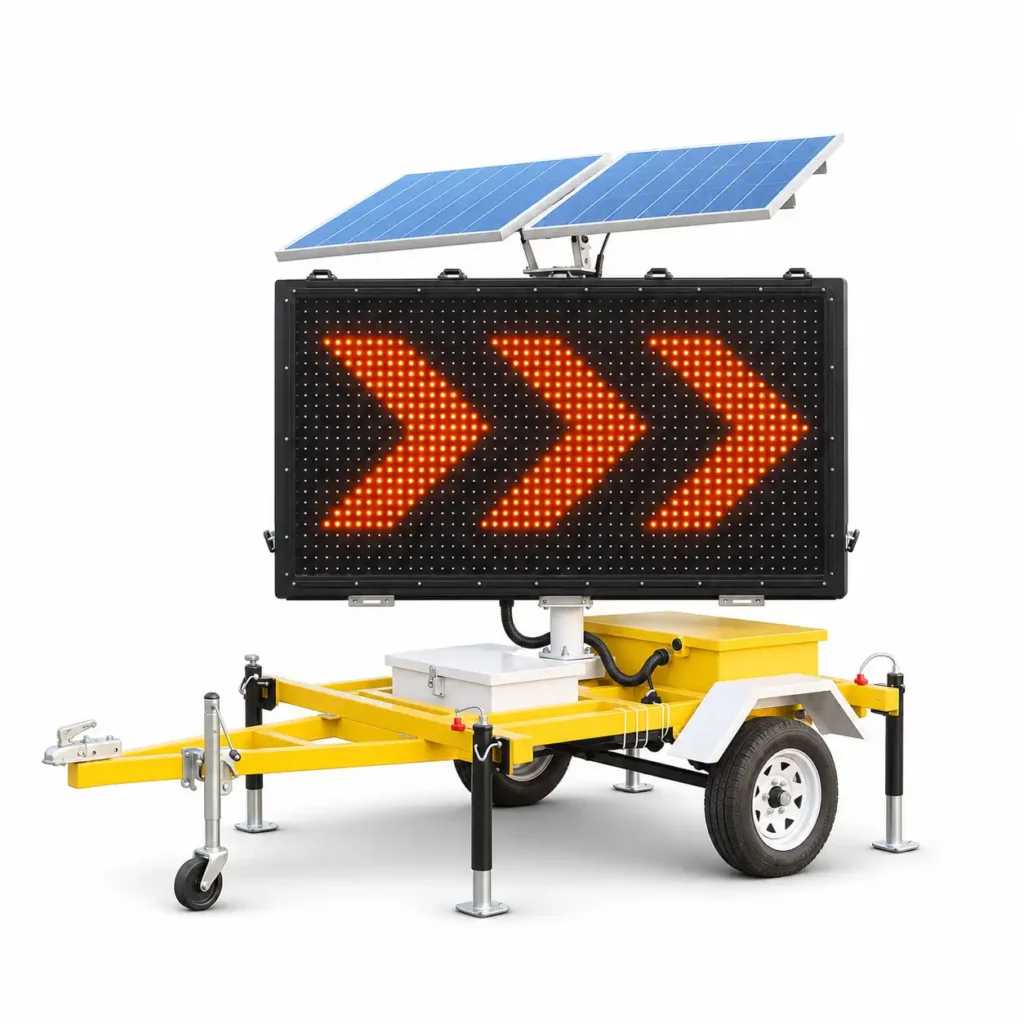
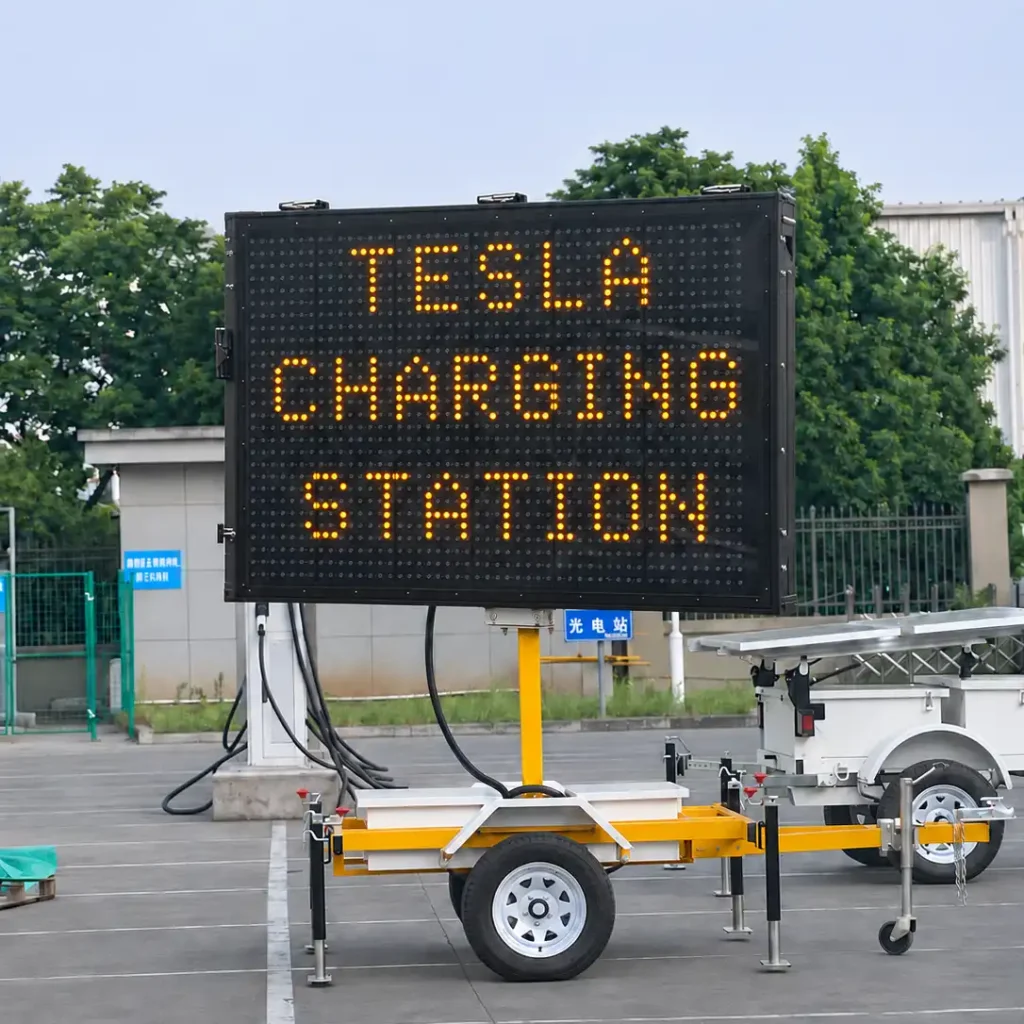
The HANKUN Compact Three-Line Amber Trailer-Mounted PCMS is a versatile portable variable message sign engineered for urban traffic control, local roadwork, and work zone safety. Featuring high-intensity amber LEDs displaying 3 lines of text on a 56 × 30 matrix, this solar-powered electronic variable message sign system (PCMS sign) is published with changeable message sign MUTCD configuration options. Built on a compact foldable variable message sign trailer, it ensures fast single-operator setup.
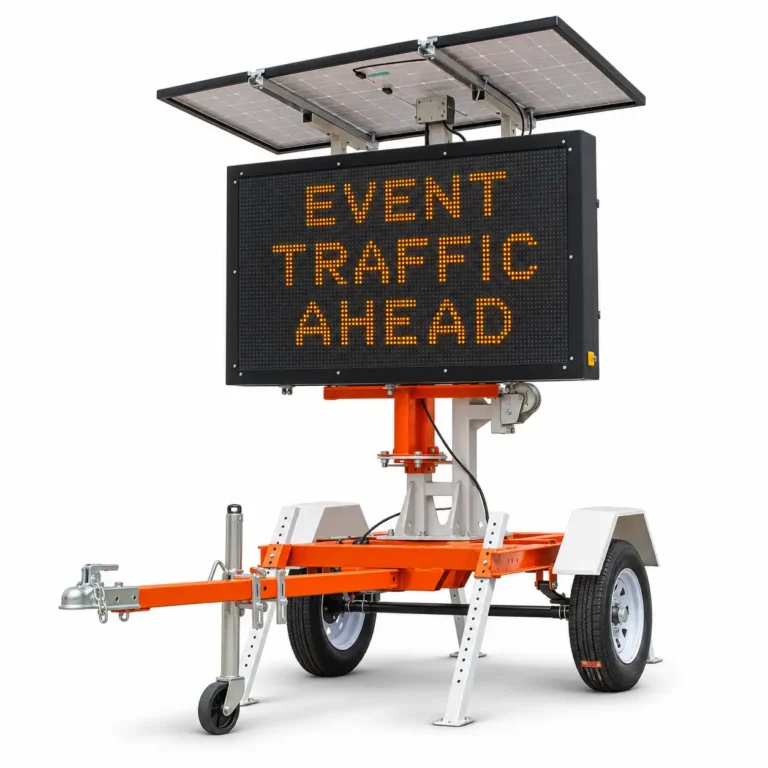
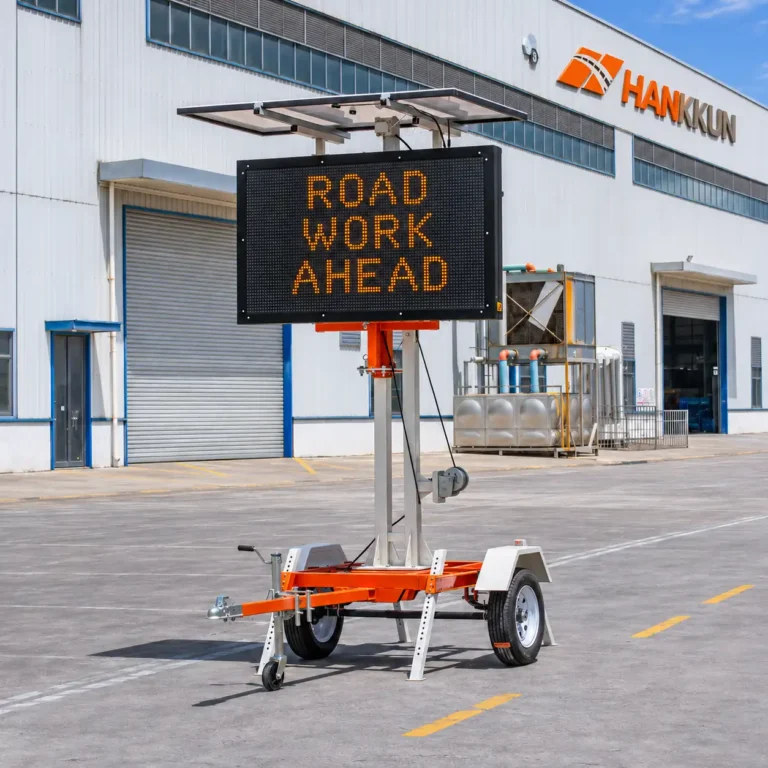
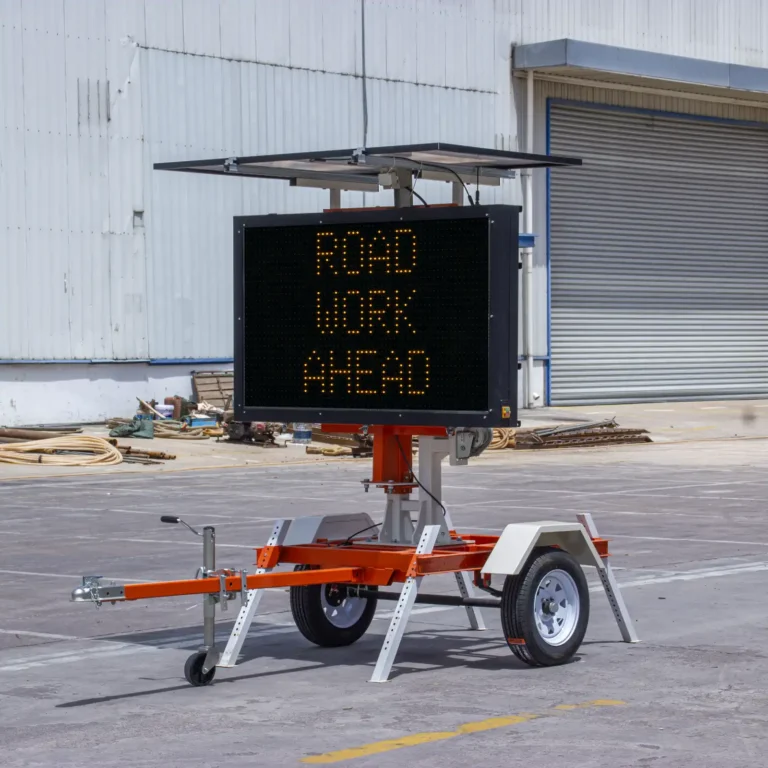
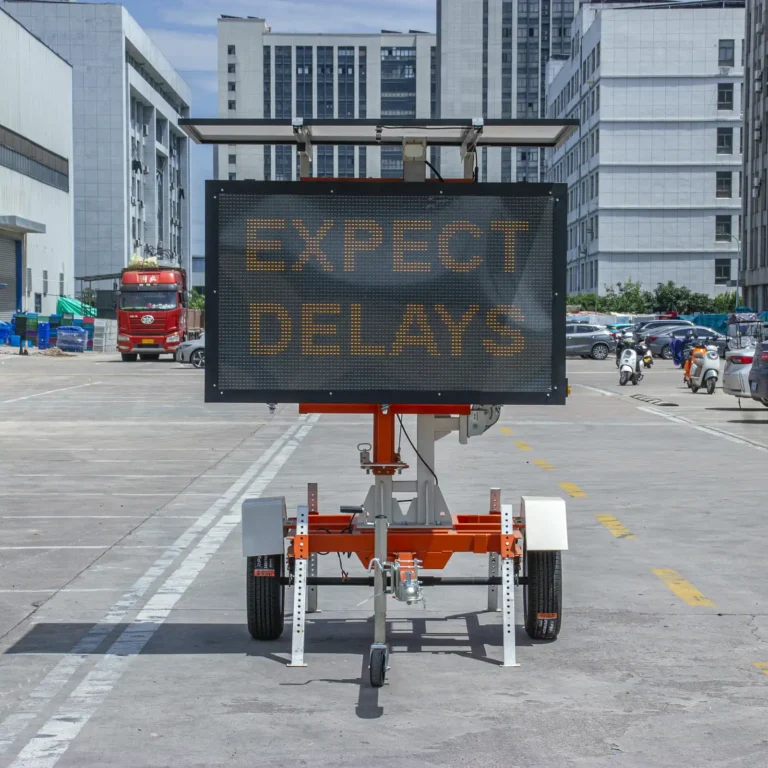
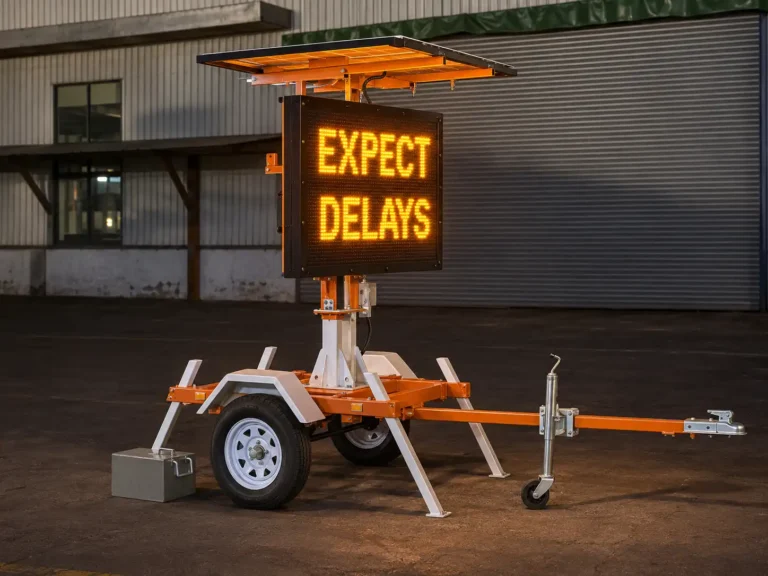
Compact 3-Line Trailer-Mounted Amber PCMS
Model HK-PTMS-CS-0810-37-A Compact Trailer-Mounted Amber PCMS
| Active Display Area | Max Character Height | Pixel Structure | Display Colour | Cabinet Dimensions |
|---|---|---|---|---|
| 1840 × 960 mm / 72.44 × 37.80 in | 227.5 mm (8.96 in) with the 5 × 7 character matrix; no extended character matrix offered on this platform | 56 × 30 pixels | 3 LEDs per pixel (5 mm through-hole LED, single colour) | Amber. A five-colour configuration of the same platform is available: its pixel carries up to 17 individual LEDs — 4 red, 4 amber, 3 green, 3 blue, 3 white. | 2040 × 1160 mm (100 mm border basis; depth 200–250 mm) |
The HK-PTMS-CS-0810-37-A is a compact, trailer-mounted portable changeable message sign featuring a 1840 × 960 mm amber LED matrix display with 3-line text and graphic symbol capabilities, powered by a self-sustaining solar array for continuous remote operations.
Share:
The HK-PTMS-CS-0810-37-A is part of the HANKUN variable message sign range, built for road authorities, contractors and rental fleets that need a legible, power-autonomous message sign at the roadside. It is a compact trailer-mounted portable changeable message sign (PCMS), and its published figures are taken from the released engineering drawings.
PCMS
In North America this class of equipment is called a portable changeable message sign, or PCMS — which is how this model is specified.
Trailer VMS
In Australia and New Zealand the trailer-mounted version of this equipment is commonly specified as a trailer-mounted VMS board, per AS 4852.2 practice.
Trailer VMS
UK and European road authorities and contractors refer to the trailer-mounted version as a mobile VMS or trailer-mounted VMS in tenders and specifications.
— Core Characteristics
01
Every model in this range is a full-matrix display — each pixel is individually addressed — so message text, left and right arrows and work-zone warning symbols can all be combined on the same panel. Models differ in pixel matrix, display colour and active display area, not in whether symbols can be shown. Symbol capability is stated as a display capability and is not tied to any compliance claim.
02
227.5 mm (8.96 in) with the 5 × 7 character matrix. No extended character matrix is offered on this platform. Character height depends on the character matrix selected, so the two are always published together.
03
56 × 30 pixels, 3 LEDs per pixel (5 mm through-hole LED, single colour).
04
1840 × 960 mm (72.44 × 37.80 in) — the illuminated area, stated separately from the cabinet.
05
3 lines × 8 characters per line (variable format) — stated together with the number of characters per line.
06
Amber. A five-colour configuration of the same platform is available; it is linked from this page.
07
Cabinet 2040 × 1160 mm on a 100 mm border basis, depth 200–250 mm. Trailer-mounted with a road-tow configuration.
08
Automatic dimming — display brightness and grey level are adjusted to ambient light conditions; a manual brightness setting is also available. The display therefore draws less power in low light, which extends the working time available from the solar array and battery bank.
09
Powder-coated and oven-baked finish. 2,000 lb (907 kg) capacity; 5-on-4.5 in. bolt-circle idler hub. Double-eye leaf spring group, 1.5 t (3,300 lb) gross capacity. Wheel track 1,800–2,200 mm matched to the active display area. Tires ST205/75 D15. Lifting: electro-hydraulic; manual winch (optional).
10
4G; GPS position reporting. Message management from phone, tablet or PC. Open API and SDK protocol provided, for integration into an existing fleet management platform.
11
This page states what is confirmed and what is not. Confirmed for this model: the 56 × 30 display matrix, the 1840 × 960 mm active display area, the character height of 227.5 mm (8.96 in) and the pixel structure, together with the solar array, battery, chassis and lifting figures. The remaining items are listed as to be confirmed rather than estimated, so nothing on this page is a placeholder value.
12
Every published dimension — including the 56 × 30 matrix and the 1840 × 960 mm (72.44 × 37.80 in) active display area — is taken from the released engineering drawings and is internally re-checkable, so the figures can be quoted in a project specification.
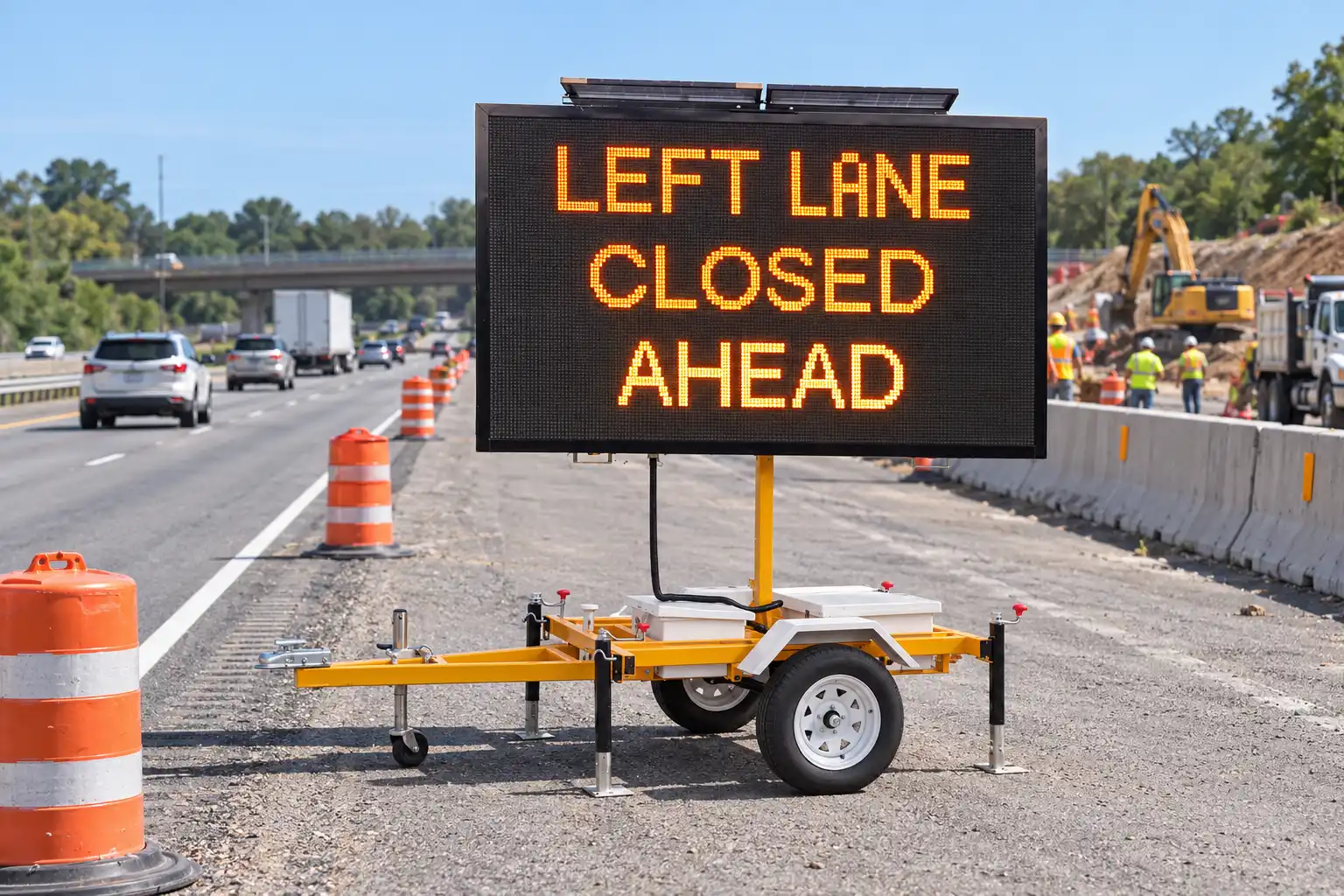
Lower-speed streets and municipal works. This model carries 3 lines of 8 characters on a 56 × 30 matrix with 1840 × 960 mm (72.44 × 37.80 in) of active display area — read at 227.5 mm (8.96 in) from a close approach — and the single amber output, which leaves one instruction with nothing competing against it, suits a street where the message rarely changes.
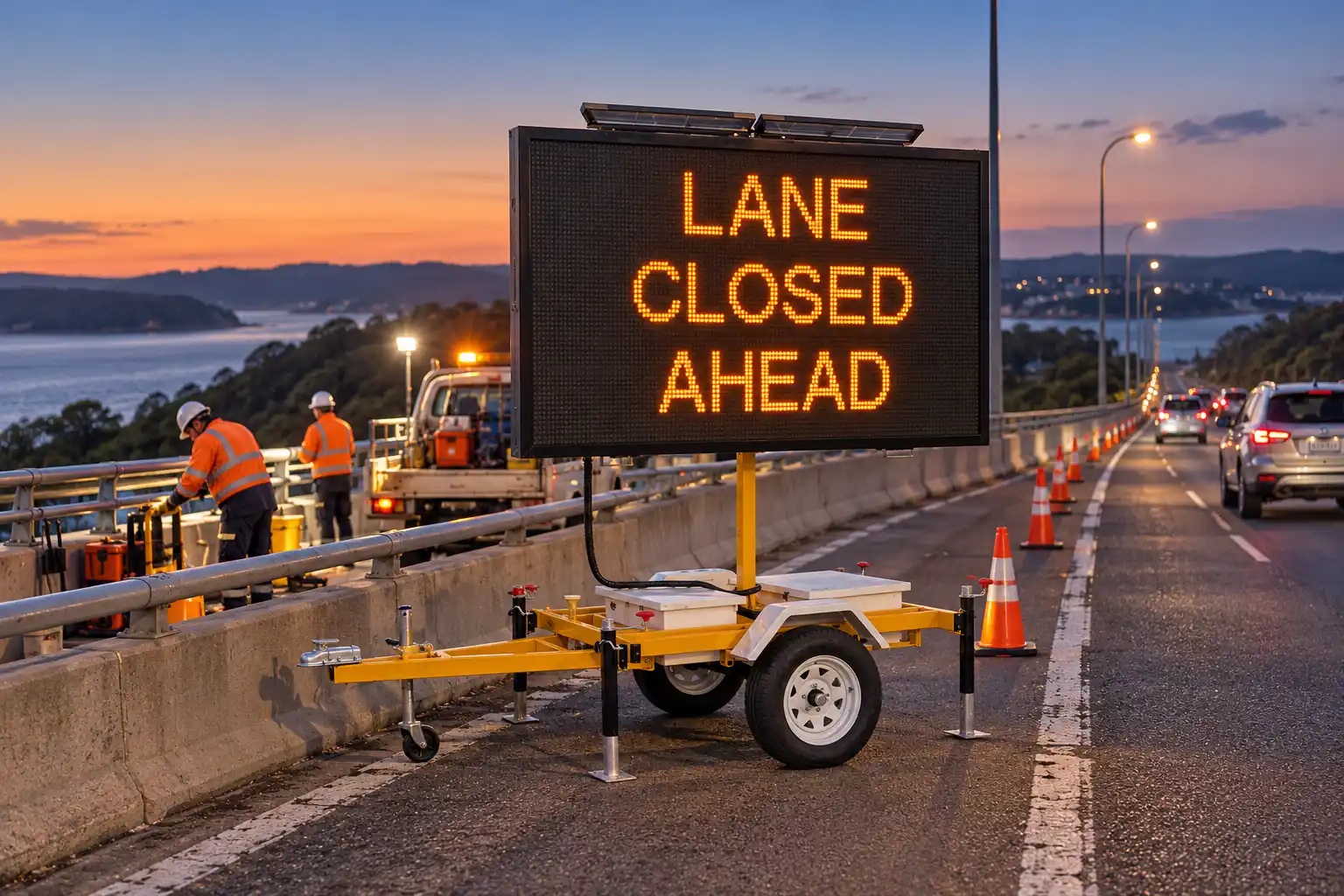
Short-lived works in built-up areas. A 2040 × 1160 mm cabinet keeps the footprint small at the kerb, the 56 × 30 matrix still holds the closure sequence, and one message colour suits a crew that sets the sign and moves on.

Works measured in hours or days. Road-tow trailer mounting with an independent solar array means no generator and no cabling at the site, and a single-colour message — the panel shows one layer of information at a time — keeps the panel simple for a crew that redeploys it mid-shift.

Immediate warning at short notice. 1840 × 960 mm of active display area is what the approaching driver reads, a 227.5 mm (8.96 in) character height is the other half of that decision, and the amber panel carries the warning on its own.
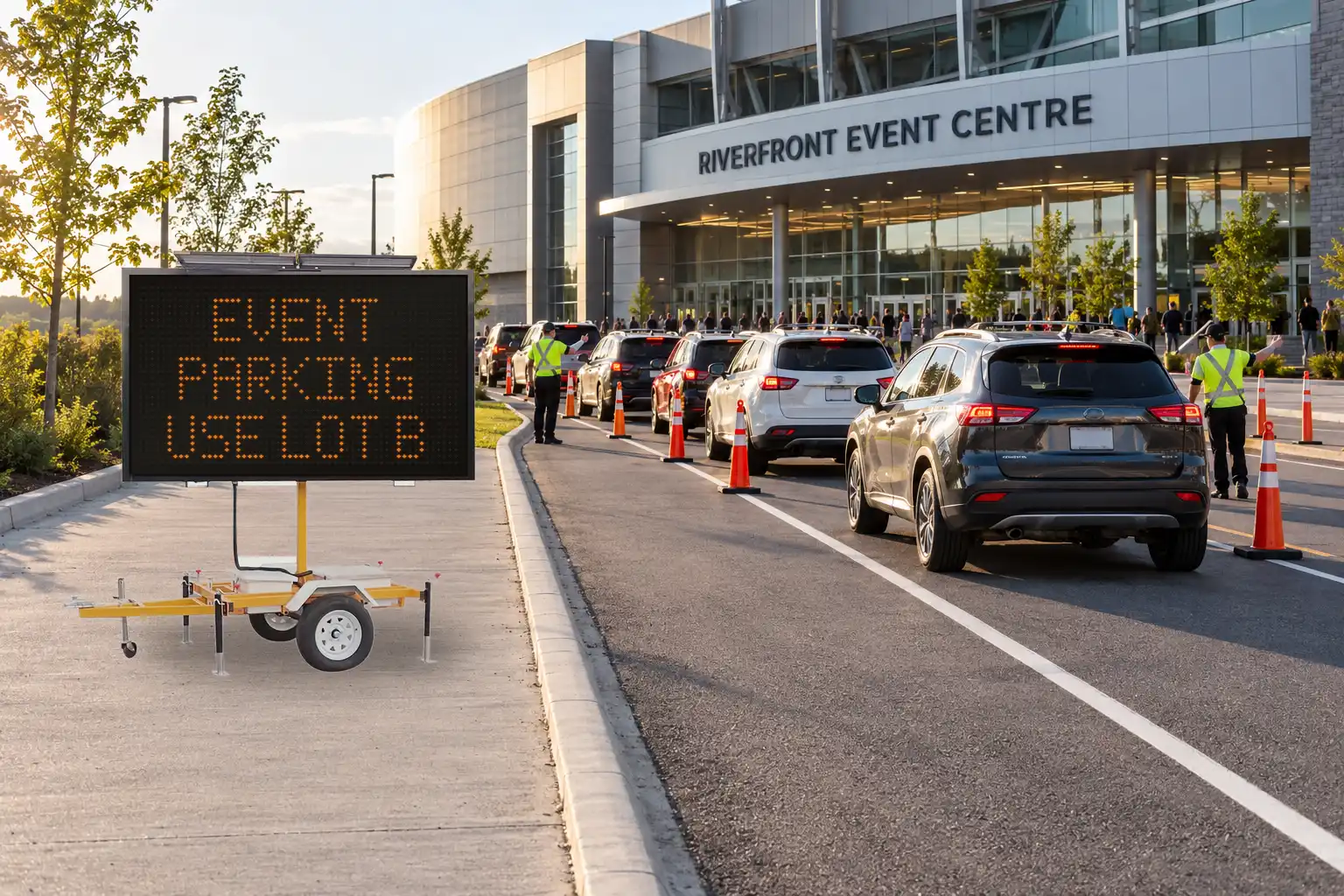
Internal roads and access control, read at walking or turning speed. The 56 × 30 matrix suits notices and symbols rather than long traffic phrases, and one message colour fits sites that change a single instruction rather than a sequence.
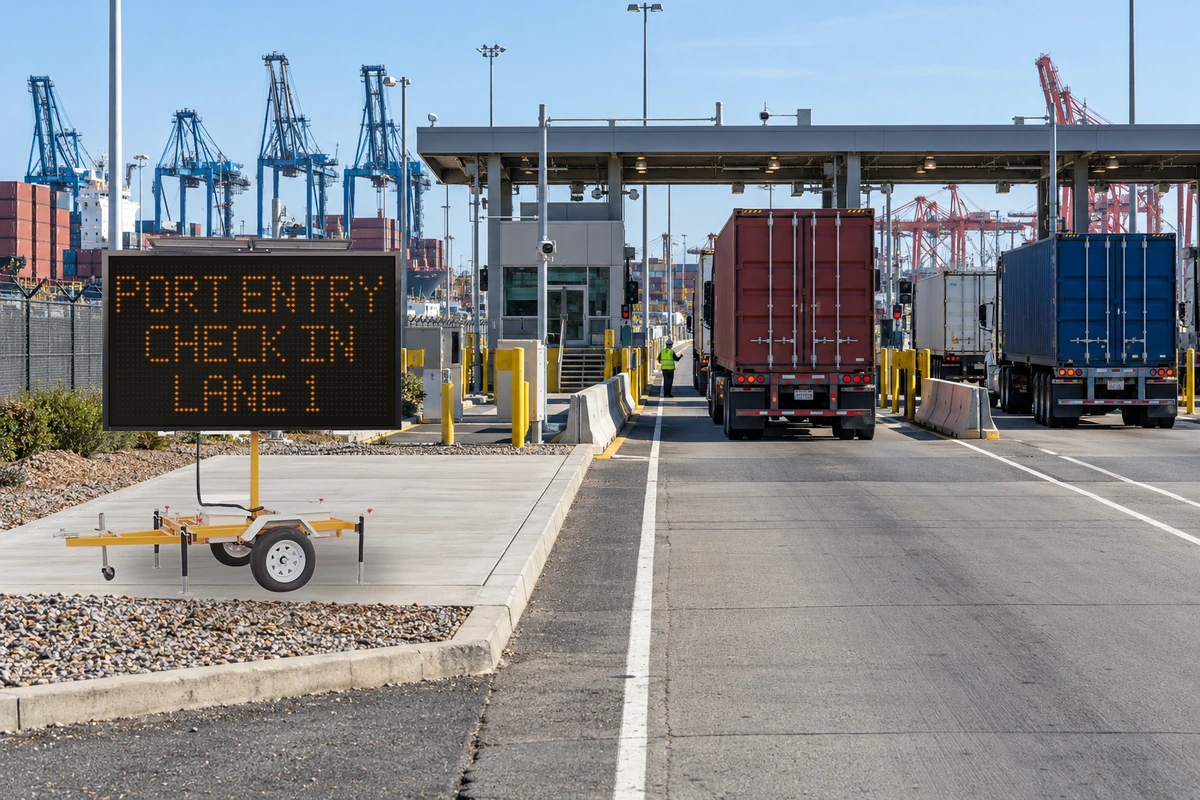
Long-term placement at a fixed point. The 2040 × 1160 mm cabinet and the 56 × 30 matrix are specified against the position, the single-colour output covers the routine notices a yard issues, and the mounting arrangement is confirmed with us.
§ MUTCD Part 6 (Chapter 6F)
§ MUTCD Table 2E-4
US practice sets letter height from the posted approach speed. MUTCD Part 6 (Chapter 6F) gives 18 in (457 mm) as the minimum letter height for a portable changeable message sign and permits shorter letters on low-speed facilities; Table 2E-4 adds that 450 mm (18 in) should be used where speeds are greater than 90 km/h (55 mph), in persistently poor weather, or where the driving task is complex. Messages are limited to two phases, and animation, flashing and scrolling are not used.
§ AS 1742.3:2019
§ State roadworks guidance
AS 1742.3:2019 and the state roadworks guidance size characters to the approach speed, at roughly 120 mm for 60 km/h approaches and 160–200 mm for 80 km/h approaches, with the larger alphabet series applied to high-speed and multi-lane works. The sign face is confirmed with the road authority for each project.
§ NZTA CoP for Temporary Traffic Management
§ Published NZ figures for LED message signs
The NZTA Code of Practice for Temporary Traffic Management sets a temporary speed limit at least 20 km/h below the normal limit, gated across the carriageway, with repeat signs at 400 m intervals. The published NZ figures for LED message signs set characters at not smaller than 300 mm inside a 50 km/h area and not smaller than 400 mm elsewhere.
§ Traffic Signs Manual Ch. 8, Table A1.2
§ TSRGD 2016
The UK sizes characters by x-height rather than cap height. Traffic Signs Manual Chapter 8 (Table A1.2) runs from 62.5 mm at 30 mph to 200 mm on dual carriageways at the national speed limit, and TSRGD 2016 sets the legal x-height limits at 35 mm to 400 mm, so a cap-height figure has to be converted before it can be placed in that table.
§ EN 12966:2014+A1:2018
EN 12966:2014+A1:2018 classifies a variable message sign on luminance, beam width, colour and luminance ratio, with a temperature class. The class required follows the road type, the viewing geometry and the climate at the site, and it is stated per configuration rather than as a single figure.
3 lines of 8 characters at 227.5 mm (8.96 in) suits street works and access restrictions, where the whole panel is read at low speed from a short distance, and the 2040 × 1160 mm cabinet is what decides whether the position at the kerb is available at all.
A crew that arrives for a few days gets the message up and then moves it to the next outage, and the 56 × 30 matrix with a 1840 × 960 mm display area are the two figures that decide whether the site fits.
The message changes by the hour — from direction to parking to egress — and a pre-set list keeps a 56 × 30 display showing the right line at the right time, without a crew editing it on site.
A compact 56 × 30 panel at 227.5 mm (8.96 in) for school zones and pedestrian routes, where the message is short and it is read from close range rather than from a highway approach.
One matrix · one layout
56 × 30 matrix→3 lines × 8→227.5 mm
227.5 mm→fixed 5 × 7→no taller matrix
Character height and line count are the same decision, and this platform answers it with its matrix rather than with a menu: a 56 × 30 grid laid out for 3 lines of 8 characters, giving 227.5 mm (8.96 in). No taller character matrix is offered on this platform, so the character height stays where it is instead of being traded against line count. That is the deliberate answer for a board whose job is one fixed message format.
Pixel → stroke → character
3 LEDs / pixel→5 mm through-hole
→clean strokes→227.5 mm character
The pixel structure is published as: 3 LEDs per pixel (5 mm through-hole LED, single colour). That is what lets a 227.5 mm (8.96 in) character be assembled from a character matrix rather than drawn as a single line of block letters, because the pixels are large enough to build a character without crowding the strokes at this height.
Power on board · site off the brief
Solar + battery→no generator / cabling→towable 2040 × 1160 mm
The platform carries its own power, which takes the site out of the design brief: no generator, no cabling and no mains connection has to be arranged before the sign can work. What is left to design is a 2040 × 1160 mm cabinet that tows between long-duration sites behind vehicles the customer already runs
North AmericaAustralia / New ZealandUK / EuropeOther
Long-duration highway work zoneShort-term / incident responseSpecial eventsFixed facility (port, airport, utility)
Arrows (left / right)Arrows plus other symbols (work-zone triangle, speed roundel, etc.)
Amber is sufficientWe need five-colour
Answered the four? Send them with your enquiry.
We reply with the configuration that matches your market, duty and message set — amber on this platform, or the five-colour model if Q4 says so.
Colour branch
Identical display geometry, only the colour configuration changes.
This is a colour choice, not a selection branch: it does not change resolution, character size or message format.
Mounting branch
The same display class in the other mounting configuration.
Trailer-mounted suits long-duration deployment and towing; truck-mounted suits vehicle-integrated operation.
If the viewing distance or the message volume is beyond what a 1840 × 960 mm active display area can serve, the HK-PTMS-MS-0607-49-A is the next step up in the amber trailer-mounted range, with a 54 × 28 matrix and a 2025 × 1050 mm active display area.
If the sign can be placed closer to the traffic, the HK-PTMS-CS-1821-24-A covers the same message format at a smaller footprint, with a 72 × 42 matrix and a 1530 × 880 mm active display area.
If a trailer is not practical, the HK-TMVMS-1821-24-A is the truck-mounted alternative in the same size class: vehicle mounting with power taken from the vehicle.
Between two sizes? Send the viewing distance and the message set.
We confirm the model against your site geometry — or point you to the next size up before you commit.
The HK-PTMS-CS-0810-37-A is one of 19 catalogued models — 15 of them published and available for specification — and it is the 8th by active display area among the published models. Within the compact amber trailer group it is the 3rd of 7. It carries a 56 × 30 pixel matrix — 56 pixels across and 30 down — over 1840 × 960 mm (72.44 × 37.80 in) of active display area, with a character height of 227.5 mm (8.96 in). Those five figures are the whole basis on which this model is chosen: the rest of the range differs in matrix, colour and display area, not in what a full-matrix display can do.
Those five figures are the whole basis on which this model is chosen: the rest of the range differs in matrix, colour and display area, not in what a full-matrix display can do.
catalogued models
in the HANKUN PCMS range
published & available
for specification
by active display area
among published models
within the compact amber trailer group
Published range · by active display area8 / 15
This model sits in the middle band of the published range — larger units above it carry up to a 56 × 32 matrix.
Compact amber trailer group3 / 7
Middle of its own group — four larger amber trailer configurations sit above it.
Need a different position in the range? Tell us the viewing distance.
We place your requirement on the same scale and name the model — this one, a step up, or a step down.
| Item | Value |
|---|---|
| Model | HK-PTMS-CS-0810-37-A |
| Mounting | Trailer-mounted (road tow) |
| Display colour | Amber |
| Active display area | 1840 × 960 mm (72.44 × 37.80 in) |
| Cabinet dimensions | 2040 × 1160 mm (100 mm border basis; depth 200–250 mm) |
| Display matrix | 56 × 30 pixels | 3 LEDs per pixel (5 mm through-hole LED, single colour) |
| LEDs per pixel | 3 per pixel — Single colour — amber (5 mm through-hole LED) |
| Message format | 3 lines × 8 characters per line (variable format) |
| Character height — standard matrix | 227.5 mm (8.96 in) with the 5 × 7 character matrix |
| Character height — extended matrix | no extended character matrix offered on this platform |
| Compliance path | MUTCD configuration options · North AmericaEN 12966 compatible configuration · Europe & UKAS 4852.2 configuration options · Australia & New Zealand |
— System & Operation
| Item | Value |
|---|---|
| Power | |
| Solar array | 2 × 360 W (720 W total) |
| Battery | 2 × 250 Ah AGM deep-cycle battery |
| Charge controller | MPPT charge controller, 30–40 A charge current |
| Panel mounting | Fixed as standard; tilt-and-rotate mounting (optional) |
| Trailer chassis | |
| Coating | Powder-coated and oven-baked |
| Axle assembly | 2,000 lb (907 kg) capacity; 5-on-4.5 in. bolt-circle idler hub |
| Suspension | Double-eye leaf spring group, 1.5 t (3,300 lb) gross capacity |
| Wheel track | 1,800–2,200 mm (model dependent) |
| Tires | ST205/75 D15 |
| Lifting | Electro-hydraulic; manual winch (optional) |
| Automatic dimming | |
| Ambient light control | Automatic dimming — display brightness and grey level are adjusted to ambient light conditions; a manual brightness setting is also available. |
| Remote operation and integration | |
| Connectivity | 4G; GPS position reporting |
| Operating terminal | Message management from phone, tablet or PC |
| Fleet integration | Open API and SDK protocol provided, for integration into an existing fleet management platform. |
| Options | |
| Vehicle speed radar | Doppler speed radar, for speed feedback and dynamic speed limit display — configuration item, agreed at ordering. |
| Solar panel mounting | Tilt-and-rotate mounting (optional); fixed as standard. |
| Lifting | Electro-hydraulic as standard; manual winch lifting (optional). |
| Power capacity | Additional solar panel or battery capacity, sized against the insolation profile of the destination market. |
| Position reporting | GPS position reporting. |
| Remote monitoring | 4G remote monitoring and control. |
| Documents available on request | |
| Technical data sheet | Issued against the configuration quoted. |
| Configuration options list | Item-by-item, so two quotes can be compared line for line. |
| Factory inspection record | Module burn-in, full-screen illumination test, structural and sealing inspection, pre-shipment re-check — one record per unit. |
| CE documentation support | CE marking and Declaration of Conformity for Europe and the UK; testing documentation available on request. |
| Still to be confirmed for your configuration | |
| Not yet fixed | Mast type, lift height and deployment method; controller model and NTCIP 1203 support; wind rating, ingress protection rating, operating temperature range and warranty terms; complete trailer weight and overall transport dimensions. |
| Not published | Visual range, luminance value, contrast ratio, dimming levels, autonomy days. Automatic dimming is published as a display capability; its threshold values and step count are not. |
— Compliance & Regional Configuration
MUTCD configuration options; NEMA TS-4 testing available on request.
✓MUTCD
✓NEMA TS-4
EN 12966 compatible configuration (class confirmed per project); CE marking and Declaration of Conformity available.
✓EN 12966
✓CE + DoC
AS 4852.2 configuration options; trailer build to applicable ADR requirements.
✓AS 4852.2
✓ADR
— Procurement Case
01
A 56 × 30 display over 1840 × 960 mm of active display area deploys on a road-tow trailer with its own power, so the site needs no generator and no cabling for the duration of the works.
02
The five published figures for this compact trailer model — 1840 × 960 mm active display area, 227.5 mm (8.96 in) character height, 56 × 30 matrix, amber display colour and a 2040 × 1160 mm cabinet — can be quoted straight into a project specification, because each one is traceable to the engineering record.
03
The amber output carries one message layer on this 56 × 30 display, so a crew is briefed once and there is no colour decision to make in service — and the same-platform options mean one spare-part set and one training path across a mixed fleet.
04
At 1840 × 960 mm this model is the 8th largest active display area among the 15 published models, and the 3rd of 7 in the compact amber trailer group — so it can be placed against the other models on published figures rather than on a sales description.
— Before You Specify
Compact Advantage & Compliance
A Compact Three-Line Amber Trailer-Mounted PCMS features a minimal chassis footprint and lightweight design, making it the practical portable variable message sign for narrow urban streets, bike lanes and tight construction sites where standard trailers cannot fit. On this model that is a 2040 × 1160 mm cabinet carrying a 56 × 30 matrix over 1840 × 960 mm of active display area — and the smaller footprint does not change the message format, which stays at 3 lines of 8 characters with the 5 × 7 character matrix.
Our specification states MUTCD configuration options, covering line capacity, character height and legibility practice for a portable changeable message sign. This compact 56 × 30 model is published with the compliance path for its destination market: MUTCD configuration options for North America, EN 12966 compatible configuration with CE marking and Declaration of Conformity for Europe and the UK, and AS 4852.2 configuration options for Australia and New Zealand. NEMA TS-4 testing is available on request, and we do not describe a sign as certified unless a certificate number applies to that configuration.
Request a quote or a configuration review through the site. Pricing is quoted factory-direct against a defined configuration — matrix, colour, mounting, compliance path and options — rather than as a headline figure. The same route covers a single unit and a multi-unit order for contractors, rental fleets or a municipal procurement. A quote that names the configuration item by item is the one that can be compared against another, which is also why the options list is confirmed at ordering rather than assumed from a price sheet.
Power & Towing
The platform carries its own supply: a 2 × 360 W solar array (720 W total), a 2 × 250 Ah AGM deep-cycle battery and an MPPT charge controller at 30–40 A, with automatic dimming that cuts draw in low light. On a shaded urban site the limiting factor is charge rather than display size, so the array and bank are matched to the insolation of the destination market. Working time between charges is set by duty cycle and site insolation and is quoted per project rather than published as a fixed number of days.
The trailer is built for road towing with a 2,000 lb (907 kg) axle, a 5-on-4.5 in bolt-circle idler hub, a double-eye leaf spring group rated at 1.5 t (3,300 lb) gross and ST205/75 D15 tires. Light commercial vehicles and utility trucks are the usual tow vehicles for this size class. Three figures decide whether a given vehicle can pull it: the trailer’s gross vehicle weight rating against the vehicle’s rated towing capacity, the coupling and lighting arrangement, and the local rules on trailer braking and overall width — and the complete transport weight is confirmed at the configuration stage rather than published as a single number.
Integration & Site Deployment
Yes. The controller can be paired with Doppler speed radar to run as a dynamic speed limit sign: it reads the approach and switches to a warning display when the threshold set for the zone is exceeded, which is how the panel works as a speed awareness unit in a residential or school zone. Radar is a configuration item rather than a base function — the sensor, trigger logic, threshold and message set are agreed at ordering, because the threshold belongs to the site rather than to the panel.
Yes — that is where the compact cabinet earns its place. A 2040 × 1160 mm cabinet at a depth of 200–250 mm fits a tunnel approach or a garage entry advisory position where a full-size trailer would not. In those positions the board carries lane status, height restriction and hazard warnings within the distance available before the decision point. Tunnel and covered-approach deployment is confirmed per project, because mounting, controller interface, luminance class and the approval path sit with the road or facility authority.
Message management is from a phone, tablet or PC over 4G, with GPS position reporting and an open API and SDK for integration into an existing fleet management platform. Text, schedules, dimming profile and battery diagnostics are handled from the same platform, so the unit does not have to be attended to change its message — which is what makes a dispersed fleet manageable from one desk. The 4G and remote arrangement is confirmed per project rather than published as a fixed figure.
Colour Choice & Supplier
Amber in the 590 nm band gives the contrast a reading task needs, on 3 LEDs per pixel at 5 mm through-hole — one LED type, a lower power draw for the same display area, and a module replacement cost that stays flat because there is no colour-mixing electronics to service or calibrate. Across a fleet that is the lower total cost of ownership. A five-colour configuration of the same platform is available when the message needs a priority colour layer; for a fleet issuing one class of message, amber is the lower lifetime cost.
HANKUN builds the display, the solar power system and the trailer chassis as one platform, so every published figure traces back to the engineering record. Units are supplied with a powder-coated, oven-baked finish and road-tow ready, and each one is checked before shipment — module burn-in, a full-screen illumination test and a structural and sealing inspection — with a factory inspection record available per unit. Configuration support before shipment, local after-sales support and factory-direct pricing worldwide. The ingress protection rating and the wind rating are stated per configuration rather than as a headline figure.
A question not listed here? Send it with your project location — the answer comes back with the configuration sheet.
Fill in your information to reserve a free exclusive video consultation. Our team will contact you within 24 hours to arrange a dedicated online meeting.